
Radio Control: Soaring
Dan Pruss
Hot Stuff: Electrostatic Stabilizer
If last month's mention of electrostatic stabilizers or autopilots grabbed your interest, here is some further good news: Maynard Hill (who has been involved with the development of the electrostatic device for the past 15 years or so) has announced that a ready-to-plug-in unit will be available by about the time you read this. No price was available as this was being written, but further information may be obtained from Aero Probe Technology Co., 2001 Norvale Road, Silver Spring, MD 20906.
"Plug-in" means the unit will be wired with plugs to fit your airborne receiver. This will allow not only being able to turn the unit on and off via your transmitter, but gain adjustment will also be possible from the ground.
Icarasoar: Spar Fix for Swept Wings
Another item from last month with some follow-up information concerns Gene Dees' Icarasoar. That flying wing has since had a series of successful flights.
As pointed out in the basic layout, the wing has a 20° sweep. This can pose structural problems in the center section, especially if you intend to have the wing panels removable near the center section. Gene's buddy, Bob Champine, came up with a fix. It isn't an instant solution—it will take a few days for the procedure to be effective—but the steps are simple:
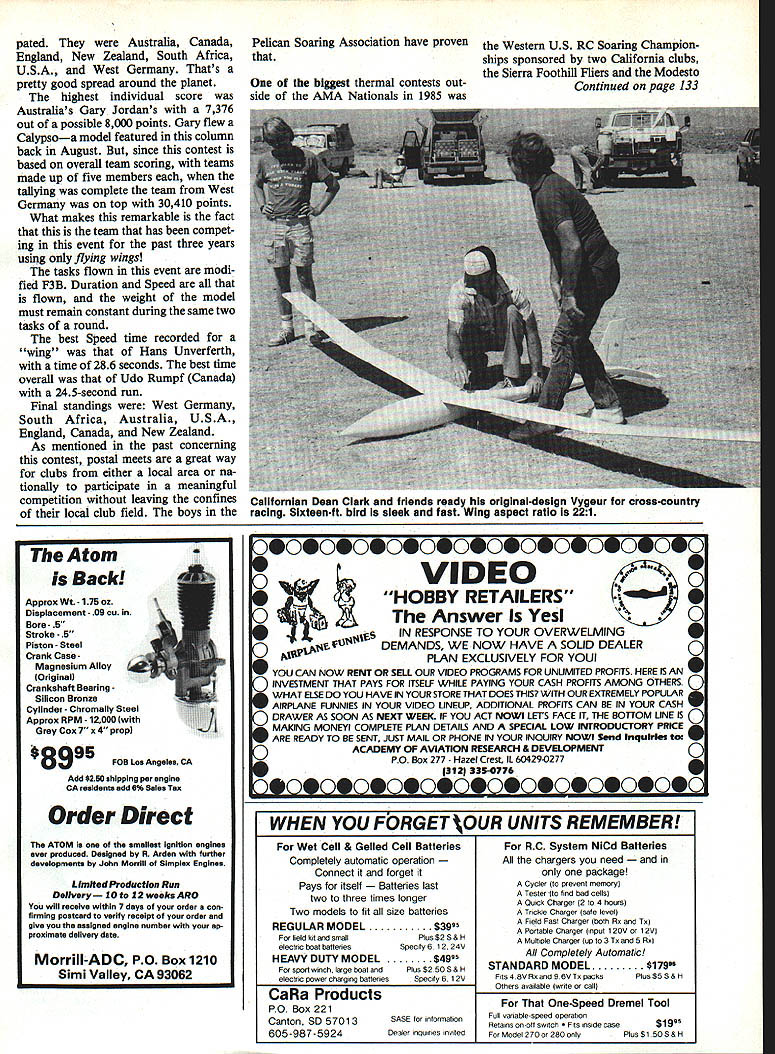
- Take selected 3/4-in. spruce spar material and soak the pieces in household ammonia for at least 24 hours. A plastic garbage bag works as a container—have it outside unless you want to get an idea of what life on Jupiter is like.
- Mark the desired wing-sweep angle on a building board.
- Bend and pin all thoroughly soaked strips to the desired angle and let them dry for two or three days.
- Laminate the dried strips with epoxy. The result is a swept-back spar with the strength of a horseshoe.
Adapt this method as necessary for blades or wing rods. A sketch illustrating the mid-spar construction method used by Gene Dees and Bob Champine was provided with the original article.
Is There a Future for Flying Wings? — International Postal Contest
From Florida, Kale Harden reports their third annual International Postal Contest was not only a rousing success but contained a few surprises.
- Participating countries: Australia, Canada, England, New Zealand, South Africa, USA, West Germany.
- Highest individual score: Gary Jordan (Australia) — 7,376 out of a possible 8,000 points. Gary flew Calypso, a model featured in this column back in August.
- Team scoring: Teams were made up of five members; overall team scoring decided the standings. West Germany topped the standings with 30,410 points.
The West German team has been competing in the event the past three years using flying wings. Tasks flown in the event were modified F3B: Duration and Speed. The flown weight of the model had to remain constant during the same two tasks. In the round, the best Speed time recorded was by Hans Unverferth — 286 seconds. Best time overall was Udo Rumpf (Canada) — 245 seconds.
Final team standings:
- West Germany
- South Africa
- Australia
- USA
- England
- Canada
- New Zealand
As mentioned previously, postal meets are a great way for clubs to participate in meaningful competition without leaving their local club field. The Pelican Soaring Association has proven that.
Western U.S. RC Soaring Championships
One of the biggest thermal contests outside the AMA Nationals in 1985 was the Western U.S. RC Soaring Championships, sponsored by two California clubs: the Sierra Foothill Fliers and the Modesto RC Club. This was a big-money contest in terms of prizes. Entry fee was $35, but first place paid $500, with prize money tapering through 20th place (20th place was still $50).
The site was the Merwin Ranch—80 acres of dichondra grass, as close as you will ever get to flying from the top of a gigantic billiards table.
On paper, the tasks were simple: nine rounds of seven-minute Precision Duration, with an in-or-out landing using a 25-foot-diameter circle. Point value for the landing: 20. This is the type of contest anybody can enter. To control the anticipated large crowd of over 150 contestants, only nine entries per frequency were allowed.
Strong winds on the first day of the two-day meet wiped out a number of entries, but overall it was a good contest. Computer scoring worked well, thanks to Rich Friend. The wind died down on Sunday, and Kevin Hobbs of the Sierra Foothill Fliers (who engineered this meet) received praise for a job well done.
Top finishers:
- 1st: Rich Spicer (South Bay Soaring Society) — flew his Synergy (featured in the column June 1984; pictured January 1985)
- 2nd: Joe Wurtis (South Bay Soaring Society)
- 3rd: Kirby Parker (formerly South Bay, now Pacific Northwest)
Plan ahead: dates are not set yet, but plans are underway to run this event again in 1986.
LSF Tournament
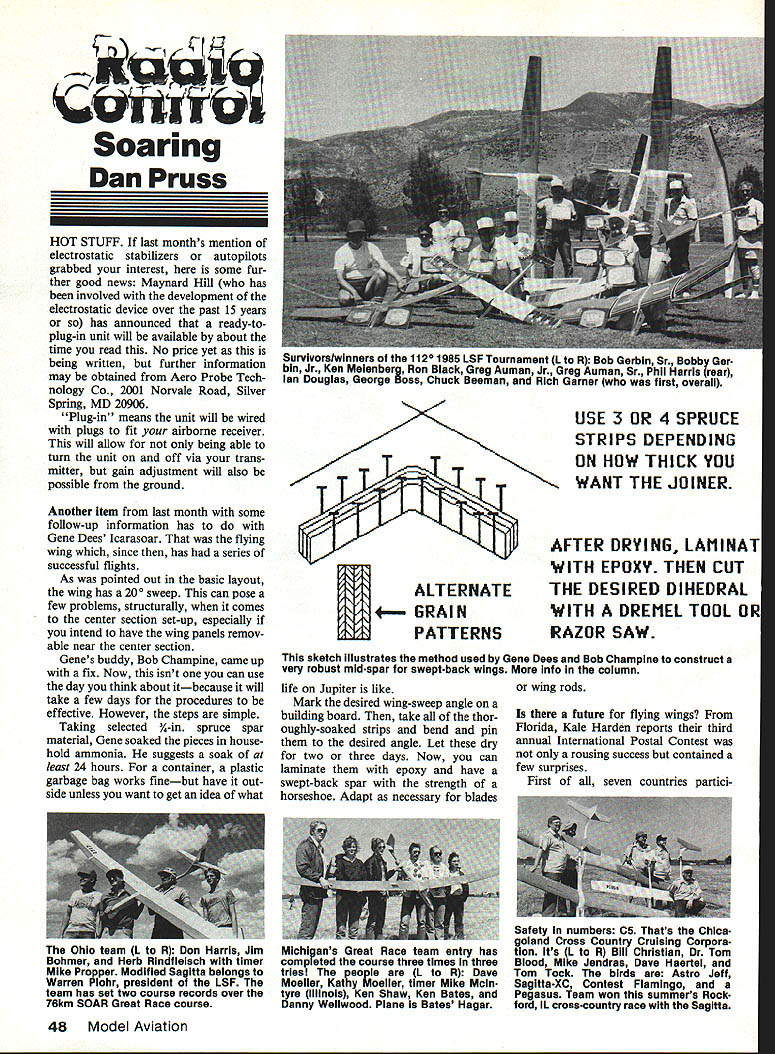
This year followed the odd-year pattern of a single contest. The site was Cal State in San Bernardino, CA. If you got through the 112° heat without glue joints coming undone, you had two good days of flying.
Tasks included:
- Three-minute Precision
- Three flights totaling 18 minutes (but only seven-minute maxes allowed)
- Man-on-man Distance
- Seven-minute Precision Duration
The Inland Soaring Society won the Most Thoughtful Club Award for furnishing free ice water and soft drinks for the weekend—a welcome gesture in the heat.
Results
Standard Class:
- Rich Garner (also 1st overall)
- George Boss
- Phil Harris
- Greg Auman, Jr.
- Ken Meienberg
Unlimited Class:
- Bob Gerbin, Sr.
- Ken Meienberg
- Chuck Beeman
- Ian Douglas
- Greg Auman, Sr.
Two-Meter Class:
- Bobby Gerbin, Jr.
- Ron Black
- Bob Gerbin, Sr.
- George Boss
- Ian Douglas
- Best Junior: Bobby Gerbin, Jr.
- Bob Gerbin, Sr.'s winning Unlimited score: 4,666 points (out of 5,200). He also placed fifth at the Western States RC Soaring Championships.
- Rich Garner's highest overall score in Standard: 4,784 points.
- Bob Gerbin, Jr.'s Two-Meter-winning score: 4,173 points.
Cross-Country Racing Highlights
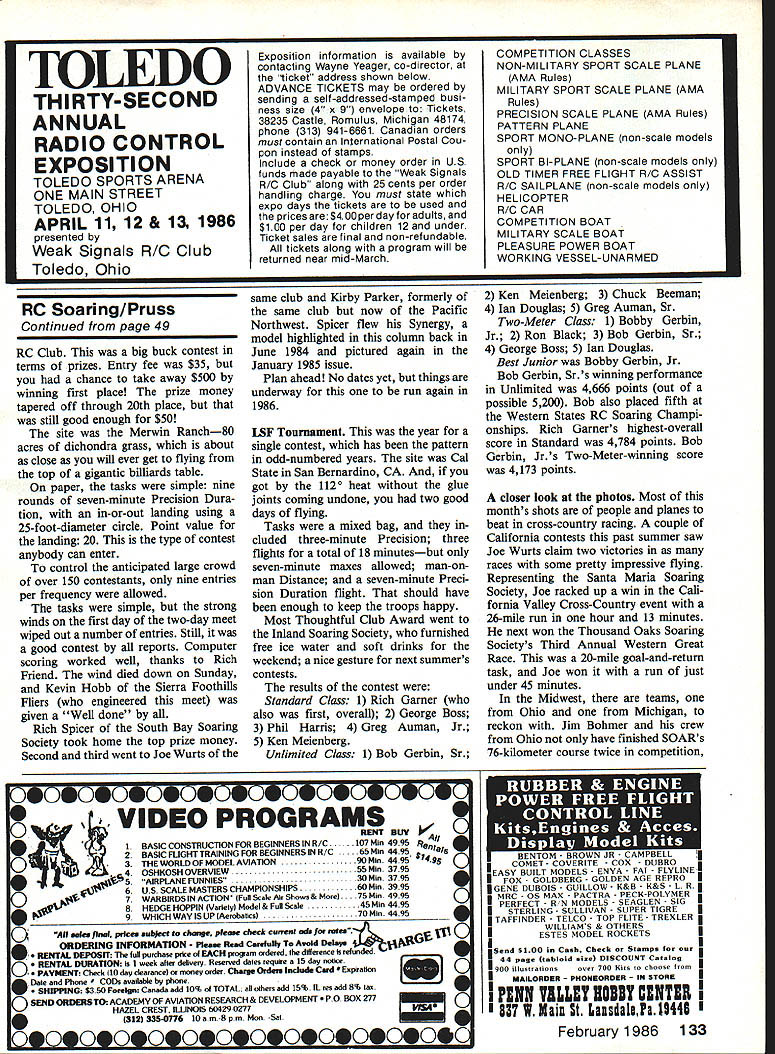
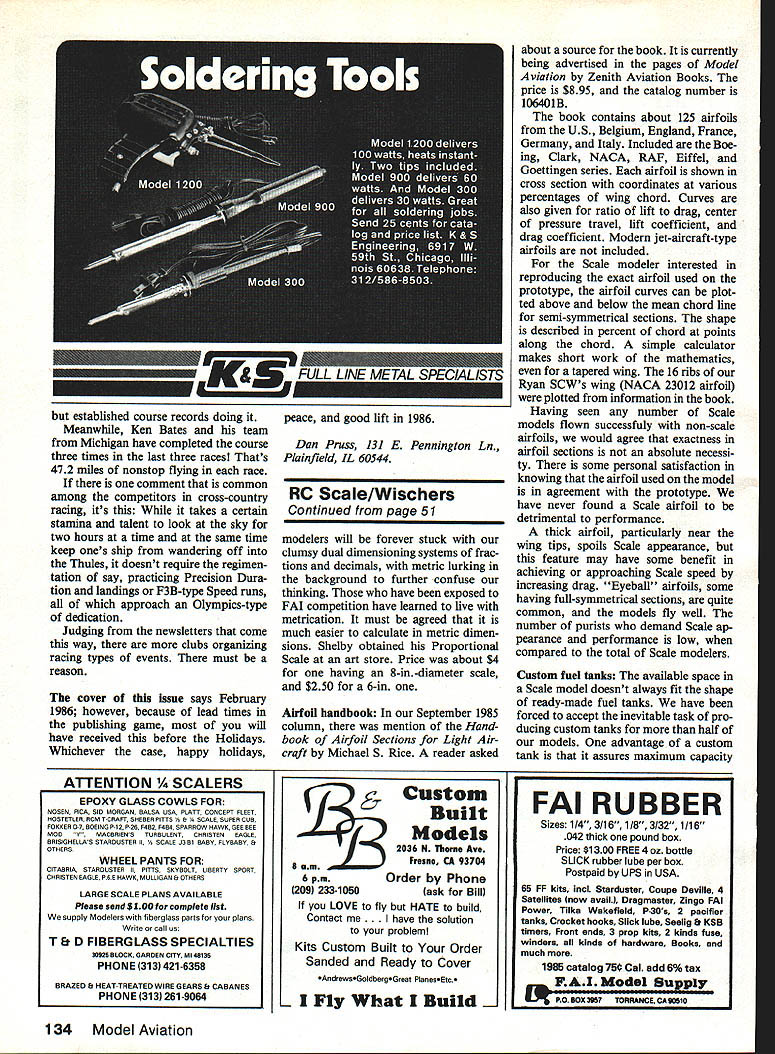
Most of this month's photos are of people and planes involved in cross-country racing. A couple of California contests this past summer saw Joe Wurtis claim two victories in as many races with some impressive flying. Representing the Santa Maria Soaring Society, Joe won the California Valley Cross-Country event with a 26-mile run in one hour and 13 minutes. He then won the Thousand Oaks Soaring Society's Third Annual Western Great Race, a 20-mile goal-and-return task, in just under 45 minutes.
In the Midwest there are teams to reckon with. Jim Bohnert and his crew from Ohio have finished SOAR's 76-kilometer course twice in competition and established course records doing it. Ken Bates and his team from Michigan have completed the course three times in the last three races — that's 47.2 miles of nonstop flying in each race.
A common comment among competitors in cross-country racing is that, while it takes stamina and talent to watch the sky for two hours and keep the ship from wandering off, it doesn't require the stringent regimen of practicing Precision Duration and landings or F3B-type Speed runs, which approach an Olympic level of dedication. Judging from club newsletters, more clubs are organizing racing-type events — and there must be a reason.
Final Notes
The cover date of this issue says February 1986; however, because of publishing lead times, most of you will have received this before the holidays. Whichever the case, happy holidays, peace, and good lift in 1986.
Dan Pruss 131 E. Pennington Ln. Plainfield, IL 60544
Transcribed from original scans by AI. Minor OCR errors may remain.

