
Radio Control: Soaring
Dan Pruss
GADGETS and ideas that should make life simpler in the workshop and on the flying field are this month's subject. But before we get into them, you've got to hear what the Madison Area Radio Control Society (MARCS) did the first week of November 1985. That was the weekend for their third annual RC symposium, an event that just gets better each year. As in the past, topics ranged from high‑tech presentations to low‑key discussions—there was something for everyone.
MARCS Symposium (November 1985)
- "Introduction to Aerodynamics" — Frank Baker (University of Wisconsin)
- "Meteorology for Soaring" — Professor Roland Stull (University of Wisconsin)
- Ken Bates — lecture on flying wings (entertaining and well‑illustrated with slides and sketches)
- Five cross‑country experts — Pat Flynn, Noal Rossow, Ken Bates, Stan Watson, and Mark Stidhem — discussed preparation, tasks, aircraft, and chase vehicles; the discussion covered aircraft design and construction techniques as well as operational aspects
- Jack Hiner (world record‑holder, Distance/Altitude) — history of variometers and thermal sensors, current use, and variometer modifications
- Bob Sealy — fiberglass work and finished fuselages showing high craftsmanship
- Wayne Custer — Super Wings foam‑core wing construction techniques
- Michael Selig — opinions and theories on airfoil shapes (nationally recognized model‑airfoil designer)
- Slide presentation — Fifth F3B World Championships in Australia
- Gregg Seydel and Scott Christensen (Top Flite Models) — "Contest Strategies"
- Results note — Terry Edmonds finished first, second, and third in categories at the 1985 AMA Nationals
Other symposium features:
- Swap session and socializing — Wisconsin style
- Table clinics and bull sessions
- Buffet lunch on Saturday (included in the $15 registration fee)
A memorable detail: eight inches of snow fell that weekend—enough to give Dr. Walt Good something to remember on his drive up from Florida.
Wing‑root airtight fit (Leon Kincaid)
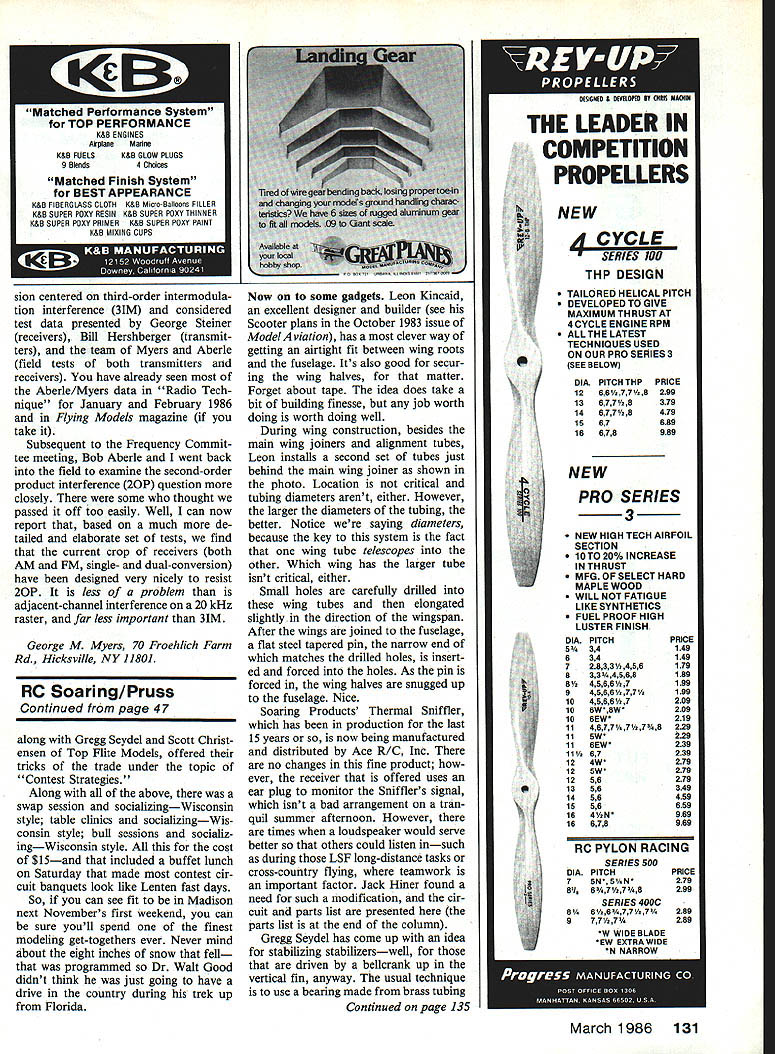
Leon Kincaid (see his Scooter plans in the October 1983 issue of Model Aviation) has a clever method for getting an airtight fit between wing roots and the fuselage; it also secures the wing halves. The idea requires some building finesse but is worth the effort.
- During wing construction, in addition to the main wing joiners and alignment tubes, install a second set of tubes just behind the main wing joiner.
- Tubing location and diameters are not critical, but larger diameters work better. The key is that one wing tube telescopes into the other; which wing has the larger tube is not critical.
- Drill small holes carefully into these wing tubes and slightly elongate them in the wingspan direction.
- After joining the wings to the fuselage, insert a flat tapered steel pin whose narrow end matches the drilled holes and force it in. As the pin is driven, the wing halves are snugged up to the fuselage.
Forget about tape—this method gives a neat, airtight join.
Thermal Sniffer (Soaring Products / Ace R/C)
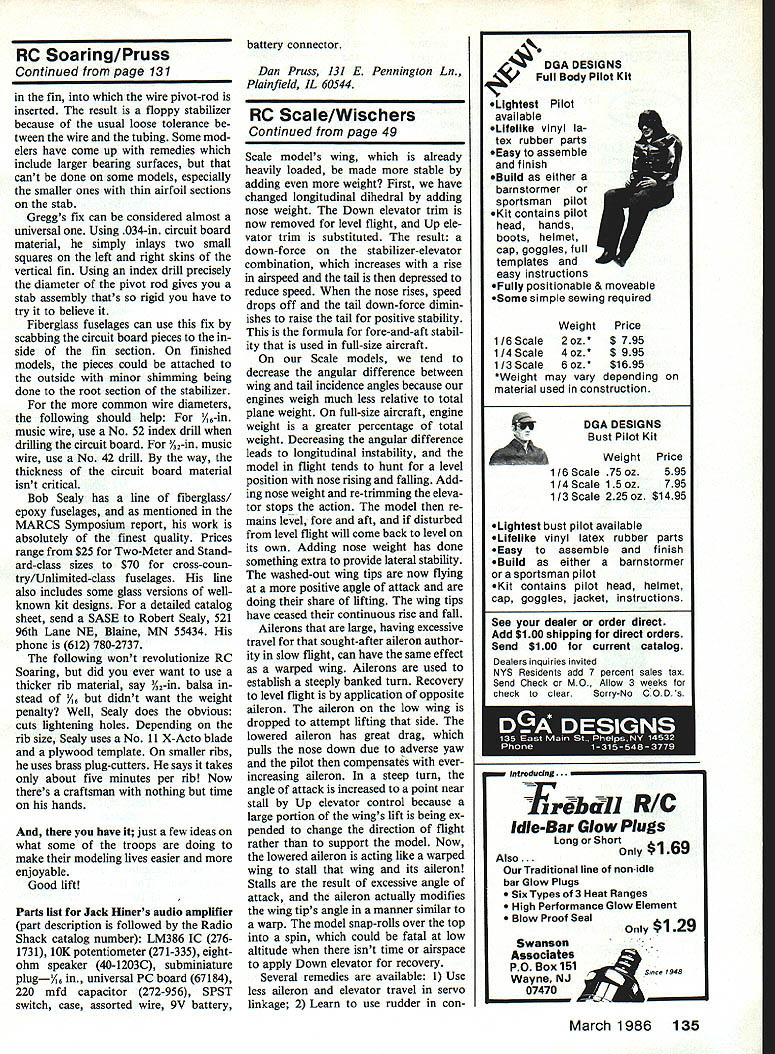
Soaring Products' Thermal Sniffer, produced for about 15 years, is now manufactured and distributed by Ace R/C, Inc. The product itself is unchanged. The receiver offered uses an earplug to monitor the Sniffer's signal, which works well on a quiet summer afternoon. For team tasks like LSF long‑distance or cross‑country flying, a loudspeaker is often better so others can listen in. Jack Hiner found a need for such a modification; the circuit and parts list for an audio amplifier are provided at the end of this column.
Stabilizer pivot bushing (Gregg Seydel)
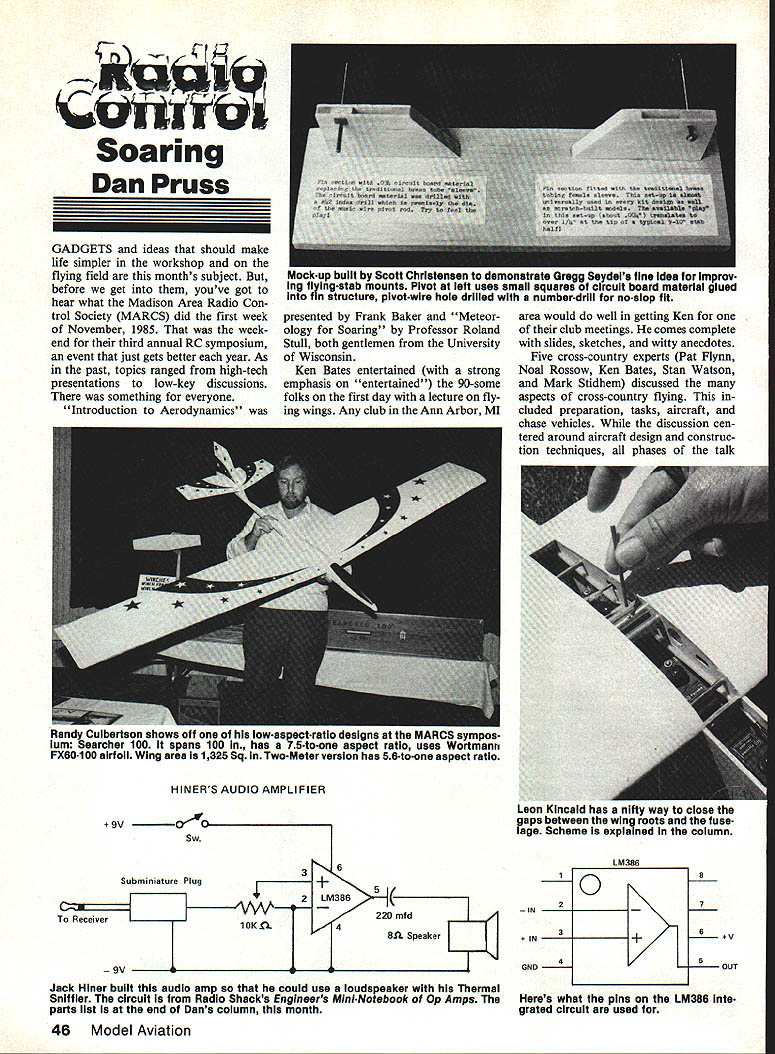
To stabilize bellcrank‑driven stabilizers (where the bellcrank is up in the vertical fin), Gregg Seydel uses a short length of Delrin rod drilled and glued into the fin as a bearing. The bellcrank pivots on a steel wire inserted through the Delrin bushing. This provides much less slop than brass tubing and avoids wear in the hole.
Low‑aspect‑ratio designs (Randy Culbertson)
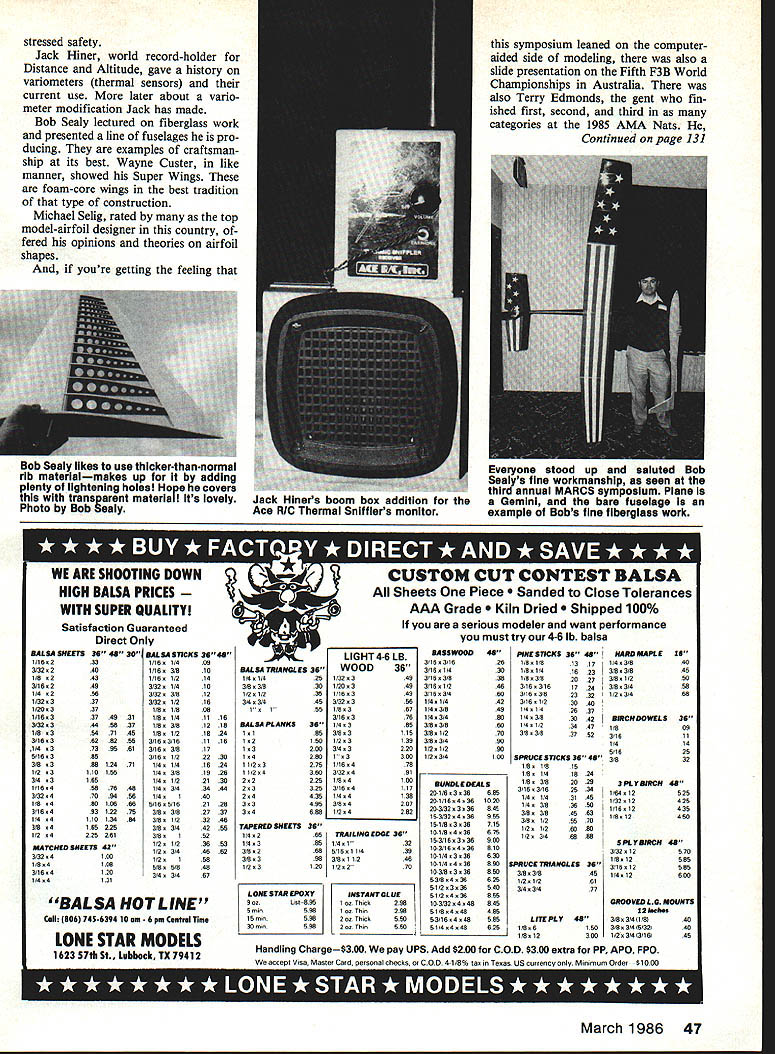
Randy Culbertson shows off low‑aspect‑ratio designs:
- Searcher 100: 100" span, aspect ratio 7.5:1 (FX60‑100 airfoil), wing area 1,813.25 sq in.
- Two‑meter version: aspect ratio 5.6:1
Fiberglass fuselage fix (circuit board mounting)
Fiberglass fuselages can use a simple fix by scabbing circuit board pieces to the inside of the fin section. On finished models, the pieces can be attached to the outside with minor shimming at the stabilizer root.
Drilling guide for common wire diameters:
- For 1/16‑in. music wire, use a No. 52 index drill when drilling the circuit board.
- For 3/32‑in. music wire, use a No. 42 drill.
- Circuit board thickness is not critical.
Bob Sealy fiberglass fuselages and rib lightening
Bob Sealy produces a line of fiberglass/epoxy fuselages noted in the MARCS Symposium report. His workmanship is excellent.
- Prices: approximately $25 for Two‑Meter and Standard‑class sizes; $70 for cross‑country/Unlimited‑class fuselages.
- He also offers glass versions of well‑known kit designs.
- For a detailed catalog, send a SASE to: Robert Sealy, 521 96th Lane NE, Blaine, MN 55434. Phone: (612) 780‑2737.
To use thicker rib material without excessive weight, Sealy cuts lightening holes in ribs:
- Uses a No. 11 X‑Acto blade and a plywood template for larger ribs.
- Uses brass plug‑cutters for smaller ribs.
- He estimates about five minutes per rib.
And there you have it—just a few ideas on what some of the troops are doing to make their modeling lives easier and more enjoyable.
Good lift!
Parts list — Jack Hiner's audio amplifier
(Part description — Radio Shack catalog number)
- LM386 IC — 276‑1731
- 10K potentiometer — 271‑335
- Eight‑ohm speaker — 40‑1203C
- Subminiature 1/8‑in. plug
- Universal PC board — 67184
- 220 µF capacitor — 272‑956
- SPST switch
- Case
- Assorted wire
- 9V battery
- Battery connector
Dan Pruss 131 E. Pennington Ln. Plainfield, IL 60544
Transcribed from original scans by AI. Minor OCR errors may remain.

