
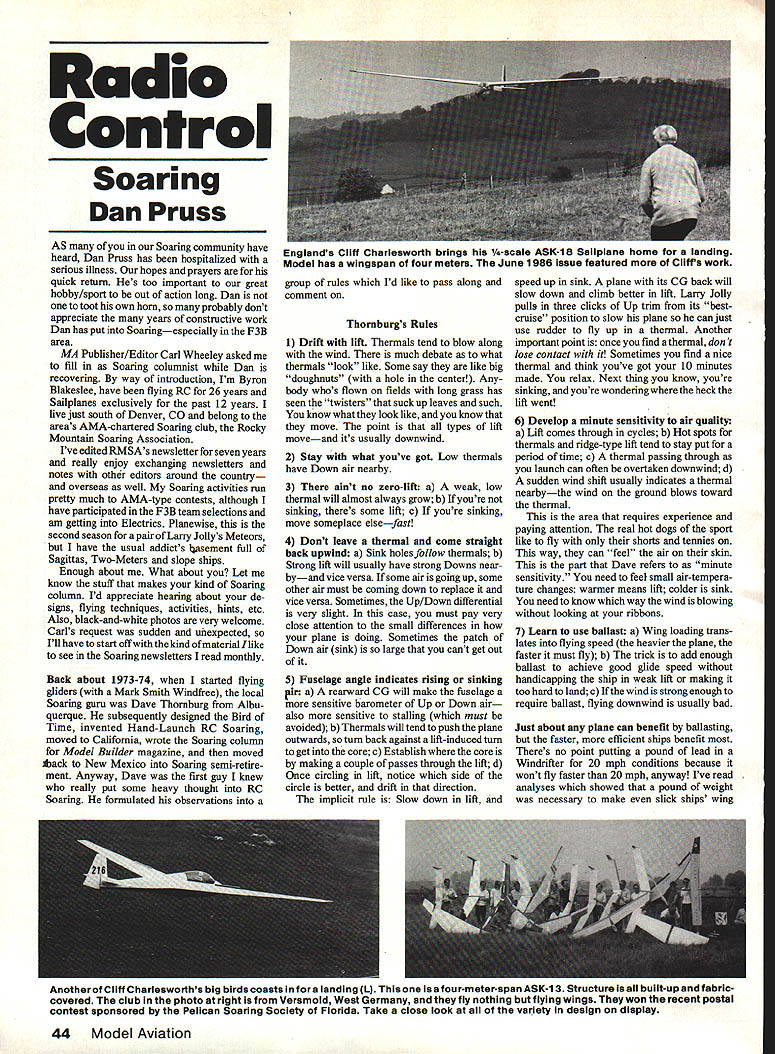
Radio Control: Soaring
Dan Pruss
As many of you in our Soaring community have heard, Dan Pruss has been hospitalized with a serious illness. Our hopes and prayers are for his quick return — he's too important to our great hobby/sport to be out of action long. Dan is not one to toot his own horn, so many probably don't appreciate the many years of constructive work he has put into Soaring — especially in the F3B area.
Model Aviation Publisher/Editor Carl Wheeley asked me to fill in as Soaring columnist while Dan is recovering. By way of introduction, I'm Byron Blakeslee. I have been flying RC for 26 years and sailplanes exclusively for the past 12 years. I live just south of Denver, CO, and belong to the area's AMA-chartered soaring club, the Rocky Mountain Soaring Association. I've edited RMSA's newsletter for seven years and really enjoy exchanging newsletters and notes with other editors around the country and overseas as well.
My soaring activities run pretty much AMA-type contests, although I have participated in the F3B team selections and am getting into electrics. Planewise, this is the second season for a pair of Larry Jolly's Meteors, but I have the usual addict's basement full of Sagittas, two-meters, and slope ships. Enough about me — what about you? Let me know the stuff that makes your kind of Soaring column. I'd appreciate hearing about designs, flying techniques, activities, hints, etc. Black-and-white photos are very welcome. Carl's request was sudden and unexpected, so I'll have to start off with the kind of material I like to see in the Soaring newsletters I read monthly.
Back about 1973–74, when I started flying gliders (with a Mark Smith Windfree), the local soaring guru was Dave Thornburg from Albuquerque. He subsequently designed the Bird of Time, invented hand-launch RC soaring, moved to California, wrote the Soaring column for Model Builder magazine, and then moved back to New Mexico into soaring semi-retirement. Dave was the first guy I knew who really put some heavy thought into RC soaring. He formulated his observations into a group of rules which I'd like to pass along and comment on.
Thornburg's Rules
- Drift with lift.
- Thermals tend to blow along with the wind. There is much debate as to what thermals "look" like. Some say they are like big "doughnuts" (with a hole in the center!). Anybody who's flown on fields with long grass has seen the "twisters" that suck up leaves and such. You know what they look like, and you know that they move. The point is that all types of lift move — and it's usually downwind.
- Stay with what you've got.
- Low thermals have down air nearby.
- There ain't no zero-lift.
- a) A weak, low thermal will almost always grow.
- b) If you're not sinking, there's some lift.
- c) If you're sinking, move someplace else — fast!
- Don't leave a thermal and come straight back upwind.
- a) Sink holes follow thermals.
- b) Strong lift will usually have strong downs nearby — and vice versa. If some air is going up, some other air must be coming down to replace it and vice versa. Sometimes the up/down differential is very slight; in this case you must pay very close attention to the small differences in how your plane is doing. Sometimes the patch of down air (sink) is so large that you can't get out of it.
- Fuselage angle indicates rising or sinking air.
- a) A rearward CG will make the fuselage a more sensitive barometer of up or down air — and also more sensitive to stalling (which must be avoided).
- b) Thermals will tend to push the plane outwards; turn back against a lift-induced turn to get into the core.
- c) Establish where the core is by making a couple of passes through the lift.
- d) Once circling in lift, notice which side of the circle is better; then drift in that direction.
The implicit rule is: slow down in lift, and speed up in sink. A plane with its CG back will slow down and climb better in lift. Larry Jolly pulls in three clicks of up trim from its "best-cruise" position to slow his plane so he can just use rudder to fly up a thermal. Another important point is: once you find a thermal, don't lose contact with it! Sometimes you find a nice thermal, think you've got 10 minutes and are allowed to relax. Next thing you know you're sinking and you wonder where the heck the lift went!
- Develop a minute sensitivity to air quality.
- a) Lift comes through in cycles.
- b) Hot spots (thermals/ridge-type lift) tend to stay put for a period of time.
- c) A thermal passing through a launch can often be overtaken downwind.
- d) A sudden wind shift usually indicates a thermal nearby — the wind on the ground blows toward the thermal area. This area requires experience and paying attention. The real hot dogs of the sport like to fly in shorts and tennis shoes so they can "feel" the air on their skin. This is the part that Dave refers to as "minute sensitivity." You need to feel small air-temperature changes; warmer means lift, colder means sink. You also need to know which way the wind is blowing without looking at your ribbons.
- Learn to use ballast.
- a) Wing loading translates into flying speed — a heavier plane flies faster and must be flown faster.
- b) Trick: add enough ballast to achieve good glide speed without handicapping the ship in weak lift or making it too hard to land.
- c) If the wind is strong enough to require ballast, flying downwind is usually bad.
Just about any plane can benefit from ballasting, but the faster, more efficient ships benefit most. There's no point putting a pound of lead in a Windrider for 20 mph conditions because it won't fly faster than 20 mph anyway. I've read analyses that showed a pound of weight was necessary to make even slick ships' wing loading increase to the point required for penetration. I haven't found this to be so. Four ounces in my Meteor makes a noticeable difference in the penetrate/don't-penetrate equation. Of course, when the wind is really howling, you have to put in everything you've got, which is about 20 ounces for my plane. But at those times flying isn't much fun and you start thinking about hitting the field — not the spot!
We send newsletters to all the hobby shops in town so that when beginners wander in, the friendly proprietor can direct them to the proper people. We often get calls: "How can I get started?" Or maybe it's: "I built a plane but don't know how to fly it."
There's no question that the best course of action for beginners is to get hooked up with the soaring club in their area. I don't know of any sailplaners who wouldn't be happy to help.
Failing the club route, the beginner can seek out individuals who are into soaring.
One final source of information — but not practical experience — is reading material. As I write, I'm looking at the Zenith Aviation Book advertisement in the July issue of Model Aviation. The Kambach book, How to Build and Fly RC Gliders, has basic material in it. A more advanced book is Radio Control Thermal Soaring by the British author George Snelgrove; it's got more detailed information of interest to advanced fliers.
Again, I'd like to ask you to drop your notes and photos to me at the address given below.
Byron Blakeslee 3134 Winnebago Dr. Sedalia, CO 80135
When responding to advertisers, mention that you read about them in Model Aviation.
Transcribed from original scans by AI. Minor OCR errors may remain.

