
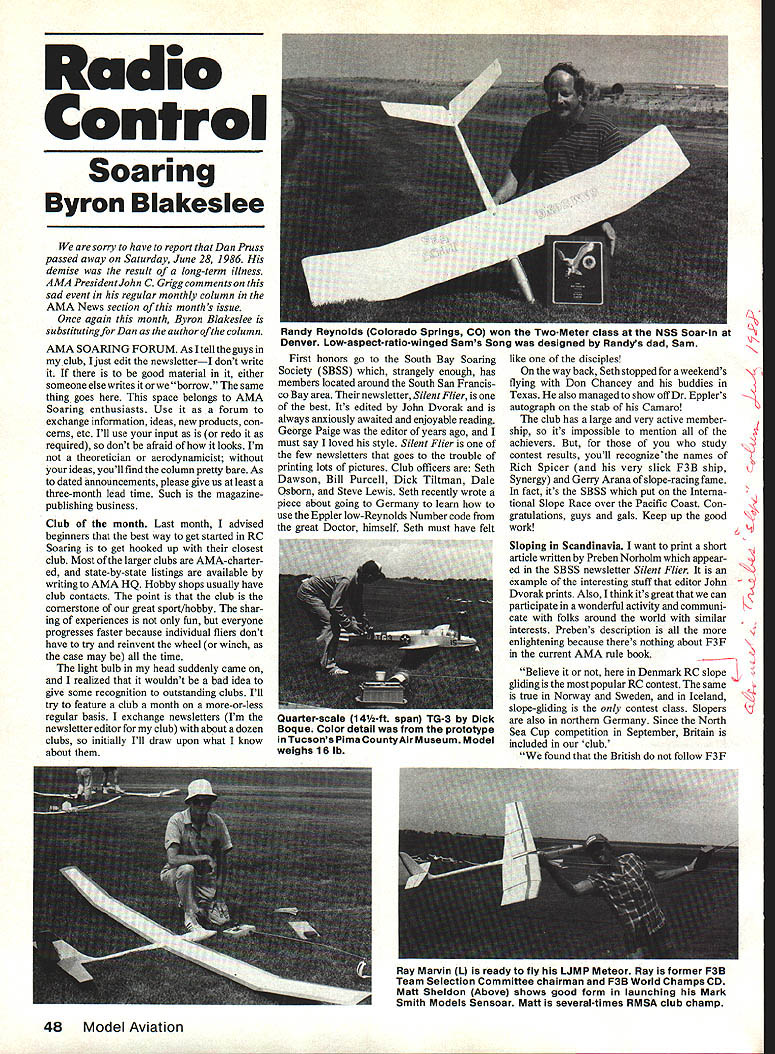
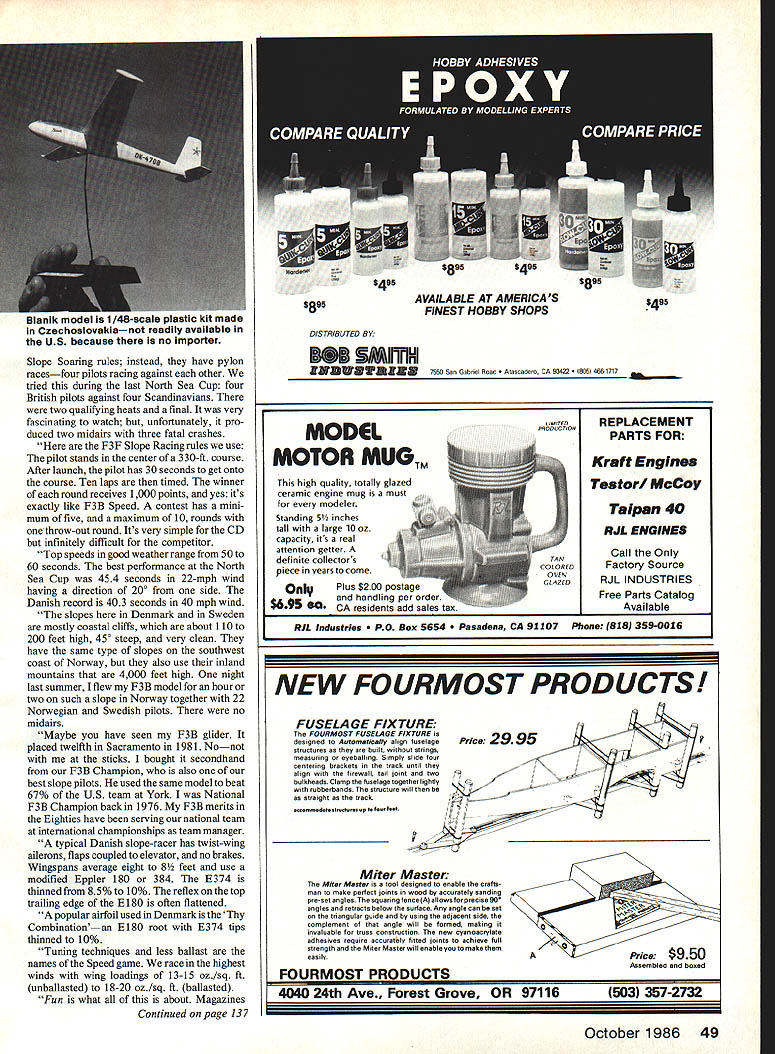
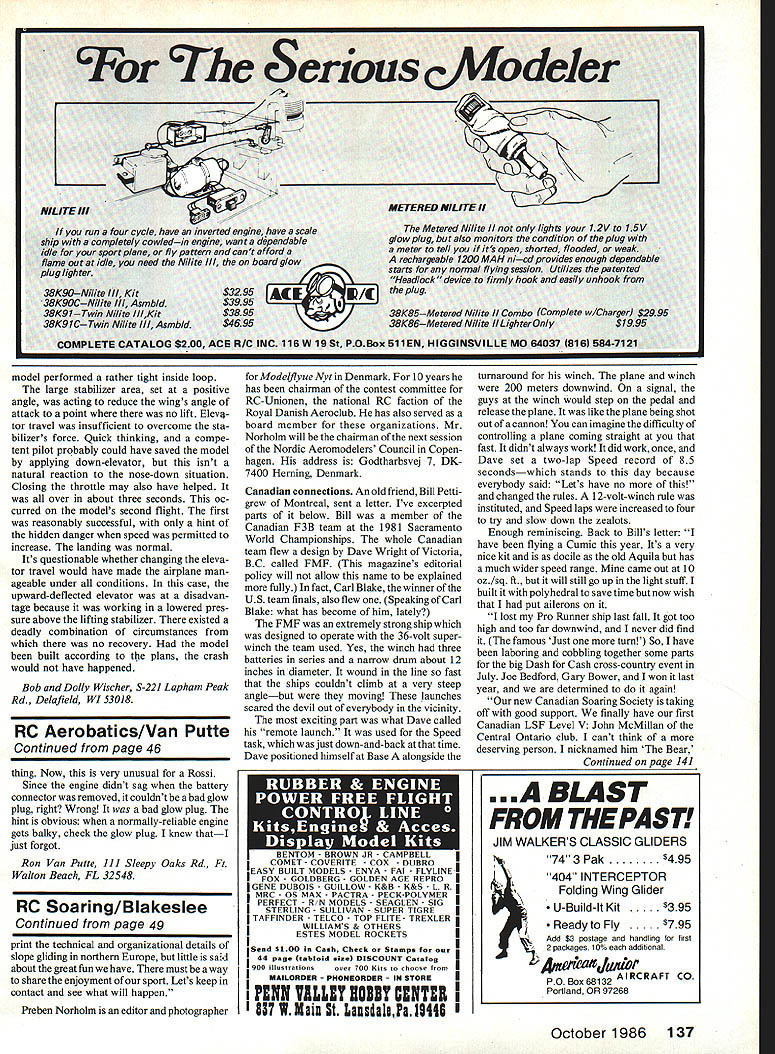
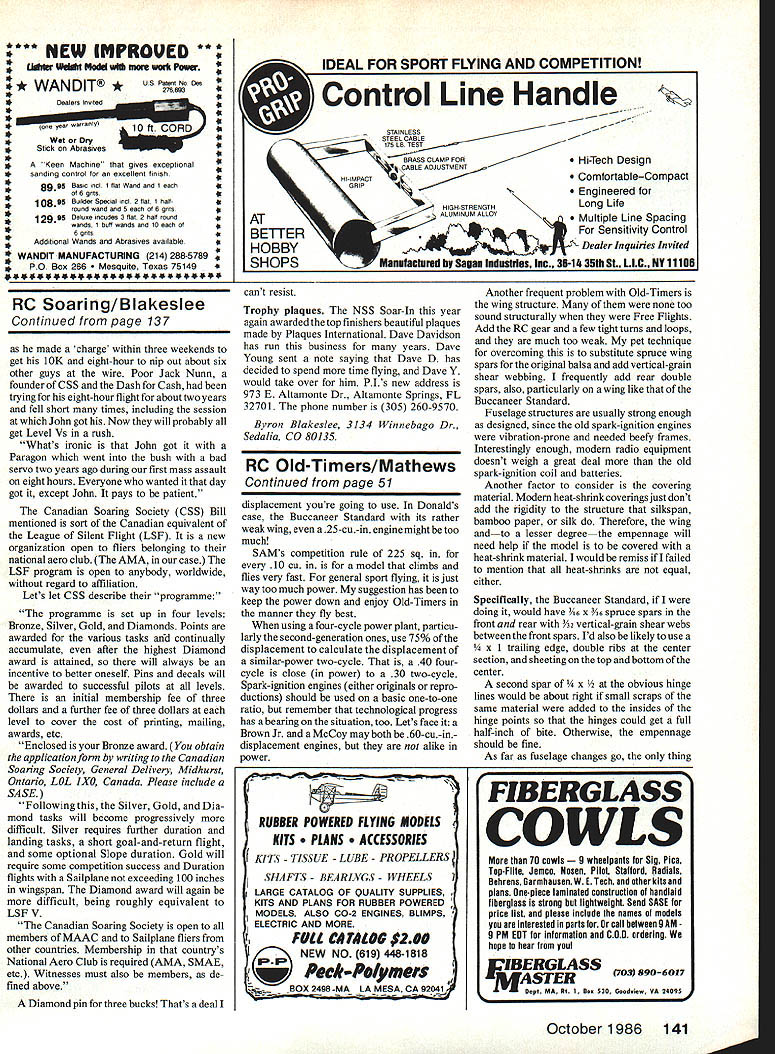
Radio Control: Soaring
Byron Blakeslee
In Memoriam: Dan Pruss
We are sorry to report that Dan Pruss passed away on Saturday, June 28, 1986, after a long-term illness. AMA President John C. Grigg commented on this sad event in his regular monthly column in the AMA News section of this month's issue.
Once again this month, Byron Blakeslee is substituting for Dan as the author of the column.
AMA SOARING FORUM
As I tell the guys in my club, I just edit the newsletter — I don't write it. If there is to be good material in it, someone else writes it or we "borrow." This space belongs to AMA soaring enthusiasts. Use it as a forum to exchange information, ideas, new products, concerns, etc. I'll use input and redo if required; don't be afraid of how it looks. I'm no theoretician or aerodynamicist; without your ideas, you'll find the column pretty bare.
For dated announcements, please give us at least a three-month lead time. Such is the magazine-publishing business.
Last month I advised beginners that the best way to get started in RC soaring is to get hooked up with their closest club. Most of the larger clubs are AMA-chartered, and state-by-state listings are available by writing to AMA HQ. Hobby shops usually have club contacts. The point is that the club is the cornerstone of our great sport/hobby. The sharing of experiences is not only fun, but everyone progresses faster because individual fliers don't have to try to reinvent the wheel (or winch, as the case may be) all the time.
The light bulb in my head suddenly came on, and I realized that it wouldn't be a bad idea to give some recognition to outstanding clubs. I'll try to feature a club a month on a more-or-less regular basis. I exchange newsletters (I'm the newsletter editor for my club) with about a dozen clubs, so initially I'll draw upon what I know about them.
Club of the Month: South Bay Soaring Society (SBSS)
First honors go to the South Bay Soaring Society (SBSS), whose members are located around the South San Francisco Bay area. Their newsletter, Silent Flier, is one of the best. It's edited by John Dvorak and is always anxiously awaited and enjoyable reading. George Paige was the editor years ago and I must say I loved his style. Silent Flier is one of the few newsletters that goes to the trouble of printing lots of pictures.
Club officers:
- Seth Dawson
- Bill Purcell
- Dick Tiltman
- Dale Osborn
- Steve Lewis
Seth recently wrote about going to Germany to learn how to use Eppler's low-Reynolds-number code from Dr. Eppler himself — he must have felt like a disciple! On the way back, Seth stopped for a weekend's flying with Don Chancey and his buddies in Texas. He almost managed to show off Dr. Eppler's autograph on the stab of his Camaro.
The club has a large and very active membership, so it's impossible to mention all of the achievers. If you study contest results, you'll recognize the names Rich Spicer (and his very slick F3B ship, Synergy) and Gerry Arana of slope-racing fame. In fact, it's the SBSS which put on the International Slope Race over the Pacific Coast. Congratulations — keep up the good work!
Sloping in Scandinavia (article by Preben Norholm)
I want to print a short article written by Preben Norholm which appeared in the SBSS newsletter Silent Flier. It is an example of the interesting stuff that editor John Dvorak prints. Also, it's great that we can participate in a wonderful activity and communicate with folks around the world who share similar interests. Preben's description is enlightening because there's nothing about F3F in the current AMA rule book.
"Believe it or not, here in Denmark RC slope gliding is the most popular RC contest. The same is true in Norway and Sweden, and in Iceland slope-gliding is the only contest class. Slopers are also in northern Germany. Since the North Sea Cup competition in September, Britain is included in our club.
"We found that the British do not follow F3F slope-soaring rules; instead, they have pylon races — four pilots racing against each other. We tried this during the last North Sea Cup: four British pilots against four Scandinavians. There were two qualifying heats and a final. It was very fascinating to watch; but, unfortunately, it produced two midairs with three fatal crashes.
"Here are the F3F slope-racing rules we use:
- The pilot stands in the center of a 330-ft. course.
- After launch, the pilot has 30 seconds to get onto the course.
- Ten laps are then timed.
- The winner of each round receives 1,000 points (it's exactly like F3B Speed).
- A contest has a minimum of five, and a maximum of ten, rounds with one throw-out round.
"It's very simple for the CD but infinitely difficult for the competitor. Top speeds in good weather range from 50 to 60 seconds. The best performance at the North Sea Cup was 45.4 seconds in a 22-mph wind having a direction 20° from one side. The Danish record is 40.3 seconds in 40-mph wind.
"The slopes here in Denmark and in Sweden are mostly coastal cliffs about 110 to 200 feet high, 45° steep, and very clean. They are the same type of slopes on the southwest coast of Norway, but they also use their inland mountains that are 4,000 feet high. One night last summer, I flew my F3B model for an hour or two on such a slope in Norway together with 22 Norwegian and Swedish pilots. There were no midairs.
"Maybe you have seen my F3B glider. It placed twelfth in Sacramento in 1981. No — not with me at the sticks. I bought it secondhand from our F3B Champion, who is also one of our best slope pilots. He used the same model to beat 67% of the U.S. team at York. I was National F3B Champion back in 1976. My F3B merits in the Eighties have been serving our national team as team manager.
"A typical Danish slope-racer has twin wing ailerons, flaps coupled to elevator, and no brakes. Wingspans average 8 to 8.2 feet and use a modified Eppler E180 or E374. The E374 is thinned from 8.5% to 10%. The reflex on the top trailing edge of the E180 is often flattened.
"A popular airfoil used in Denmark is the 'Thy Combination' — an E180 root with E374 tips thinned to 10%.
"Tuning techniques and less ballast are the names of the Speed game. We race in the highest winds with wing loadings of 13–15 oz./sq. ft. (unballasted) to 18–20 oz./sq. ft. (ballasted).
"Fun is what all of this is about." — Preben Norholm
Canadian Soaring Society (CSS) program and notable achievements
At a recent session John made a "charge" within three weekends to get his 10K and eight-hour flights, nipping out about six other guys at the wire. Poor Jack Nunn, a founder of CSS and the Dash for Cash, had been trying for his eight-hour flight for about two years and fell short many times, including the session at which John got his. Now they will probably all get Level V in a rush.
"What's ironic is that John got it with a Paragon which went into the bush with a heap of servo trouble two years ago during our first mass-assault on eight hours. Everyone who wanted it that day got it, except John. It pays to be patient."
The Canadian Soaring Society (CSS) Bill mentioned is sort of the Canadian equivalent of the League of Silent Flight (LSF). It is a new organization open to fliers belonging to their national aero club (the AMA, in our case). The LSF program is open to anybody, worldwide, without regard to affiliation.
CSS describes their programme:
"The programme is set up in four levels: Bronze, Silver, Gold, and Diamond. Points are awarded for the various tasks and continually accumulate, even after the highest Diamond award is attained, so there will always be an incentive to better oneself. Pins and decals will be awarded to successful pilots at all levels. There is an initial membership fee of three dollars and a further fee of three dollars at each level to cover the cost of printing, mailing, awards, etc.
"Enclosed is our Bronze award. (You obtain the application form by writing to the Canadian Soaring Society, General Delivery, Meaford, Ontario, L0L 1X0, Canada. Please include a SAE.)
"Following this the Silver, Gold, and Diamond tasks will become progressively more difficult. Silver requires further duration and landing tasks, a short goal-and-return flight, and some optional slope duration. Gold will require some concentration success and duration flights with a sailplane not exceeding 100 inches in wingspan. The Diamond award will again be more difficult, being roughly equivalent to LSF V.
"The Canadian Soaring Society is open to all members of MAAC and to sailplane fliers from other countries. Membership in that country's National Aero Club is required (AMA, SMAE, etc.). Winners must also be members, as defined above."
A Diamond pin for three bucks! That's a deal I can't resist.
Trophy plaques and notes
The NSS Soar-In this year again awarded the top finishers beautiful plaques made by Plaques International. Dave Davidson has run this business for many years. Dave Young sent a note saying that Dave D. has decided to spend more time flying, and Dave Y. would take over for him.
P.J.'s new address is 973 E. Altamont Dr., Altamonte Springs, FL 32701. The phone number is (305) 260-9570.
Byron Blakeslee 3134 Winnebago Dr. Sedalia, CO 80135
Transcribed from original scans by AI. Minor OCR errors may remain.

