

Radio Control: Soaring
Byron Blakeslee
CONGRATULATIONS to our new F3B team:
- Steve Work — Albuquerque, NM
- Rich Spicer — San Jose, CA
- Steve Lewis — Santa Ana, CA
Alternate members:
- Larry Jolly
- Seth Dawson
The German-made King and the Spicer-developed Synergy dominated the finals. Two Kings and three Synergys were in the top five; in total there were seven Kings and four Synergys out of 17 contestants.
The 1987 F3B World Championships will be held at Achmer Airport near Osnabrück in the northwest corner of Germany, not far from Bremen. Dates: July 24–August 2, 1987. Contest Director: Hans-Joachim Kunze. The late Dan Pruss was to have been an FAI jury member but will be replaced by either Geoff Dalimer or Sandy Pimenoff.
At the '86 Nats several people asked whether I was going to replace Dan as MA's Soaring contributing editor. I answered, "No — nobody can replace Dan — but I'll try to continue doing the column as best I can." Others wondered if a column-writer needed to be some kind of rock star. The answer, as proven at the contest, is an emphatic "No!" My only qualification is knowing when to send the copy in. Column content will be determined by what you ask about and/or send in.
Reader suggestions
Barry Kurath (newsletter editor, Portland Area Sailplane Society) sent a copy of his excellent bi-monthly and a letter with many good suggestions. Quoting part of Barry's letter:
"Enjoyed the section on Thornburg's Rules. His 'River of Air' article is legendary. Our club members prefer hard information aimed at various levels of skill and experience. Construction tips, trends in design, trimming airplanes, and new products are some of the favorite subjects. Contest reports are good if they include data and photos of the airplanes rather than 'Joe Blow won long flights and accurate landings.' In other words, we like anything that we can use to make our flying better and more fun."
Thanks, Barry — I couldn't agree more. If we can come up with this kind of material on a regular basis, the column should satisfy its objectives. As homework, I've been rereading many of Dan's old columns (luckily I never threw away MA magazines), and I believe these were Dan's objectives, too. Since this is the publication of the AMA, I feel a special responsibility to try to serve AMA sailplane fliers. So, keep those cards, letters, photos, and newsletters coming in!
Club of the Month — Minnesota RC Soaring Society
In recognition and appreciation of the fine job they did in hosting the F3B finals, this month's Club of the Month is the Minnesota RC Soaring Society. Well done! It was a lot of work, but members had the reward of seeing and meeting many of the top fliers in the country — always fun and a great learning experience.
Finals Contest Director was Bob Sealy, who is also club president and a former editor of MRCSS' excellent newsletter. Other club officers:
- Dale Eason
- Tim Thomas
- John Borlaug
Ross Swenson is the current editor and was kind enough to send photos. Ross writes: "Our club now has 102 members. All skill levels and interests are represented. We fly thermal, slope, and electrics. Just shows how popular the various facets of Soaring are."
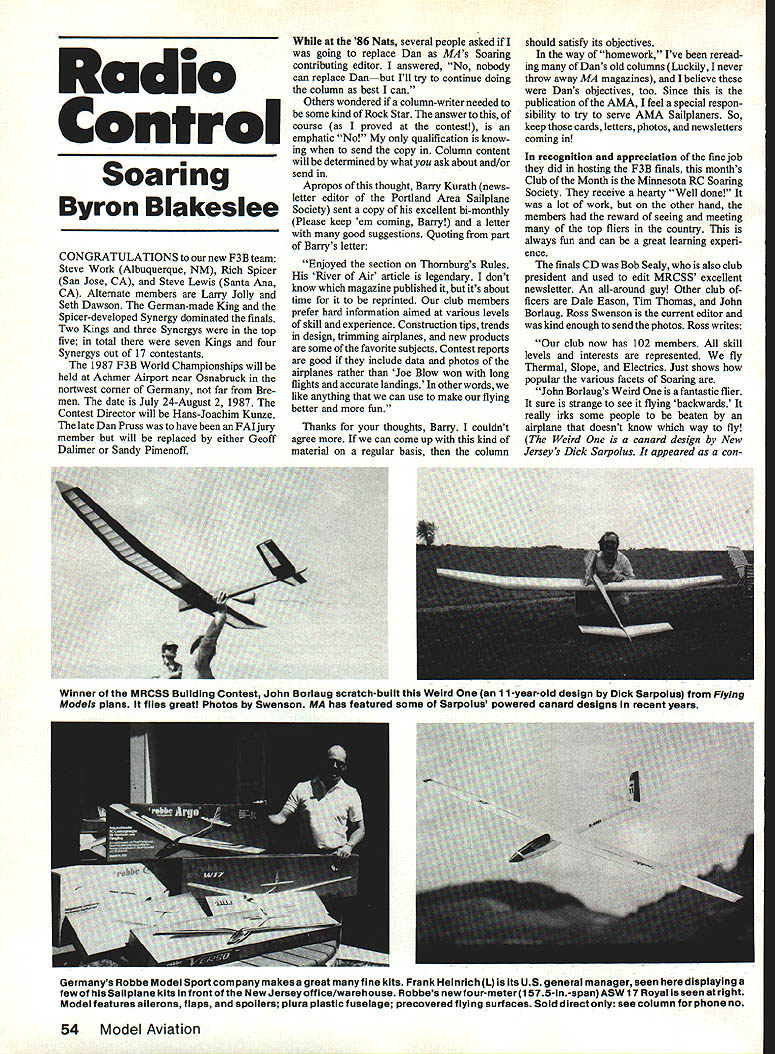
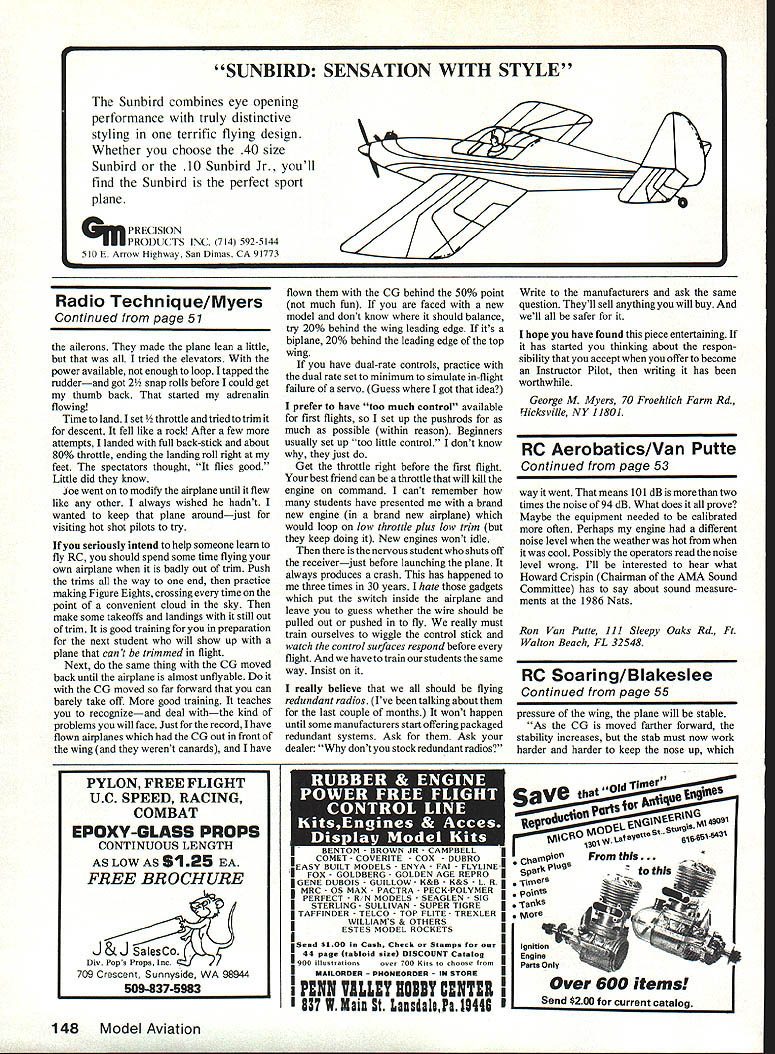
John Borlaug's Weird One is a fantastic flier. It's strange to see it flying "backwards" — it really irks some people to be beaten by a plane that doesn't look like it knows how to fly! The Weird One is a canard design by New Jersey's Dick Sarpolus; it appeared as a construction article in the June 1975 issue of Flying Models magazine.
F3B people concur there should be ways to get bigger involvement. F3B is at a real crossroads: either its appeal is broadened, or it could become extinct. If you have ideas, you're invited to write and we'll kick around possible solutions.
Sailplane trim
The following piece by Ian Turner appeared in the October 1986 newsletter of the South Bay Soaring Society. It's a well-written and significant article because trimming can be such a vexing problem:
"In listening at various flying sessions, I have heard a lot of different remarks made having to do with the trim of a sailplane. Statements like 'You've really got to keep this plane moving,' and 'When you haul back on the trim, she really floats' are typical.
"I have sensed on many occasions that defining the best trim setting is not a well-understood thing. In this article, I've tried to explain the options and the resulting effects that are open to us.
"Let me deal briefly with the CG location. From an aerodynamic performance point of view, the CG location has only a second-order effect on such things as sink speed and glide ratio. Providing the CG is ahead of the center of pressure the model will be stable. If you move the CG forward you will pay a penalty in increased trim drag as the tail has to produce more lift to maintain equilibrium. If you move the CG aft the tail will produce less lift, and so trim drag will be less. The aircraft will be less stable and the stick-free dihedral effect will be reduced. Hence, with the CG aft the model will be more 'sensitive' and will tend to demand more pilot corrections.
"If you are racing around the slope in strong conditions you may prefer the CG to be a little aft so your plane is more responsive; for thermalling and precision flying you will probably prefer it a little forward to give more stability. A compromise position is usually best. I suggest starting with the CG at the manufacturer-recommended position and then moving it slightly forward or aft to suit your particular flying style and the prevailing conditions.
"Next consider the effect of tailplane incidence and elevator trim. Increasing tailplane incidence (more positive) moves the trim point toward higher speed and can reduce trim drag at higher speeds but may increase trim drag at low speed; decreasing tailplane incidence does the opposite. Close-to-neutral elevator with very slight up-trim for slow flight is generally recommended. Excessive up-trim will increase trim drag and may cause the model to have poor penetration in wind. Excessive down-trim will make the model fly faster but increase sink.
"Control throws and rates are another important area. Too much control throw and the model will be twitchy and hard to fly precisely; too little and you won't have enough authority. Exponential around neutral can help by reducing sensitivity where fine control is needed.
"Ballast and wing loading also change the trim and handling. More wing loading increases speed and penetration but increases sink rate. Sometimes a small amount of ballast is useful in strong conditions, but remember it alters handling and trim.
"Finally, remember that most trim changes are interrelated. When you move the CG you change the elevator trim needed; when you adjust tailplane incidence you alter the handling and may need to change the CG slightly. Work methodically: change one thing at a time, fly a consistent test pattern, and note the differences."
— Ian Turner
A later continuation of Turner's thoughts expands on trim and performance:
"When pushing the trim (or stick) hard forward, the model flies fast and comes down fast: the wing is at low angle of attack, drag is lowest but lift is reduced and lift/drag ratio is poorer.
"As the trim is moved back, the plane slows and its angle of descent reduces. At some point the glide angle reaches its flattest — the best lift-to-drag ratio. It is not the point of minimum sink because the model is still flying quite fast. This trim is best for distance or when working between thermals.
"As the trim is moved back further, flying speed reduces more and the glide angle increases. Just before the stall the wing is at its highest angle of attack and the plane is in a condition of minimum energy dissipation and hence minimum sink. The key parameter here is not CL/Cd but CL^(3/2)/Cd. When this is maximized, sink is lowest.
"One confusing thing is that the glide angle near minimum sink may appear worse than the optimum, giving the illusion of high sink. Try timed flights from two launches (on a day without much thermal activity), one trimmed for best glide and one just off the stall. The near-stalled condition can show as much as 25% better duration in some cases.
"Reynolds number effects can be important. When flying speed differs greatly between minimum sink and best glide, small models may operate at Reynolds numbers where the airfoil performance changes significantly."
A list of trim pointers follows:
- The glide angle (for any particular trim) is independent of wing loading. A loaded model will fly faster along the same glide path than a lightly loaded one.
- The cleaner the model, the greater the difference between the trim for flattest glide and that for minimum sink.
- The lowest glide angle is best for distance (thermal-hunting).
- The lowest-sink condition is best when in a thermal.
- The CG position mostly affects stability and not glide performance. It should be as far back as is comfortable to control.
Work methodically: change one variable at a time, fly a consistent test pattern, and note the differences.
Robbe kits and equipment
A good example of a "ready-to-fly" philosophy is the RC Star kit introduced at Toledo this year. The 94.5-in span kit includes a blow-molded Plura plastic fuselage, almost-finished Jedelsky-airfoil wing, glue, decals, sanding sealer, hardware, lead nose weight, sandpaper, paintbrush — and even two screwdrivers. There's no paint included, but the sealed, natural-color balsa surfaces are serviceable. The list price was $129.
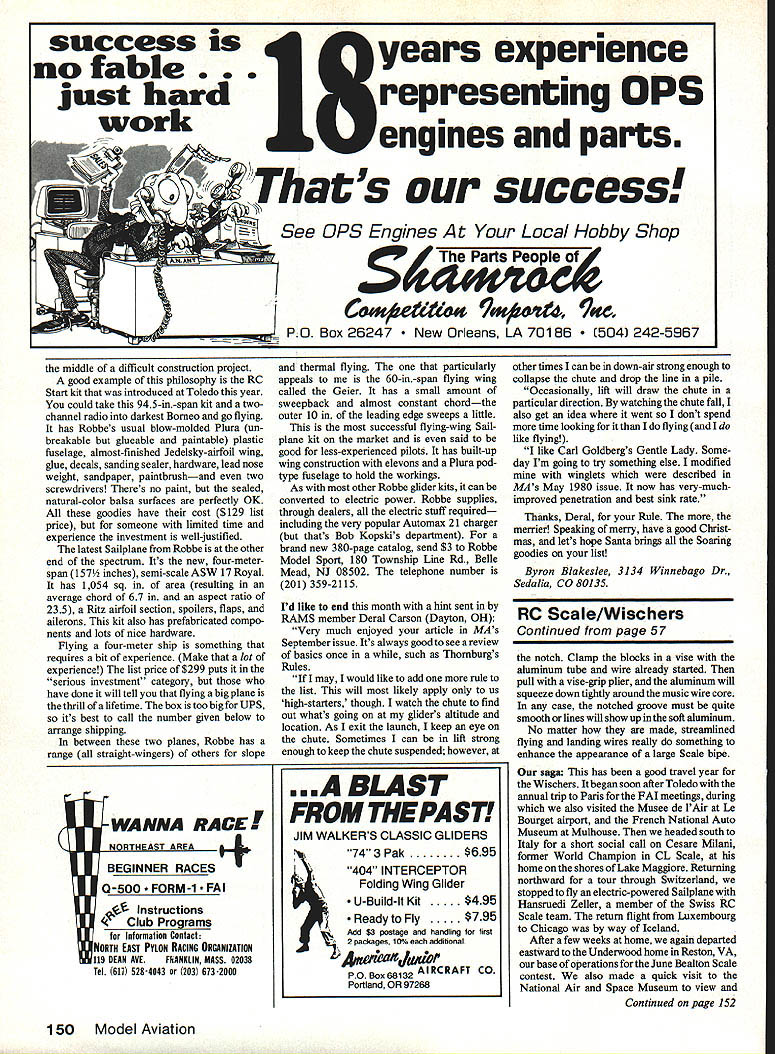
Robbe's latest sailplane at the time is a four-meter (157.5 in) ASW 17 Royal. Features:
- 1,054 sq. in. area (average chord 6.7 in, aspect ratio 23.5)
- Ritz airfoil section
- spoilers, flaps, ailerons
- Plura plastic fuselage parts and precovered flying surfaces
List price was $299. Flying a four-meter ship requires considerable experience but is very rewarding. The box is too big for UPS; call to arrange shipping.
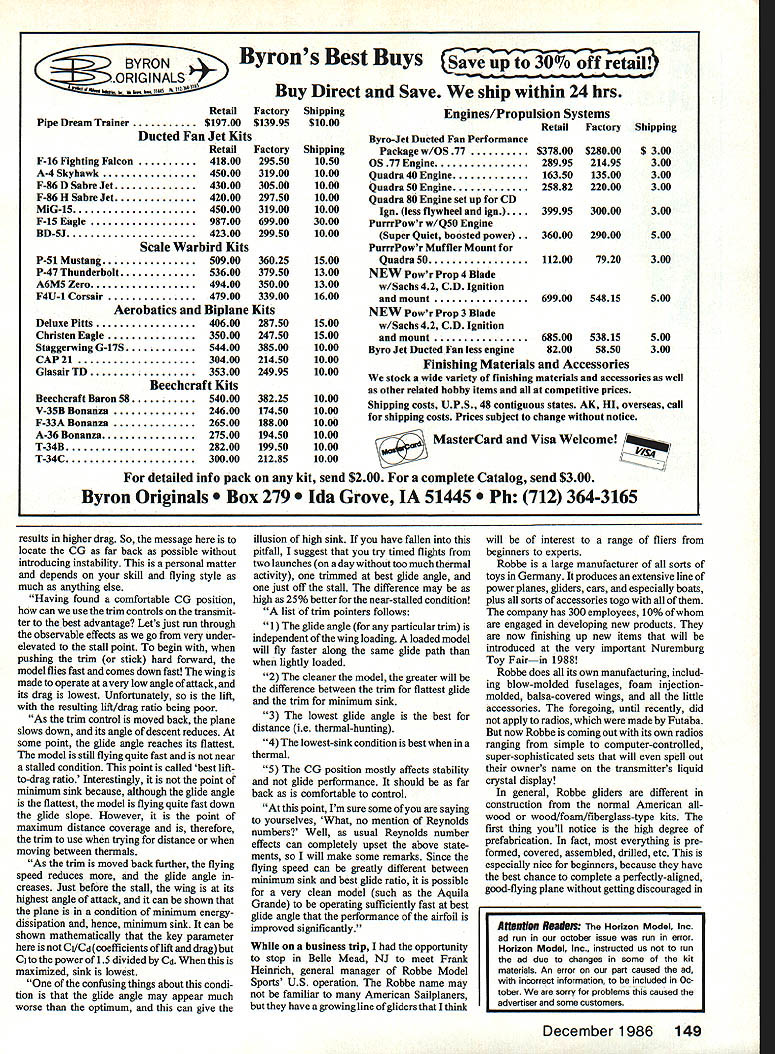
Robbe also offers a range of other straight-wing models for slope and thermal flying. A notable kit is the 60-in span flying wing called the Geier: swept leading edge, almost constant chord, built-up wing with elevons and a Plura pod-type fuselage. Many Robbe kits can be converted to electric power; Robbe supplies electric accessories through dealers.
For a catalog (380 pages), send $3 to: Robbe Model Sport 180 Township Line Rd. Belle Mead, NJ 08502 Phone: (201) 359-2115
Events and results
- Joe Jan Wurts were the winning team in the Santa Maria Soaring Society's sixth annual cross-country contest. They completed the full 26-mile triangular course near California Valley, CA, two days into the meet.
RAMS tip and closing
A hint sent in by RAMS member Deral Carson (Dayton, OH):
"As I exit the launch, I keep an eye on the chute. Sometimes I can be in lift strong enough to keep the chute suspended; other times I can be in down-air strong enough to collapse the chute and drop the line in a pile. Occasionally lift will draw the chute in a particular direction. By watching the chute fall, I get an idea where it went so I don't spend more time looking for it than I do flying."
Deral also modified his Carl Goldberg Gentle Lady with winglets (described in MA, May 1980) and reports improved penetration and best sink rate.
Thanks, Deral — the more rules and tips, the merrier. Have a good Christmas, and let's hope Santa brings all the soaring goodies on your list.
Byron Blakeslee 3134 Winebago Dr. Escondido, CA 92025
Transcribed from original scans by AI. Minor OCR errors may remain.

