
Radio Control: Soaring
Byron Blakeslee
S.O.A.R. Scale Uprising
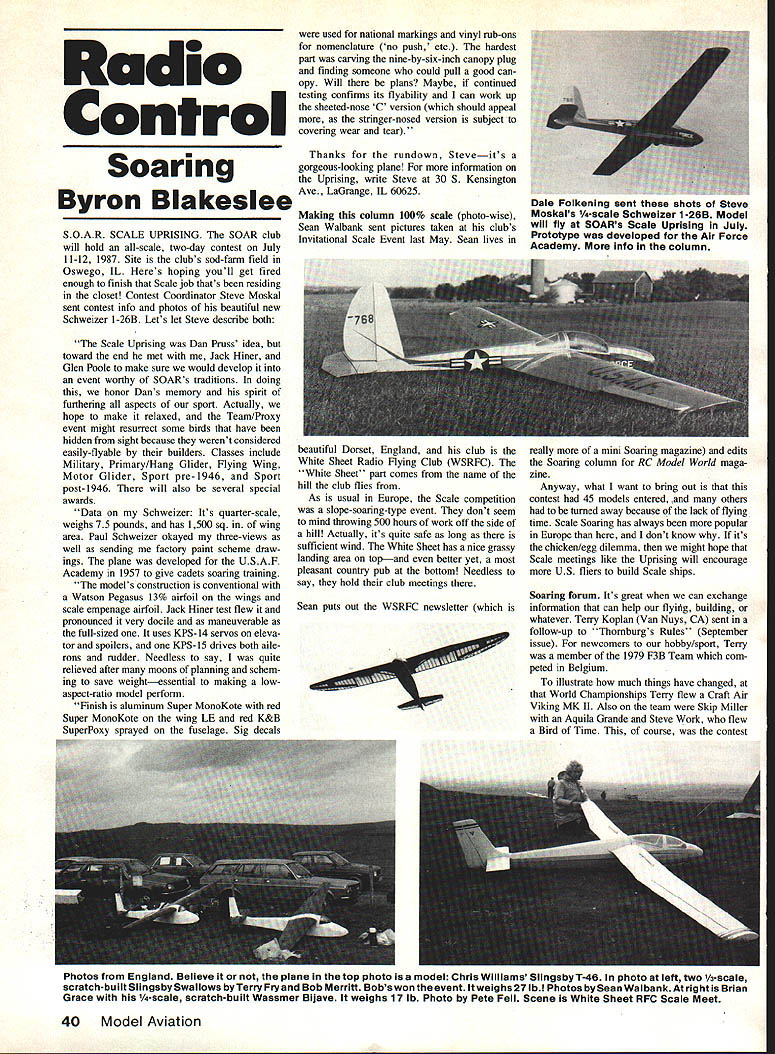
The SOAR club will hold an all-scale, two-day contest on July 11-12, 1987. The site is the club's sod-farm field in Oswego, IL. Here's hoping you'll get fired up enough to finish the scale job that's been residing in the closet! Contest Coordinator Steve Moskal sent contest information and photos of his beautiful Schweizer 1-26B. Steve describes both the contest and his model:
"The Scale Uprising was Dan Pruss' idea, but toward the end he met with me, Jack Hiner, and Glen Poole to make sure we would develop it into an event worthy of SOAR's traditions. In doing this, we honor Dan's memory and his spirit of furthering all aspects of our sport. Actually, we hope to make it relaxed, and the Team/Proxy event might resurrect some birds that have been hidden from sight because they weren't considered easily flyable by their builders. Classes include Military, Primary/Hangar, Flying Wing, Motor Glider, Sport pre-1946, and Sport post-1946. There will also be several special awards.
"Data on my Schweizer: It's quarter-scale, weighs 7.5 pounds, and has 1,500 sq. in. of wing area. Paul Schweizer okayed my three-views as well as sending me factory paint-scheme drawings. The plane was developed for the U.S.A.F. Academy in 1957 to give cadets soaring training.
"The model's construction is conventional with a Watson Pegasus 13% airfoil on the wings and scale empennage airfoil. Jack Hiner test flew it and pronounced it very docile and as maneuverable as the full-sized one. It uses KPS-14 servos on elevator and spoilers, and one KPS-15 drives both ailerons and rudder. Needless to say, I was quite relieved after many moons of planning and scheming to save weight—essential to making a low-aspect-ratio model perform.
"Finish is aluminum Super MonoKote with red Super MonoKote on the wing leading edge (LE) and red K&B SuperPoxy sprayed on the fuselage. Sig decals were used for national markings and vinyl rub-ons for nomenclature (no push, etc.). The hardest part was carving the nine-by-six-inch canopy plug and finding someone who could pull a good canopy. Will there be plans? Maybe, if continued testing confirms its flyability and I can work up the sheeted-nose 'C' version (which should appeal more, as the stringer-nosed version is subject to covering wear and tear)."
Thanks for the rundown, Steve—it's a gorgeous-looking plane! For more information on the Uprising, write Steve at 30 S. Kensington Ave., LaGrange, IL 60525.
White Sheet Invitational Scale Event (WSRFC)
Making this column 100% scale (photo-wise), Sean Walbank sent pictures taken at his club's Invitational Scale Event last May. Sean lives in Dorset, England, and his club is the White Sheet Radio Flying Club (WSRFC). The "White Sheet" part comes from the name of the hill the club flies from. As usual in Europe, the scale competition was a slope-soaring-type event. They don't seem to mind throwing 500 hours' work off the side of a hill! Actually, it's quite safe as long as there is sufficient wind. The White Sheet has a nice grassy landing area on top—and even better yet, a most pleasant country pub at the bottom, where they hold their club meetings.
Sean produces the WSRFC newsletter (more of a mini soaring magazine) and edits the Soaring column for RC Model World magazine. This contest had 45 models entered, and many others had to be turned away because of lack of flying time. Scale soaring has long been more popular in Europe than in the U.S.; we can only hope that Scale meetings like the Uprising will encourage more U.S. fliers to build scale ships.
Soaring Forum
It's great when we can exchange information that can help our flying, building, or whatever. Terry Koplan (Van Nuys, CA) sent a follow-up to "Thornburg's Rules" (September issue) for newcomers to the hobby/sport. Terry was a member of the 1979 F3B Team which competed in Belgium. To illustrate how much things have changed, at World Championships Terry flew a Craft Air Viking Mk II. Also on the team were Skip Miller with an Aquila Grande and Steve Work, who flew a Bird of Time. This was the contest in which the Austrians introduced the age of high-velocity soaring—the little 83-inch-span Dassel blew everyone away. In the Speed task, however, the South Africans won the Team Trophy with relatively conventional (i.e., built-up construction) airplanes.
Terry emphasizes that rules, homework, teamwork, and intelligent flying can overcome some equipment shortfalls. His additions to Thornburg's Rules follow.
Rules, homework, teamwork, intelligent flying (from Terry Koplan)
- Never cover the same air twice.
- Decide a flying strategy that will cover the most sky without traveling over an area you have already checked out. Don't depend on another flier to find the thermal for you, and don't automatically abort your flight plan if another flier has lift.
- Know your flying site.
- If it is a flying site you have never visited, talk to the locals about where the best thermal spots are.
- If you are at this new site for competition and you are serious about doing well, walk the entire flying perimeter deciding where potential good thermal areas might be. Get to the site at least one day early and fly it.
- Use your spotters to tell you not only where the good air is, but where the bad air is.
- In competition, tell your spotters what your flight plan is. Don't let them "fly" your airplane, but rather have them give you input as to what is happening to the air where you are not. Also choose a spotter whom you feel comfortable with and who is a good judge of air conditions. Terry cites helpers such as Bill Nibley and Ken Wagner, and occasions when he used pilots like Dave Thornburg, Mark Smith, and Steve Work.
- The spotters' input does not stop once you have made your decision. Use them to plan a landing pattern that will avoid other airplanes. One spotter should be telling you about wind direction and speed to aid in setting up the proper approach for a good landing. Most contests are still won in the landing circle.
If followed along with Thornburg's Rules, these additions will give you a big head start on the competition.
Terry Koplan — personal notes and reflections on Dan Pruss
"I am currently married with two future fliers, ages two years and six months, respectively. Flying has been limited quite a bit, but I still do fly on occasion. I have needed my 6.2-mile goal to complete LSF Level 5 since John Baxter became the first one to accomplish it. Some day I will complete the final task. I am an AMA Contest Director and have had several articles published in flying magazines. My scale Glasflugel 604 was the cover plane and feature article in Scale RC Modeler.
"There has been much said about Dan Pruss and what he has done for soaring. As a member of the '79 FAI Soaring team, I will remember Dan as our team manager. Back in the early Seventies Dan with his club, SOAR, ran what was called the SOAR Nationals. One of the big reasons they did this was that the AMA did not recognize soaring at that time. This contest became bigger than any single AMA event and was the premier event of the year. The SOAR Nationals drew over 200 competitors from all over the country. At one meet there were names like Mark Smith, Dave Shadel, Otto Heithecker, Don Edberg, Warren Plohr, LeMon Payner, Col. Bob Thacker, John Baxter, Dave Thornburg, Bob Gill, Dale Nutter, Jeff Mirflick, Dwight Holly, and many more. These people all flew against one another at a single major contest. Even today, glider pilots do not travel to the AMA Nats like they did to the SOAR Nationals. Why? Dan Pruss ran a class contest. The participation in the SOAR Nats is one of the reasons soaring was finally added as an AMA event. Thank you Dan Pruss. I will always treasure the people and experiences I had because of you."
Frequency Interference and Scanning
Kurt Rosner, a Rocky Mountain Soaring Association member, had his favorite bird shot down by off-field interference. To find what hit him, Kurt bought a frequency scanner and discovered a commercial station operating 10 kHz below his channel 44.
Kurt describes his scanner: "The Regency MX-500 may be the first (readily-available) of a new breed of communications receivers—continuous coverage from 25 to 550 MHz. Other receivers give you several segments (bands) within that range, but they don't give you access to, for example, the RC channels on 72 MHz. This one does.
"Its frequency-synthesized (no crystals), keyboard-controlled with an alphanumeric LCD display, and comes in a nifty compact package. You can program it as a 20-channel scanner and set it up to search between any two frequencies in steps of 5, 12.5, or 25 kHz. AM, NFM, or WFM (narrow- or wide-band FM) can be selected. For example, you might want to program up to 20 RC channels in Scan mode, and Search from 72.0 to 73.0 MHz in 5 kHz steps to find potentially troublesome signals lurking between the RC channels in your area."
The MX-500 comes with a plug-in telescoping antenna, 120-volt adapter, a cable to install a cigarette-lighter plug (or whatever) to run on your car's 12-volt battery, and a mounting bracket. Kurt got his from CW Electronic Sales in Denver for $299 (recently reduced from $415; it first hit the market at $600). Two negatives: the instructions are skimpy and don't cover all keyboard-control capabilities of the unit, and this little gem may distract you from your real hobby! It's imported by Regency Electronics, Inc., 7707 Records St., Indianapolis, IN 46226.
Kurt's next step was to contact our District IX Frequency Coordinator, Steve Mangles, in Denver. Steve found the "offender" was a mobile phone service broadcasting data and voice signals directionally from Denver towards Boulder (where Kurt got hit). Kurt can hear this signal loud and clear on his new scanner. Steve also learned that the same company had applied for additional FCC allocations in the 72 MHz range. We also learned a commercial service is installing a new transmitter in the mountains which will broadcast 10 kHz off channel 52—effectively eliminating its usefulness in the Denver area. Let's hope they don't get those allocations.
FCC / AMA frequency notes
A review of the "AMA News" section (March 1983 Model Aviation) by Bob Abeler, then Chairman of AMA's RC Frequency Committee, provides the official context:
- Our new RC channels (50 aircraft-only channels were planned to be operational by January 1991) are all spaced between existing commercial radio stations (private radio services, common carrier paging services, etc.).
- The closest a commercial station can operate to one of our new RC channels is 10 kHz. However, as the rules are written, if a commercial radio station operating 10 kHz away from your RC channel causes you interference, you must be the one to assure frequency protection. In that regard we are a secondary user in the eyes of the FCC.
- Because of this, the AMA was granted a seemingly large number of authorized channels. Selecting the correct RC channel for your area will become a major problem, especially in the near future.
Each time channel spacing narrows, we need more "selective" receivers. The 1991 receivers must be able to reject adjacent channels 20 kHz away so we don't shoot each other down. But the "primary" user 10 kHz away can still get you; that's why the FCC gave us 50 channels—to enable us to dodge the primary users.
What to do / Advice
- Determine which channels to avoid in your area and which appear clear. Your District Frequency Coordinator should help with this.
- Inform your Coordinator of any interference problems—advance information is what Coordinators really need.
- A scanner like Kurt's can tell you if there are transmissions likely to hit you and give an idea of signal strength at the particular location you're monitoring. Clubs might consider investing in one.
- Talk to the commercial operators if possible to learn their usage patterns; some companies have authorizations but use the frequencies sporadically, which can lead to intermittent interference.
- Be aware of two types of interference:
- Commercial interference from outside transmitters (as discussed above).
- Interference we create with our own transmitters—intermodulation. There has been extensive writing on intermodulation; with good luck the 1991 receivers will reduce that problem.
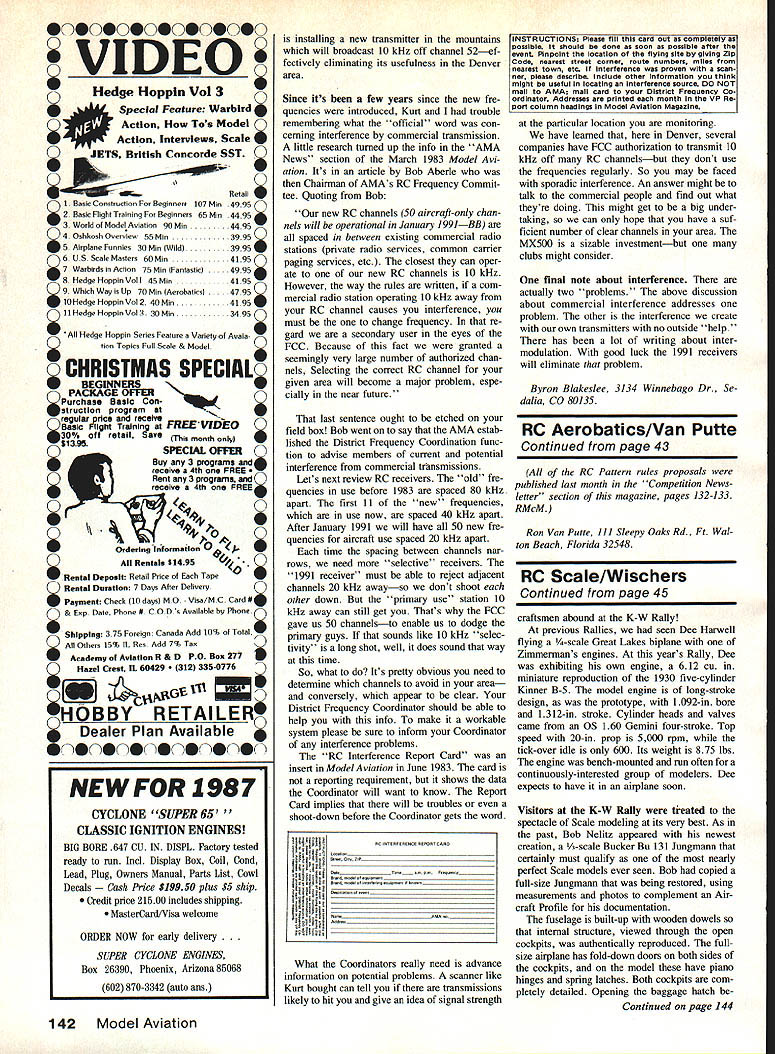
The "RC Interference Report Card" insert in Model Aviation (June 1983) shows the data the Coordinator will want to know. It is not a reporting requirement, but it indicates the kind of information useful to address interference before it causes trouble.
Byron Blakeslee 3134 Winnebago Dr., Sedalia, CO 80135.
Transcribed from original scans by AI. Minor OCR errors may remain.

