
Radio Control: Soaring
Byron Blakeslee
Club of the Month — The Portland Area Sailplane Society (PASS)
- PASS is a very active group in the Pacific Northwest and a big booster of Bob Dodgson's series of designs.
- Club officers: Dave Johnson, Tom Brightbill, Craig Robinson.
- Co-editors of the club newsletter: Barry Kurath and Kevin Coleman.
Barry Kurath reports:
"We have been around since 1976, and several charter members are still active. Membership has been about 35 for most of the club's history, but it appears to be going through a rapid growth spurt right now. Some of the reasons for this seem to be related to improved publicity. An information sheet has been distributed to area hobby shops, we have been on local TV news, and we have been getting good coverage in the national model press. The club had been somewhat narrowly focused with the active members concerned only with the Northwest Soaring Society contest season.
"The increase in variety of activities this year has made PASS more appealing to beginners and sport fliers. New activities this year included a fun fly and family picnic and our first-ever cross-country race. The fun fly brought out a good crowd of people who don't usually see contests. The cross-country was the favorite event of the year. The quiet Dave Johnson described it as an 'orgy of flying'—just to give an idea of how much fun we had. Any club that hasn't tried a cross-country event is really passing up a great facet of our hobby.
"During the cross-country weekend, two of our younger members made AMA record attempts—three of which seem to have been successful. We'll have to wait for official certification to be certain, but Matt Coleman, age 14, set the Junior Declared Distance and Junior Thermal Duration records, while Mike Erbguth set the Senior Declared Distance record. Also, Eric Jackson did his LSF Level IV Goal and Return task, making it look easy by having more altitude when he got back than when he started!
"Something else that's new this year is the club's Mylar sticker. They're very popular and we use them on gold, silver, and bronze medallions for our Hand-Launch contest awards. By the way, PASS has always had a Hand-Launch contest season, maybe earlier than any other glider club. This year we had six scheduled. The September contest was the only one rained out in spite of Portland's reputation for unpredictable weather!"
Barry also noted that 1986 was the fifth straight year Brightbill, Neilson, and Johnson have competed in the Nats. Those three make a formidable team.
Suggestion: A Nats Team Trophy
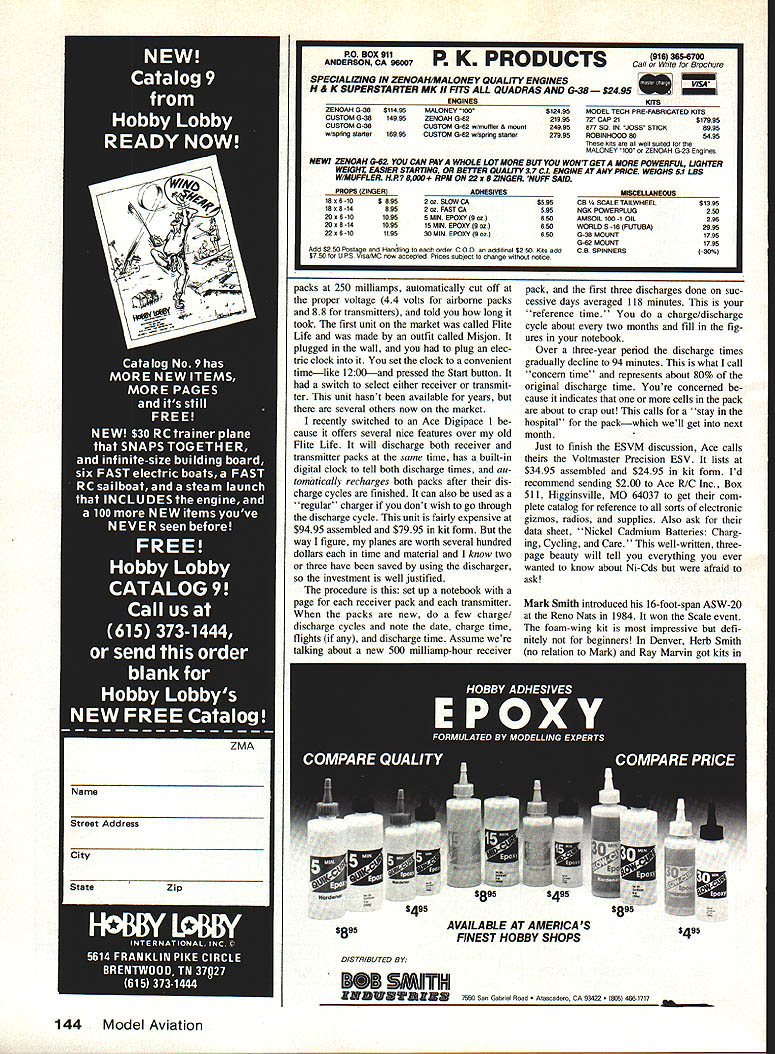
I wonder why the Nats doesn't have a team award. Dan Pruss had a Team Trophy when he CD'ed the SOAR Nats up to 1974. The first Soaring event at the AMA Nats had a team award (won by the San Fernando Valley Silent Flyers). Imagine the excitement: classic battles between Dodgson straight-wingers and California poly-birds!
A possible stipulation: fliers must belong to the same AMA-chartered club and the top three scores from a chartered club would be counted. With today's computerized scoring it shouldn't be difficult to keep track. What do you think?
"Your President Speaks" — Dave Johnson (selected paragraphs)
"Contests around the Northwest sometimes take on almost the appearance of being 'one-design' contests, what with all the Windsongs being flown this year (13 of 26 Unlimited—AMA Class D—gliders at the recent Portland contest were Windsongs). But even Bob Dodgson himself isn't necessarily all smiles about this since, at the first Redmond, WA contest, he started 'flying' another Windsong while his own dived into a gravel parking lot, suffering minor damage. A similar situation occurred at Mt. Vernon, WA where another Windsong spiraled in from high altitude while everyone (including the plane's unfortunate owner) was watching the other Windsongs still circling overhead. It only takes a few seconds' distraction.
"As long as I'm handing out advice, I'll report something I've mentioned in the past. Buy an expanded-scale voltmeter and use it! It saved my Pixy this summer. In fact, apparently a bad servo drained the battery in about 15 minutes. A second battery pack drained just as quickly. It was the first day I flew my Pixy—it could have been my last. An ESVM is the only way you can catch such problems out at the field. I routinely check my batteries during the course of a day of flying. Most of the time it just gives peace of mind knowing everything is OK, but this time it saved a plane."
Batteries and Expanded-Scale Voltmeters (ESVM)
How an ESVM works (non-technical)
- Most modern radios use four Ni-Cd cells (4.8 nominal volts) for the airborne pack and eight cells (9.6 volts) in the transmitter.
- Typical flight current is around 250 mA. A 500 mAh airborne pack should deliver about two hours at 250 mA.
- Just before a pack runs out, cell voltage drops: 1.2 V per cell is nominal; 1.1 V is about as low as you should use. That means about 4.4 V on a four-cell pack—roughly an 8% drop from nominal.
Why a regular voltmeter is no good:
- A regular voltmeter has very high input resistance. If you measure a pack not under load, even a nearly-dead pack can show normal voltage.
- Regular meters make it hard to read the small voltage differences we're concerned with.
Expanded-scale voltmeters solve both problems:
- Their scales are expanded to read about 4.3–5.3 V for airborne packs and 8.6–10.6 V for transmitters.
- They include a built-in load (resistor) to draw roughly 250 mA while measuring, giving a true reading of the pack under load.
If your pack reads "in the red" after only 15 minutes of flying, something is wrong—either excessive drain (bad servo, short, etc.) or a weak cell.
Dischargers / Cyclers
If you suspect a 500 mAh pack is weak: after a proper charge, plug it into an ESVM and time how long until the voltage drops into the red (4.4 V). At 250 mA this should be about two hours for a healthy pack. Keep a stopwatch and record discharge time—do not allow the pack to discharge below safe limits to avoid cell reversal.
A data notebook for each pack is a good practice: record dates, discharge times, flights, and any anomalies. If discharge times drop to about 80% of the original (e.g., from 118 min to ~94 min) over time, treat that as "concern time"—the pack may be failing and should be retired or rebuilt.
Equipment Recommendations
- I recently switched to an Ace Digipace I because it discharges both receiver and transmitter packs simultaneously, has a built-in digital clock showing discharge times, and automatically recharges after discharge cycles. It can also be used as a regular charger. Price: about $49.95 assembled, $39.95 in kit form. Worth it given the value of saved planes.
- Ace's Voltmaster Precision ESVM lists at $34.95 assembled and $24.95 in kit form. Send $2.00 to Ace R/C, Inc., Box 511, Higginsville, MO 64037 for their full catalog and ask for the data sheet "Nickel Cadmium Batteries: Charging, Cycling, and Care."
Scale Sailplanes and Herb's Retracts
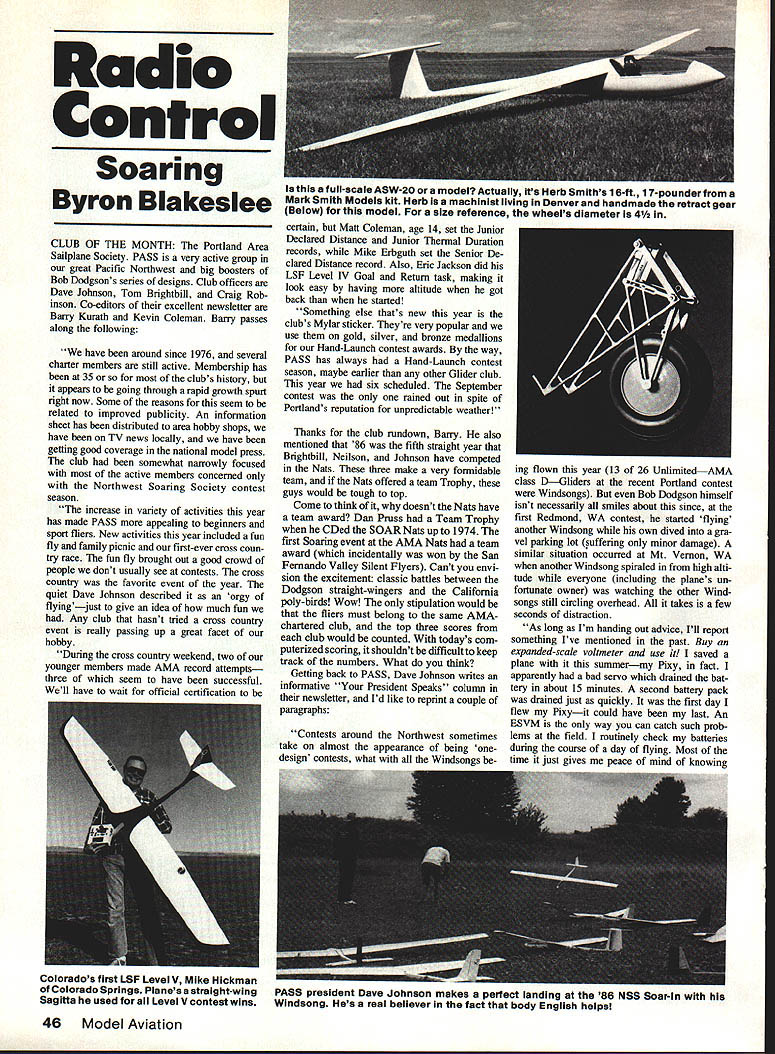
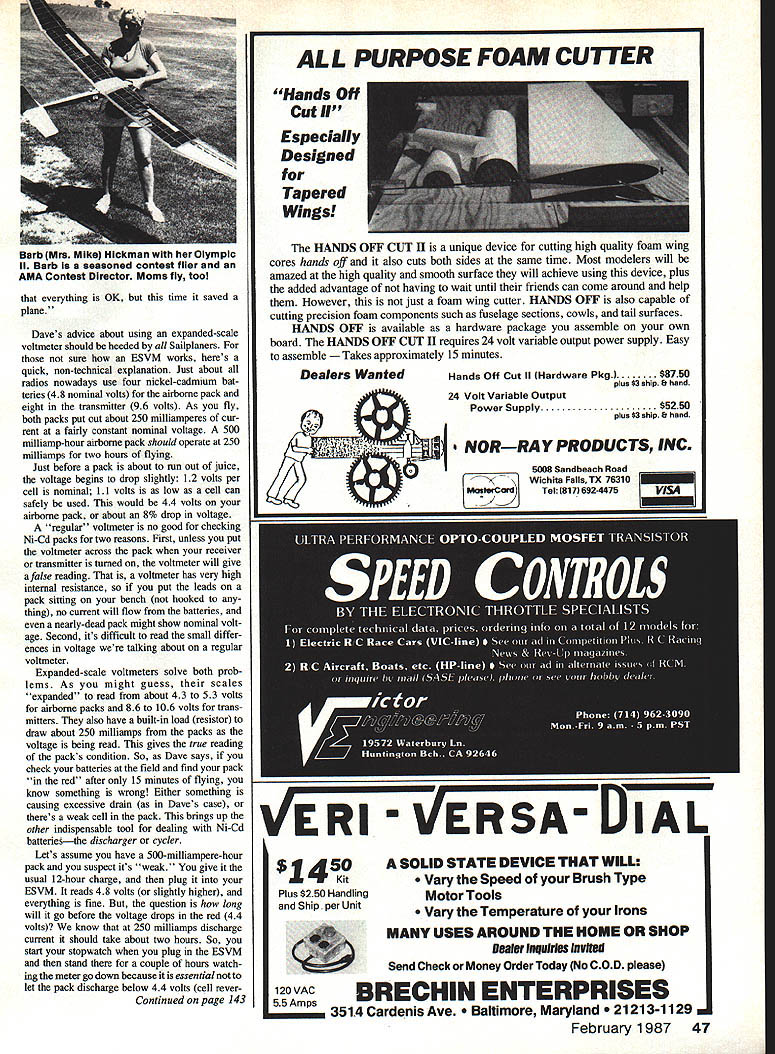
Mid-1985 Herb finished his first scale model and it is a treat to see—extremely scale-like in the air. Herb is a machinist and fabricated two retract gear units from solid aluminum stock—one for each ship. The workmanship is gorgeous. The "sliding-pin-in-slot" mechanism locks over the center for both the Up and Down positions.
National Sailplane Symposium — Madison, WI
The fourth annual National Sailplane Symposium was held in Madison, WI last November. Sponsored by the Madison Area R/C Society, it was the biggest and best yet. Al Scidmore recorded the proceedings and will make available a thick book covering all that went on. The 1985 Proceedings is available now and is highly recommended.
Contents include:
- Dan Pruss' report on the 1985 F3B World Championships in Australia.
- Frank Baker's introduction to aerodynamics.
- Professor Roland Stull's talk on meteorology for R/C soaring.
- Ken Bates' talk on flying wings.
- Topics on cross country, variometers, adhesives, fiberglass fuselages, construction techniques, and Michael Seig's discussion on airfoils and the ideal F3B speed run.
Prices (including book-rate postage): 1985 — $10; 1984 — $8; 1983 — $7. Add $1 per book for first-class postage. Order from Walt Seaborg, 1517 Forest Glen Rd., Oregon, WI 53575.
Vintage Sailplanes — Martin Simons' Book
Kookaburra (Australia) now has Martin Simons' new book available. It reportedly contains over 100 line drawings of full-scale sailplanes/gliders from 1908 to 1945, about 300 photographs (many in color), and considerable historical and technical information.
Sean Walbank describes it as "an excellent read—just the kind of stuff to curl up with next to the fire in order to plan next year's Scale masterpiece!"
To order: cashier's check for A$28.75 (about US$35) to Kookaburra Technical Publications Pty. Ltd., P.O. Box 646 Dandenong 3175, Victoria, Australia. For A$35 they'll send the book plus a 30" x 21" poster showing 30 vintage sailplanes.
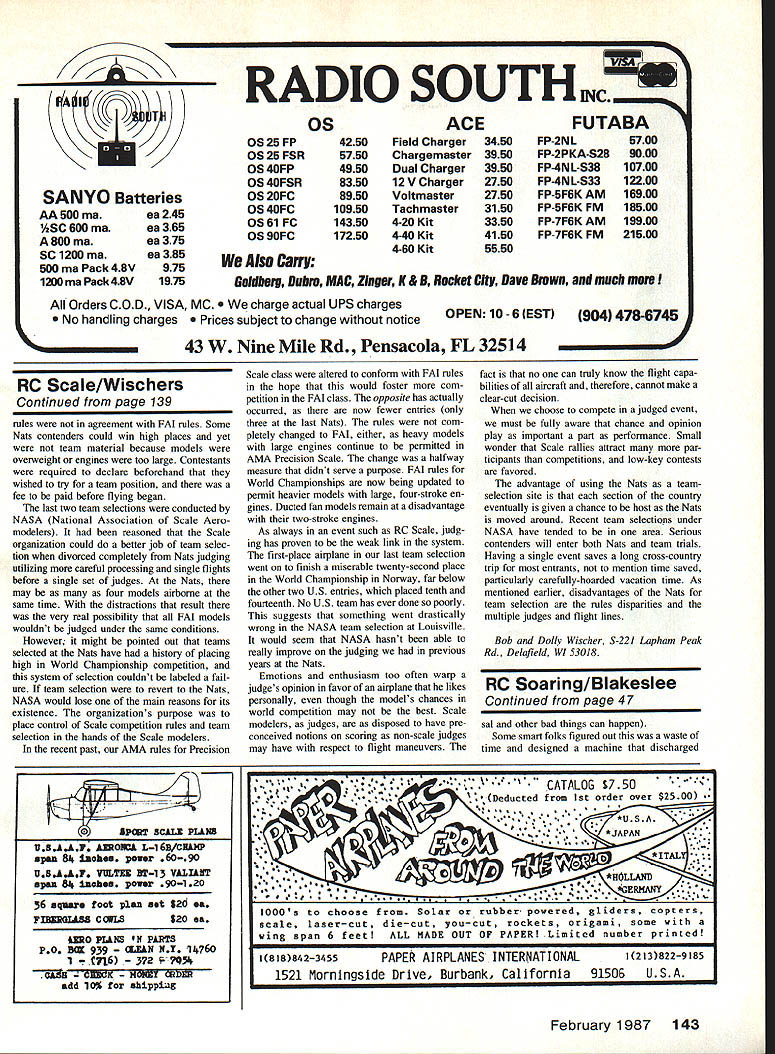
Mike Hickman — LSF Level V
Submitted by Ivan Hickman, Colorado Springs: his son Mike earned his first LSF Level V using a Sagitta XC with a Thermic Sniffer. Mike is past president of the Pikes Peak Soaring Society (PPSS) and currently NSS District IX vice president.
Highlights:
- Mike reached Level V quickly—an impressive achievement given he has been an AMA member for only five years and pursuing LSF goals for four years.
- He won three contests with 20+ contestants, in a region with many skilled fliers.
- For his eight-hour duration, he used various sites and finally found a mesa-like slope between Colorado Springs and Denver with a 340-foot face. He obtained permanent permission to use the site for PPSS.
- He completed the duration on March 10, using an Olly II augmented with D dry cells to aid NiCd capacity and wearing a snowmobile suit for protection.
- His efforts involved many tries (about 20 attempts) before succeeding—persistence paid off.
LSF Level V is rare: with LSF around since the early 1970s and an estimated 6,000–7,000 members worldwide, fewer than four dozen individuals have reached Level Five.
Calendars and Awards
Time to order 1987 calendars. The German "Segelflug-Bildkalender" (Sailplane Picture calendar) makes excellent contest awards. I buy 20" x 14" mats, mount the calendar pictures, and have 12 nice awards for contests. Order from Aero Smithing, 4020 Daventry Court, Charlotte, NC 28226. Phone: (704) 365-0821. Price: $12.95 plus $3.50 packing and UPS shipping.
Handicapping Different-Size Classes
Handling different-size classes in the same contest is tricky. Options:
- Award separate prizes for Two-Meter, Standard, and Unlimited (AMA classes B, C, D).
- Or make no distinction by size and use experience-level classes instead.
An interesting handicapping system from the Central Ontario Glider Group: Neil Tinker set target times to gain 1,000 points—Two-Meter ships get 5 minutes, Standard 8 minutes, Unlimited 10 minutes. Given Two-Meter performance at the 1986 U.S. Nats, this may be generous to small ships, but it's an idea. Any other suggestions on handicapping are welcome.
Winter Flying Tips
Keep feet and hands warm and dry. A few practical tips:
- For slight cold, use inexpensive jersey gloves and cut one-inch slits in the thumbs so sticks can go inside. These cost about $2 a pair at grocery stores.
- A transmitter "cozy": have your spouse sew an open-bottom bag from nylon lined with flannel, about 14" wide by 13" high, with a one-inch slit for the antenna. Let the bag dangle on the antenna at launch, then slide it down to keep your hands warm without losing stick "feel."
- Wind that makes eyes water is bothersome—ski goggles help. Ordinary protective goggles under $5 will go over eyeglasses and work fine.
Contact
Byron Blakeslee 3134 Winnebago Dr. Sedalia, CO 80135
Transcribed from original scans by AI. Minor OCR errors may remain.

