
Radio Control: Soaring
Byron Blakeslee
Update: F3B World Championships
Assuming it's about the first week of February when you read this, it will be just four months until the U.S. F3B team departs for Germany to compete in the Sixth World Championships. Much remains to be done, mainly raising enough money to get the team there — and back. The AMA supplies funding for transportation and entry fees, but the bulk of the money must come from kind‑hearted contributors. Please send contributions to the address below.
Team members
- Steve Work — Albuquerque, NM. Age 31. First U.S. Finals; second person to achieve LSF Level V. Member of the 1979 U.S. F3B Team. Avid full‑size soaring pilot. Employed by Sperry Aerospace R&D as an electronics technician.
- Richard Spicer — San Jose, CA. Age 42. Second at U.S. Finals. LSF Level IV; winner of the 1985 Western Soaring Championships. Designer and builder of the Synergy composite sailplane. Employed by AT&T.
- Steve Lewis — Santa Clara, CA. Third at U.S. Finals. Member of the South Bay Soaring Society; also flew a Synergy. Employed by Brunswick Corp.
- Lynn King — Boulder Creek, CA. Age 40. Team Manager. Built the winches used by Team Synergy; avid slope flier and South Bay member. Employed as a tool and die maker at Hewlett‑Packard.
- Tom Thompson — Albuquerque, NM. Assistant Team Manager and fund‑raising chairman. Age 43. Managed the Albuquerque effort that helped Steve Work take top spot at the Finals. Contractor; has served as transportation manager for the Coors International Bicycle Classic.
- Phil Renaud — Albuquerque, NM. Tactician and Team Assistant. Age 42. Placed ninth at the Finals. Holds an M.S. in Astronautical Engineering from the U.S. Air Force Academy and works as a USAF test pilot engineer assistant.
Please send donations to: F3B SOARING TEAM P.O. Box 9328 Albuquerque, NM 87119 Phone: 505/884‑9635
Club of the month: Modesto Radio Control Club (Modesto, CA)
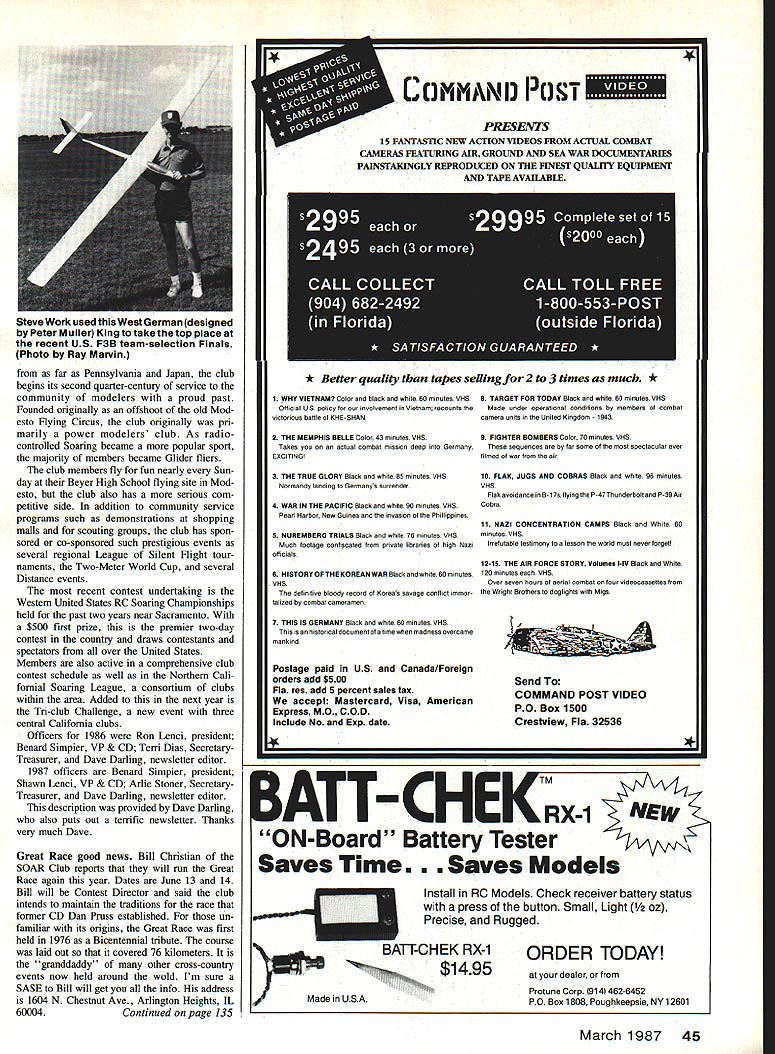
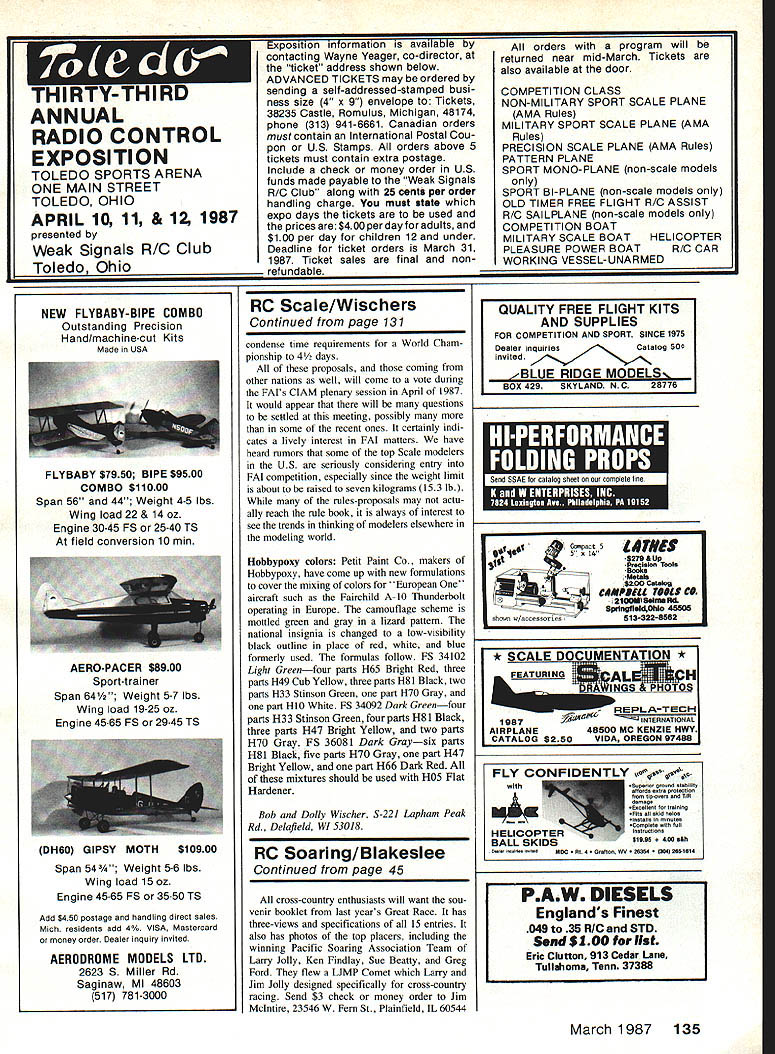
AMA charter #135 belongs to the Modesto Radio Control Club of Modesto, CA. The club, now beginning its second quarter‑century of service, has about 50 members (44 Model Aviation members). It began as an offshoot of the old Modesto Flying Circus, originally a power‑modelers club. As radio‑controlled soaring became popular, the majority of members became glider fliers. Club members fly nearly every Sunday at the Beyer High School flying site.
The Modesto club also has a serious competitive side. In addition to community service programs (demonstrations at shopping malls and for scouting groups), the club has sponsored or co‑sponsored several regional League Silent Flight tournaments, the Two‑Meter World Cup, several distance events, and the Western United States RC Soaring Championships held near Sacramento the past two years. The $500 first prize at that premier two‑day contest draws contestants and spectators from across the U.S. Members are active in a comprehensive club contest schedule and the Northern California Soaring League, a consortium of area clubs. Next year will add the Tri‑club Challenge, a new event among three central California clubs.
Officers
- 1986: Ron Lenci, President; Bernard Sempier, VP & CD; Tern Dias, Secretary‑Treasurer; Dave Darling, Newsletter Editor.
- 1987: Bernard Sempier, President; Shawn Lenci, VP & CD; Arlie Stoner, Secretary‑Treasurer; Dave Darling, Newsletter Editor.
Description provided by Dave Darling.
Great Race
Good news from the SOAR Club: the Great Race will run again this year on June 13–14. Bill Christian will be Contest Director and intends to maintain the traditions established by former CD Dan Press. The Great Race began in 1976 as a Bicentennial tribute with a 76‑kilometer course and has become a model for many modern cross‑country events. For information, send a SASE to Bill Christian, 1604 N. Chestnut Ave., Arlington Heights, IL 60004.
All cross‑country enthusiasts will want the souvenir booklet from last year's Great Race. It includes three‑views and specifications of all 15 entries and photos of the top places, including the winning Pacific Soaring Association team (Larry Jolly, Ken Findlay, Sue Beatty, Greg Ford) flying a LJMP Comet designed specifically for cross‑country. Send $3 (check or money order) to Jim McIntire, 23546 W. Fern St., Plainfield, IL 60544.
Notes and gear
- Dave Thompson's 1/32‑in‑span Owl is a new kit on the market; a fine flier according to reports.
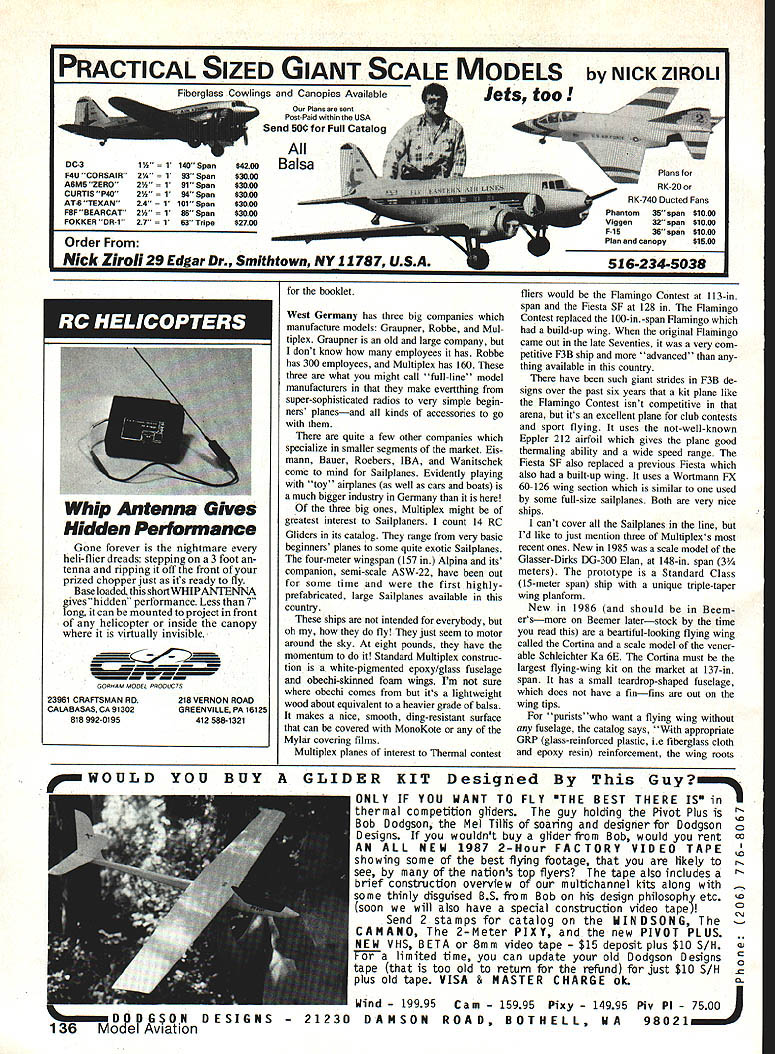
- Kurt Rosner's Regency MX‑5000 frequency scanner unit (described in January '87) is very sensitive and compact — good range.
Multiplex radios and Bremer RC West
The sole factory‑authorized importer for Multiplex in the U.S. is Bremer RC West, 7725 E. Redfield Road, Suite 105, Scottsdale, AZ 85260; tel. (602) 483‑9577. Kits are available directly from Bremer, Hobby Lobby in Tempe, or Wilshire Model Center in Los Angeles. Example prices from Bremer's list: Flamingo Contest and Fiesta SF — $180; Alpina SZ200, Contesta 21 — (prices vary); DG‑300 (box) — $315. Note: the DG‑300 box is too large for UPS and must be shipped by truck.
Multiplex radios (imported by Bob Bremer) are generating excitement. Two basic lines are available: the Royal and the Commander. The Royal is feature‑rich; the top Profi 2000 is very expensive and may have limited U.S. sales. Bob Bremer has established a complete service department in Scottsdale for Multiplex radios.
Both Royal and Commander feature FM transmission with PCM and microprocessors in both transmitter and receiver. The Royal accepts plug‑in "softmods" — software packages that program the transmitter's microprocessor. There are about 20 softmods, including two specifically for F3B; one F3B softmod includes a memory feature for trim settings so one transmitter can fly multiple planes by swapping softmods.
In Germany they operate with 10 kHz spacing between model transmission frequencies: 20 channels in the 35 MHz band reserved for aircraft and 22 channels in the 40 MHz band for cars and boats. Multiplex calls its receiver a "PCM‑DS" (double superhet, i.e., double‑conversion), which provides narrow‑band reception sufficient to reject transmissions 10 kHz away.
These radios are not inexpensive, but they offer advanced protection against interference. Bremer sells radios without servos and chargers, assuming serious modelers already have those. Older positive‑pulse servos can be converted with Multiplex pigtails, or you can choose from Multiplex servos. Royal transmitters range from about $450 to $590 depending on options; the Commander set is about $380. Catalogs are available from Bremer RC West.
Trends: ailerons and kit developments
Aileron‑equipped ships have become increasingly common in AMA Thermal competitions among serious contestants. Ailerons provide better control in wind and during landing and, combined with sleeker, slightly heavier designs, enable faster flight, greater range, and better penetration. In calm, minimal‑lift conditions, lighter polyhedral designs (e.g., Wingrider) can have the edge, but most competitors choose a design that performs well across a broad range of conditions.
A common approach is converting polyhedral kits to straight wings to add ailerons. Typical mods include beefed inboard spars, full sheeting, and ailerons driven directly by small servos in the wings or by bellcranks and pushrods to a single fuselage servo.
Notable kit examples and developments:
- Marks Models Sensor (straight‑wing conversion of the Panic design): Mark Smith's Panic (designed for the 1983 F3B Worlds) evolved into the Sensor (poly wing with flaps). Scott Dukes flew a straight‑wing Sensor at a recent AMA contest — it looked and flew very well.
- Larry Jolly Model Products (LJMP) straight‑wing Meteor: Lenny Keer flew a straight‑wing Meteor (mods: 5/16‑in. wing‑joiner rods, doubled inboard spars, full sheeting, straight leading edge, servos ahead of the ailerons, straight rudder). Larry Jolly is turning day‑to‑day LJMP operations over to Alex Bereczky; Larry will continue design work. A 5‑m Meteor kit may be offered.
- Dave Thompson's Owl: a new kit designed for all‑out AMA thermal competition. The Owl has 132 in. span, a fully sheeted built‑up wing with an Eppler 193 airfoil, an epoxy/glass fuselage with removable nose cone, a plywood keel in the nose area, and a Thermic Shifter in the prototype. Easy to build and strong — attractive to those who prefer a straight kit rather than modifying a polyhedral kit.
Closed‑circuit cross‑country contest — Corpus Christi RC Club
Chuck Caldwell (newsletter editor and CD) described a closed‑circuit cross‑country contest held on a Navy airfield last August:
"We fly four laps of a five‑kilometer triangular course, making it 20 km total distance. The Navy cooperates by giving us exclusive use of the field for the weekend — it is normally a training airfield. It works out to a nice, relatively headache‑free contest, and there's no road traffic to worry about! The contestants bring their own — or share — launching equipment.
"There's a nice prize to shoot for: $500 in cash to the first team to complete the 20 km in 32 minutes or less. The special cash prize is in addition to the regular prizes and trophies. Nobody won the money this year, but the low time was turned in by Jim Farris flying his 14‑foot, T‑tailed Spirit. The wings are sheathed with formica, making an ultra‑smooth surface! Also on Jim's team were Dick Reddy and Chris Lee. Next year we may raise the 'money' time to 40 minutes. Dates for '87 are August 22 and 23."
Thanks to Chuck for the report — the format keeps all planes in view from the starting area and makes for an exciting event.
Byron Blakeslee 3134 Winnebago Dr. Sedalia, CO 80135
Transcribed from original scans by AI. Minor OCR errors may remain.

