
Radio Control: Soaring
Byron Blakeslee
F3B World Team and Fundraising
Tom Thompson of Albuquerque, F3B assistant team manager and fundraising chairman, dropped in over the Christmas holiday with the latest team news. Our F3B team—Steve Work, Rich Spicer, and Steve Lewis—will represent the U.S.A. against about 29 other countries this summer in Osnabrück, West Germany. The RC soaring competition runs July 24 through August 2. Fliers and equipment (aircraft and radios) will be world-class and state-of-the-art.
The team needs community support to make the best possible showing in Germany. Donations will earn souvenirs and entry in a sweepstakes for industry-donated prizes (prize list to be printed when finalized). Please send checks to: F3B Soaring Team Box 9328 Albuquerque, NM 87119
Donation levels:
- $5 — U.S.A. F3B pin for your flying hat
- $10 — U.S.A. F3B team patch and information sheets on the team's planes
- $15 — both of the above
(Contributions larger or smaller than these amounts are welcome.)
Comet — new German sailplane (team aircraft)
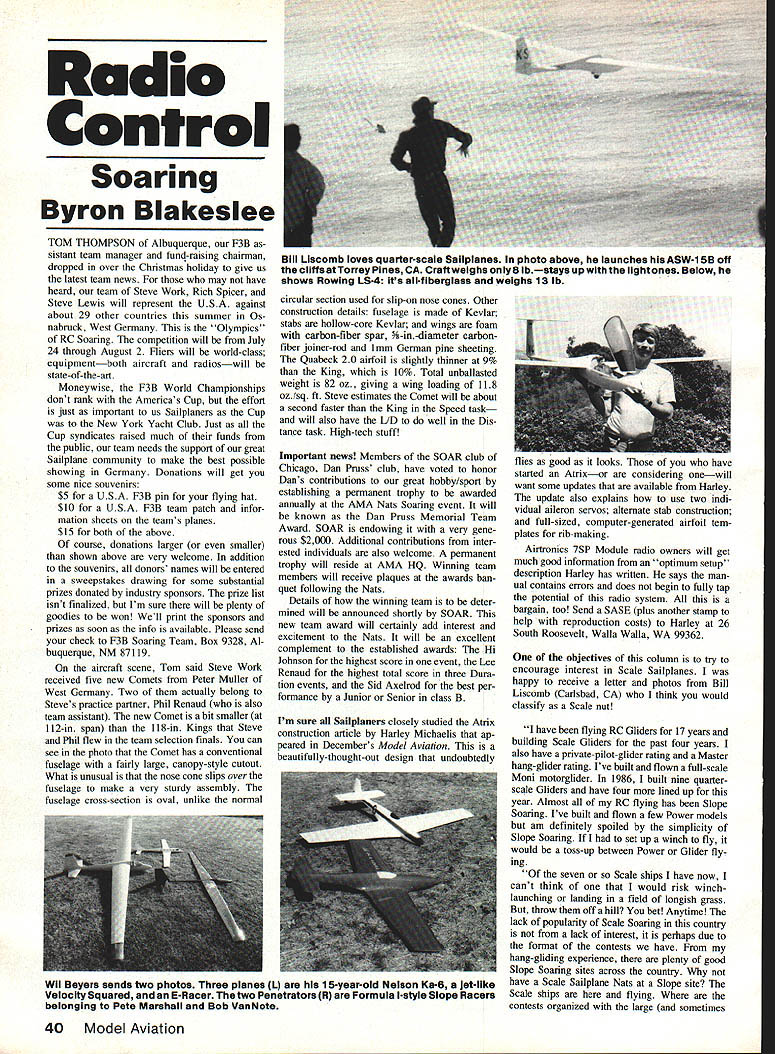
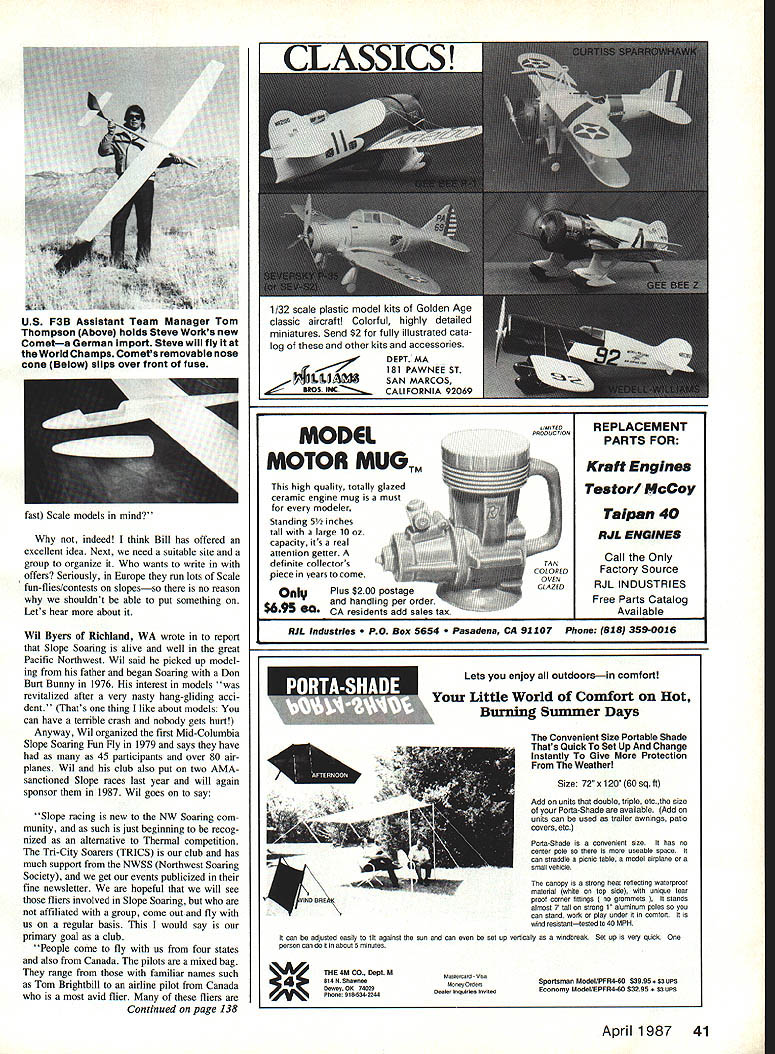
Tom reports that Steve Work received five new Comets from Peter Müller of West Germany; two belong to Steve’s practice partner Phil Renaud (also a team assistant). The Comet is a bit smaller than the King series (112 in span vs. 118 in). It has a conventional fuselage with a fairly large canopy-style cutout. An unusual feature: the nose cone slips over the fuselage, creating a very sturdy assembly; the fuselage cross-section is oval rather than the usual circular section used for slip-on noses.
Construction details:
- Fuselage: Kevlar
- Stabilizers: hollow-core Kevlar
- Wings: foam with carbon-fiber spar
- Joiner rod: 5/8 in diameter carbon-fiber
- Skinning: 1 mm German pine sheeting
- Airfoil: Quabeck 2.0 (about 9% thickness vs. King at 10%)
- Total unballasted weight: 82 oz
- Wing loading: 11.8 oz/sq ft
Performance notes: Steve estimates the Comet will be roughly 2 seconds faster than the King in the Speed task and will have the L/D to do well in the Distance task.
Dan Pruss Memorial Team Award (SOAR, Chicago)
Members of the SOAR club (Chicago) have voted to honor Dan Pruss by establishing a permanent trophy to be awarded annually at the AMA Nats Soaring event: the Dan Pruss Memorial Team Award. SOAR is endowing the trophy with $2,000; additional contributions are welcome. The permanent trophy will reside at AMA headquarters; winning team members will receive plaques at the awards banquet following the Nats. SOAR will announce details shortly about how the winning team will be determined.
This new team award will complement existing Nats awards:
- Hi Johnson — highest single-event score
- Lee Renaud — highest total score in the three Duration events
- Sid Axelrod — best performance by a Junior or Senior in Class B
Atrix update — Harley Michaelis
Sailplaners will want to study the Atrix construction article that appeared in December's Model Aviation. Harley Michaelis has prepared an update that clarifies and extends the manual, including:
- Use of two individual aileron servos
- Alternate stabilizer construction
- Full-sized computer-generated airfoil templates for rib-making
- Setup tips for Airtronics 75P Module radio owners
Harley notes the original manual contains errors; the update helps owners fully tap the radio's potential. To obtain the update, send a SASE (plus an extra stamp to help reproduction costs) to: Harley Michaelis 26 South Roosevelt Walla Walla, WA 99362
Scale Sailplanes — reader letters and ideas
One objective of this column is to encourage interest in scale sailplanes. Bill Liscomb of Carlsbad, CA, wrote with photos and ideas. Bill has been flying RC gliders for 17 years and building scale gliders for the past four. He holds a private-pilot glider rating and a Master hang-glider rating and has built and flown a full-scale Moni motorglider. In 1986 he built nine quarter-scale gliders and has four more planned.
Bill suggests organizing a Scale Sailplane Nats at a slope site, noting that in Europe many scale fun-fliests and contests are held on slopes. He argues the lack of scale contests in the U.S. is not lack of interest but lack of organization and suitable events. If you’re interested in helping organize or hosting such events, write in.
Northwest slope soaring — Wil Byers report
Wil Byers of Richland, WA, reports that slope soaring is active in the Pacific Northwest. Wil began soaring with a Don Burt Bunny in 1976 and organized the first Mid-Columbia Slope Soaring Fun Fly in 1979; attendance has reached as many as 45 participants with over 80 airplanes. Wil’s club, the Tri-City Soarers (TRICS), received support from the Northwest Soaring Society (NWSS) and has organized AMA-sanctioned slope races.
Highlights from Wil’s report:
- Pilots come from four states and Canada; skill levels vary from well-known competitors to enthusiastic newcomers.
- Good relations with local parks and recreation have helped make events successful.
- Typical hill heights in the area range from 600 to 1,100 ft; one site within 15 miles will usually work in any wind.
- Cascade Head (Oregon coast) is a spectacular 1,295 ft slope overlooking the ocean. Landings can be made on the face of the hill in good grass.
Contact Wil Byers at: 632 Meadows E., Richland, WA 99352.
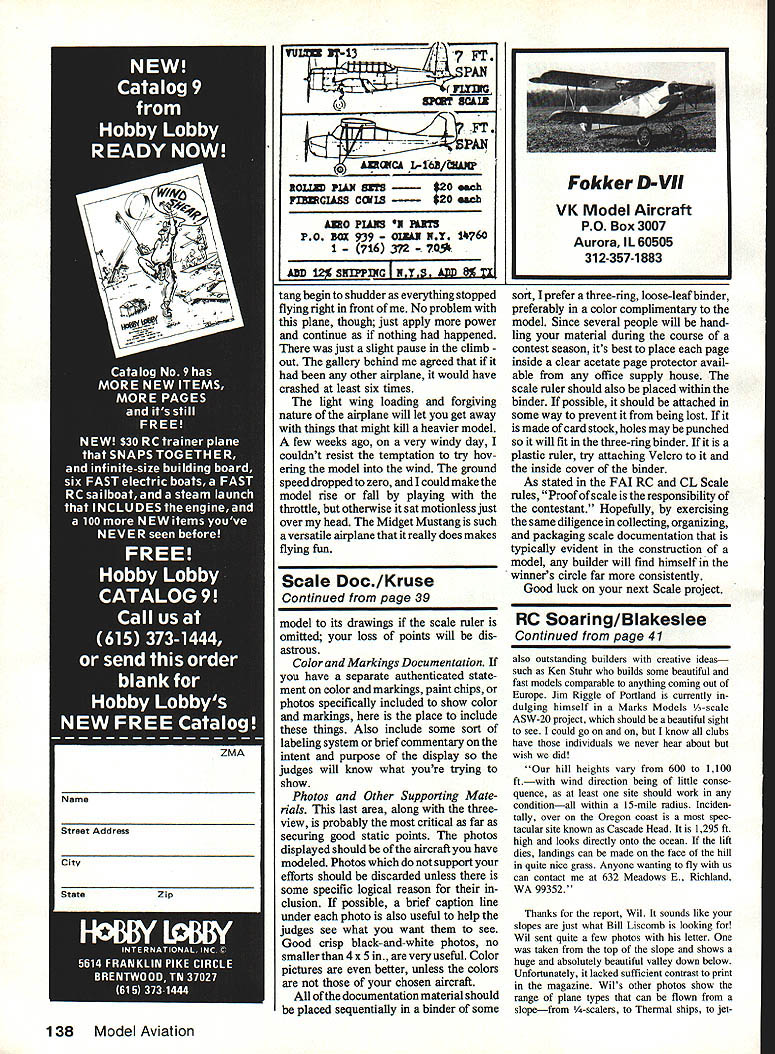
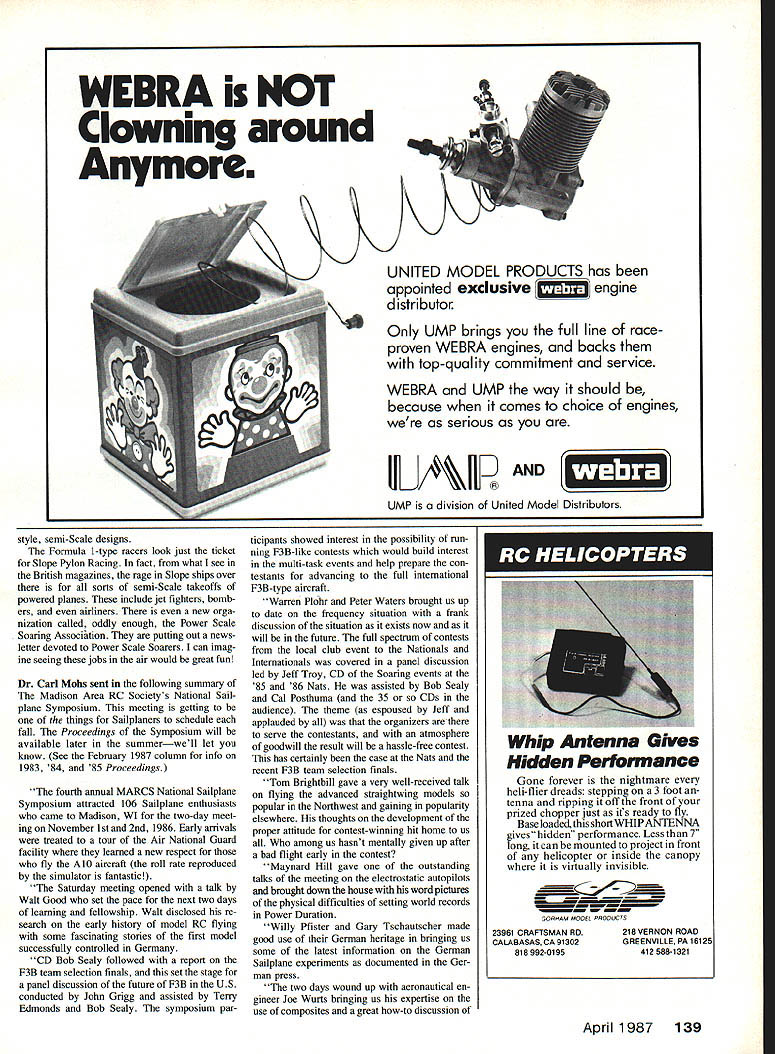
Wil sent photos showing the variety of slope-flyable models—from 1/4-scale sailplanes to thermal ships and jets—and examples of semi-scale and Formula 1–type slope racers. A new organization, the Power Scale Soaring Association, is producing a newsletter devoted to power scale soarers.
MARCS National Sailplane Symposium (Madison)
Dr. Carl Mohs summarized the fourth annual Madison Area RC Society (MARCS) National Sailplane Symposium, held November 1–2, 1986, which attracted 106 sailplane enthusiasts. Key presentations and events included:
- Tour of an Air National Guard facility and simulator demonstration
- Walt Good on early RC flying history
- Bob Sealy on F3B team selection finals and a panel on F3B’s future in the U.S.
- Frequency-management update by Warren Plohr and Peter Waters
- Panel on contests from local clubs to Nationals, led by Jeff Troy, with Bob Sealy and Cal Posthuma
- Tom Brightbill on flying advanced straightwing models and contest strategy
- Maynard Hill on electronic autopilots and power-duration record challenges
- Willy Pfister and Gary Teschmacher on German sailplane competitions
- Joe Wurts on composites and vacuum-bagging foam-and-glass wings
Proceedings of the Symposium will be available later in the summer. MARCS has scheduled a fifth symposium on October 31–November 1, 1987. To get on the mailing list, write: Dr. Carl Mohs 5024 Lake Mendota Dr. Madison, WI 53705
Upcoming events
- International Slope Race (ISR): May 2–3, near Davenport, CA (between San Francisco and Santa Cruz). Head-to-head format with four planes on a two-pylon course; two days of heat racing with flyoffs for top pilots. Contact: Bob DeMattei, 1580 Parrot Ave., Sunnyvale, CA 94087. Phone: (408) 732-3009 (home) or (415) 723-2950 (work).
- Sugarloaf Classic cross-country race: May 30–31. Sponsored by the Capital Area Soaring Association (CASA). Contest Director: Charlie Wells, 1-B Westway, Greenbelt, MD 20770. Course site near Sugarloaf Mountain, south of Frederick, MD.
- SOAR Scale Uprising: dates changed to August 1–2 to avoid near conflict with the Nats. For information, write Steve Moskal, 30 S. Kensington Ave., La Grange, IL 60525.
Sailplane Design Program (Commodore)
Eddie Dumas Jr. of Knoxville has written a Sailplane Design Program for the Commodore personal computer. The program predicts performance changes when you vary airfoil, wing span, chord, or CG. Included airfoil data: Eppler 193, 205, and 214; ten kit sailplanes are on the disk (including both sizes of Sagitta and the Windsong). Eddie bases his analysis on Eric Lister’s Sailplane Designer’s Handbook and Soar Tech data. Cost: $20 for a diskette and full operating instructions. Send $20 to: Eddie Dumas Jr. 3220 Boomerang Lane Knoxville, TN 37931 Eddie promises reasonably priced updates as more files are developed.
Ni-Cd batteries revisited
An expanded-scale voltmeter (ESVM) is useful at the field to check pack voltage and decide if you can fly "once more around the flight." However, an ESVM does not indicate pack capacity (how many flights per charge) or internal behavior during discharge. Many packs show a flat mid-level plateau during discharge followed by a steep voltage collapse; the plateau may last several minutes on some packs and 10–15 minutes on others. This behavior often disappears after several cycles and does not necessarily affect overall capacity. Recommendation: don’t condemn a pack solely for showing this plateau—cycle it a few times and retest.
Closing
I appreciate the letters, reports, and photos from readers—keep them coming. For correspondence: Byron Blakeslee, 5134 Winnebago Dr., Sedalia, CO 80135.
Transcribed from original scans by AI. Minor OCR errors may remain.

