
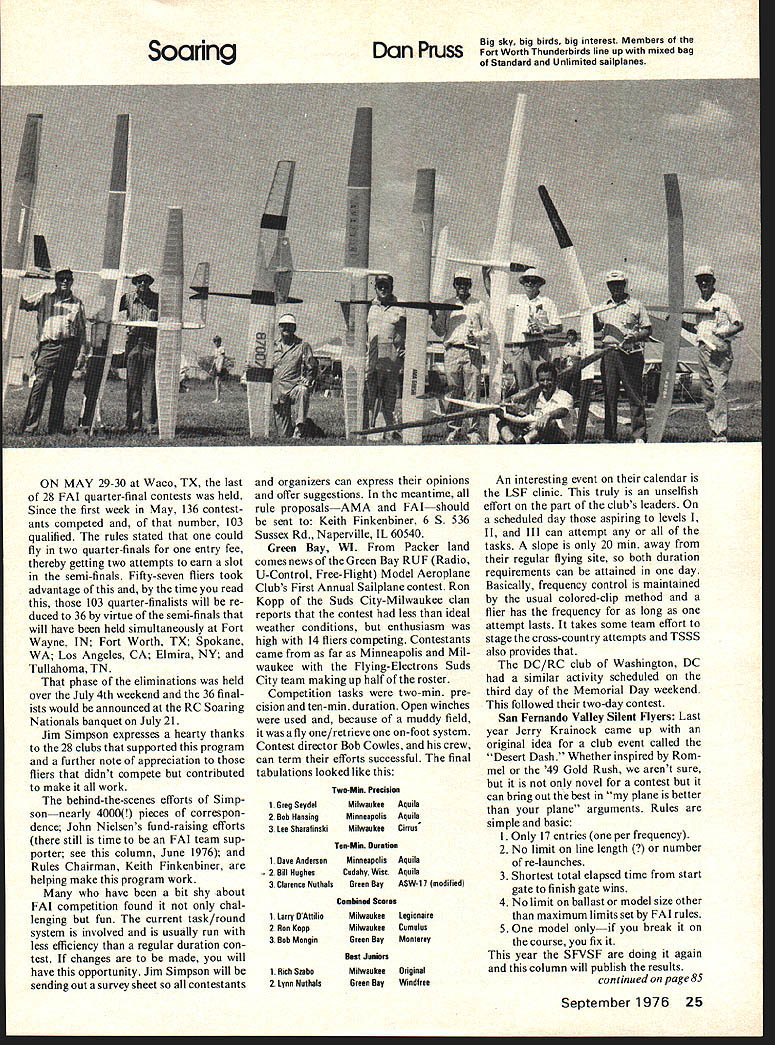
Radio Control: Soaring
ON MAY 29-30 at Waco, TX, the last of 28 FAI quarter-final contests was held. Since the first week in May, 136 contestants competed, and of that number, 103 qualified. The rules stated that one could fly in two quarter-finals for one entry fee, thereby getting two attempts to earn a slot in the semi-finals. Fifty-seven fliers took advantage of this, and by the time you read this, those 103 quarter-finalists will be reduced to 36 by virtue of the semi-finals that will have been held simultaneously at Fort Wayne, IN; Fort Worth, TX; Spokane, WA; Los Angeles, CA; Elmira, NY; and Tullahoma, TN.
That phase of the eliminations was held over the July 4th weekend and the 36 finalists would be announced at the RC Soaring Nationals banquet on July 21.
Jim Simpson expresses hearty thanks to the 28 clubs that supported this program and a further note of appreciation to those fliers that didn't compete but contributed to make it all work.
The behind-the-scenes efforts of Simpson—nearly 4,000 (!) pieces of correspondence; John Nielsen's fund-raising efforts (there still is time to be an FAI team supporter; see this column, June 1976); and Rules Chairman Keith Finkenbiner, are helping make this program work.
Many who have been a bit shy about FAI competition found it not only challenging but fun. The current task/round system is involved and is usually run with less efficiency than a regular duration contest. If changes are to be made, you will have this opportunity. Jim Simpson will be sending out a survey sheet so all contestants and organizers can express their opinions and offer suggestions. In the meantime, all rule proposals—AMA and FAI—should be sent to: Keith Finkenbiner, 6 S. 536 Sussex Rd., Naperville, IL 60540.
Green Bay, WI. From Packer land comes news of the Green Bay RUF (Radio U-Control Free-Flight Model Aeroplane Club)'s First Annual Sailplane contest. Ron Kopp of the Suds City-Milwaukee clan reports the contest had less than ideal weather conditions, but the enthusiasm was high with 14 fliers competing. Contestants came from as far as Minneapolis and Milwaukee with the Flying-Electrons Suds City team making up half the roster.
Competition tasks were two-min. precision and ten-min. duration. Open winches were used because of a muddy field, with a fly one/retrieve one-on-foot system. Contest director Bob Cowles and his crew can term their efforts successful. The final tabulations looked like this:
Two-Min. Precision
- Greg Seydel, Milwaukee, Aquila
- Bob Massing, Minneapolis, Aquila
- Lee Sharafinski, Milwaukee, Cirrus
Ten-Min. Duration
- Dave Anderson, Minneapolis, Aquila
- Bill Hughes, Cudahy, Wisc., Aquila
- Clarence Nuthals, Green Bay, ASW-17 (modified)
Combined Scores
- Larry D'Attilio, Milwaukee, Legionaire
- Ron Kopp, Milwaukee, Cumulus
- Bob Mongin, Green Bay, Monterey
Best Juniors
- Rich Szabo, Milwaukee, Original
- Lynn Nuthals, Green Bay, Windfree
An interesting event on their calendar is the LSF clinic. This truly is an unselfish effort on the part of the club's leaders. On a scheduled day those aspiring to levels I, II and III can attempt any or all of the tasks. A slope is only 20 min. away from their regular flying site, so both duration requirements can be attained in one day. Basically, frequency control is maintained by the usual colored-clip method and a flier has the frequency for as long as one attempt lasts. It takes some team effort to stage the cross-country attempts and TSSS also provides that.
The DC/R/C club of Washington, DC had a similar activity scheduled on the third day of the Memorial Day weekend. This followed their two-day contest.
San Fernando Valley Silent Flyers: Last year Jerry Krainock came up with an original idea for a club event called the "Desert Dash." Whether inspired by Rommel or the '49 Gold Rush, we aren't sure, but it is not only novel for a contest but it can bring out the best "my plane is better than your plane" arguments. Rules are simple and basic:
- Only 17 entries (one per frequency).
- No limit on line length or number of re-launches.
- Shortest total elapsed time from start gate to finish gate wins.
- No limit on ballast or model size other than maximum limits set by FAI rules.
- One model only—if you break it on the course, you fix it.
The SFVSF is doing it again this year and this column will publish the results. edge with the motor installed. A two-strand motor of 2-mm rubber about 19 in. long works well. Put in about 1,000 turns and allow the model to ROG. If it flies straight ahead and stalls, bend the rudder over for a left turn. If stalling persists, bend the stabilizer trailing edge down. Remember that tightening up a left turn will help convert a stall into a spiral climb and reduce the need for more down-thrust or stabilizer force during the initial power burst. When the model is adjusted to climb in a smooth left turn without stalling add a few more turns — my normal maximum is about 1,500. The model should take off, make a fairly steep climb to the left, nearly stall but roll out and proceed into a shallow left climb. If the stall is too severe, the turn is too tight; bend the stabilizer down more or add more down-thrust with a shim behind the top of the nose block.
If, on the initial flights, the model refuses to climb but rather flies in a right-to-left circle, open up the turn with the rudder. If climb is still poor remove some of the ballast clay and consider yourself lucky. Stalling is the more probable difficulty. The additional incidence built into the lower left wing should hold it up during turns. However, if it doesn't, add a small trim tab.
The prototype model is nearly five years old now and has provided a lot of enjoyable flying competitive as well as just for fun. I hope yours does the same for you.
Ron Kopp pointed out the fact that, although half of the contestants were of the Suds City team, it is support like this that encourages new clubs to further promote RC Soaring. He pointed out that the Suds City Soaring Team — now sponsored by Old Milwaukee beer — first successful contest was because a group down Chicago way was kind enough to loan winches and operators, and that the newly formed group now has an annual bash — Old Milwaukee sponsored — called the Suds City Soar-In.
Tri-State Soaring Society: Mention of that group was made a while back and it is now probably one of the fastest growing clubs in the country. Made up of fliers from eastern Ohio, western Pennsylvania, and West Virginia, the organization has over 60 members and, judging from their newsletter The Sandbag (now there's an honest name that calls it the way they see it), this group is most active.
Their expert/sportsman categories were discussed in this column last month. In Sharon Center, OH, on May 22, 28 fliers competed and J. Kelleher topped them all with his Grand Esprit. The next five places were also won by those in the "expert" class but J. Davis out-flew the next two and earned seventh place overall and a first in the sportsman class. Davis flew a Paragon.
Clubs that are inspired by this style of competition need not have a local desert to stage such an event. Get off the busy expressways and explore the roads that once were the only routes across this country. You'll be surprised at the distance one can fly using these roads for navigating, landing, and re-launching. It is realized that not all of the U.S.A. is flat land and bean fields, but if your area lends itself to that type of terrain, appraise it.
Those of us that have been following the adventures of Jack Hiner and his magic aeroplanes recently witnessed a couple of events from which all can benefit.
Last year Jack could do no wrong. First an FAI distance record (see Model Aviation, Sept. 1975) of 32 miles. Then he was the second to accomplish the 20-kilometer goal and return task for LSF — Level V (only three others have). A club duration record of over three hours was made but didn't fulfill the requirements for LSF, Level V duration. When he did have witnesses, the flight of two hours was made but the last half was done on rudder only because the elevator servo failed. Although this was a touch-and-go situation, the flight was uneventful and probably showed more skill and nerve on the part of the witnesses and spectators than Jack.
In the fall, with a sailplane specially
Radio Control: Soaring
designed around a Replogle barograph the type used by full scale sailplanes—Jack began efforts to break Ray Smith's altitude record. Conditions were less than good, but the experience was valuable.
On May 16 with conditions close to ideal, a serious attempt was made on breaking the altitude record. The plane to be flown had the same wing used for setting the distance record, the fuselage was the one mentioned earlier. Considering the cloud base it was determined that 7,000 feet could be reached. Visibility, because of previous experiments, would be no problem. The plane was launched and in 45 min. the bird was at an altitude estimated to be over 4,000 ft.
Then suddenly, in what appeared to be radio interference, the 14-ft. craft went through maneuvers intended only for certain aerobatic events. Less than 20 sec. later, the left wing was seen to break away and one can guess the remaining flight path. However, as the plane plummeted Jack was able to change directional rotation which proved that he had a working radio. Small compensation.
The plane was destroyed, the barograph and radio damaged and, upon close inspection, the following was revealed: The left wing did not break but separated from the fuselage. (A conventional two-piece wing was used mounted on two wires that go through the fuselage. Rubberbands held the two wings tightly to the fuselage.) It was determined from planes close to the proportions of Jack's that the largest wire available (7/32 in.) was not suitable and 1/4 in. would have to be used. Taking 1/4 in. drill rod and having it case-hardened seemed to serve this purpose well. It did for over a year.
The analysis further revealed that the forward wing wire sheared at the left wing/fuselage joint! A closer inspection indicated that an imperfect treatment of case hardening could have been the cause for the wire breaking.
Whether a fatigue limit was eventually reached by the normal wing loads or if wind shear put an undue stress on the wings, won't be known. It is surmised that what was thought to be radio interference was really the left wing breaking the forward wire; then the wing changed incidence by pivoting on the rear wire. This put the plane into a series of wild gyrations until the left wing slid off of the remaining wire. The barograph's trace indicated an altitude of 4,700 feet was reached.
Ideas, hints, club events, contest results, availability of 1/4-in. piano wire... send to: Dan Pruss, Box 490, Plainfield, IL 60544.
Transcribed from original scans by AI. Minor OCR errors may remain.

