
Radio Control: Soaring
Byron Blakeslee
Update: IMS Show & U.S. F3B Team
During the IMS Show in Pasadena in January, the U.S. F3B team members met with the AMA Executive Council and many industry representatives. Reports were very upbeat and positive. Depending upon funds raised, there is a good chance our team will have eight members — three more than previously announced.
This is important because, in an AMA contest, success rests roughly 80% on the pilot and 20% on the plane. At the World Championships it's closer to 1/3 pilot, 1/3 plane, and 1/3 support crew. For each flight, two winches must be put out, working time and flight time must be tracked, re-launches must be considered (and done), and the other planes in the flight group must be monitored so the pilot can concentrate on his flight. This takes a lot of organization and well-trained people. Our guys will do a great job.
Support the Team
- Team pin: $5
- Patch: $10
- Both: $15
All contributors will be eligible for a big sweepstakes drawing with many prizes. The merchandise list is not yet completed; it will be printed as soon as available. Send checks to:
F3B Soaring Team P.O. Box 9328 Albuquerque, NM 87119
F3B Focus
As a buildup to the F3B World Championships, this column will devote significant space to F3B. Even those not planning to compete will find items of interest.
F3B is the world-class international competition class for sailplanes. It consists of tasks of Thermal Duration, Speed, and Distance. (See pages 102–105 in the 1986–87 AMA Official Model Aircraft Regulations for complete rules.) The designation "F3B" was assigned by the Federation Aeronautique Internationale (FAI).
Letter from Trey Wood (Daphne, AL)
After doing well locally in AMA contests, I decided F3B was the next step. At the '79 Nats in Lincoln I saw the first Sagitta given to Skip Miller. He told me Lee Renaud might sell a prototype kit; I called, and he did. In 1980 I went to Texas to compete in an elimination round of F3B but did not go to the Finals because of distance and because I didn't think I was good enough.
Two years later I went to the Finals in Joliet, IL. During the first round I had to drop out with radio problems. In AMA contests and F3B elimination rounds everyone is willing to help anyone who needs it. That's one of the things I enjoy about flying sailplanes. Even the guy in first place will help someone in second or third do the best he can.
But at the F3B Finals it's cutthroat — every man for himself. Since there is no F3B activity in my area, and the AMA Sailplaners had quit, I relied only on my wife and brother for help. One guy at those Finals helped me when he wasn't flying: he repaired a crack in my fuselage and even tried to convince me to stay in the competition using his backup plane. Everyone else seemed too wrapped up in their own psychological warfare.
One true champion was Dwight Holley. At the 1981 World Champs in Sacramento I asked Dwight a short question about how he hinged his ailerons. He put down his model, opened his toolbox, and gave me one of his hinges — and the name and address of someone who made the jig to make the hinges.
I realize competition is fierce and contestants can't be expected to help everyone, but what about the guy who might be the best pilot to represent the U.S. but doesn't get to even try for the team because he doesn't have the necessary backup personnel? F3B pilots take their own helpers to the Finals. Do they go to the World Champs too?
Another problem is technical information. I still don't know what an "arrow-shaft hinge" is. I read the magazines for tips and hints, but I'm missing a lot of information. Is there a source that deals with new construction methods and ideas?
There seems to be a lot of talk about the lack of interest in F3B in the U.S. I believe most people here think F3B is just too much trouble — it takes a lot of people and equipment to practice, much less run a contest. Why not take a poll and ask modelers what they don't like about F3B? I'd be interested in others' reasons for not participating.
Response and Notes
- I was glad to hear Trey's comments about Dwight Holley. Dwight won the Sacramento World Championships Trey mentioned. There was a brief announcement in February Model Aviation that Dwight had passed away and his business would be closed; Bob Kopski wrote about him in the March issue. Dwight had become interested in electric airplanes and had built a retail business in that field. He was a longtime Sailplaner and very successful East Coast competitor. As Pete Carr said, "Dwight's skill was so consistent that people would say he either spent 10 minutes looking for lift or 10 minutes working the lift. Either way, he and his sailplane would lead the rest of us from the first flight to final standings." He will be missed.
- Trey's point that most people in the U.S. think F3B is too much trouble is on target. F3B is a lot of work and can be costly. There is also a "technology gap" — it takes time and money to learn what’s hot in planes, radios, winches, etc. You either invest thousands of hours and lots of money developing a competitive plane (as Rich Spicer and his group did with the Synergy program), or you buy a known competitive plane (for example from Peter Müller in Germany).
- F3B is the highest form of the hobby/sport: demanding and competitive. I liken F3B flying to Indianapolis or Formula 1 auto racing — great to watch, but not something everyone expects to do. Trey's idea of a poll is good; readers who want to "unload" should write in. I'll look for common threads and publish the consensus.
John Wyss: Mechanical Aspects of Launching
John Wyss (Boulder, CO) was a finalist at the last two team selection Finals and is developing his own F3B design, the Virga. Many top F3B competitors are willing to share information, though they often lack time to write. John provided the following summary of launch systems used at the 1986 F3B Finals to give aspiring F3B fliers a starting point.
Motors
The motor is the most important part of the launch system. Rule requirements for motors mostly involve physical size — check the rule book.
- Ford long-shaft starter motor: The stock Ford starter is used on the majority of winches in the U.S. Modified versions (extra field coils, better brushes, balancing, needle bearings on the output shaft, etc.) can be done by a good starter-rebuilding shop for around $70. Additional, less-common modifications were used by some members of team Synergy.
- DGM racing car starter motor: Designed for past U.S. F3B teams and used by several countries at recent World Championships. It uses the same mounting plate and shaft as the Ford but is otherwise different. It can replace the Ford without major winch modifications. Initially advertised as extremely powerful, it costs around $200. DGM is (or was) in Torrance, CA. Phone: (213) 320-3170 for current prices.
- Bosch starter (Mercedes diesel): Popular in Europe. It does not have a long shaft and requires extensive modification to drive the drum. Ron Vann used one at the Finals with a gear-driven drum; it appeared very powerful.
Winch Line
Monofilament is now standard for F3B. It is superior to braided nylon mainly for two reasons:
- Stretch: Most monofilament stretches and transfers winch energy smoothly to the sailplane, especially during the zoom phase. This reduces abrupt pitch changes and is less stressful on the sailplane. Rich Spicer used line stretch effectively by tensioning the line so his heavy Synergy could climb on tow for several seconds before the zoom.
- Aerodynamic drag: Monofilament has lower aerodynamic drag than braided nylon. Braided nylon can induce a curve in the towline that pulls backward and down as the sailplane approaches the turnaround, taking energy away from the sailplane. Some have tried using Kevlar as an air-line to reduce drag, but Kevlar lacks stretch and is difficult to tie.
Not all monofilaments are the same: some are too stiff to knot, others lack durability. John reports excellent results with a Japanese line called Jinaki: over 200 F3B launches with no breakage. Recommended tests: 200-lb and 160-lb; some competitors use 125-lb for better stretch but lower breaking strength.
Janus, Inc. (for Jinaki): 10903 Inglewood Avenue, Inglewood, CA 90304 Phone: (213) 678-4821
Turnarounds
- Bicycle-wheel-hub turnarounds will not work with monofilament — the hub must have a diameter greater than one inch to prevent burning the line.
- Aircraft control cable pulleys with ball bearings are a key ingredient in turnarounds that won't damage monofilament.
- A stainless steel, ball-bearing pulley about 1-1/4 inches in diameter has performed well.
Other Factors
- Drum diameters at the Finals ranged from 2-1/2 inches to over four inches. It is important to match drum diameter to motor, sailplane, and expected wind conditions.
- Very few drums were belt-driven; most were directly driven off motor shafts.
- Most winches were pulsed by foot or hand switch.
- A two-speed winch used by Roger Roth and Larry Jolly employed two switches: the first reduced current via a stainless-steel resistor for a low, constant speed (no pulsing) during the early launch; the second supplied full current at zoom. This system was very effective.
Conclusion: At the 1986 F3B Finals contestants launched competitively using a variety of systems. One factor that stood out was that the sailplane with the greatest wingspan (Synergy) consistently launched the highest.
Wind-Tunnel Work: Michael Selig (Princeton)
Michael Selig is known for work on high-performance airfoils for sailplanes. He is doing graduate work at Princeton University and has access to a low-speed, low-turbulence wind tunnel — valuable because most prior wind-tunnel work on RC sailplane airfoils was done in Germany (Eppler and Althaus).
In January Michael asked modelers to construct wind-tunnel models (wing sections) for tests. Models needed:
- Built-up, sheeted, and covered with Monokote; and
- Foam-cored, sheeted, and covered with fiberglass.
Michael plans to test 30 or more airfoils. He wrote:
"Our goal is ambitious but possible. We will be limited only by the number of wind tunnel models we receive. Unlike previous tests by others, the focus of our experiments will not only be testing known airfoils but also checking, by experiment, a new and better class of airfoils for RC sailplanes. With your support we can settle many questions and ultimately accelerate the quality of our sport."
Builders of models will be acknowledged in Michael's final report, to be published in Soaring.
Airfoils of Interest (Michael's comments)
- Clarke-Y: Crops up often. Althaus' tests showed very low drag, lower than Eppler predicted. Michael wants to resolve the discrepancy.
- E193: To compare with Althaus' results.
- E205: A decambered E193; expected to perform similarly but with lower lift.
- E214: Seen on the Windsong; its shape differs from the typical Eppler family.
- FX-60-100: Performed well in Althaus' tests; Michael wants to determine why it shows low drag compared to more popular airfoils.
- HQ 1.5/9.0 and 2.5/9.0: Designed in a simple way (Quabeck) but seem to perform well; testing should clarify why.
- MB253515: Long-debated against the E205; Michael suspects the MB may hold surprises and wants unbiased comparison.
- S2027: A redesigned MB253515 — theory suggests it is better; experiment will confirm.
- S3002: Reportedly poor in some accounts; Michael plans to re-evaluate.
- S3021: Designed to improve on the E205; Althaus' tests and flight tests suggest success — comparative testing with the 205 is planned.
- S4061: A possible thoroughbred. Michael's experience with a Prodigy suggests high L/D — wind-tunnel tests will check.
- S4062: A lower-drag, higher-Reynolds-number version of the 4061 for large cross-country sailplanes; tests will explore limits.
International Postal Challenge (IPC)
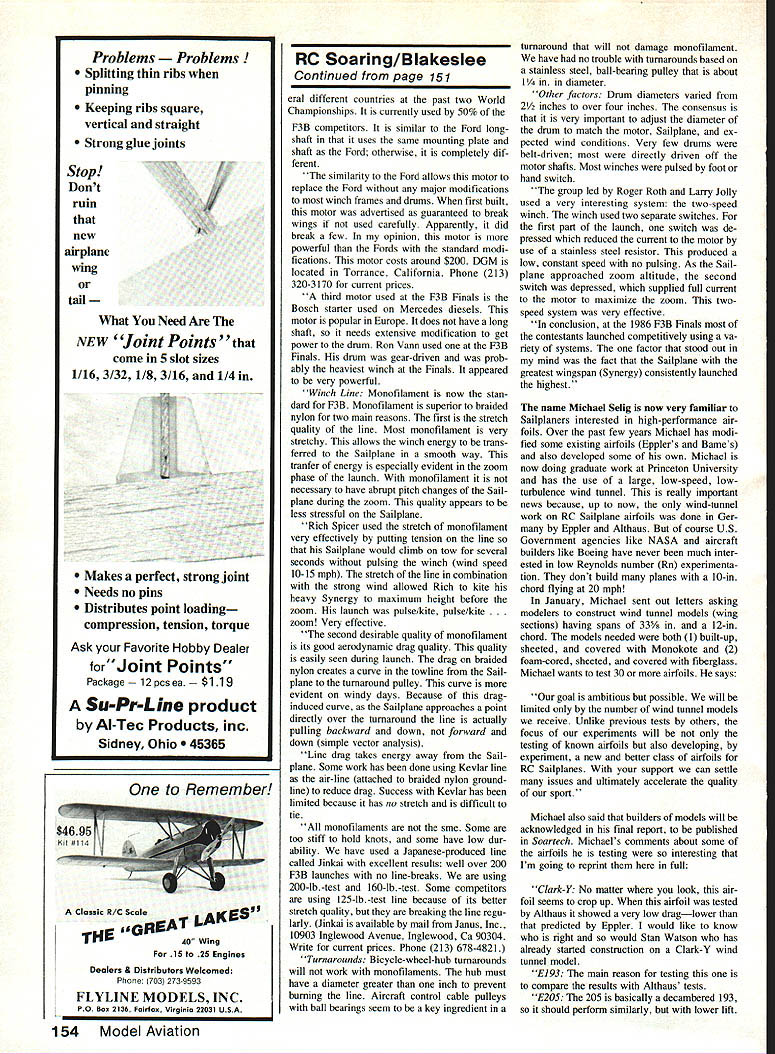
The 1986 International Postal Challenge was held last September. Clubs worldwide fly the same tasks on the same day at their own fields; the top five scores from each club are counted. No prizes are given, but it allows clubs to "compete" with friends overseas.
- Winner (1986): FSV Versmold, West Germany — a club that specializes in flying wings. Reinhard Werner was co-coordinator for the '86 event and described their effort.
- Note: The 1987 IPC concluded the last weekend in March (three rounds of Duration and Distance). Results will be passed along when available, and information on entering the 1988 IPC will be provided.
Announcements & Products
- Dodgson Designs videotape (1987): A two-hour tape with flight sequences and Bob Dodgson discussing design philosophies. Features four planes: 134-in. span Windsong; 60/72-in. Pivot Plus; Two-Meter Pixie; 100-in. Camano. Includes slope, flatland, and contest footage. Available in VHS, Beta, and 8mm.
- Price: $15 deposit plus $10 shipping and handling ($25 total).
- Order from: Dodgson Designs, 21230 Damson Road, Bothell, WA 98021.
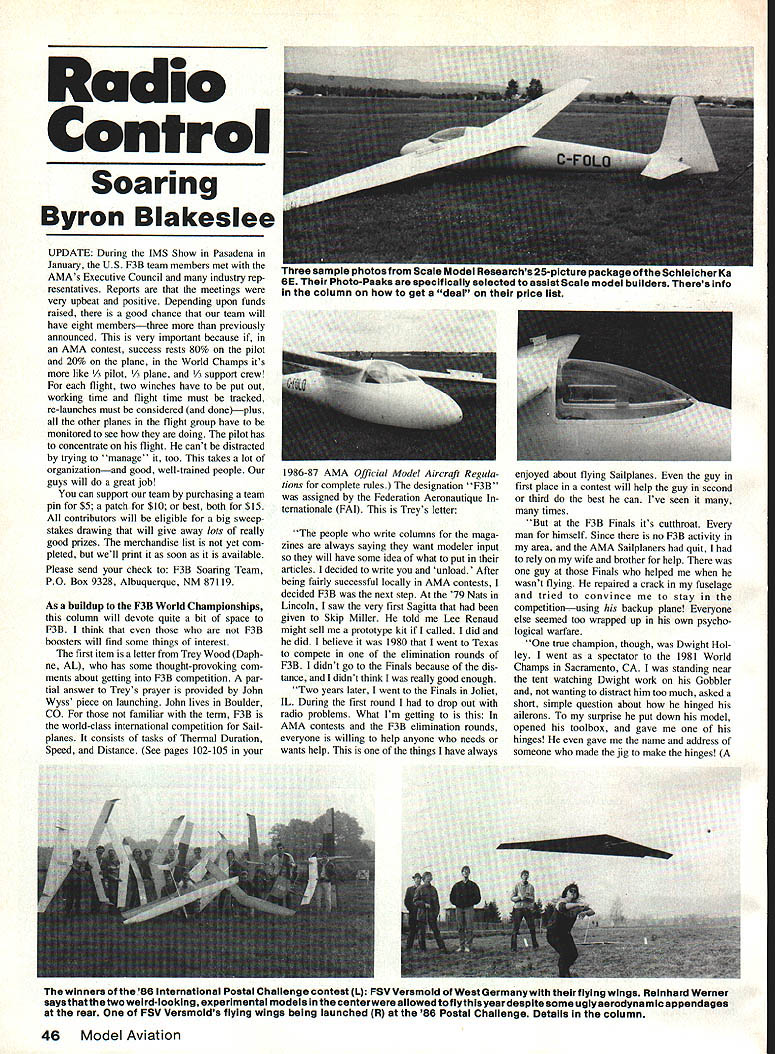
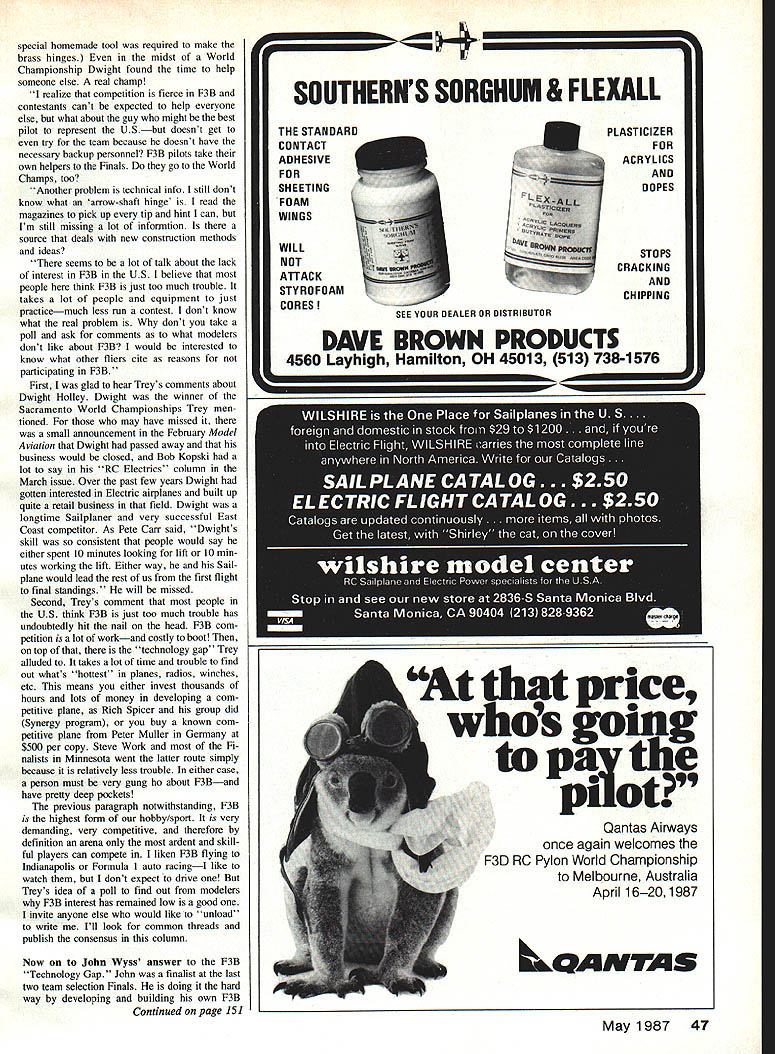
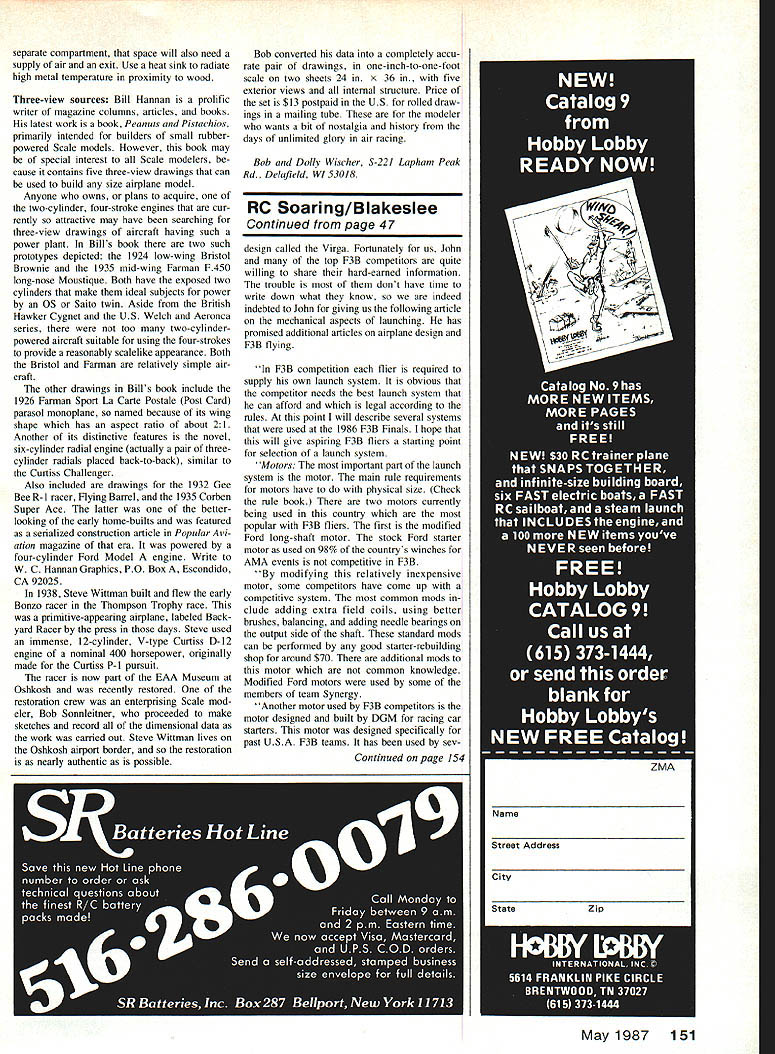
- Scale Foto-Paks (Bob Banta / Scale Model Research): Foto-Paks of 32 sailplanes and 14 powered sailplanes are available. Packs contain 8–30 full-color 3½" x 5½" photos showing models in flight and full-scale details.
- Prices: $7 to $19.
- Order information: Scale Model Research, P.O. Box 125, St. Louis, MO 63166.
- Bob also has a complete list of over 1,400 Foto-Paks available for $2 plus a long SASE. His (alternate) address is 2334 Ticonderoga, Costa Mesa, CA 92626.
- By special arrangement, if you send me a long SASE (my address is at the end of the column), I'll send you a Xerox of the page that contains the Sailplanes and Motor-Gliders only.
- Some packs include Koku-Fan three-view drawings or Xerox copies of photos from magazines.
Events
- Second International and First U.S. F3H Cross-Country Contest (Thousand Oaks Soaring Society)
- Dates: July 9–12
- Site: Taft, CA (hot weather, very good lift)
- Sanctions: FAI and AMA; F3H rules strictly followed.
- Contact: Chuck Griswold, 1646 La Jolla Drive, Thousand Oaks, CA 91360.
- Santa Maria Soaring Society Seventh Annual X-Country
- Dates: June 6–7
- Format: Single-launch event over a 25-mile triangular course in California Valley; barbecue and raffle Saturday night.
- Contact: Larry Turner, 323 Noguera Place, Arroyo Grande, CA 93420.
- Third Annual Western U.S. RC Soaring Championships
- Dates: June 13–14
- Site moved from Merwin Ranch to Modesto (more land; central lodging and dining). Modesto RC Club responsible for the event.
- Contact: Dave Darling, 2705 Harvest Road, Modesto, CA 95355-3430.
Byron Blakeslee 3134 Winnebago Dr. Sedalia, CO 80135
Transcribed from original scans by AI. Minor OCR errors may remain.

