
Radio Control: Soaring
Byron Blakeslee
F3B Team Update
How many of you were as proud of Dennis Conner and his Stars & Stripes crew in the America's Cup races as I was? As soon as the fourth race was completed the inflatable tender came alongside and passed over the American flag to fly on Stars & Stripes' transom. I admit I felt a thrill—and this was 2:00 a.m. Denver time! The America's Cup analogy is appropriate because it is commonly agreed that Conner and the Sail America syndicate not only came up with the fastest boat, but their preparation and crew work were the best. They also spent a lot of money.
You will be happy to learn that our F3B team is going after the 1987 World Championships with the same businesslike approach. I have seen copies of the team's biweekly Activity Report, and I can tell you they are covering all the bases. The team intends to go to Osnabrück as prepared and organized as Conner went to Fremantle—but on a much smaller budget.
Team budget
The team has estimated a total program cost of $28,628. The AMA is paying round‑trip airfare for three team members (team manager, assistant team manager), team entry fees, food and lodging for team officials during meet dates, and three extra nights' lodging at the contest site for practice flying (80% extra charge, if any, for transportation of model boxes). Expenses for travel, room/board, etc., for spouses or other team support personnel are to be paid by team members' contributions or supporters. Vehicle rental fees are paid by team members.
Team fund: an escrow account held at AMA Headquarters contains monies from contributions and program entry fees. The team budget breaks down roughly as follows:
- $18,940 — airfares, food and lodging for eight team members (Germany)
- $3,500 — airfares and lodging for practice sessions (California, New Mexico)
- $4,736 — pins, patches, sold uniforms, winch line, winch batteries
At first glance this may seem like a lot of money, and we can't afford to spend less and expect the team to make a better showing (as Germany did in England '83 and Australia '85). Also note that fliers don't get help with airplanes, radios or winches—they put in a very large personal investment of time and money.
Sweepstakes and fundraising
I don't believe it is official yet, but the team is hoping to have a really terrific prize in a special drawing in addition to a sweepstakes trip to Europe to watch the Championships. Details are incomplete, but it appears one special prize may be open to $15 contributors only. Tune in next month for more info.
Merchandise prizes donated so far to the sweepstakes include:
- Antronics — six Championship radios and six Antares kits
- Top Flite Models — six Antares kits and three dozen rolls of MonoKote
- Bob Martin R/C Model Products — Hobie Hawk kit
Many other prizes will be coming in. To get your name in the sweepstakes, purchase a team pin for $5; a team patch for $10; or both for $15. Please send your check to: U.S. F3B Team, P.O. Box 9328, Albuquerque, N.M. 87119.
Practice sessions
The Team has scheduled three full-blown practice sessions:
- California — March (first practice; specific dates not listed)
- Albuquerque, NM — May 23–25
- Sunnyvale, CA — June 27–28
All interested sailplaners are invited to come out to watch—and even help. For information call Phil Renaud at (505) 822-8307 for Albuquerque and Seth Dawson at (408) 739-7404 for Sunnyvale.
World Championships preview
The '87 World Champs is expected to be the largest yet. At least 29 countries should be there, and some Eastern Bloc countries will compete for the first time. East Germany and Poland are expected, with some rumors about Russia. These countries have a reputation for holding back in sporting events until they are sure they have a good chance of winning, so it will be interesting to see what actually happens.
Dan Pruss Memorial Team Awards
There will be two Dan Pruss Memorial Team Awards contested in 1987. One will be at the AMA Nats in Lincoln, NE. The other will go to the winning national team at the F3B World Championships at Osnabrück, West Germany. This award is being sponsored by Dan's family and fills a void at the World Champs: while the individual winner receives the Holuburg Trophy, the team has had no comparable award.
The Nats Team Trophy reintroduces an idea Dan used when he was CD of the Soar Nats in the early 1970s. There hasn't been a Nats Team Award for 12 years, so it will be tremendously exciting to see how clubs go about trying to win it. The Award is being endowed by a generous contribution ($2,000) from Dan's home club, the Silent Order of Aeromodelling by Radio (SOAR). Quoting from the Club's announcement:
"The Dan Pruss RC Soaring Team Award was created to honor his name by fostering the spirit of team competition at the AMA Nats—a spirit that is the enduring legacy of Dan Pruss as evidenced by the national Soaring contests he created and his guidance of our national teams in international Soaring events. Each of the three members of the winning team will receive a distinctive trophy, and their names will also be inscribed on a plaque to be kept on permanent display at AMA Headquarters."
Rules for the Nats Team Trophy
- Each team will consist of three members of the same AMA Chartered Club.
- There will be no limitation on the number of three-person teams per club.
- Each team must declare for the award by registering with the Soaring Event Director prior to the first official flight.
- Each member may fly in any or all Thermal Duration events.
- Each member's best performance in only one event will be used to determine that member's contribution to the team's total score.
- The total team score will be calculated by place (same as sailboat racing): first = 1 point, second = 2 points, third = 3 points, etc. The best team score is the lowest total.
- In the event of a tie between teams, the flight point-scores used in the calculation of their places will be used to determine the winning team.
This award is a magnificent gesture to Dan's memory by SOAR's members and should foster teamwork within AMA Chartered Clubs. The winning team could well be comprised of fliers who were "out of the money" in all classes—consistent placings across team members will often beat a single high finish plus lower placings.
Quarter-scale ASW-20L (Bill Liscomb)
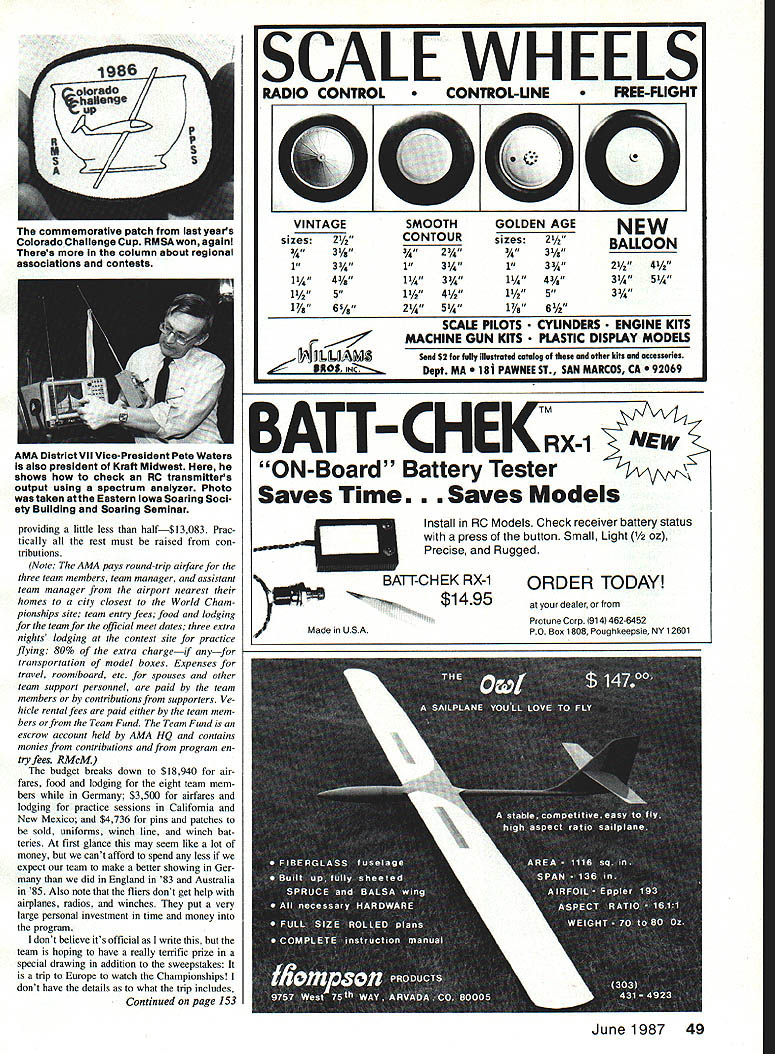
Bill Liscomb (Carlsbad, CA) sent in a photo and report of his latest quarter-scale sailplane project: an ASW-20L made by Fiber Glas Flugel Unlimited of West Germany. Bill's bird is all glass—completely prefinished and therefore expensive. Specifications:
- Span: 14 ft. 8 in.
- Weight: 12.5 lb.
- Aspect ratio: 26:1
Bill also reports that five-foot-long, 1/16-in. music wire for pushrods is available from K&S if you place a $30 order. Bill got 41 pieces for $30. K&S advertises in Model Aviation—best call them before ordering.
Eastern Iowa Soaring Society Seminar
The Eastern Iowa Soaring Society held its Third Annual Building and Soaring Seminar in February. Sixty-four sailpilots from Iowa, Illinois, Minnesota and Wisconsin attended. The outstanding lineup included:
- Pete Waters — president of Kraft Midwest and AMA District VII VP
- Paul Carlson of Off The Ground Models — winner of the '86 Nats Lee Renaud Trophy with his Sensational Prodigy
- Gunther Frank and Kevin Collins — silicone hinge techniques
- Terry Edmonds (LSF Level V) — European design and building techniques
- Jim Porter (Level V) and Ed Harris — airfoil selection and trim relating to flying visibility
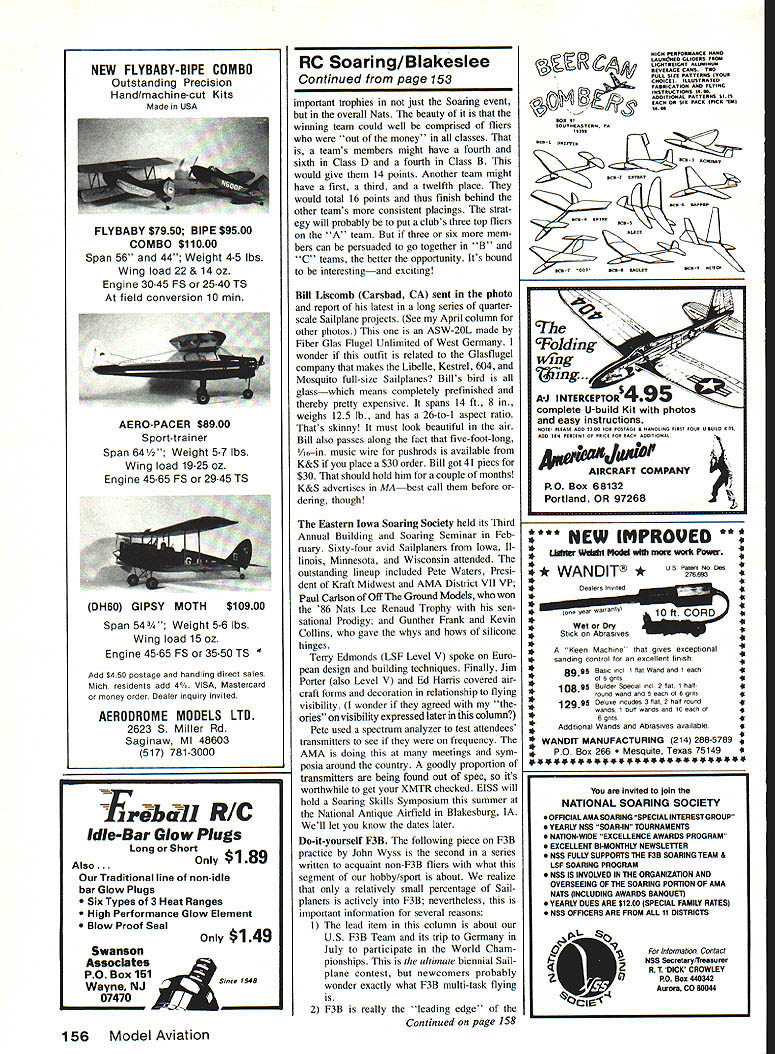
Pete used a spectrum analyzer to test attendees' transmitters to see if they were on frequency. The AMA is doing this at many meetings and symposiums around the country; a goodly representation of transmitters are being found out of spec, so it's worthwhile to get your transmitter checked. EISSS will hold a Soaring Skills Symposium this summer at the National Antique Airfield in Blakesburg, IA — dates to be announced.
Do-it-yourself F3B (John Wyss)
The following piece on F3B practice by John Wyss is the second in a series written to acquaint non-F3B fliers with this segment of our hobby/sport. Only a relatively small percentage of sailplane pilots are actively into F3B, but the information is important because F3B is where new airfoils, construction materials, radios, launching and flying techniques are developed. Flying and practice pointers that are good for F3B fliers will be applicable to all sailplane contest fliers.
What is F3B?
F3B is multi-task sailplane competition consisting of three tasks: Speed, Distance, and Duration. Objectively measuring performance is a part of F3B that makes it unique. Speed and Distance are measured by stopwatch and lap counts; Duration has a fixed limit (six minutes and a 100-point landing). In Duration, almost any contest flyer piloting any sailplane design can score maximum points. The Speed and Distance tasks can be compared worldwide—only a handful of competitors worldwide have flown faster than 20 seconds in Speed or more than 20 laps in Distance.
Measuring performance and practice
This objective measurement leads to practice: by practicing Speed and Distance you can objectively measure improvement. High-quality practice will result in improved performance. This should interest the many contest fliers who regularly fly a six-minute Duration with a 100-point landing and who may be bored.
There are two parts to F3B practice: the course and the practice routine. The accuracy of the course is essential to objective measurement. Please read the current F3B rules in your AMA rule book for the course definition. An accurate course must be used for every practice session.
Course equipment
Two pieces of equipment are necessary for a good and accurate course:
- A measured line — preferably 3/16-in. or 1/8-in. steel cable, measured and marked at 150 meters and 200 meters. The line is used to set the distance between base A and base B at exactly 150 meters. The 200-meter mark is for the winch-to-turnaround measurement. The line should be on a good spool that can be quickly wound in.
- Two sighting devices — set up at base A and base B to define two vertical, parallel planes 150 meters apart. One effective design (described by Dan Pruss, Model Aviation, June 1983) consists of:
- a 1/8-by-36-in. music-wire hoop epoxied into holes drilled in the opposite sides of a 1-1/4-in. square block of wood or Plexiglass (all sides at right angles),
- a 1/4-in. hole drilled at right angles to the plane of the hoop through the block, and a 1/4-by-6-in. brass tube inserted through the hole (one end fitted with telescoping tubing reduced to 1/8 in.) to sight through to the opposite device, assuring the planes defined by the two hoops are exactly parallel,
- a 1/4-20 threaded rod in the bottom of the block to allow attachment to a standard camera tripod.
Setting up the course
- Unreel the measured line parallel and adjacent to the winch line.
- At the 150-meter mark, set up the base B sighting device and sight back to base A using the V in the hoops.
- Then sight base A to base B. For practice, the safety-line plane is defined by the line between the two tripods. The course can be set up in less time than required to set up a winch.
Practice session routine
A practice session requires at least three people:
- one to fly,
- one to time and call turns at base A,
- one to time and call turns at base B.
Procedure:
- The base A person starts the stopwatch and starts the flier on a second stopwatch.
- The base B person tracks the working time on the stopwatch and signals turns to the flier, either by flag or walkie-talkie.
- The base A person calls all the turns to the flier.
- When the flier completes the Speed or Distance task, the base B person records the number of laps, the base A person records the time when the model lands back to base A, and the base B person records the performance and helps retrieve the model from the field.
- The flier lands and prepares for the next flight.
We usually have each flier fly five flights consecutively before rotating positions. In two hours, three fliers can fly 10 flights each. This is a vigorous pace—realistic preparation for an actual F3B contest.
The Speed and Distance tasks can be flown by any sailplane—remember that all sailplanes have a redline (maximum speed not to exceed). Improved performance will be achieved regardless of design; as skill improves, the need for better-performing sailplanes will become apparent.
The techniques of flying a world-class Speed run or a 20-lap Distance flight are complex and controversial, but through practice world-class performance can be achieved. F3B Speed and Distance flying will accurately measure the skill of the flier and the actual performance of the sailplane.
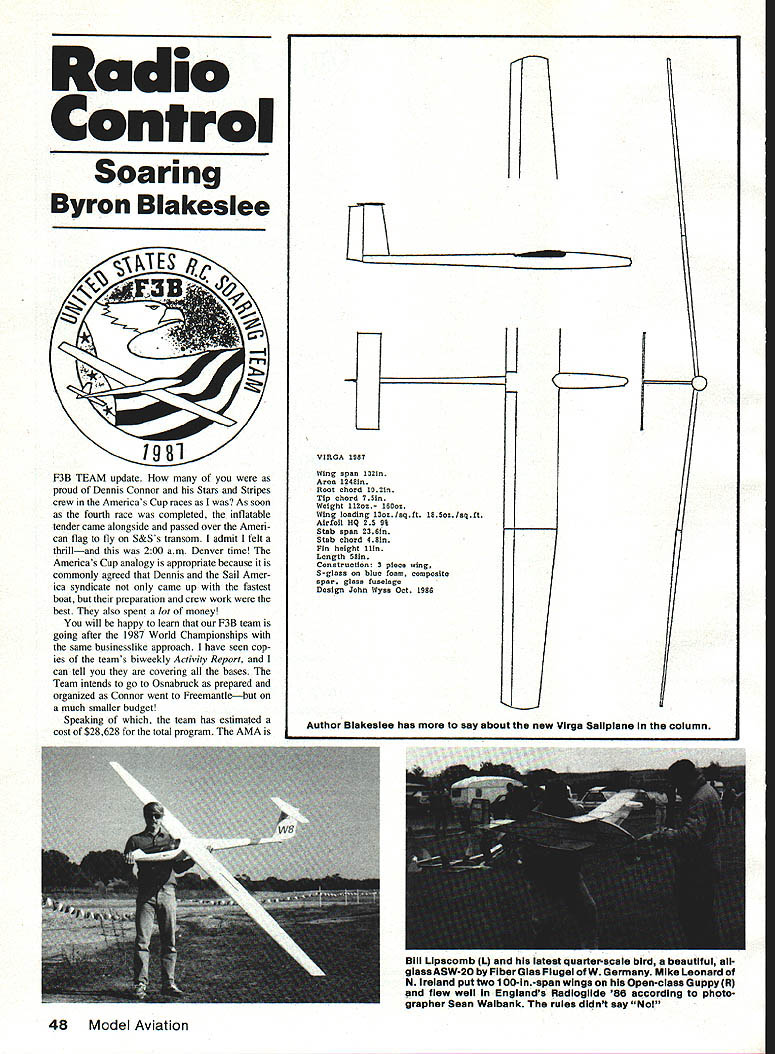
Note on John Wyss' Virga 87
To support his habit, John will be selling a very limited number of his new Virga 87 F3B ships as builders' kits or almost ready-to-fly. If anyone wants a competitive, all-glass-and-foam F3B sailplane but can't afford the $500 German jobs, contact John at (303) 494-0363.
Why eagles don't need sunglasses
The last time I went for an eye examination I asked the doctor what kind of sunglasses he would recommend to folks silly enough to gaze up in the sky all day. He said amber-colored glasses would be good because they provide more contrast with blue sky than green or grey-colored sunglasses. I tried amber-colored polarizing clip-ons over my prescription glasses and found he was right: my white-and-red plane was more visible, and the wing bottoms (red) stood out better at a greater distance.
I also heard about Suntiger—a high-tech orange-colored sunglass. The story with eagles is that they have a colored dye in their eyes that cuts out the high-energy (shorter wavelength) half of the visible spectrum (the ultraviolet and blue end). Suntigers work like those filters: they block ultraviolet through green and pass only yellow, orange and red.
Benefits:
- UV protection — UV rays can cause cataracts and other eye disorders; most sunglasses will cut out UV, but vary in overall transmission.
- Reduced chromatic aberration — blocking the blues eliminates the eye's inability to focus on blue and red simultaneously, increasing visual clarity.
- Reduced blue-light scattering — blue light is scattered more by moisture particles; removing blues yields a sharper image on smoggy or hazy days.
Practical effects for sailplaners:
- The whole world looks orange wearing Suntigers; colors are distorted (red looks bright pink, blue planes may disappear), but overall visibility is improved for many color combinations.
- Suntiger offers three degrees of orange in plain (Avian) and polarized (PST) lenses and several frame styles (Avian ~$40–$70; PST ~$50–$80). They will make single-vision prescription glasses or coat CR-39 lenses. Ask about club discounts on multiple orders.
Suntiger contact: Suntiger, 3043 Foothill Blvd., Suite 12, La Crescenta, CA 91214. Phone (818) 957-6291.
Other companies (JSA, Eddie Bauer catalog, etc.) offer similar glasses, so you may be able to find something locally.
Color and visibility tips:
- Many beginners believe multicolored wings improve visibility; at distance a plane usually appears as a monotone dot, and multicolors can break up the outline (camouflage).
- A solid light color on wing tops and a solid dark color on the bottoms works well. Transparent films can be harder to see on hazy days. White wingtips are absolutely deadly in an overcast sky.
- Red bottoms and white tops are my standard colors; avoid shades of blue if you wear Suntiger-type sunglasses.
- When flying far off, you often see wing bottoms; when the plane turns it's reassuring to see a contrasting top color to tell which way it's turning. Concentrate your eyes on the plane to avoid losing track. Vee-tailed planes can be especially confusing.
Multiplex Radios Revised
In the March column I said Beemer RC West wouldn't be importing Multiplex's top-of-the-line radio because of the price. I was wrong: Bob "Beemer" Boomer now has the Profi 2000 super-system available. If you don't flinch at a Mercedes 450 SL price, the Profi 2000 set (with four servos) at about $1,600 could be what you're looking for.
To get full details, send $4 to Beemer RC West, 7225 E. Redfield Rd., Suite 105, Scottsdale, AZ 85260 and request a copy of the complete Multiplex catalog. It shows the three radios Bob is importing plus the full line of Multiplex scale and competition sailplanes. The other radios Bob sells are:
- Royal MC — $567.50 (one servo)
- Commander — $460 (one servo)
Bob says he has not heard reports of radio interference from his customers. This is encouraging because some receivers (the "1991" receivers) have not been immune to commercial broadcasters (pagers, data transmission, etc.) operating near our channels. In Europe, tighter channel spacing has driven manufacturers to design very tight dual-conversion receivers.
Regional Soaring Associations
The idea of regional soaring associations is an excellent way to get larger groups of sailplaners together. Examples:
- Eastern Soaring League — one of the oldest associations and the origin of the NSS (National Soaring Society).
- Southern California Soaring Clubs (SC) — consists of Pasadena Soaring Society (PSS); Pacific RC Soaring Association (PSA); North Country Clouds (NCC); Harbor Soaring Society (HSS); Soaring Union of LA (SULA); and Inland Soaring Society (ISS).
- Northwest Soaring Society — about 140 members from Washington, Oregon, Idaho, and Western Canada.
If there are other regional associations I haven't mentioned, please write and I'll spread the information.
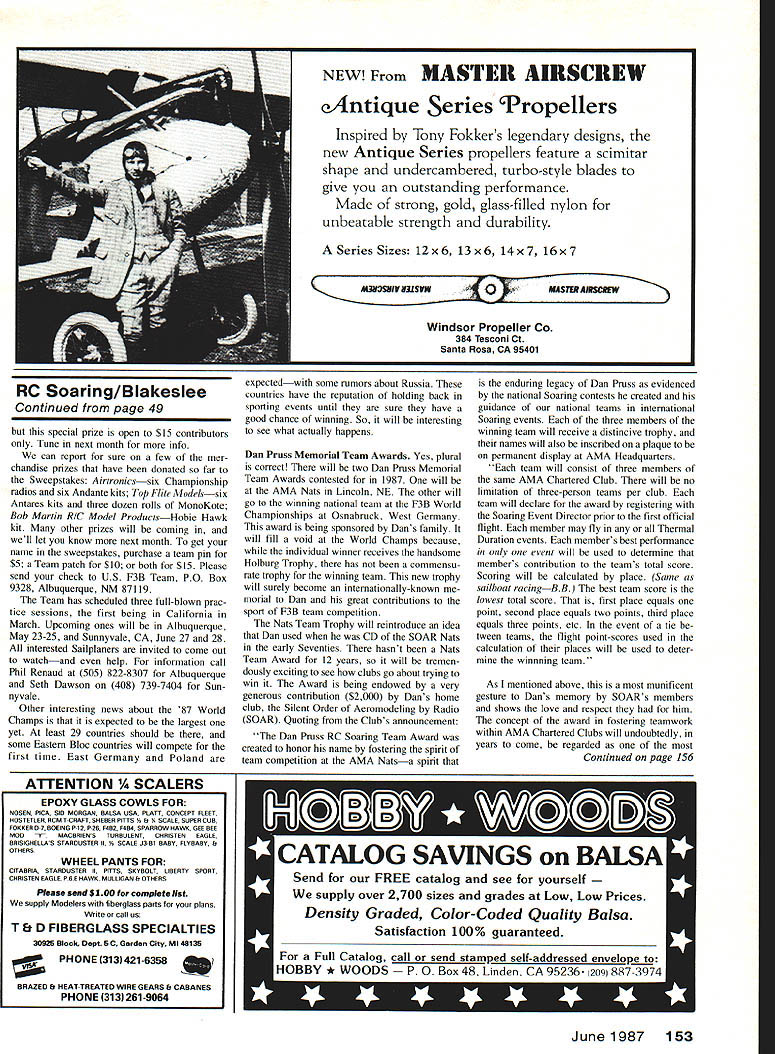
In Colorado we have only two soaring clubs (Denver–Boulder area and Colorado Springs) and our activities are closely combined. In 1985 the Pikes Peak Club president, Randy Reynolds, instituted the Colorado Challenge Cup, a western-style "shoot-out" for state bragging rights. There is no limit to the number of fliers from each club; the winning side is determined by the top five scores from each club. Challenge your neighbor club—you'll enjoy it!
Club Newsletter Exchange
Editors are encouraged to send in their name and address, and we'll see if other editors would like to begin an exchange. This month:
- Randy Reynolds, Pikes Peak Soaring Society — 122 East Unitah, Colorado Springs, CO 80903
- Vaughn Entwistle, The Greater Detroit Soaring & Hiking Society — 36098 Jeffrey Drive, Sterling Heights, MI 48310
Byron Blakeslee 3134 Winnebago Dr., Sedalia, CO 80135
Transcribed from original scans by AI. Minor OCR errors may remain.

