
Radio Control: Soaring
Byron Blakeslee
F3B Team Update
UPDATE. In mid‑July our F3B team will fly to Germany to compete in the "Big One"—the world championships at Osnabrück. It's going to be a tough competition. The Europeans, already formidable in F3B, will be on home turf. West Germany has a very strong team plus current World Champ Rolf Decker. Countries competing will include Argentina, Australia, Belgium, Canada, China, Denmark, Finland, France, East Germany, Great Britain, Hungary, Israel, Japan, the Netherlands, New Zealand, Norway, Poland, Spain, Sweden, Switzerland, U.S.A., and West Germany.
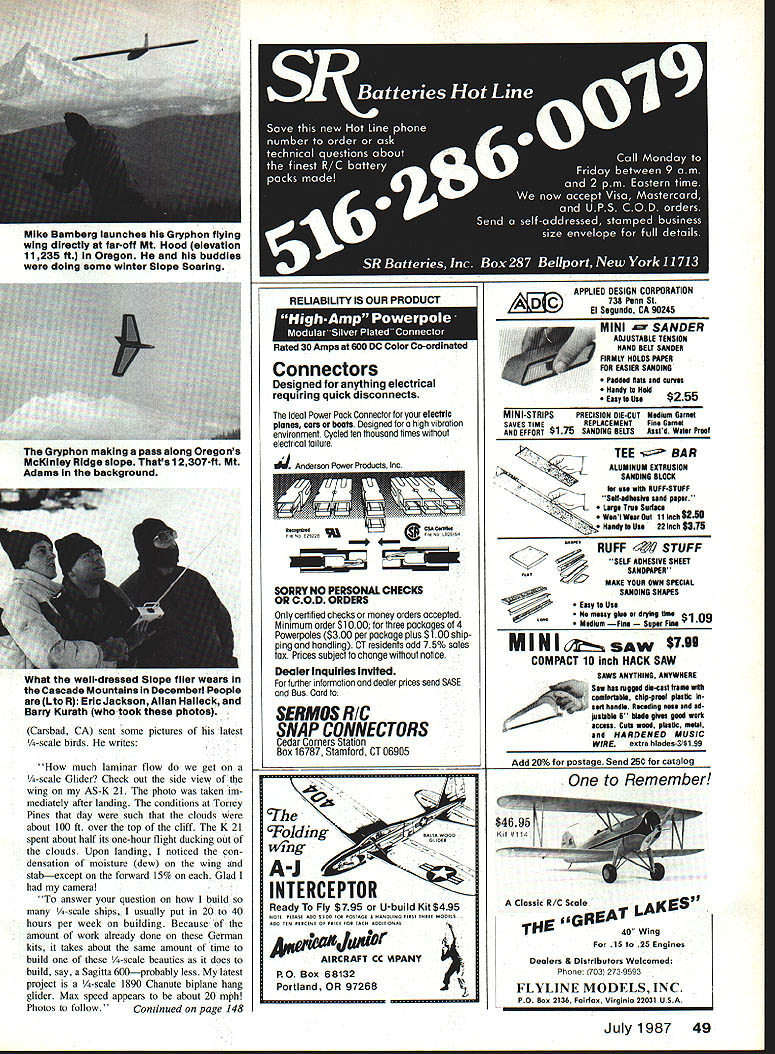
Last month we talked about our team's budget and the need to raise funds in order to have a chance of doing well—maybe winning—at Osnabrück. Time is growing short, and we still have some funds to raise. We want our guys concentrating on the contest — not worrying if there's enough funding. If you haven't sent for a team patch or pin, please write your check for:
- $15 for both patch and pin
- $10 for the patch only
- $5 for the pin only
Send donations to: U.S. F3B Soaring Team, P.O. Box 9328, Albuquerque, NM 87119.
A contribution also enters you in a sweepstakes with many merchandise prizes. The big prize (for a $15 donation) is a round‑trip airline ticket to Germany; this is contingent on airline donation negotiations. The merchandise list includes:
- Airtronics: Six Championship radios
- Top Flite: Six Antares kits and 36 rolls MonoKote
- Bob Martin: Three Bob Cat kits, 10 Talon kits, three Pussycat kits
- ACE R/C: IFF charge system
- Carl Goldberg: Six Gentle Lady kits
- Midwest: Lazybird kit
- Sky High R/C: Airborne Thermal Detector
- MAN: Three subscriptions
Team Letter Excerpt
In closing this F3B team report, the team shares part of a letter sent to Mrs. Patricia Pruss:
"My husband had only two bequests in his will—things he truly believed in. The first was SOAR, the second was the F3B team. I wish you all the best, and in Dan's name, I'll say, 'Winning may never change the world, but sportsmanship and friendship might make a difference.'"
Slope Flying — McKinley Ridge (Barry Kurath, PASS Club)
Slope sites are where you find them! Barry Kurath of Portland (PASS Club) wrote about the club's sloping last winter. It may not be typical, but it's a good example of what to expect for some great flying.
McKinley Ridge runs north‑south and is about 3,900 ft in the Gifford‑Pinchot National Forest in the Cascade Mountains. Prevailing winds are east or west, so there is almost always good lift. The air rises some 2,500 ft as it flows over the ridge in either direction. Ten of us braved a mean, snow‑covered logging road one day for some glorious flying. This summer we plan to combine a camp‑out, a pylon race, and a fun‑fly on this slope. It's only a bit over an hour from Portland and combines great flying with reasonable access.
Thanks for the information and photos, Barry — everyone looking at the pictures will feel a bit cooler!
1/4‑Scale Gliders (Bill)
(Carlsbad, CA) sent pictures of recent 1/4‑scale birds and writes:
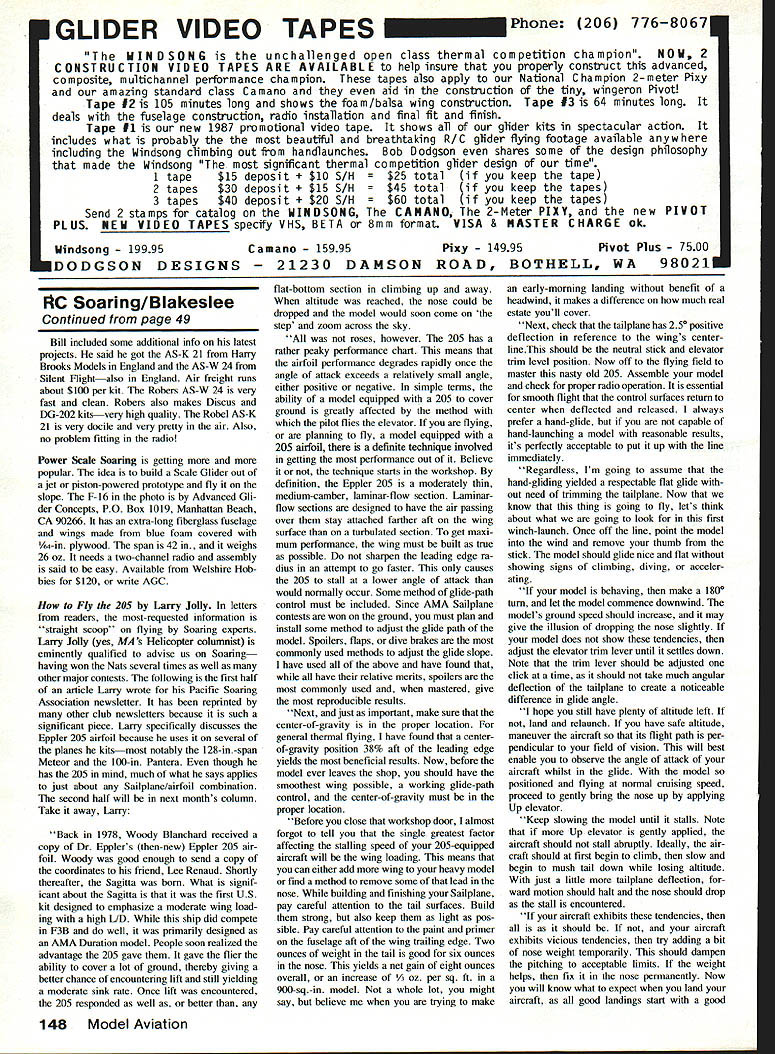
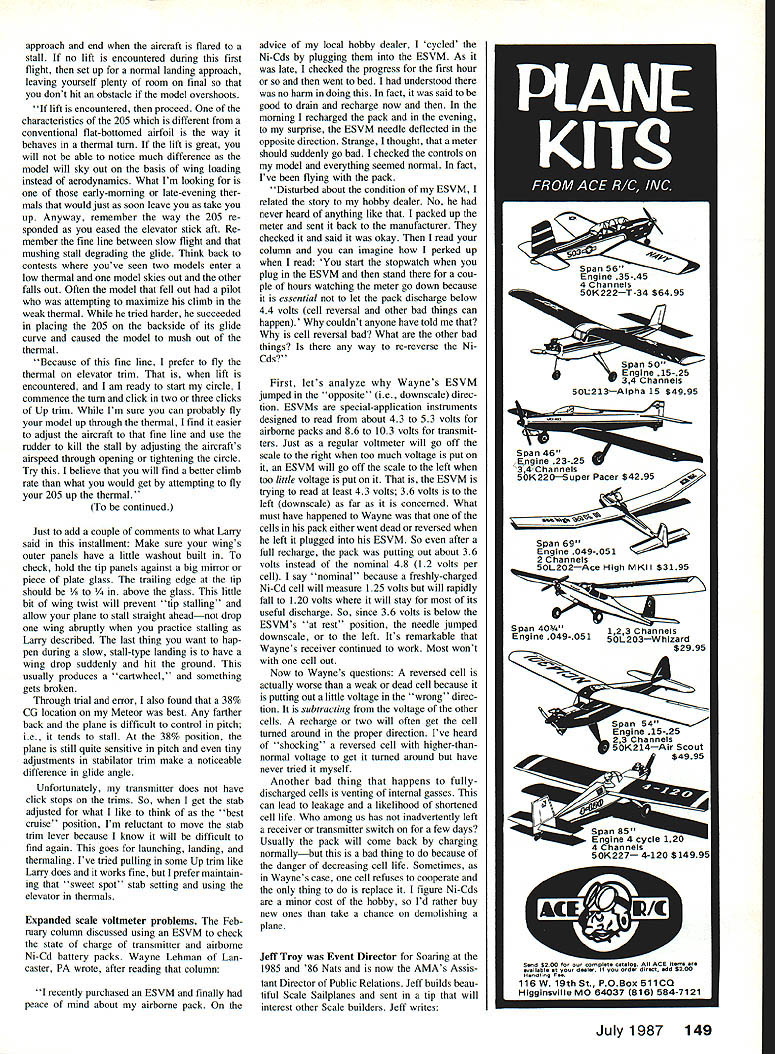
"How much laminar flow do we get on a 1/4‑scale glider? Check out the side view of the wing on my AS‑K 21. The photo was taken immediately after landing. The conditions at Torrey Pines that day were such that clouds were about 100 ft over the top of the cliff. The K‑21 spent about half its one‑hour flight ducking out of the clouds. Upon landing I noticed condensation (moisture) on the wing and stab—except on the forward 15% on each. Glad I had my camera!"
On building many 1/4‑scale ships: Bill usually spends 20 to 40 hours per week building. Because much work is already done on the German kits, it takes about the same time to build a 1/4‑scale as, say, a Sagitta 600—probably less. His latest project was a 1/4‑scale 1890 Chanute biplane hang glider (max speed about 20 mph). Photos to follow.
Bill noted suppliers: AS‑K 21 from Harry Brooks Models (England), AS‑W 24 from Silent Flight (England). Air freight runs about $100 per kit. Robers (Robel) makes high‑quality Discus and DG‑202 kits; the AS‑K 21 is docile and fits the radio easily.
Power Scale Soaring
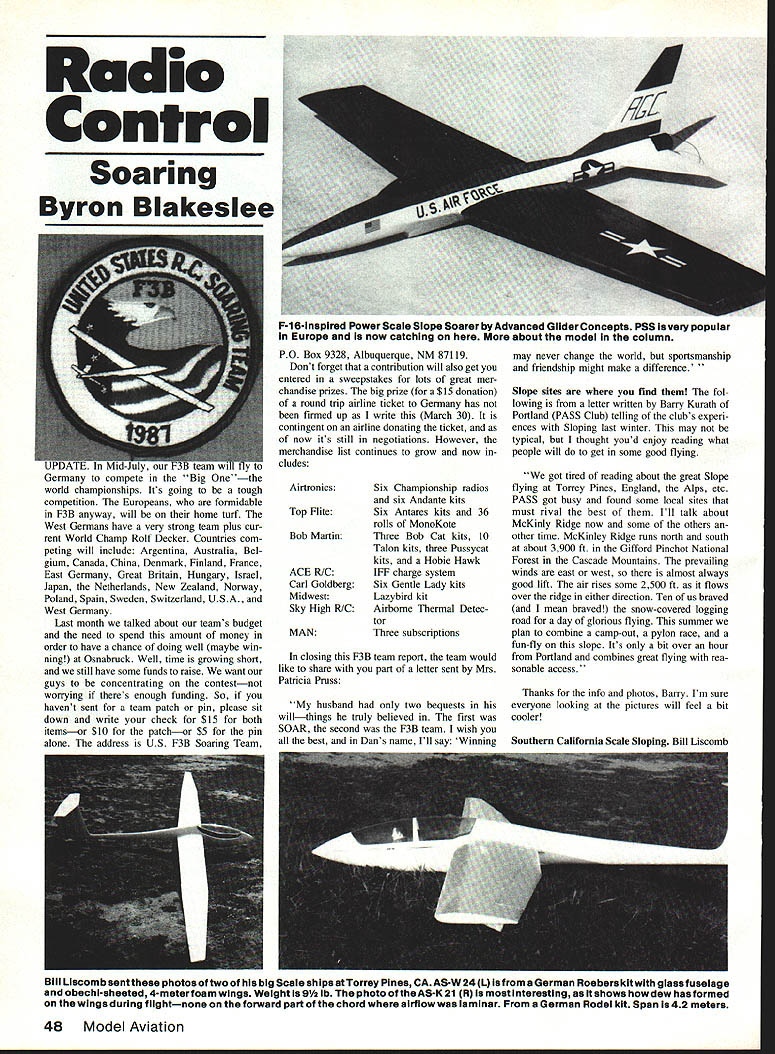
Power Scale Soaring — building scale gliders from jet or piston prototypes and flying them on the slope — is growing in popularity. Example: an F‑16 by Advanced Glider Concepts (AGC), P.O. Box 1019, Manhattan Beach, CA 90266. It has an extra‑long fiberglass fuselage and wings of blue foam covered with 1/16‑in. plywood; span 42 in., weight 26 oz. Needs a two‑channel radio. Available from Welshire Hobbies for $120, or write AGC.
How To Fly the 205 — Larry Jolly (part 1)
In reader requests, the most‑requested info is straight talk on flying the Eppler 205 airfoil. Larry Jolly (Pacific Soaring Association) is well qualified—he has flown the Nats several times and many other major contests. The following is the first half of Larry's article (the second half will appear next month). Much applies to other sailplane/airfoil combinations, though he focuses on the Eppler 205 because it is used on the 128‑in Meteor and the 100‑in Pantera.
"Back in 1978, Woody Blanchard received a copy of Dr. Eppler's then‑new Eppler 205 airfoil. Woody sent the coordinates to Lee Renaud, and shortly thereafter the Sagitta was born. The Sagitta was the first U.S. kit designed to emphasize moderate wing loading with a high L/D. While it competed in F3B and did well, it was primarily designed as an AMA Duration model. People realized the advantage the 205 gave them: the ability to cover a lot of ground (improving chances of finding lift) while still yielding a moderate sink rate. Once lift was encountered, the 205 responded as well as, or better than, any flat‑bottom section in climbing. When altitude was reached, the nose could be dropped and the model would soon come on 'the step' and zoom across the sky.
"All was not roses, however. The 205 has a rather peaky performance chart. Its performance degrades rapidly once the angle of attack exceeds a relatively small angle, positive or negative. In simple terms, a model with a 205 is greatly affected by how the pilot flies the elevator. If you fly (or plan to fly) a model with a 205, there is a definite technique involved in getting the most performance out of it. Believe it or not, the technique starts in the workshop.
"By definition, the Eppler 205 is a moderately thin, medium‑camber, laminar‑flow section. Laminar sections are designed to have air stay attached farther aft on the wing surface than on a turbulent section. To get maximum performance, the wing must be built as true as possible. Do not sharpen the leading‑edge radius to try to go faster; this only causes the 205 to stall at a lower angle of attack. Some method of glide‑path control must be included. Since AMA Sailplane contests are won on the ground, install a way to adjust the glide path: spoilers, flaps, or dive brakes are common. Larry finds spoilers most commonly used and, when mastered, give the most reproducible results.
"Next, make sure the center‑of‑gravity is in the proper location. For the general thermal flyer, a CG about 36% aft of the leading edge yields the most beneficial results. Before the model leaves the shop you should have the glide‑path control working and the CG set.
"One of the single greatest factors affecting the stall speed of your 205‑equipped aircraft is wing loading. You can either add wing area to a heavy model or remove some nose lead. While building and finishing your sailplane, keep tail surfaces strong but light. Pay attention to paint and primer aft of the wing trailing edge—two ounces in the tail can save six ounces in the nose, a net gain that matters in marginal landings.
"Check that the tailplane has about 2.5° positive incidence relative to the wing centerline; this should be the neutral stick and elevator trim position. Off to the field to master the 205. Assemble your model and check radio operation. Controls must return to center when released. Hand‑glide is preferred, but if you can't hand‑launch reliably, use a line launch.
"Assuming a decent hand‑glide, point the model into the wind and remove your thumb from the stick. The model should glide flat without climbing, diving, or accelerating. Make a 180° turn and let it go downwind. Ground speed will increase and the nose may appear to drop slightly; if not, adjust elevator trim one click at a time.
"If you still have altitude, maneuver so the flight path is perpendicular to your vision to observe angle of attack. Gently bring the nose up with elevator and slow the model until it stalls. Ideally, the aircraft should first begin to climb slightly, then slowly mush tail‑down while losing airspeed; with a little more tailplane deflection forward motion should halt and the nose should drop at the stall.
"If the nose drops sharply like a knife, the aircraft is slightly nose heavy. This can be corrected by adding a small amount of up‑thrust, by using a touch of up trim, or by shifting ballast slightly aft. With corrections made, set up a normal landing approach and flare to a stall as needed. If no lift is encountered, make a normal landing leaving plenty of room on final.
"If lift is encountered, proceed carefully. The 205 behaves differently from conventional flat‑bottom airfoils in thermals. In strong lift you may not notice the difference, but in weak thermals the 205's peaky nature matters. Remember the fine line you observed between slow flight and mushy stall. In contests you've likely seen two models enter a low thermal—one skids out and the other falls out. Often the one that fell out had a pilot attempting to maximize climb and pushed the 205 onto the backside of its glide curve, causing it to mush out.
"Because of this fine line, I prefer to fly thermals on elevator trim. When lift is encountered and I begin my circle, I click in two or three clicks of up trim and use rudder and circle size to control airspeed and avoid stalling. I find I get better climb rates than by trying to fly the 205 'up' into the thermal."
This installment ends here; the second half of Larry's article will appear next month.
Additional Tips (Editor)
- Washout: Ensure outer wing panels have a bit of washout. Hold tip against a mirror or plate glass—the trailing edge at the tip should be 1/8" to 3/16" above the glass. This wing twist prevents wing stalling and helps the plane stall straight ahead rather than dropping a wing abruptly.
- CG notes: Some pilots find different CGs work best; for example, through trial and error a 38% CG on a Meteor worked best for one builder. Too far back makes pitch control difficult; tiny stabilator adjustments noticeably affect glide angle.
- Transmitter trims: If your transmitter lacks click stops, be cautious changing trims; it's easy to lose a preferred "sweet spot" for cruise, launch, landing, and thermaling. Some prefer using elevator in thermals rather than changing stab trim.
Expanded‑Scale Voltmeter Problems
The February column discussed using an ESVM to check state of charge of transmitter and airborne Ni‑Cd packs. Wayne Lehman of Lancaster, PA, wrote about an unexpected downscale needle deflection after cycling his pack on an ESVM overnight.
Diagnosis:
- ESVMs read roughly 4.3–5.3 V for airborne packs (and 8.6–10.3 V for transmitters). If too little voltage is present (e.g., ~3.6 V), the needle goes downscale (left), just as a regular voltmeter goes offscale to the right if overloaded.
- One cell likely went dead or reversed while the pack was left on the ESVM. After recharge the pack still read about 3.6 V, so the meter jumped downscale.
- A reversed cell subtracts from the pack voltage. A recharge or two will sometimes reverse it back. "Shocking" with higher‑than‑normal voltage is sometimes reported but risky.
- Fully discharged cells can vent internal gases, leak, and have shortened life. If one cell refuses to cooperate, replace it.
Conclusion: Ni‑Cds are a minor cost; replacing suspect cells is safer than risking pack or model damage.
Scale Building Tip (Jeff Troy)
Jeff Troy (Event Director for Soaring at the 1985 and '86 Nats; AMA Assistant Director of Public Relations) sent a tip for scale builders—details omitted here; Jeff also supports the F3B team fundraising.
LSF (League of Silent Flight) Testimonial (Mike)
A reader, Mike, describes how the LSF program helped him progress:
- Level I: a couple of five‑minute flights and learning to read near a spot on the ground.
- Level II: more demanding landings and contest flying.
- The LSF program offers a series of achievable goals leading to improving flying skills, making contests less intimidating and building confidence toward higher levels (up to Level V and beyond).
To start, send name and address (plus five stamps) to: LSF, P.O. Box 647, Mundelein, IL 60060. You will receive a Level I voucher and program details.
Events: NSS Soar‑In and SOAR Scale Uprising
- The National Soaring Society's 1987 Soar‑In Contests will be held around the country between June 1 and July 26. The idea is for many clubs to hold similar contests at roughly the same time to have fun and spread the word about the NSS. Marshall Long of Texas is the Soar‑In Coordinator this year. Check the Contest Calendar for the Soar‑In closest to you.
- SOAR's Scale Uprising is coming up August 1–2 (originally July 11–12, moved to avoid near conflict with the Nats). This promises to be the biggest all‑Scale Soaring event held in the U.S. Contest Coordinator Steve Moskal provided details:
- August 1 — AMA Sport Scale for six classes (see AMA rule book).
- August 1–2 — Thermal Duration for six classes. Ships must have been flown in AMA Sport Scale. In/out of 100‑ft. diameter circle for 20 landing bonus points. Duration rounds five to 10 minutes (weather dependent) with objective of seven to eight rounds in two days. Straight scoring will be used with no points from Sport Scale.
- Electric‑motor gliders will be judged and flown the same as above. No limit to motor run or number of charges.
Contacts
- U.S. F3B Soaring Team: P.O. Box 9328, Albuquerque, NM 87119.
- LSF: P.O. Box 647, Mundelein, IL 60060.
- Byron Blakeslee: 3134 Winnebago Dr., Sedalia, CO 80135.
Transcribed from original scans by AI. Minor OCR errors may remain.

