
Radio Control: Soaring
Byron Blakeslee
An editorial comment added to my June 1987 column created some confusion about team funding. Readers might have mistakenly believed that contributions to the Team Fund could be used to defray expenses involved in a team member taking a spouse to the World Champs. Such is NOT the case.
The Team Fund is used to help defray the costs of taking additional team‑support personnel to the Champs and to help pay for rental vehicles. If a spouse accompanies a team member, all of the spouse's expenses are the responsibility of that team member. R. McM.
Club of the Month: Clarence Sailplane Society
(Submitted by club secretary Lyn Perry and newsletter editor Roman Paryz; Roman provided photos and captions.)
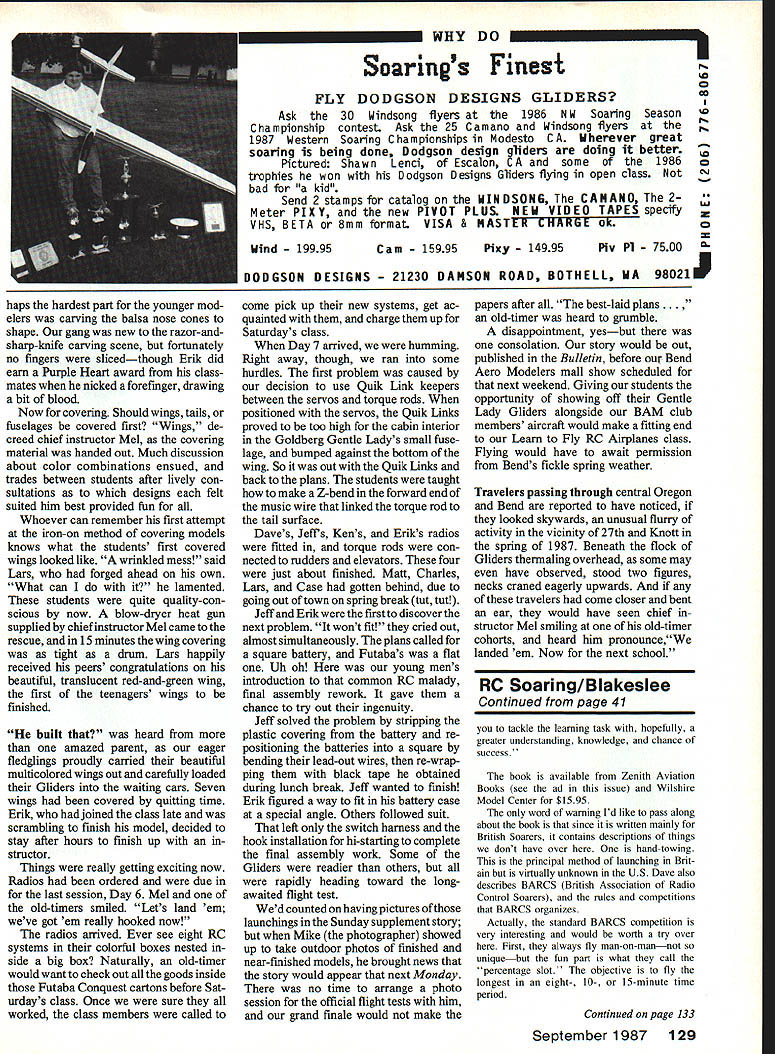
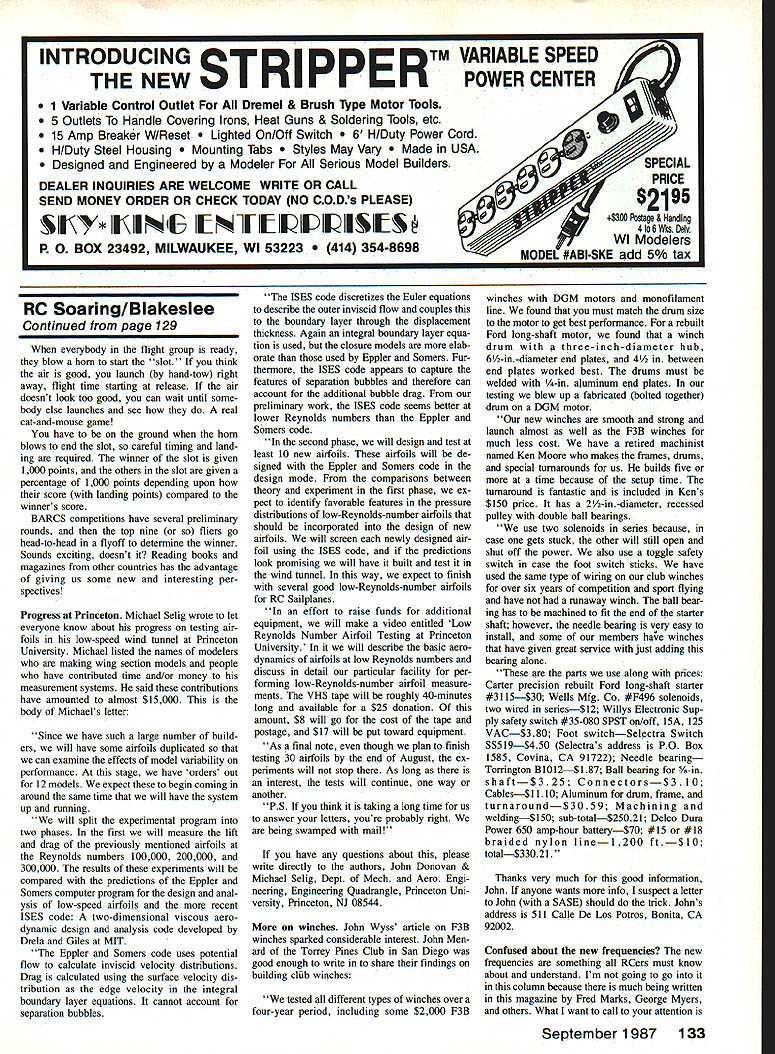
The Clarence Sailplane Society is AMA‑chartered club #1883, begun in late 1982 when founding father Ed Waters had no one to fly with him. Members are drawn from across Western New York, including Buffalo and surrounding towns; many members, including Ed, are from Clarence, N.Y., and the flying site is a series of turf farms located in Clarence—hence the name.
- Membership: 54
- Notable members: AMA 20 (former AMA President John Grigg), AMA 195 (Ron Kirk)
- Club president: Jim Sonnenmeier (completing his doctorate in aerospace engineering at SUNY Buffalo)
- Occupations represented: several aerospace company employees, many teachers
- Age range: high school students through retirees
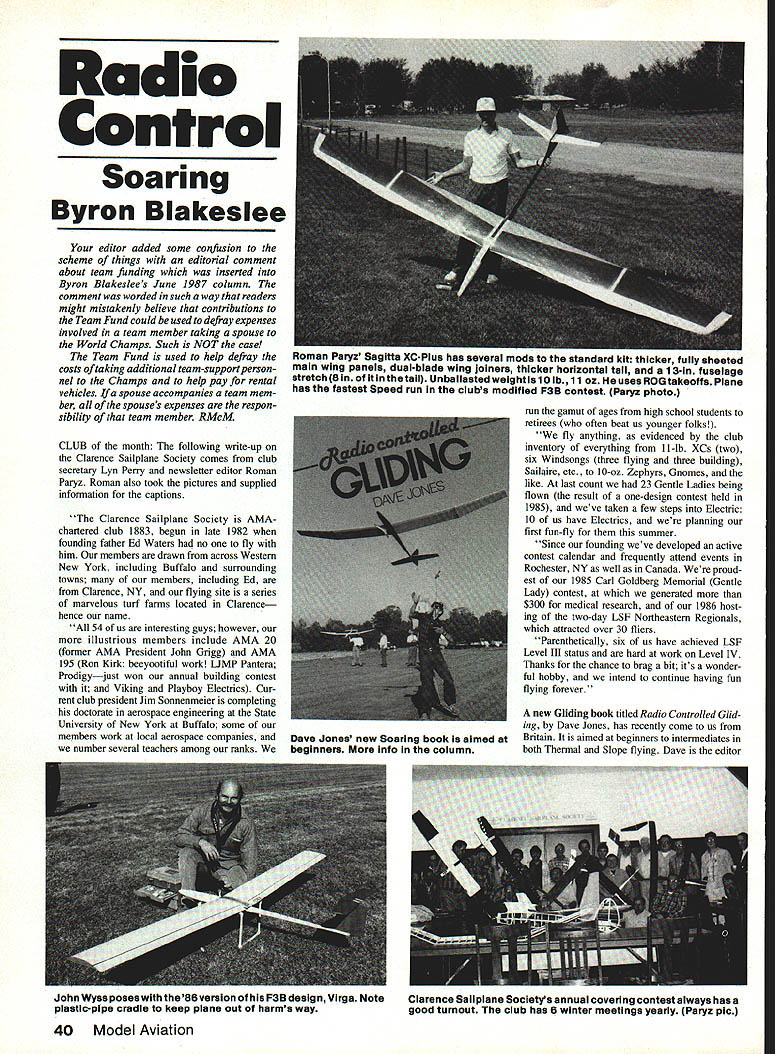
We fly a wide variety of models: from 11‑lb XCs, Windsongs (flying and building), Sailaire, and similar large models to very light Zephyrs and Gnomes. At last count we had 23 Gentle Ladies flying as the result of a one‑design contest held in 1985. We’ve also taken steps into electric flight: 10 members own electrics and we are planning our first electric fun‑fly for the summer.
Since founding, the club has developed an active contest calendar and frequently attends events in Rochester, N.Y., and Canada. Highlights include the 1985 Carl Goldberg Memorial (Gentle Lady) contest, which raised more than $300 for medical research, and hosting the two‑day LSF Northeastern Regionals in 1986, which attracted over 30 fliers. Six members have achieved LSF Level III status and are working toward Level IV.
Thanks for the chance to brag a bit — it’s a wonderful hobby, and we intend to keep having fun flying forever.
Learn-to-Fly RC Airplanes class (Bend, Oregon)
(Story adapted from club reports and class notes.)
The students faced the usual early problems: carving balsa nose cones with razor blades (Erik nicked a forefinger), deciding covering order (wings first), and choosing color schemes. Initial iron‑on covering attempts produced wrinkled wings until chief instructor Mel produced a heat gun/blow‑dryer that tightened the coverings in minutes. The first finished wings drew admiration from parents and fellow students.
Radios arrived on the penultimate session. The class unpacked several Futaba Conquest systems and prepared to install them. On final assembly Day 7 a number of practical problems arose:
- Quik Link keepers between servos and torque rods were too tall for the Gentle Lady’s small cabin and bumped the wing; students reverted to making Z‑bends in the music wire linkages per the plans.
- Futaba supplied a flat battery rather than the square battery shown on the plans. Solutions included reconfiguring battery cells and rewrapping (Jeff) and angling the battery case (Erik).
- Remaining tasks included switch harnesses and hi‑start hook installation.
Although a newspaper photo session could not be arranged for the official flight tests, the students displayed their gliders at the Bend Aero Modelers mail show the following weekend. Spring weather delayed some flying, but the class successfully launched models at a later session near 27th and Knott in Bend, with chief instructor Mel smiling and announcing, “We landed ’em. Now for the next school.”
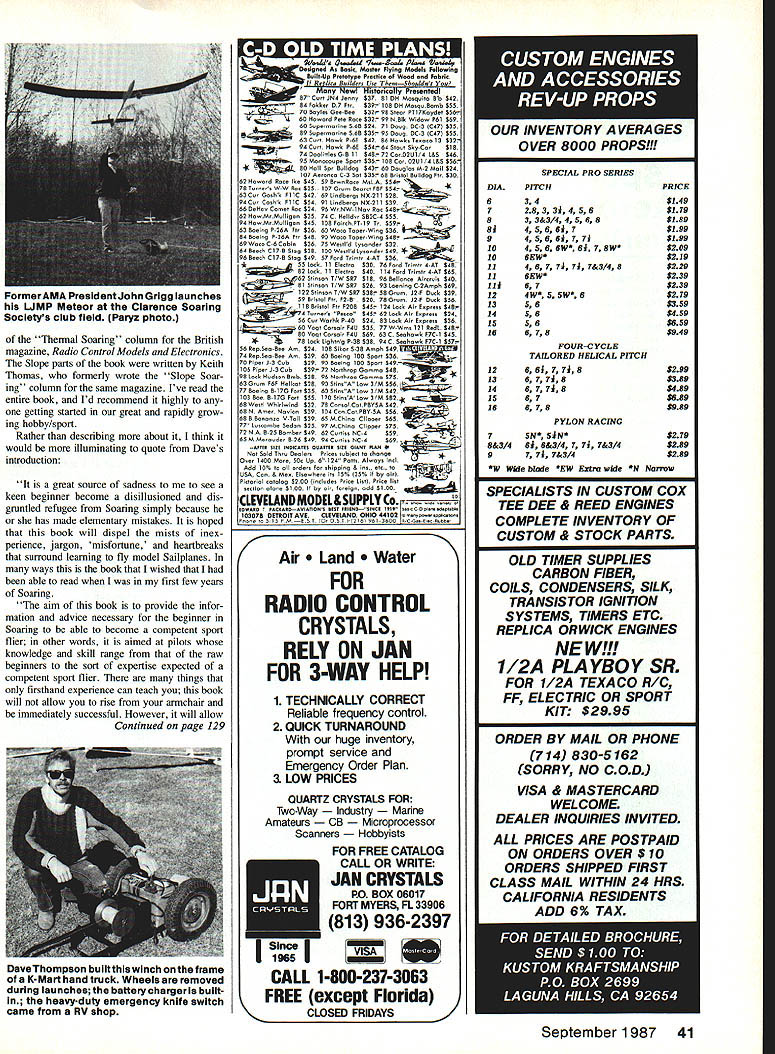
Book recommendation: Radio‑Controlled Gliding (Dave Jones)
A new gliding book from Britain, Radio‑Controlled Gliding by Dave Jones, is aimed at beginners to intermediates in both thermal and slope flying. I recommend it highly to anyone getting started. Rather than summarize it fully, here is part of Dave’s introduction (edited for clarity):
"It is a great source of sadness to see a keen beginner become disillusioned and a disgruntled refugee from soaring simply because he has made elementary mistakes. I hope this book will dispel some of the mists of inexperience, jargon and misfortune, and the heartbreaks which surround learning to fly model sailplanes. In the ways a book can, I wish I had been able to read something like this in my first few years of soaring."
The book aims to provide the information and advice necessary for a beginner to become a competent sport flier. It does not replace firsthand experience, but it helps prevent many common early mistakes.
Low‑Reynolds‑Number airfoil testing (Princeton University)
(From John Donovan & Michael Selig, Dept. of Mechanical and Aerospace Engineering, Princeton University.)
- The ISES code discretizes the Euler equations to describe the outer inviscid flow and couples this to the boundary layer through the displacement thickness. It uses an integral boundary layer equation with more elaborate closure models than the Eppler and Somers code and appears to capture separation bubbles and the associated drag, making it better at lower Reynolds numbers.
- In the second phase of their work they plan to design and test at least 10 new airfoils using Eppler and Somers in the design mode, screen designs with ISES, and wind‑tunnel test the most promising low‑drag profiles. The objective is to produce several good low‑Reynolds‑number airfoils for RC sailplanes.
- To raise funds for additional equipment they will produce a roughly 40‑minute VHS video, "Low Reynolds Number Airfoil Testing at Princeton University." It will describe the basic aerodynamics at low Reynolds numbers and the Princeton facility. The tape will be available for a $25 donation: $8 covers tape and postage and $17 goes to equipment.
- They plan to finish testing 30 airfoils by the end of August and will continue testing as long as there is interest.
If you have questions, write to: John Donovan & Michael Selig, Dept. of Mech. & Aero. Eng., Engineering Quadrangle, Princeton University, Princeton, NJ 08544.
Winches — club experience (Torrey Pines Club, San Diego)
(From John Menard.)
Over four years the Torrey Pines Club tested many winch types, including high‑end F3B winches. Their findings:
- Match drum size to the motor for best performance.
- For a rebuilt Ford long‑shaft starter motor they found an optimal drum of: 3‑in. diameter hub, 6‑1/2‑in. diameter end plates, 4‑1/2‑in. between end plates. Drums must be welded with 1/4‑in. aluminum end plates; bolted drums can fail.
- Turnarounds: a 2‑1/2‑in. diameter recessed pulley with double ball bearings; turnarounds made on a lathe.
- Use two solenoids in series (redundancy if one sticks) and a toggle safety switch in case the foot switch sticks. Needle bearings and properly machined ball bearings improve reliability.
Parts list and approximate prices (as supplied):
- Carpenter precision rebuilt Ford long‑shaft starter #3115 — $30
- Wells Mfg. Co. #F496 solenoids (two wired in series) — $12
- SPST on/off switch, 15A, 125VAC — $3.80
- Foot switch — $5.50
- Needle bearing — Torrington 80‑102 — $1.87
- Ball bearing for 3/16‑in. shaft — $3.25
- Cables — $11.10
- Aluminum for drum, frame, and turnarounds — $30.59
- Machining and welding — $150
- Subtotal — $250.21
- Delco Dura Power 650 amp‑hour battery — $70
- #15 or #18 braided nylon line, 1,200 ft — $10
- Total — $330.21
For more information write to: John Menard, 51 Calle De Los Potros, Bonita, CA 92002. Include a SASE if you want a reply.
Frequencies and equipment
The new frequencies are important for all RCers. Bob Aberle wrote a series of four articles in Flying Models (June–September) covering the history of our frequency issues and the new equipment required to fly 20 kHz apart from each other and 10 kHz from commercial broadcasters. Bob was chairman of the AMA Frequency Committee when the new frequencies were secured from the FCC; his four articles are highly recommended.
Soartech No. 6
Herb Stokely publishes the Soartech series and the Soaring column in Flying Models. Issue No. 6 (154 pages) contains mainly technical papers appealing to the more scientific sailplaner. Contents include:
- "Wind‑tunnel testing of low‑Reynolds‑number airfoils at Princeton University" — Michael Selig
- "A German/English–English/German technical dictionary for RC sailplane terminology" — Armin Saxer
- "Optimization of the System RC Sailplane" — Armin Saxer
- "Airfoil Families 12A, 14A and 15A" — Rolf Giersberger
- "Equilibrium, Stability, and the Load on your Tail" — David Fraser
- "The Friction Drag and Pressure Drag of Airfoils" — W.H. Phillips
- "A BASIC program for estimating the weight of RC sailplanes—based on Schlosser" — Max Chernoff
- "New developments in plotting airfoils with home computers and dot‑matrix printers" — Chuck Anderson
- "A Pascal program for automatic performance estimation—based on the Saxer and Simons programs in Soartech No. 2" — Ed Kamm? (possibly an attribution question)
- "Calculation of the Neutral Point and Static Margin" — Ernie Currington
Soartech No. 6 (and back issues) is available from Herb Stokely for $5 per copy. Address: Herb Stokely, 1504 Horseshoe Circle, Virginia Beach, VA 23451.
Computer programs and design software
- Chuck Anderson has upgraded his airfoil plotting program to support the Macintosh and to plot any NACA four‑ or five‑digit and quasi‑Bezier airfoil from equations (no need to enter coordinates). Upgrades: return old disk + $5 (new features), C64→C128 upgrade $10. Contact: Chuck Anderson, P.O. Box 305, Tullahoma, TN 37388; phone (615) 455‑5788.
- Eddie Dumas announced his Sailplane Design Program for IBM PC compatibles (MS‑DOS BASIC 2.0). Requires double‑density floppy drive and optional Epson printer. Includes updated sailplane data files and seven airfoil data files. Price $20. Contact: Eddie Dumas, 3220 Boomerang Lane, Knoxville, TN 37931; phone (615) 690‑3180.
F3B news and rule changes
(From Don Lowe's "President's Corner," July AMA News.)
- The 1989 F3B World Championships are expected to be held in the U.S. (probably on the East Coast). The Soaring Worlds will be one of four World Championships held simultaneously (Pattern, Pylon, Helicopter are the others).
- It is expected that in 1988 there will be a proposal to drop the Speed task from F3B. Support for dropping Speed was reported as fairly unanimous at the April Plenary.
- A West German proposal to eliminate the Weak Link rule was rejected. The majority still want a means to limit launch power. Writing enforceable winch rules that limit power without encouraging very costly equipment remains unresolved.
- The Builder of the Model rule was dropped (since many competitors fly completely finished factory models).
F3B without the Speed task:
- Designers are expected to move toward larger planes with higher aspect ratio wings to obtain higher launches and improve L/D for the Distance task’s laps in the allowed time.
- The Weak Link remains a consideration for big planes; however, weak links can be made strong enough to accommodate somewhat larger designs.
- Eliminating Speed may remove a psychological barrier for some beginners, possibly increasing participation more by perception than by practical change to flying style.
I’ve also long considered holding an international Duration‑only event (no Speed, no Distance). A Duration-only championship could use the British percentage "slot" system and might encourage the development of specialized Duration designs.
Wilshire Model Center catalog
The May 1987 sailplane catalog from Wilshire Model Center lists many imported sailplanes and suppliers. Manufacturers represented include:
- Germany: Airjet (successor to Carrera), Michael Bernardo, K&K, Modell, Elsner, Multiplex (kits, radios, accessories), Graupner, Robbe, Rodinger, KDH Modellbau
- Great Britain: Edmonds, Micro Mold
- U.S.: Mark Craft Modelers, Cheerful Models, Bob Sealy Quality Fiberglass, JM Glascraft, Aeronautics, Larry Hargraves Models, Advance Glider Concepts, Sailplanes of Santa Monica, Magnum Hobbies
Wilshire’s sailplane catalog is $2.50 (mail order). Address: Wilshire, 2836 Santa Monica Blvd., Santa Monica, CA 90404. Phone: (213) 829‑9362. An electric motors/kits catalog is also available for $2.50.
The Great Scheme of Things
Model Aviation governance
- The Federation Aeronautique Internationale (FAI), based in Paris, governs sport aviation worldwide.
- The FAI delegates U.S. supervision to the National Aeronautic Association (NAA).
- The NAA delegates model aviation matters in the U.S. to the Academy of Model Aeronautics (AMA).
- The FAI’s committee for model aviation is CIAM (Comité International d'Aéronautique Modélisme), which oversees international model competition and sets rules (e.g., F3A, F3B, F5B).
The AMA organizes Special Interest Groups (SIGs) for different disciplines (Pattern, Control Line, Pylon, Electric, Free Flight, Soaring). The National Soaring Society (NSS) is the Soaring SIG.
The National Soaring Society (NSS)
- Formed in 1974 (following the Eastern Soaring League) to provide a nationwide voice for sailplaners.
- Membership and volunteer participation remain crucial: the NSS is run by volunteers and benefits from active involvement by sailplane enthusiasts.
- The NSS can advise the AMA Contest Board, contribute to CIAM meetings and rules, run Nats Soaring events, assist the national F3B team, and develop programs and contests.
If you feel Soaring ranks above a "2" on your interest scale, consider joining and helping. Dues are modest and include the bimonthly journal Soaring. Next month I will print names and addresses of all NSS District VPs; they’ll be happy to hear from you. In the meantime, look for the NSS ad in this magazine and request an application.
Byron Blakeslee 3134 Winnebago Dr. Sedalia, CO 80135
Transcribed from original scans by AI. Minor OCR errors may remain.

