






Radio Control: Soaring
Byron Blakeslee
Apology
An apology to our F3B team. In the June column I discussed the budget for our F3B team; an editorial insertion intended to clarify the situation caused confusion. The offending sentence read: "Expenses for travel, room/board, etc. for spouses and other team support personnel are paid by the team members or by contributions from supporters."
To be clear: your contributions were applied only to the expenses of the eight team members. Spouses and other support persons (for example, Dr. David Williams, the team's media coordinator) were not counted among the eight team members; their travel expenses were their own responsibility. I regret not catching and correcting this sooner. By the time you read this the World Championships will have been over about a month; I hope the situation is now cleared up and no Sailplaners were put off by the misunderstanding.
Eastern Iowa Soaring Society
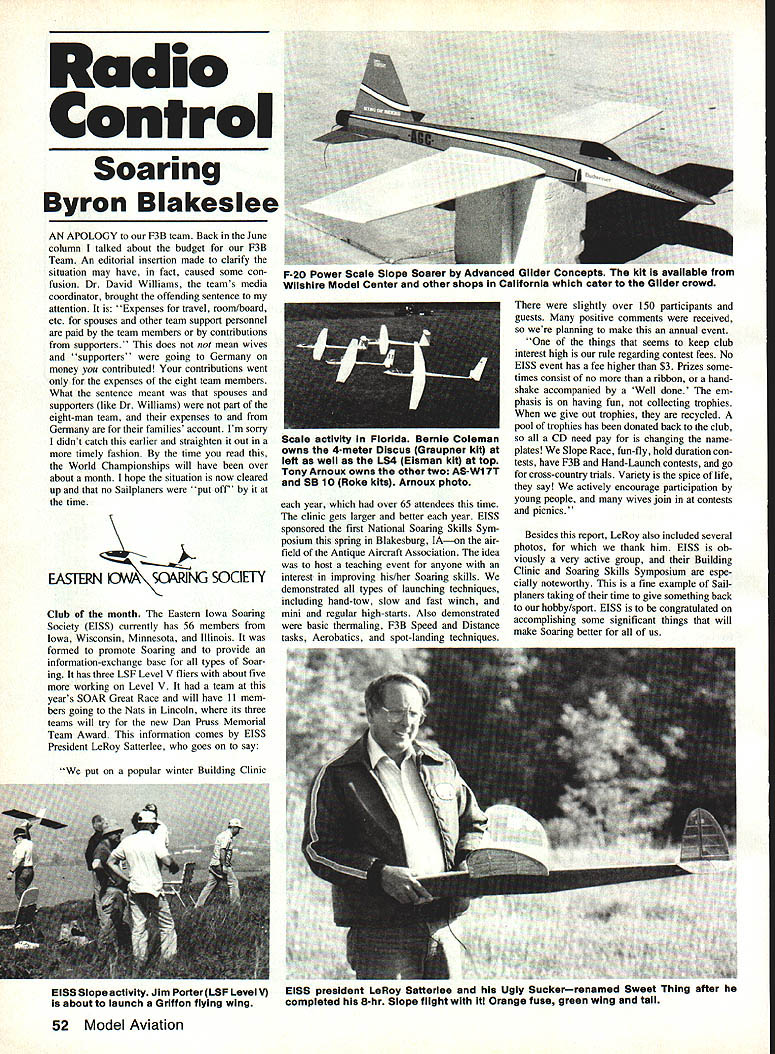
Club of the month: The Eastern Iowa Soaring Society (EISS) currently has 56 members from Iowa, Wisconsin, Minnesota and Illinois. It was formed to promote soaring and to provide an information-exchange base for all types of soaring. The club has three LSF Level V fliers with about five more working toward Level V. EISS fielded a team at this year's SOAR Great Race and will have 11 members going to the Nats in Lincoln, where its three teams will vie for the new Dan Pruss Memorial Team Award.
From EISS president LeRoy Satterlee:
- EISS runs a popular winter Building Clinic each year; this year it drew over 65 attendees and grows each season.
- EISS sponsored the first National Soaring Skills Symposium in the spring at Blakesburg, IA (the Antique Aircraft Association airfield). The Symposium demonstrated many launching techniques—hand-tow, slow and fast winch, mini and regular high-starts—plus basic thermalling, F3B Speed and Distance tasks, aerobatics, and spot-landing techniques. Slightly over 150 participants and guests attended. Positive feedback was received and the club plans to make this an annual event.
- A club rule keeps contest fees low: no EISS event has a fee higher than $3. Prizes are often small—ribbons or a handshake and a "Well done." The emphasis is on fun, not trophies. Donated trophies are recycled; the club only needs to change nameplates.
- EISS runs slope races, fun-flys, duration contests, F3B and hand-launch contests, and cross-country trials. The club actively encourages youth participation and family involvement; many wives join contests and picnics.
EISS is an active group whose Building Clinic and Soaring Skills Symposium are excellent examples of sailplaners giving back to the hobby. Congratulations to EISS for accomplishments that will benefit all of us.
Lift-Detecting Devices
It would be nice to have a gadget that pointed out where the good air is—though that might take away some of the sport's challenge. There are, however, electronic devices that tell you when your plane encounters rising air.
Thermal Mixer (High Sky)
- Made by High Sky, 3929 Kansas Street #9, San Diego, CA 92104. Contact: Rainer Weiback, (619) 297-5792.
- Small plastic case: 2.3 x 1.5 x 0.6 in.; weight about 1 oz.
- Plugs into the receiver and a rudder servo (conveniently taped to the receiver case). It deflects the rudder when the plane is rising so a rising plane will begin a turn; the direction can be set left or right.
- To avoid automatic turns during launch, the Mixer is also controlled by a proportional trim channel (e.g., the throttle channel) so you can set Off → Medium On → Full On in flight.
- Mark I operates only when the plane is rising; Mark II can be adjusted to turn the rudder when the plane is sinking less than about 3 ft/s.
- Practical notes: normal pilot input overrides the Mixer. Using the throttle channel to control the Mixer can conflict with other proportional functions (e.g., spoilers) on radios with few channels; a six- or seven-channel radio solves that.
- Author's experience: the Mixer worked on an LMP Meteor—rudder deflected when lifted and returned to neutral when released. Useful when lift is subtle or the plane is far away.
Thermic Sniffer (Ace R/C, Inc.)
- Developed by Don Clark and Walt Good; currently made by Ace R/C, Inc.
- The airborne unit contains a miniature variometer and a radio transmitter that sends an audio tone to a receiver worn by the flier (earphone).
- Operation: at level flight you hear a steady tone (~1,000 Hz). In lift the pitch rises; in sink the pitch falls. Sensitivity allows detection of vertical motion as low as a few inches per second.
- Unit size and weight: about 4.75 x 1.5 x 0.75 in.; weight ~3 oz with a 9V battery. Two transmitting antennae (28 in. long) are recommended—one down the fuselage, one in a wing tube.
- Frequencies: ten transmitter frequencies are available—five in the 49 MHz band and five newer ones in the 27 MHz band (27 MHz proved less susceptible to interference). Only one flier per frequency can operate at a time.
- Use and technique:
- Searching for lift: track laterally across the field upwind; if none, head downwind and search across the wind. Listen for tone near or slightly above rest tone, then make wide, flat turns. Short, repeated pitch increases during turns indicate a thermal—remain circling and you should see altitude increase and sustained high pitch as you core the thermal.
- Launching: use the Sniffer to detect launch apex—when the Sniffer's tone stops screaming, start the zoom/release or stop pulling and float off the line.
- Flying: the Sniffer provides early warning of lift and sink for smoother corrections.
- Trimming (Best L/D): on calm days set slight down trim, dive shallowly until the Sniffer tone is low, then mark the elevator trim when the tone returns to rest—this gives max L/D speed setting.
- Trimming (Best CL): in stable-tone air, add small amounts of up trim until porpoising begins, back off to stability and mark that as best CL for rising/unstable air.
- Hints: don't "fly the tone"—fly the plane first. Keep the tone low in volume so your eyes remain primary. The Sniffer is an aid, not a miracle.
Lift-Detecting Devices — Practical Use Summary
- Devices like the Thermal Mixer and Thermic Sniffer confirm what your eyes see and give advance warning where lift is subtle or distant.
- Use lateral tracking across the wind, listening and watching for pitch changes, then transition to wide, flat turns to center and core thermals.
- Adjust radios and controls so the device does not interfere with launch or other critical operations.
Electrostatic Stabilizers
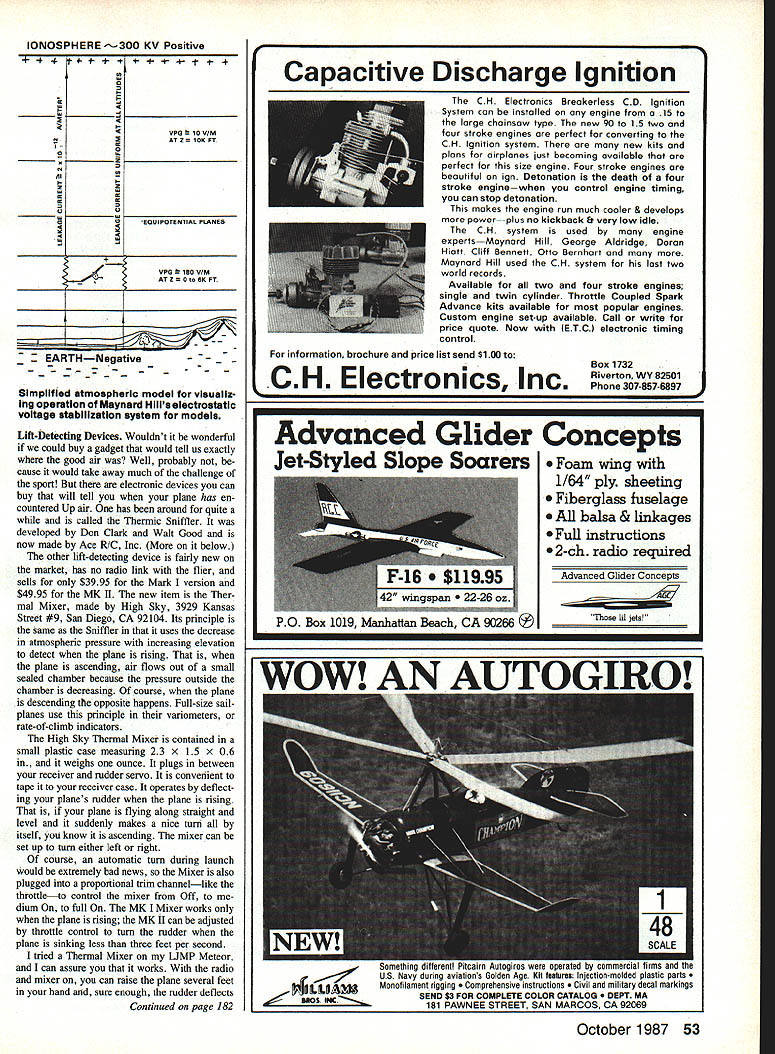
Electrostatic stabilizers (ES) act like an autopilot, attempting to keep the airplane straight and level. Interest grew after the 1985 Westover Nats when Helmut Leike flew his Two‑Meter "Heidi" with ES on both roll and pitch and achieved excellent results in windy, slope-like conditions.
Inventor and supplier
- Inventor: Maynard Hill, Silver Spring, MD. Longtime modeler and RPV researcher; first published on ES in 1972.
- Units are available from Aero Probe Technology, 2001 Novaler Road, Silver Spring, MD 20906.
- Price: $174 per stabilizer unit (choice of connectors) plus $28 for the two required ionizer units. An information packet is available for $5 (applies toward purchase if you buy a unit).
How it works
- The system senses the fair-weather DC electric field in the atmosphere (typical potential gradient near the surface: ~100–200 V/m). When an aircraft banks or pitches, the sensor detects voltage differences between wing tips or between nose and tail.
- A two-meter-span sailplane at 45° bank might see a tip-to-tip voltage difference on the order of 200 volts. When the aircraft is level the difference drops to near zero.
- Onboard electronics convert the sensed voltage differences into servo commands that automatically apply corrective controls to return the aircraft to level flight.
Warnings and limitations
- Atmospheric electric fields are not always vertical. In disturbed conditions (near thunderstorms, some snow/rain storms, blowing dust, or near industrial electrostatic precipitators) the field can be nonstandard; the ES may then command inverted flight or steep banks/dive. Units include an auxiliary control to disengage the stabilizer; when off the aircraft is under normal RC control.
- It is recommended to take a new model aloft under full RC control first, then engage the ES to fine-tune trim and gain—especially on pitch. Novices should not rely on ES for initial takeoffs; a skilled pilot should check system setup first.
Capabilities claimed by the inventor
- A wing-leveler installed on a sailplane can:
- Return the sailplane to wings-level attitude any time you release the stick (even from an inverted attitude).
- Prevent inversion or steep spiral dives; properly set, hard-over roll produces a steady bank of ~30°–45°, useful when thermalling at visibility limits.
- In windy or turbulent conditions, generate rapid correctional commands to smooth buffeting faster than a ground pilot can react.
- Note: rudder-only roll control has a fundamental aerodynamic limitation—if made fast enough to respond to gusts it may oscillate. A damper (capacitor/filter) is used in the sensor circuit to slow response. Aileron-based roll control performs markedly better (can recover wings-level from 45° bank in ~1 second vs. 3–4 seconds for rudder-only).
Ionizers and installation
- Wing-leveler: mount an ionizer at each wing tip and run a wire or copper tape to the sensor. For pitch stabilization, mount ionizers near the nose and tail; both axes can be done with three ionizers (one at each tip and one at tail).
- The Statimaster ionizers used in some units contain a polonium isotope and have a useful life of about nine months in this application. Ionizers emit harmless alpha particles that do not penetrate skin; similar ionizers are used widely in commercial antistatic brushes.
- You can bench-test sensors without ionizers installed, but ionizers are required for flight operation.
Control and adjustment
- An auxiliary proportional channel (not a simple on/off) is used to engage/disengage the stabilizer in flight and to adjust gain so smoothing can be increased without inducing oscillation.
Flight-testing the Electrostatic Stabilizer
Test flights were conducted using two models owned by Ray Marvin: a 150 in. span rudder/elevator Sailaire and an 11 ft. 8 in. span Globemaster with full-span ailerons.
- Sailaire tests: a 0.01 µF capacitor (damper) was connected across the wing-tip ionizers. After takeoff and straight flight, the stabilizer was switched on and the plane flew well. With aileron connected to rudder trim the plane maintained a straight path; when put into a turn and the stick released, autotrim returned the plane to straight flight in about 180° of turn. Rudder deflections were not obvious; response could likely be improved by increasing gain. The Sailaire's large wing and polyhedral made it slow to respond to rudder-only overcontrol, so it was not considered the best test platform.
- Globemaster tests: performed with full-span ailerons (results indicate aileron-equipped models will generally give better, quicker roll recovery than rudder-only designs).
Overall, flight reports indicate the ES can provide effective wing-leveling and gust-smoothing when properly installed, trimmed, and damped—especially on aircraft with ailerons. Novices should have an experienced pilot check setup and trim before relying on the system.
Closing
Devices such as the Thermal Mixer and Thermic Sniffer can augment visual cues to find and work lift, while electrostatic stabilizers offer active assistance to keep aircraft straight and level. Each has limitations and requires careful installation, trimming, and an understanding of what it can and cannot do. Used wisely, they can make soaring more effective and enjoyable.
Transcribed from original scans by AI. Minor OCR errors may remain.

