
Radio Control: Soaring
Byron Blakeslee
Scale Slope Soarers — Mid‑Columbia Fun‑Fly
Attention, Scale Slope Soarers. Remember when there were virtually no Scale Slope Soaring events in the U.S.? Wil Byers and the Tri‑City Soarers of Richland, Kennewick, and Pasco, WA have stepped into the breach. They will hold the 1988 National Mid‑Columbia RC Soaring Scale Fun‑Fly and Soaring Social May 27–29 (Memorial Day weekend).
This is great news. While Scale Slope contests and get‑togethers are very popular in Europe, they have been neglected in the U.S. It's a chicken/egg situation: no events—no fliers; no fliers—no events. Wil is taking the right approach by planning a fun‑fly for Scale and Power Scale fliers. As Wil's announcement says: "No judging, no rules, no hassles. Only flying, looking, swapping, talking—the best non‑contest you will ever attend." There will be raffles for merchandise. Maddie Weiss of Wilshire Model Center and Jerry Slates of Viking Models have already signed on.
For those facing a long drive to southern Washington state, the fun‑fly is a good excuse to plan a Pacific Northwest vacation. The mid‑Columbia basin is "sun‑drenched" and offers many activities besides sloping, including:
- fishing
- golf
- windsurfing
- water skiing
- camping
- backpacking
- wine tours
- river tours
- visiting historical sites
Wil has arranged special rates at the New Clover Island Inn (double, $35 per night), and the banquet will be there. Entry is $25, which includes the banquet. Get complete details by sending a SASE to: Wil Byers 632 Meadows Drive East Richland, WA 99352 Phone: (509) 627‑5224
Northern California Soaring League (NCSL)
In the June 1987 column we mentioned regional soaring associations. Ray McGowan of Napa, CA, wrote to describe the Northern California Soaring League (NCSL), which consists of seven clubs:
- Modesto Radio Control Club
- Sierra Foothills Soaring Society
- North Bay Soaring Society
- South Bay Soaring Society
- Delta Soaring Society
- Diablo Valley Soaring Society
- Silverado Soaring Society
Membership for all seven clubs totals about 255. Ray has been president of the NCSL for seven years and is also president of the Silverado Club.
The NCSL runs an annual round‑robin format of contests at each club with a standard format: three-, five-, seven-, and nine‑minute precision duration with landing bonus points. At season's end a champion is established and awards are presented to the top 10 (traditionally silver trays, with a silver wine cooler for the champion).
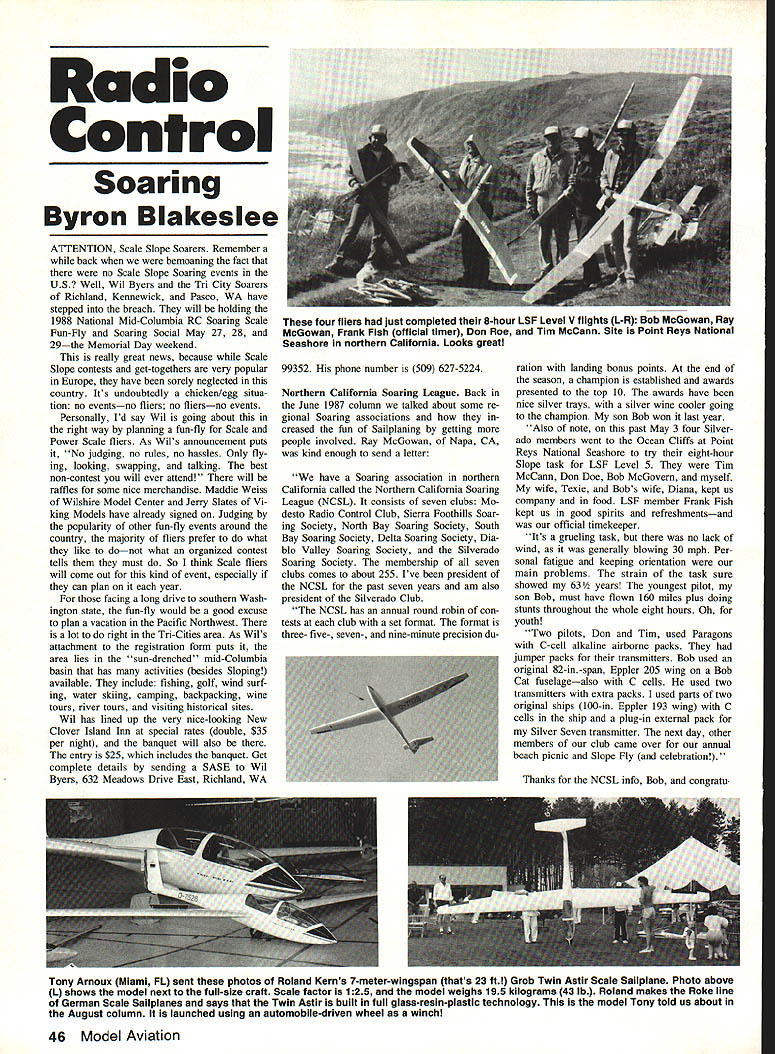
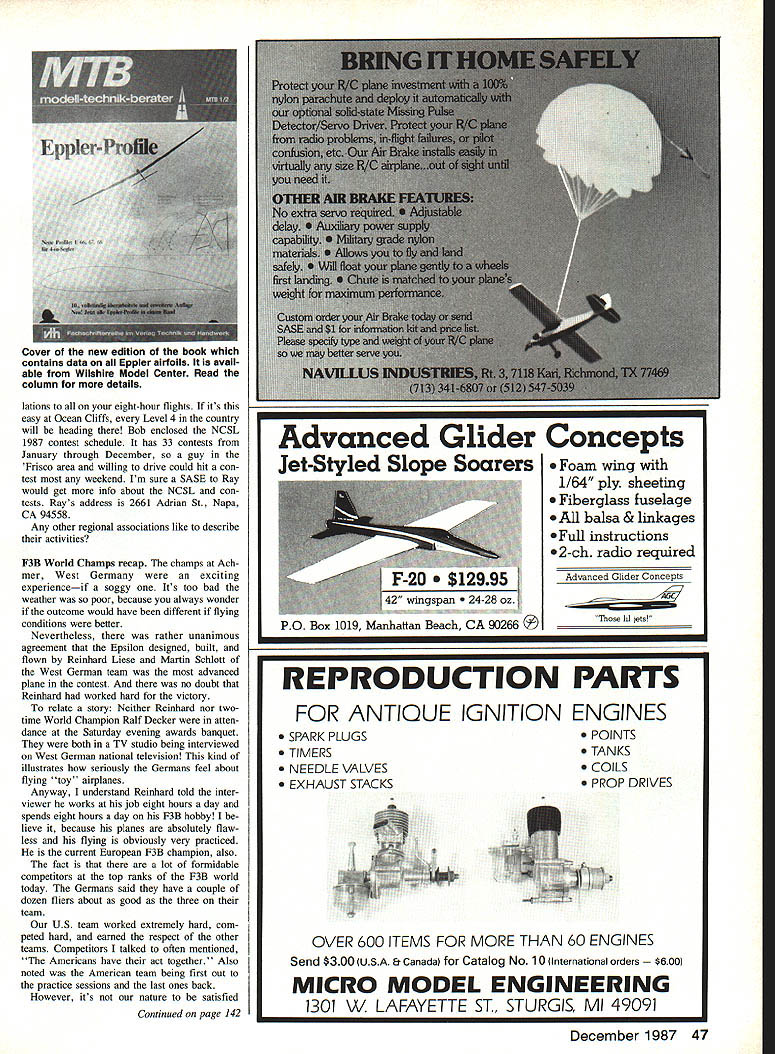
On May 3, four Silverado members attempted an eight‑hour Slope task (LSF Level 5) at Ocean Cliffs, Point Reyes National Seashore: Tim McCann, Don Roe, Bob McGovern, and Ray McGowan. Texie (Ray’s wife) and Diana (Bob’s wife) kept them company, and Frank Fish was official timekeeper. It was a grueling task with winds generally around 30 mph; fatigue and orientation were the main problems. Ray noted his son Bob flew over 160 miles and performed stunts throughout the eight hours. Equipment included Paragons with C‑cell alkaline airborne packs and jumper packs for transmitters; other pilots used Eppler‑wing ships with external packs and multiple transmitters.
The NCSL 1987 contest schedule had 33 contests from January through December, so a willing driver in the San Francisco area could find a contest most weekends. For more information, send a SASE to: Ray McGowan 2661 Adrian St. Napa, CA 94558
Any other regional associations that want to describe their activities are invited to write in.
Thanks to Ray for the NCSL info, and congratulations to all on your eight‑hour flights.
F3B World Championships — Achmer recap
The F3B World Championships at Achmer, West Germany, were exciting but soggy. Poor weather makes you wonder how results might have differed under better conditions.
There was broad agreement that the Epsilon, designed, built, and flown by Reinhard Liese and Martin Scholz (West Germany), was the most advanced plane in the contest. Reinhard worked hard for the victory—so hard that he and two‑time World Champion Ralf Decker were being interviewed on West German national television during the Saturday awards banquet. Reinhard reportedly said he works eight hours a day at his job and spends eight hours a day on his F3B hobby—his planes and flying show the dedication. He is also the current European F3B champion.
The top ranks of F3B today are formidable. The Germans said they have a couple dozen fliers about as good as the three on their team. Our U.S. team worked extremely hard, earned respect, and often were first out to practice and last back. However, it's not our nature to be satisfied with seventh place. We want to be competing for the win when the 1989 World Championships are held on our home ground. To do this we need programs to spread information on F3B designs, construction methods, winches, etc., and to encourage more "working time" events. Phil Renaud and the '87 team are committed to helping new programs if supported by clubs.
Observations from Achmer:
- Pilot skills overall were better than in prior years—top pilots were closely matched and the top 20 were very competitive.
- Airplane designs have largely settled to a common effective form influenced by Ralf Decker: about the same size and very strong to withstand slingshot launches, winches, and monofilament lines.
- A notable exception were the wings built by Hans Müller and his son Peter, featuring wood wing skins and German laminar‑flow airfoils—excellent workmanship (I’d hang one in the living room as an objet d'art).
Purchasing and import notes:
- Hans Müller’s planes can be ordered in the U.S. through Becker U.S.A., San Diego. Write to Dave Hice for a catalog at 2820 "A" Altaview Dr., San Diego. Phone: (619) 234‑1071. Hans custom‑makes planes—talk with Dave about exact setups.
- The most popular purchased plane at Achmer was the Impuls by Roving (about five flown). Jim Hoog (Netherlands) had a serious shot at the win with one. I judge strength by how much wings move during ping/zoom launches—most stayed very stiff.
- Roving (Roland Sommer) planes are imported exclusively in the U.S. by Wilshire Model Center. Maddie Weiss says the Impuls is expensive (about $1,000), so she hasn't stocked it; call her for special orders: (213) 829‑9362.
- Another notable manufactured plane was the Albatros by Fiber Glas Flugel—well regarded by knowledgeable fliers. Fiber Glas Flugel has no known U.S. importer; contact them directly at Streichweiler 21, 8218 Unterwossen, West Germany. Price in Germany was about 1,400 marks (~$780 at 1.8 marks/dollar).
John Dvorak will cover the technical aspects of the championships in an upcoming Model Aviation issue; he got good pictures at Achmer.
Balancing wings and preventing tail‑heaviness
A common fault with scale models is tail‑heaviness. A few guidelines:
- If a wing will be covered with plastic film, correct any imbalance before covering.
- For fiberglass and resin finishes, an extra coat of resin on one half—especially near the tip—can help. Resin doesn't evaporate, so added volume remains and helps balance.
- Adding coats of dope to balance a wing is frustrating because solvents evaporate over a long time; weight changes are unpredictable—similar to balancing props with evaporative coatings.
- Know the weight of balsa sheets in your workshop and use lighter materials toward the tail. It's easy to grab the first sheet in the stack, but density matters.
- At the Carl Goldberg Models plant we watched skilled workers pick up balsa pieces by one end to judge suitability. A simple weighing technique eliminates guessing and helps avoid tail‑heavy models.
The National Soaring Society — Part Two
This was intended for the September issue. Here are NSS officers and contacts:
- President: Pete Carr, 329 Little Ave., Ridgway, PA 15853
- Secretary‑Treasurer: Cliff Oliver, 8151 Broadway, San Antonio, TX 78209
- Executive VP: Gene Shelkey, 217 Euclid Ave., Scottdale, PA 15683
District VPs:
- District 1 VP: Jim Tyrie, 39 Smith Rd., Bedford, NH 03102
- District 2 VP: Ray Juschiuks, 7 Evergreen Ave., New Hyde Park, NY 11040
- District 3 VP: Pete Carr, 329 Little Ave., Ridgway, PA 15853
- District 4 VP: Woody Blanchard, 1733 Beach Rd., Hampton, VA 23664
- District 5 VP: none (volunteer needed)
- District 6 VP: Roger Stegall, 4585 Apollo Dr., Rockford, IL 61111
- District 7 VP: Al Sicadmore, 5013 Dorset Dr., Madison, WI 53711
- District 8 VP: Marshall Long, 824 Garden Meadow, Universal City, TX 78148
- District 9 VP: Mike Hickman, 6270 Rabbit Ears Cir., Colorado Springs, CO 80919
- District 10 VP: Dave Darling, 2705 Harvest Rd., Modesto, CA 95355
- District 11 VP: none (volunteer needed)
- Director at Large: Ray Marvin, 2781 S. Garfield, Denver, CO 80210
P.S. NSS members will vote for president and all even‑numbered district VPs in 1988. Districts 5 and 11 need volunteers.
Sailplaners do it their own way
It's wonderful that people can enjoy the hobby in whatever way suits them. For every high‑tech competitor there are many who fly Gentle Ladies in schoolyards or fields. Greg Aloishin wrote about his lightweight, nostalgic approach:
A number of years ago I abandoned power and took up gliders. I gave up contests and found myself bucking the tide. I like flying early morning and evening, working weak lift. I build light and use a well‑seasoned hi‑start. I've tried many undercambered airfoils—most recently the Göttingen 500. I love it! There's nostalgia building with the mindset of the old free‑fighters, but with modern knowledge and advantages.
Greg recently read George Stringwell's Radio Control Soaring and found others experimenting with offbeat light gliders. If you have information on lightweights, contact Greg at: 3792 Mosswood Drive Lafayette, CA 94549
Newsletter exchange
Soaring club newsletter editors who wish to exchange with other clubs should send their names. This month Ken Oden of the Atlanta Soaring Association seeks exchanges. Contact: Ken Oden 1325 Winding Branch Circle Dunwoody, GA 30338
Flying‑wing fans: Soartech No. 7, "The Flying Wing Special," edited by Gene Dees, includes:
- Scarab flying wing description by Gene Dees
- RC flying wing articles by Ken Bates, Noel Falconer, and Bob Thornburg
- "Performance Analysis" of the Horten IV by Zvegorafsky (Missouri State University)
- Two new airfoils for flying wings by Michael Selig
- A program for finding CG and plotting variable airfoils
- "Gliding Flight of the Dog‑Faced Bat Observed in a Wind Tunnel" by C. J. Pennycuick
- Two pieces from the Paul MacCready team: a replica pterosaur development paper and "The Gossamer Condor and Albatross" case study with detailed drawings
Soartech No. 7 is $5 postpaid (U.S. & Canada). To order No. 7 and No. 8 as they come off the press, send $10 to: Herb Stokely 1504 Horseshoe Circle Virginia Beach, VA 23451
New Eppler airfoil book
Verlag für Technik und Handwerk (West Germany) published a new soft‑cover, 138‑page modeler‑oriented edition covering all Eppler airfoils (MTB 1/2). It combines previous MTB 1 and MTB 2, adds new material and Michael Selig's wind‑tunnel research on RC sailplane airfoils. It's printed in German, but coordinates and performance curves are usable even with limited German.
Quoting from the press release translation: "This manual is now published in its 10th edition. Completely revised, it combines the previously published two volumes of Eppler profiles. All Eppler profiles are shown in several thicknesses with corresponding coordinates. Also new are the polar diagrams. Because of an expansion of Dr. Eppler's calculations, the polars all contain 'bubble warnings.' The instructions have been totally revised and brought up to latest standards. They contain many hints from theory and practice, as well as usage instructions. Also included is extensive information for drawing the profiles. New profiles designed specifically for large model gliders are included—E66, E67, and E68."
The book is available from Maddie Weiss at Wilshire Model Center for $19.95 plus postage. To contact Verlag für Technik directly: Postfach 1128, 7570 Baden‑Baden, West Germany.
More German kits — Bauer Modelle (A.M.S. Imports)
Arnold Wratschko of A.M.S. Imports sent a catalog of Bauer Modelle sailplane and power ARF kits. Bauer offers a full line, including a twin‑boom Electric with a 3.85‑meter wingspan. The catalog is in German, so some construction details are uncertain. Descriptions mention fuselages finished in aero‑glass with a gel coat and "finished" wings.
Gliders being imported (prices in U.S. dollars, subject to mark/dollar exchange rates):
- Variant 290 "Dash" — 2.9 m wingspan, ailerons — $291
- Variant 300A "Record" — 3.0 m wingspan, ailerons and trailing‑edge air brakes — $303
- Super Variant 400A "Contest" — 4.03 m wingspan, ailerons, brakes, and T‑tail — $449
- 2.8 semi‑scale model of the Akaflieg München experimental sailplane — 3.0 m wingspan — $504
- FS 25 "Semi‑Scale" (big plane for thermal and slope flying) — 4.14 m wingspan — $546
Boxes are large and cannot be shipped by UPS—truck, bus, or air freight must be arranged. To order or get a catalog ($6), write to: A.M.S. Imports 1110 S. Wells Ave. Reno, NV 89502 Phone: (702) 786‑7733 or 1‑800‑752‑7733
Byron Blakeslee 3134 Winnebago Dr. Sedalia, CO 80135
When responding to advertisers, mention you read about them in Model Aviation.
Transcribed from original scans by AI. Minor OCR errors may remain.

