

Radio Control: Soaring
Byron Blakeslee
Scale Scene — Bill Liscomb Retracts
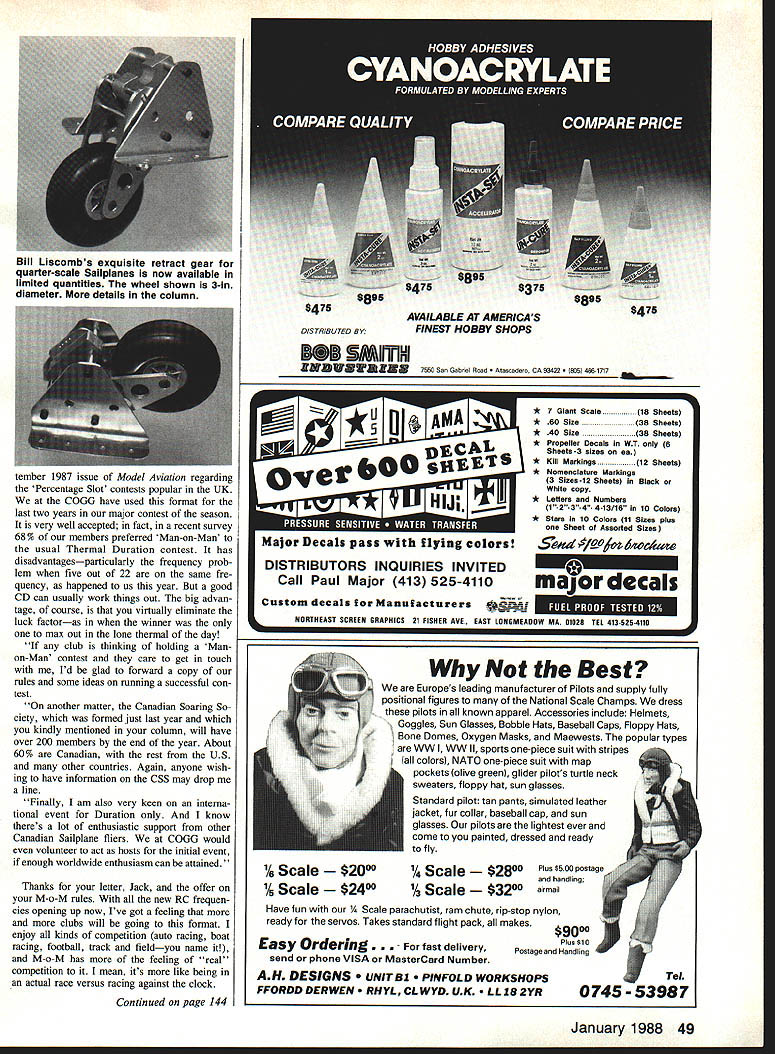
Bill Liscomb, our more-or-less Scale/Slope correspondent from Southern California, has gone into the manufacturing end of things. His quarter-scale retracts are beautifully made from aircraft-grade materials.
- The pictured wheel is 3 inches in diameter; the unit can accommodate up to 3½ inches.
- Two sizes are available:
- Standard: 3-inch-long mounting brackets, for planes up to 10 lb.; standard unit weighs 5½ oz. without the wheel.
- Heavy-Duty: 6-inch mounts, for ships over 10 lb.
- Scale builders will typically use operating retract doors; the wheel coming down pushes the doors open. Bill recommends light elastic bands for closing.
- Retracts can be operated with a Pattern-type servo — a special "retract" servo isn't necessary. The mechanism locks in both the Up and Down positions so landing loads are not transmitted to the servo.
Prices: $45 for the Standard unit, $50 for Heavy-Duty, plus about $3 postage. Available directly from Bill or from Wilshire Model Center, Los Angeles, CA. Contact Bill Liscomb at 7034 Fern Place, Carlsbad, CA 92008.
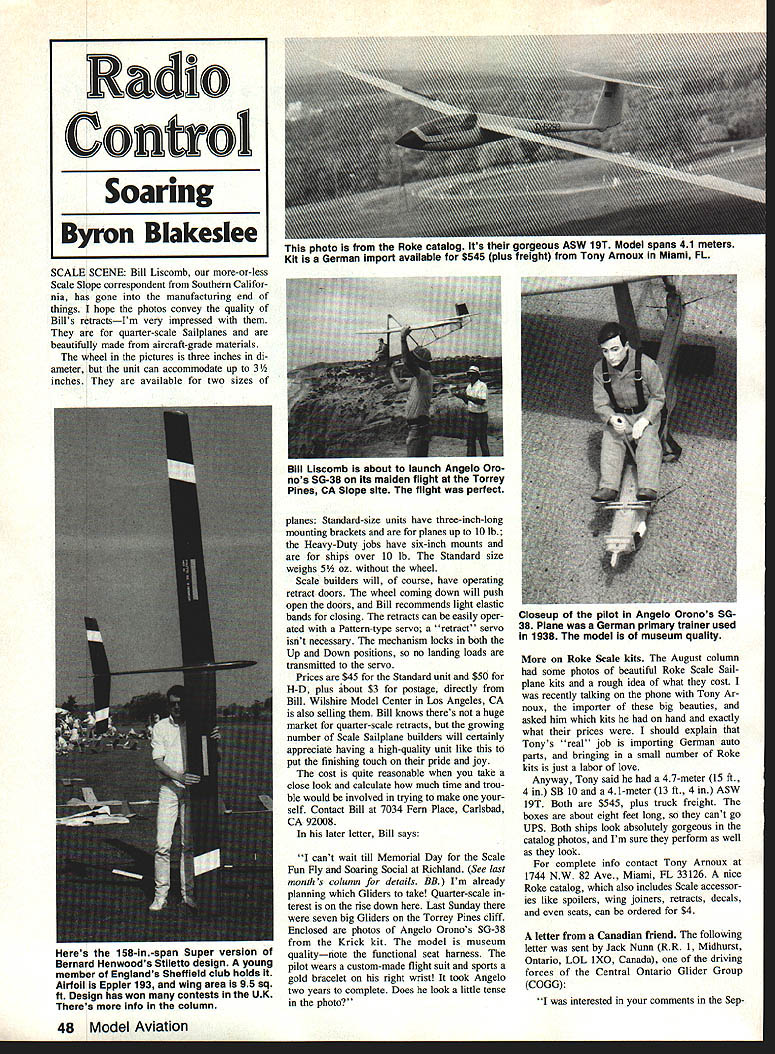
Bill also wrote: "I can't wait till the Memorial Day Scale Fun Fly and Soaring Social at Richland. Gliders take quarter-scale interest is on the rise down here. Last Sunday there were seven big gliders on the Torrey Pines cliff. Enclosed are photos of Angelo Oronos's SG-38 from the Roke kit. The model is museum quality—note the functional seat harness. The pilot wears a custom-made flight suit and sports a gold bracelet on his right wrist. It took Angelo two years to complete."
Roke Scale Kits
More on Roke scale kits: Tony Arnoux, importer, said he had on hand:
- SB 10 — 4.7 m (15 ft 4 in)
- ASW 19T — 4.1 m (13 ft 4 in)
Both are $545 plus truck freight (boxes are about eight feet long and cannot go UPS). The Roke catalog also lists scale accessories (spoilers, wing joiners, retracts, decals, seats) and can be ordered for $4. Contact Tony Arnoux, 1744 N.W. 82 Ave., Miami, FL 33126.
Percentage Slot / Man‑on‑Man Contests (COGG Letter)
A letter from Jack Nunn, R.R. 1, Midhurst, Ontario, L0L 1X0, Canada — one of the driving forces of the Central Ontario Glider Group (COGG) — reports their experience with Percentage Slot (Man‑on‑Man) contests:
- COGG used the format the last two years with very good acceptance; a recent survey showed 68% of members preferred Man‑on‑Man to the usual Thermal Duration contest.
- Disadvantages: frequency congestion can be a problem (e.g., five of 22 contestants using the same frequency). A competent Contest Director can usually resolve issues.
- Advantages: Man‑on‑Man virtually eliminates the luck factor — the winner must beat opponents directly rather than relying on finding the single thermal of the day.
COGG is considering holding a Man‑on‑Man contest and offered to provide rules and ideas for running a successful event. Jack also noted the Canadian Soaring Society (formed recently) was expected to have over 200 members (about 60% Canadian, the rest U.S. and other countries). Anyone wanting information about the CSS may contact Jack.
If any club is thinking of holding a Man‑on‑Man contest, Byron will forward a copy of the rules and advice on running a successful contest.
International Duration — Outlook and Concerns
We must thank Jack and COGG for offering to host an international Duration event. COGG has experience with FAI‑sanctioned events; their "Dash for Cash" cross‑country race was an F3H event in 1987.
Key points:
- An international Duration event is plausible, but it needs workable rules and interest from several countries.
- Care must be taken not to dilute support for F3B; F3B remains the international class for sailplane competition. International Duration should be a specialty event, serving pilots who prefer Duration over Speed and Distance tasks.
- Flight-slot lengths would likely be longer than F3B; 10–15 minute flights would be typical rather than the six-minute F3B Duration slot.
What's the Ultimate Thermal Ship?
When designing for Duration only, parameters open up. Three general categories of Duration sailplane design:
- Traditional rudder/elevator polyhedral floaters
- Large spans (e.g., Meter at 128 in.; British Open Class ships 140–190 in.)
- Soaring airfoils like Eppler 193
- Dry wing loadings ~9–12 oz/ft²
- Positive stability and good tracking; suitable for long Duration slots
- Modern straight-wing thermal ships
- Example: Bob Dodgson's 124-in. Windsong
- Camber-changing wings (flaps/ailerons) and airfoils corrected for Duration (e.g., Eppler 214)
- Handle light lift well and can cope with tight wind conditions
- Systems like "lock-out" flaps for high drag/spot landings and good lateral control
- Big‑wing approach
- Very large span, high aspect ratio, low wing loading, often laminar airfoils optimized for very low speeds
- Fragile in launch and gusty conditions but unbeatable in very light lift
There is no single "ultimate" design — conditions and pilot preferences will favor different types. An international Duration event would likely encourage a mix of these designs and classes.
F3B Influence and Launching
- Modern F3B designs are optimized for winch launches and fast Speed/Distance tasks, but their speed and efficiency allow them to cover ground quickly and climb strongly.
- Typical F3B ships: ~120 in. span, 12–14 oz/ft² loading. Sections have evolved (Quabeck, then RG-15 by Rolf Girsberger).
- If international Duration used standardized/hybrid winch lines, F3B ships would still outlaunch others but might lose some extreme zoom.
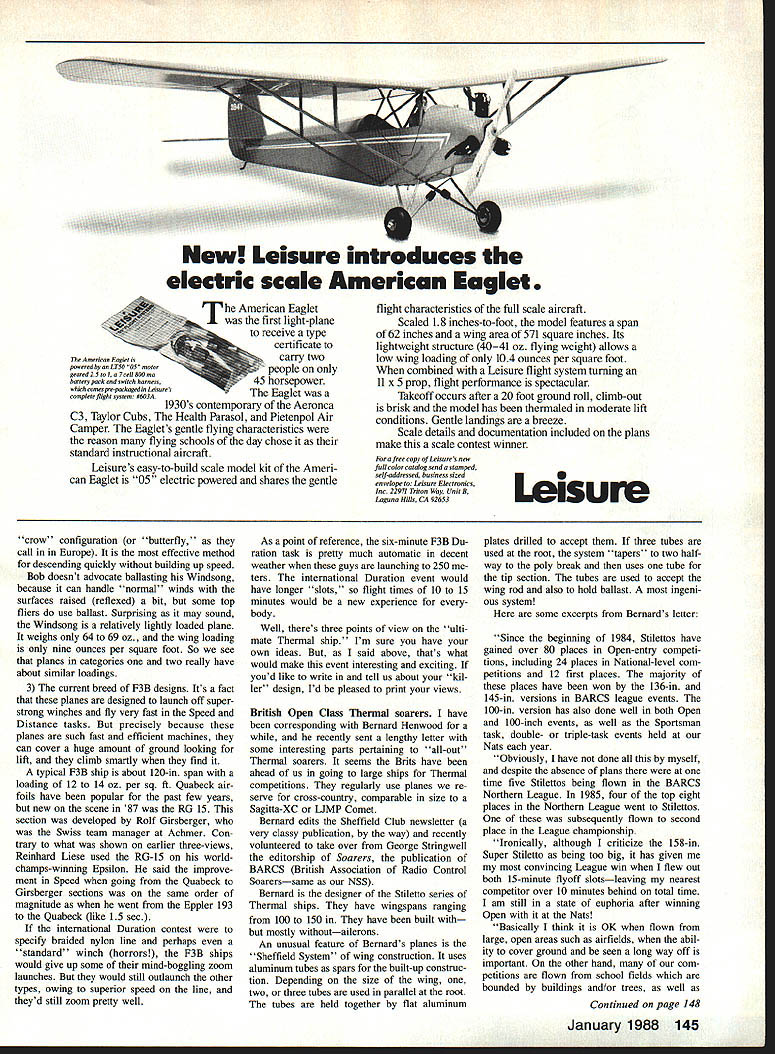
British Open Class Thermal Soarers — Bernard Henwood
Bernard Henwood (Sheffield Club) has been prominent in the UK with the Stiletto series (100–150 in. spans). Notes from Bernard:
- Stilettos gained many places in Open events since 1984; the 136-in. and 145-in. versions have been particularly successful.
- The design has been effective in BARCS league events and Nationals.
- Bernard’s "Sheffield System" wing construction uses aluminum tubes as spars: one, two, or three tubes in parallel at the root, tapering to fewer tubes outboard. The tubes accept the wing root and support spars — an ingenious, robust system.
- Bernard observes that very large planes are best flown from large, open areas; in confined fields bounded by trees/buildings, maneuverability can be a handicap.
- Rudder/elevator (R/E) models, with greater dihedral, track better and self-stabilize in light turbulence; aileron models require more pilot input but perform better where maneuverability matters.
- Bernard is cautious about flaps/flaperons increasing complexity and potentially reducing participation, but admits the technical challenge is tempting.
The Fine Art of Thermal Flying (Bob Dodgson)
Bob Dodgson's building instructions include a concise, practical piece on thermal flying. Key points and the four basic ingredients:
- Be decisive — know the most probable areas to look for lift and have the guts to go for them.
- Recognize workable lift — distinguish weak workable lift from turbulent, non-useful air.
- Have the plane and skills to work lift efficiently and move out fast when needed.
- Know when to leave a dying thermal — push the stick forward and reflex flaps to escape bad air rather than flounder.
Practical tips:
- Watch the sky and other fliers to establish lift patterns (like card counting in poker).
- Avoid searching for thermals far downwind unless you are certain; finding a thermal downwind is hard to hold because sink will blow you out of range.
- Look within a half-mile radius for signs of lift: circling birds (hawks, eagles, buzzards, seagulls), swallows darting (insect activity), columns of dust or thistledown, sudden extra lift on tow.
- Wind shifts and localized warming are indicators; dark ground cover, parking lots, dark roofs, bridges, or sun-facing slopes often generate thermals.
- Work thermals appropriately: gentle flat circles when high; very tight wing-tip circles (8–10 ft diameter) centered on a hot spot when necessary; some thermals may require slow upwind climbs on the verge of stall with fast downwind turns.
- At low altitude, small mistakes can turn a max flight into a premature landing.
(The second half of Bob's article will appear in next month's column.)
Late News from Bob Dodgson
Bob wrote about an "Automatic Flap‑Aileron Reflex Trim" system he is testing. He is converting a Pixie with Windex to a single‑set‑of‑only‑three‑servos approach and finds the system promising. The device uses an additional pushrod and moving part to achieve automatic reflex trimming. Bob included a diagram and explanation in his notes; Byron reported the controls may look complex but are logical once studied.
Shop Notes and Closing
- Bill Liscomb's retracts are solidly built; he recommends light elastic bands for closing and notes the unit locks both up and down so servos are not loaded by landings.
- Prices are reasonable given the time and trouble saved over building your own.
Anyone wishing further information about international Duration ideas, rules, or contacts may drop Byron a line — he will forward copies of rules and discuss successful formats.
Byron Blakeslee, 3134 Winnebago Dr., Sedalia, CO 80135.
Transcribed from original scans by AI. Minor OCR errors may remain.

