
Radio Control: Soaring
Byron Blakeslee
3134 N. Winnebago Dr. Sedalia, CO 80135
National Scale Fun-Fly
Wil Byers wrote to say that planning for the first Scale Sailplane Slope Fun-Fly in the U.S. is coming along nicely. The dates are May 27–29, 1988. The site is near Richland in the southeast part of the state of Washington. Additional details were in my December 1987 column.
There is a definite upswing in interest in scale sailplanes, and more and more fliers are finding that flying their big beauties on a good slope is the ultimate thrill. The Fun-Fly will be just as advertised—no competition! There will be good flying on a great site, good conversation with old and new flying buddies, and the opportunity to see many scale ships up close and in the air.
As a bonus, there will be quite a few very good raffle prizes. Circus Hobbies has donated two JR PCM radios! Other sponsors include Wilshire Model Center, Viking Models U.S.A., Beemer RC, Satellite City, and Model Builder magazine. More information on this event can be obtained by sending a SASE to Wil Byers, 632 Meadows Dr. E., Richland, WA 99352.
Wil Byers' letter (Scale gliders)
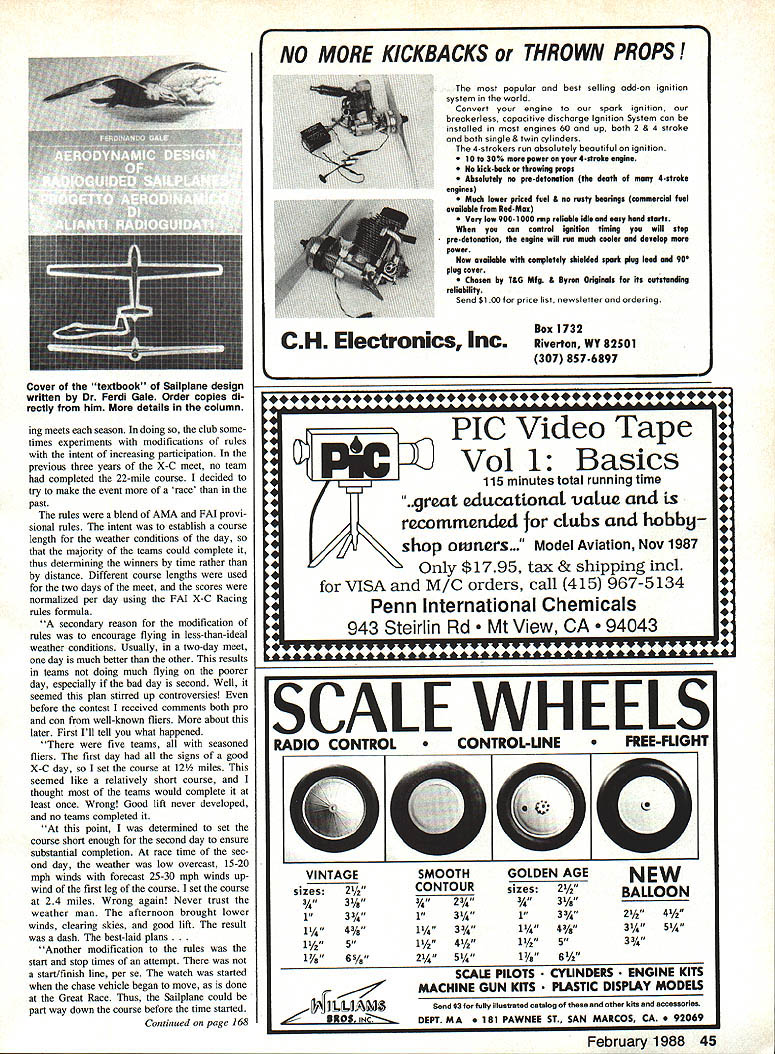
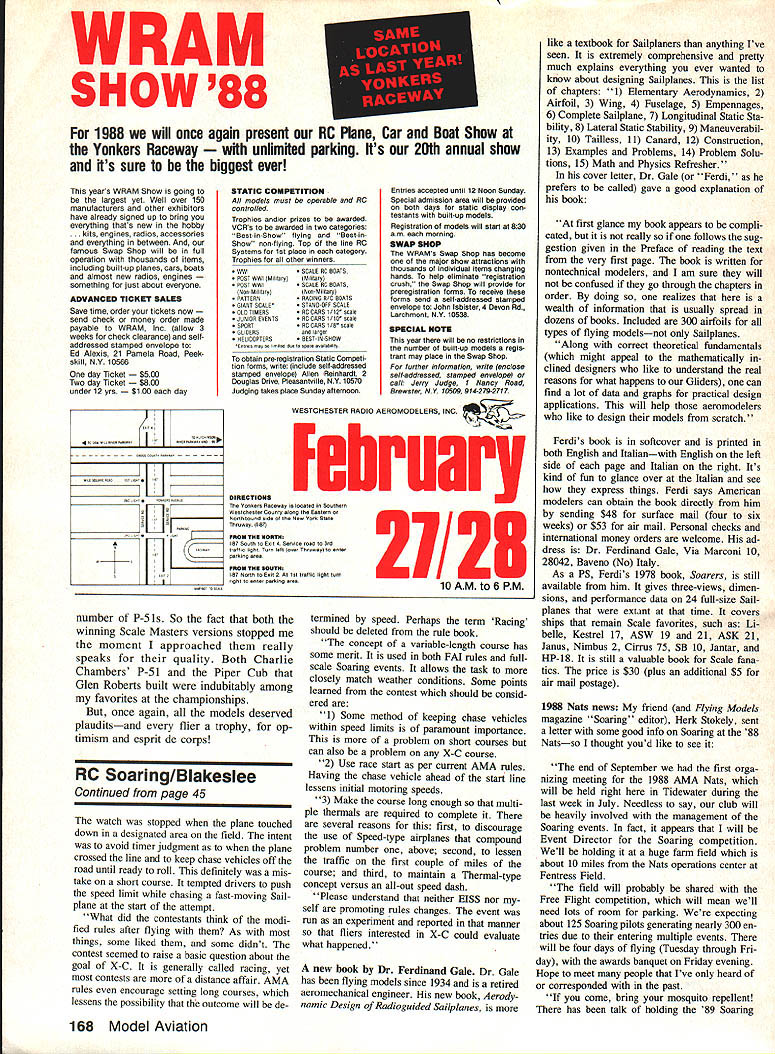
Wil enclosed pictures of scale gliders owned by Peter Bechtel, taken at Peter's home in Coeur d'Alene, ID. They were all gorgeous. All were built from semi-completed kits and appear to be readily available and easy to build. They are all 1/4-scale and are: Ka-6, Speed Astir, LS-4, and DG-300.
Peter bought all except the DG-300 from Wilshire Model Center. The DG is a Multiplex kit and came from Bob Boomer at Beemer RC West. Also, he is working on a Salto 1/4-scale from Jerry Slates of Viking Models. The fiberglass fuselage is of very high quality. Wil was so impressed that he purchased one as well. The price, in Wil's opinion, is quite good at $97 for a fuselage, canopy, canopy frame, plans, and shipping. Additionally, Peter is planning on buying a Hans Muller ASW 22 which sports a 21-ft span.
1988 Canadian Nats
Jack Nunn of the Central Ontario Glider Group (COGG) wrote to say that the Canadian Nats will be held at Brantford, near Hamilton, Ontario—about 70 miles straight west of Niagara Falls. The dates are August 6–8. Jack will be the CD and promises that it will be the biggest and best soaring contest ever held in Canada. Note that the dates are the weekend following the AMA Nats (July 23–31), so an avid sailplaner could take a couple of weeks' vacation and hit two Nats in one trip! A SASE to Jack Nunn, RR 1, Midhurst, Ontario L0L 1X0, Canada will get you all the information.
Top man at the 1987 Canadian Nats
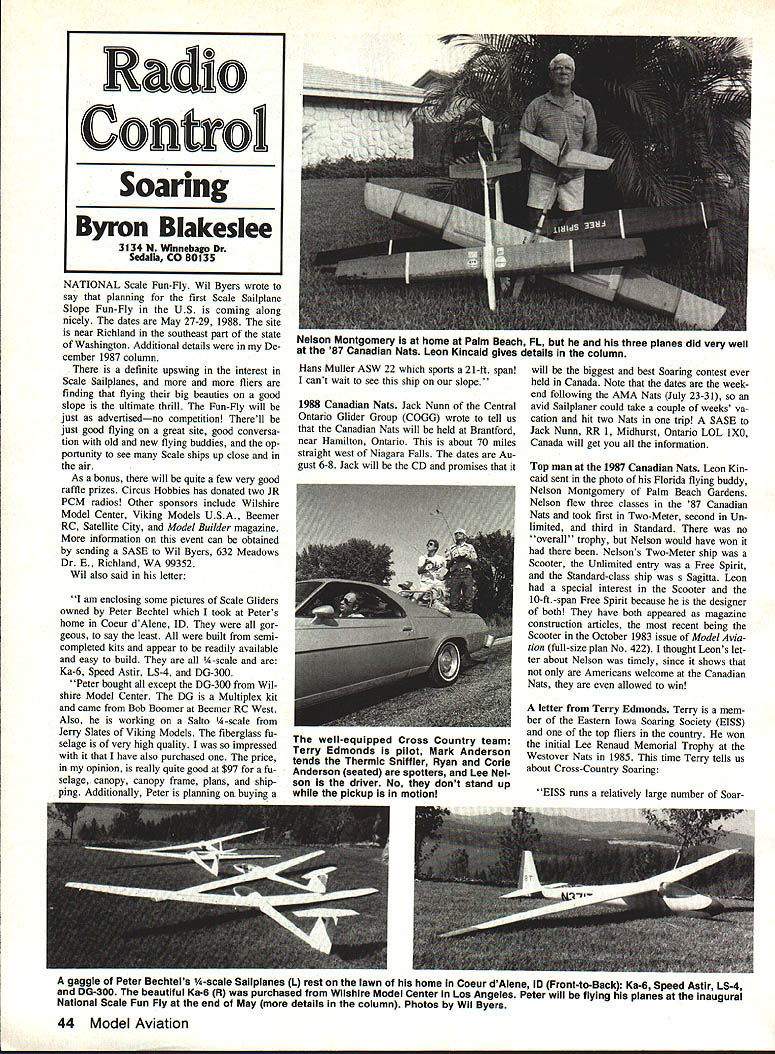
Leon Kincaid sent in a photo of his Florida flying buddy, Nelson Montgomery, of Palm Beach Gardens. Nelson flew three classes in the '87 Canadian Nats and took first in Two-Meter, second in Unlimited, and third in Standard. There was no "overall" trophy, but Nelson would have won it had there been one. Nelson's Two-Meter ship was a Scooter, the Unlimited entry was a Free Spirit, and the Standard-class ship was a Sagitta.
Leon has a special interest in the Scooter and the 10-ft span Free Spirit because of the designer of both. They have both appeared as magazine construction articles, the most recent being the Scooter in the October 1983 issue of Model Aviation (full-size plan No. 422). This letter shows that not only are Americans welcome at the Canadian Nats, they are even allowed to win!
A letter from Terry Edmonds — Cross-Country Soaring
Terry Edmonds is a member of the Eastern Iowa Soaring Society (EISS) and one of the top fliers in the country. He won the initial Lee Renaud Memorial Trophy at the Westover Nats in 1985. This time Terry reports on Cross-Country (X-C) soaring and an experimental format EISS ran to increase participation.
EISS runs a relatively large number of soaring meets during the season, sometimes experimenting with modifications to the rules to increase participation. In the previous three years' X-C meet no team completed the 22-mile course, so they decided to try to make the event a race. Past rules blended AMA and FAI provisional rules; the intent was to establish a course length and weather conditions on the day that the majority of teams could complete, determining winners by time rather than distance. Different course lengths were used during the two days of the meet; scores were normalized per day using the F.M. X-C Racing rules formula. The secondary reason was to encourage flying in less-than-ideal weather conditions. Usually, in a two-day meet, one day is much better than the other. This results in teams not doing much flying on the poorer day, especially if the bad day is second.
The plan stirred up controversies. Even before the contest Terry received comments both pro and con from well-known fliers. Five seasoned teams entered. The first day had signs of a good X-C day, so Terry set the course at 12.5 miles. Good lift never developed, and no teams completed it.
Determined to set the course short enough for the second day, Terry set the course at 2.4 miles. Wrong again—never trust the weatherman. The afternoon brought lower winds, clearing skies, and good lift. The result was a dash.
Another modification to the rules was the start and stop times of an attempt. There was not a start/finish line per se. The watch was started when the chase vehicle began to move, as is done at the Great Race. Thus, the sailplane could be part way down the course before the time started.
The second change concerned a team-member substitution after an attempt. This is not allowed in AMA or FAI X-C rules. They allowed the substitution so the pilot could be changed between legs to give more people a chance to fly and to make the event more of a team event. As it turned out, no substitutions were made. The third change was to permit unlimited landings and relaunches inside the course; this eliminated the unsportsmanlike tactic of landing immediately after a climb and restarting later to gain time. They also allowed relaunches after an outlanding; the time continued during the recovery.
Scoring was by elapsed time with penalties, as in FAI rules. In addition, points were awarded for spot landings and for a restricted-altitude landing at the finish.
The meet was exciting and provided a lot of useful data on rules modifications. The changes encouraged more flying on both days and made the event more of a team effort. EISS plans to continue refining the rules to increase participation and to make X-C racing fairer and more fun for everyone.
The watch was stopped when the plane touched down in a designated area on the field. The intent was to avoid timer judgment as to when the plane crossed the line and to keep chase vehicles off the road until ready to roll. This was a mistake on a short course: it tempted drivers to push the speed limit while chasing a fast-moving sailplane at the start of the attempt.
What did the contestants think of the modified rules after flying with them? As with most things, some liked them and some didn't. The contest seemed to raise a basic question about the spirit of X-C. It is generally called racing, yet most contests are more of a distance affair. AMA rules even encourage setting long courses, which lessens the possibility that the outcome will be determined by speed. Perhaps the term "racing" should be deleted from the rule book.
The concept of a variable-length course has some merit. It is used in both FAI rules and full-scale soaring events. It allows the task to more closely match weather conditions. Some points learned from the contest which should be considered are:
- Some method of keeping chase vehicles within speed limits is of paramount importance. This is more of a problem on short courses but can also be a problem on any X-C course.
- Use race start as per current AMA rules. Having the chase vehicle ahead of the start line eliminates initial motoring speeds.
- Make the course long enough so that thermals are required to complete it. There are several reasons for this: first, to discourage the use of speed-type airplanes that compound problem number one above; second, to lessen traffic on the first couple of miles of the course; and third, to maintain a thermal-type course versus an all-out speed dash.
Please understand that neither EISS nor Terry Edmonds are promoting permanent rules changes. The event was run as an experiment and reported so fliers interested in X-C could evaluate what happened.
A new book by Dr. Ferdinando (Ferdinand) Gale
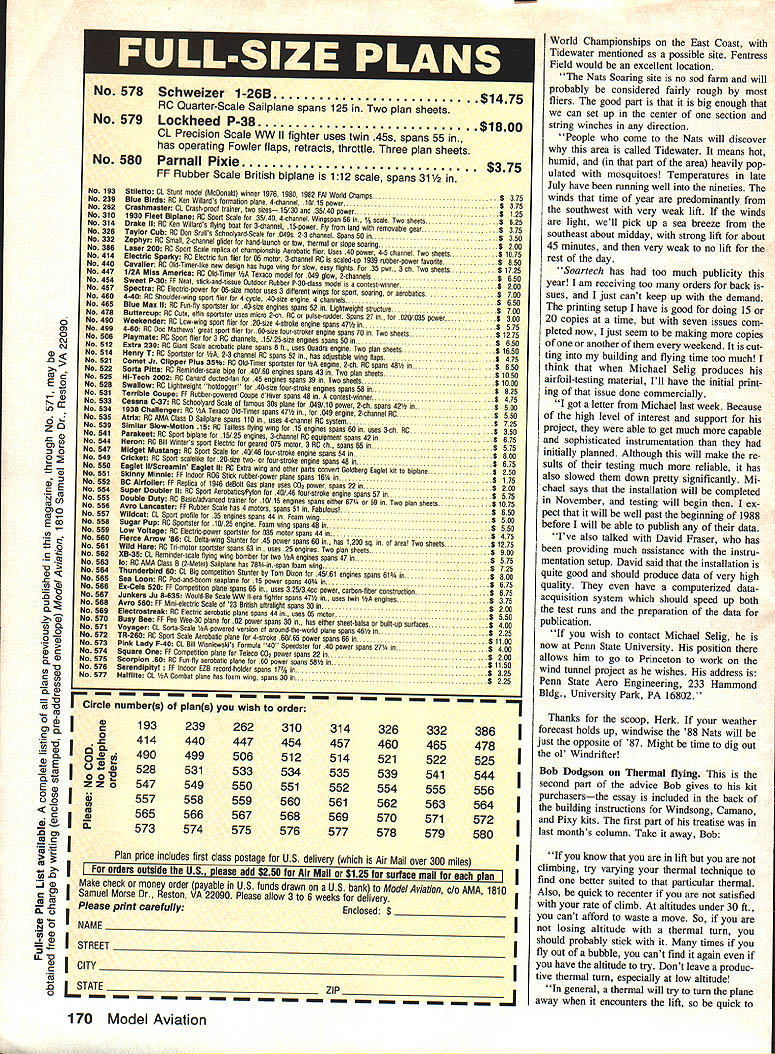
Dr. Gale has been flying models since 1934 and is a retired aeronautical engineer. His new book, Aerodynamic Design of Radioguided Sailplanes, is like a textbook for sailplaners—extremely comprehensive and explaining nearly everything about designing sailplanes. Chapter list:
- Elementary Aerodynamics
- Airfoils
- Wing
- Fuselage
- Empennage
- Complete Sailplane
- Longitudinal Static Stability
- Lateral Static Stability
- Maneuverability
- Ballast
- Controls
- Construction
- Examples and Problems
- Problem Solutions
- Math and Physics Refresher
In his cover letter Ferdi explained the book: at first glance it appears complicated, but it is not if one follows the Preface suggestion of reading the text from the first page. The book is written for nontechnical modelers and gathers a wealth of information usually spread across dozens of books. Included are 300 airfoils for all types of flying models, with data and graphs for practical design applications. This will help aeromodellers who like to design their models from scratch.
Ferdi's book is softcover and printed in both English and Italian—English on the left side of each page and Italian on the right. American modelers can obtain the book directly from him by sending $48 for surface mail (four to six weeks) or $53 for air mail. Personal checks and international money orders are welcome. His address is: Dr. Ferdinando Gale, Via Marconi 10, 28042 Baveno (NO), Italy.
P.S. Ferdi's 1978 book, Soaring, is still available from him. It gives three-view drawings, dimensions, and performance data on full-size sailplanes extant at that time—ships that remain scale favorites. The price is $30 (plus $5 for air-mail postage).
World Championships / Nats site (Tidewater)
World Championships on the East Coast have been discussed, with Tidewater mentioned as a possible site. Fentress Field would be an excellent location.
"The Nats soaring site is no sod farm and will probably be considered fairly rough by most fliers. The good part is that it is big enough that we can set up in the center of one section and string winches in any direction.
"People who come to the Nats will discover why this area is called Tidewater. It means hot, humid, and (in that part of the area) heavily populated with mosquitoes!" Temperatures in late July have been running well into the nineties. The winds that time of year are predominantly from the southwest with very weak lift. If the winds are light, you'll pick up a sea breeze from the southeast about midday, with strong lift for about 45 minutes, and then very weak to no lift for the rest of the day.
Soartech and Michael Selig wind-tunnel project
"Soartech has had too much publicity this year! I am receiving too many orders for back issues, and I just can't keep up with the demand. The printing setup I have is good for 1,000 copies at a time, but with seven issues completed now, I seem to be making more copies of one or another of them every weekend. It is cutting into my building and flying time too much! I think that when Michael Selig produces his aircraft-testing material, I'll have the initial printing of that issue done commercially."
Michael Selig's project obtained much more capable and sophisticated instrumentation than initially planned, which will make testing results more reliable but has slowed the schedule. Michael said the installation will be completed in November, and testing will begin then. Publication of their data is expected to be well past the beginning of 1988.
David Fraser has provided much assistance with the instrumentation setup. The installation includes a computerized data-acquisition system which should speed up both test runs and data preparation.
If you wish to contact Michael Selig, he is at Penn State University: Penn State Aero Engineering, 233 Hammond Bldg., University Park, PA 16802.
Bob Dodgson on thermal flying
This is the second part of advice Bob gives to his students—the essay is included in the back of the building instructions for Windsong, Camano, and Pixy kits. The first part appeared in last month's column.
If you know that you are in lift but you are not climbing, try varying your thermal technique to find one better suited to that particular thermal. Also, be quick to reconnect to your spots when you are bottoming out—if you leave one too long you won't get back to the lift. At altitudes under 50 ft., you can't afford to waste a move. So, if you are losing altitude with a thermal turn, you should probably stick with it. Many times if you fly out of a bubble, you can't find it again even if you have the altitude to try. Don't leave a productive thermal turn, especially at low altitude!
In general, a thermal will try to turn the plane away when it encounters the lift, so be quick to recentre and stay in the core. Try to be as precise as possible in your thermal search pattern, whether searching or coming home. Any edge over the competition in the performance of your glider is one more point in your favor.
Having the best plane, however, will do you little good if you have not mastered the ship. The more sophisticated the glider is, the better the flier must be in order to harness the higher capability. Become so familiar with your glider that it feels like an extension of yourself; you shouldn't even have to think about the mechanics of flying it. This frees your mind to fly each lift opportunity almost on instinct as your thermaling skills increase.
Perhaps the one thing that really separates the great thermal fliers from the OK thermal fliers is the ability to immediately recognize when to stay in a thermal, when to recenter in it, and when to leave it. How many times have you seen a gaggle of fliers slowly circling to the ground in air that contained the thermal only minutes before? The smart fliers left the thermal as it was breaking up and quickly and decisively went in search of another one while still high enough to do so, thus saving their flights.
If a great thermal encounter sinks, he will recognize it immediately and will not waste precious altitude floundering in it. One of the hardest things to do, when in sink, is to reflex the wing trailing edge and push in down elevator to increase your apparent sink rate so you can get the plane moving fast and fly out of the sink as quickly as possible. Fly anywhere—just get out of the down air! Whatever you do, though, do not retrace your flight path and fly through the same down air where you have just flown. Anything is better than that.
Great thermal fliers are decisive, smooth, and attentive. They can work any air within a range of half a mile or more, speeding out of sink and maximizing any form of lift. The great thermal flier expects to get his time whenever he goes up, and he doesn't give up until he is on the ground. Climbing out from 15 ft. is not an uncommon feat for the skilled thermaler, be it on final approach or elsewhere. It is common to see great thermalers like Dave Banks thermal his Windsong out from a hand toss.
Once you have the basic skills and the best thermaling machine to fly, you can spend a lifetime improving your thermaling skills. You will learn to work lift that you could not work the year before—or even the week before. You will find your decision-making improving so that you can now salvage "max" flights out of air that is eating everyone else alive. The thrill of thermal competition flying is that there is no end to how far you can go. Each flight is a totally new challenge to be optimized. The person who best optimizes each flight opportunity is the one who wins the most contests. This personal growth in thermaling skill is, to me, the ultimate and ever-new thrill and joy of soaring.
Thanks to Bob Dodgson for permitting his piece to be reprinted in the column. His final paragraph especially expresses what the hobby and sport are all about.
Transcribed from original scans by AI. Minor OCR errors may remain.

