
Radio Control: Soaring
Byron Blakeslee 3134 N. Winnebago Dr. Sedalia, CO 80135
Eastern Soaring League (ESL)
The ESL (Eastern Soaring League) is probably the oldest regional association of soaring clubs in the country. Ray Juschkus was recently appointed to the PR post and sent photos and a rundown of ESL activities. ESL consists of 10 clubs:
- CASA — Capital Area Soaring Association (Maryland)
- Charles River Radio Controllers (Massachusetts)
- DBSF — Daniel Boone Silent Fliers (Reading, Pennsylvania)
- LIFT — (York, Pennsylvania)
- LISF — Long Island Silent Fliers (Syosset, Long Island, New York)
- MVSF — Millstone Valley Silent Fliers (Millstone, New Jersey)
- NJSF — North Jersey Silent Fliers (Morristown, New Jersey)
- SKST — Storm King Soaring Team (Pine Bush, New York)
- TMSST — Tidewater Model Soaring Society (Virginia)
- VFSS — Valley Forge Silent Fliers (Valley Forge, Pennsylvania)
Ray says ESL schedules 10 weekend contests during the summer season—one per club. Pilots are divided into two classes, Sportflier and Expert. A Sportflier advances to Expert after accumulating 12 points. An annual meeting and evening banquet is held at the end of the season.
Ray is also active as the NSS (National Soaring Society) District II VP, AMA District II Associate VP, and contributes kit reviews and articles to Flying Models magazine. Sailplaners wishing to get in touch with ESL or any member club may contact Ray at: 7 Evergreen Ave., New Hyde Park, NY 11040.
Test Flight — Flying Rainbow
Chuck Caldwell wrote this story, which appeared in the Texas Soaring Conference Magazine.
The butterflies are there, like always. As I remove the winch from the back of the car and begin to set up for a morning of flying, the "test flight butterflies" assault me. They are so bad that I don't notice I'm standing in an ant bed. What a way to start the day.
Larry Cox is busy setting up the VCR to capture what he hopes won't be a full-blown catastrophe. The subject will be the first flight of my just-completed flying wing, the Flying Rainbow. Carol Shields and David Crossno are there to celebrate (if it flies), or to commiserate (if it doesn't), and David keeps busy with his helicopter.
How did I get into this predicament? I could tell a long story to humiliate myself, but in front of witnesses—and for all to tape for posterity—I'm trying to fly a swept-wing, tailless glider. Heaven protect me; I certainly don't protect myself!
This all started with my infatuation with the full-scale vintage sailplane called the Horten IV. Yes, that's it; I can blame my present woes on Walter and Reimar Horten, who designed and flew their glider in Germany during WWII. Someday I'm going to build a model of it. But first I need to learn to fly a flying-wing model with swept wings. Hence the plane I'm about to possibly splatter. Yes, it's definitely a swept-wing, tailless glider.
My plane, built from a Walter Panknin design, has a wingspan of 3,200 mm (about 126 in.). Wing area is 1,690 sq. in. My plane, built with foam cores and 1/16-in. balsa sheeting, weighs 6 lb ready to fly. That translates to a wing loading of about 8.18 oz per sq. ft. The sweep is on the quarter-chord line, about 20°. Speed brakes can also serve as flaps during launch. I'm using my best radio, a custom-built Ace Silver Seven, with four Futaba S-33 micro servos mounted sideways in the wing. Wingtip fins are prominent but carry no control surfaces. A small underwing skid carries the tow hook. The handle is about four inches long—now stained with nervous perspiration—because I'm ready to go.
Previous experience with tail-draggers and grass to prevent damage has taught me I can't hand-toss; a glider needs to fly faster than I can throw. So I am, in front of God and everybody, about to winch-launch an untried beautiful baby. Turn radio check—good. Hook up, press foot switch, build up tension till I can barely hold. Close eyes—THROW! Open eyes, grab transmitter, foot still hard down on foot switch. Rainbow, 200 ft straight above, clawing altitude; hands shaking badly. I accidentally give too much down—then up—elevator, resulting in the best zoomie launch I've ever done.
Per previous plans, I do a gentle right, followed by a left turn. Then I let it come down when it wants to. Wow! This thing is fast. Three minutes later I'm in ground effect, learning all about why these planes need speed. Two hundred meters upwind, the Rainbow reluctantly kisses Mother Earth. In the distance, I can hear Larry cheering!
"God bless the Horten brothers."
This article was borrowed from the Texas Soaring Conference Magazine. Marshall Long, editor. Chuck hails from Corpus Christi. Many readers will relate to the "sweaty palms" syndrome, remembering their first launch of a new ship.
Photos and Notes on Dr. Walter Panknin
Dr. Walter Panknin lives in Gummersbach, West Germany. He sent photos when he was temporarily in the New York City area. Lee Murray reports Walter is flying with Terry Good (Walt's son) and the Storm King club. Soaring really is a hobby that brings friends together across the globe. Walter can come here—or we can go almost anywhere and find new friends to fly with.
Photo captions (as supplied):
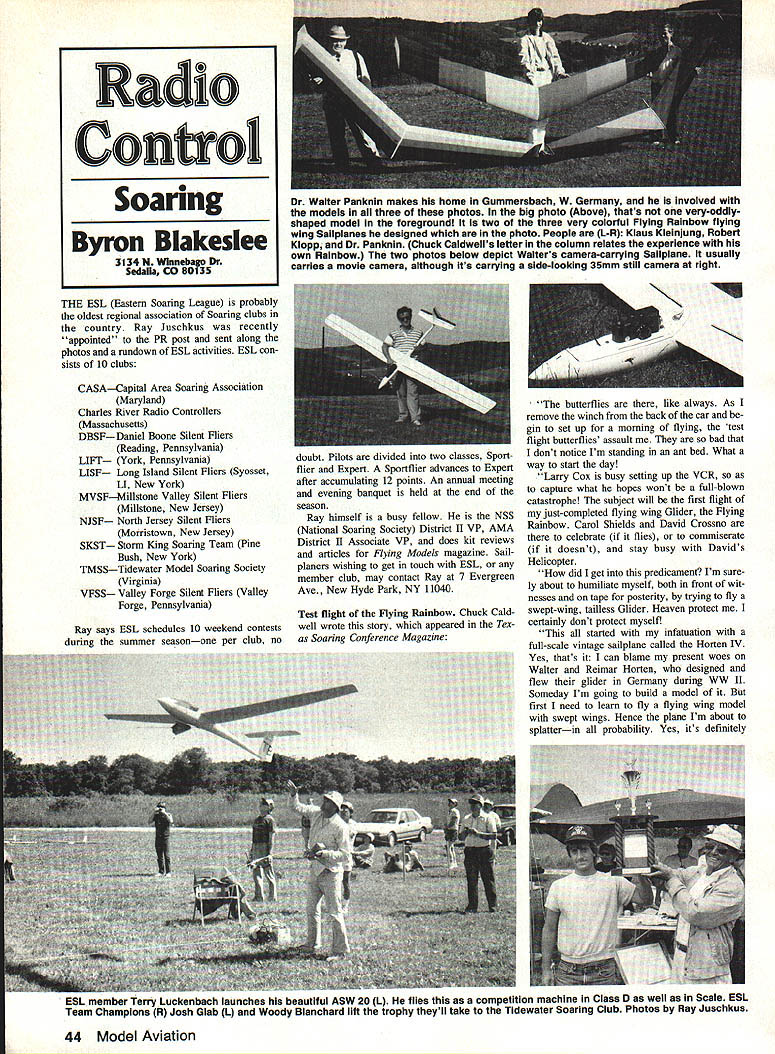
- The big photo shows an oddly shaped model in the foreground; two colorful Flying Rainbow flying wings are behind.
- People, left to right: Klaus Klehnung, Robert Klopp, Dr. Panknin, Chuck Caldwell. Caldwell's letter in the Letter Column relates his experience with his own Rainbow.
- Two photos depict Walter's camera-carrying sailplane; it usually carries a movie camera but will take a side-looking 35mm still camera.
1987 National Sailplane Symposium
Dr. Carl Mohs sent a summary of the fifth annual MARCS Symposium held in Madison, WI, October 31–November 1. Highlights:
- 111 participants from 15 states continued the steady growth of the meeting.
- Thursday early arrivals toured the EAA Museum at Oshkosh with a personally conducted tour by museum director Karl Swickley.
- Friday included a tour of the UW Meteorology Department and a briefing on interpreting satellite information for weather forecasting.
- Saturday sessions opened with Dr. Walt Good on long-range forecasts and RC frequencies; the work of the AMA Frequency Committee was recognized.
- Lee Murray presented research comparing available covering films for models.
- Professor E. Roland Stull lectured on latest techniques in thermal research.
- Pete Waters presented updates on radios, followed by a lively discussion about radio equipment needs.
- Karl Seelig offered insight into the mindset and philosophy of a consistent winner.
- Paul Carlson reported on Michael Selig's slow-speed wind-tunnel airfoil tests at Princeton—results expected another year hence.
- Gary Tsarchester reported from the German model press, highlighting the need for more F3B-type contests in the U.S. Dinner featured a talk by a couple who flew around the world in their Beechcraft Bonanza.
- Sunday "table clinics" showed computer programs, new kits and designs; Joe Wurts demonstrated vacuum-bagged foam wings, producing excellent finishes quickly.
- Paul Carlson discussed design thoughts on the Ideal Thermal Duration Sailplane, emphasizing drag reduction.
- Ken Bates updated attendees on flying-wing experiments and launching solutions that now allow consistent straight contest-type launches.
- Joe Wurts summarized his cross-country and slope-racing experiences and successes over the past two years.
The printed Proceedings of the '86 Symposium are available for $10 (plus $1 for first class postage) from Walt Seaborg, 1517 Forest Glen Rd., Oregon, WI 53575.
Building the LJMP Comet
Arlie Stoner wrote this piece originally in the Modesto RC Club's newsletter (then edited by his wife Shirley). Highlights of his build and flying impressions:
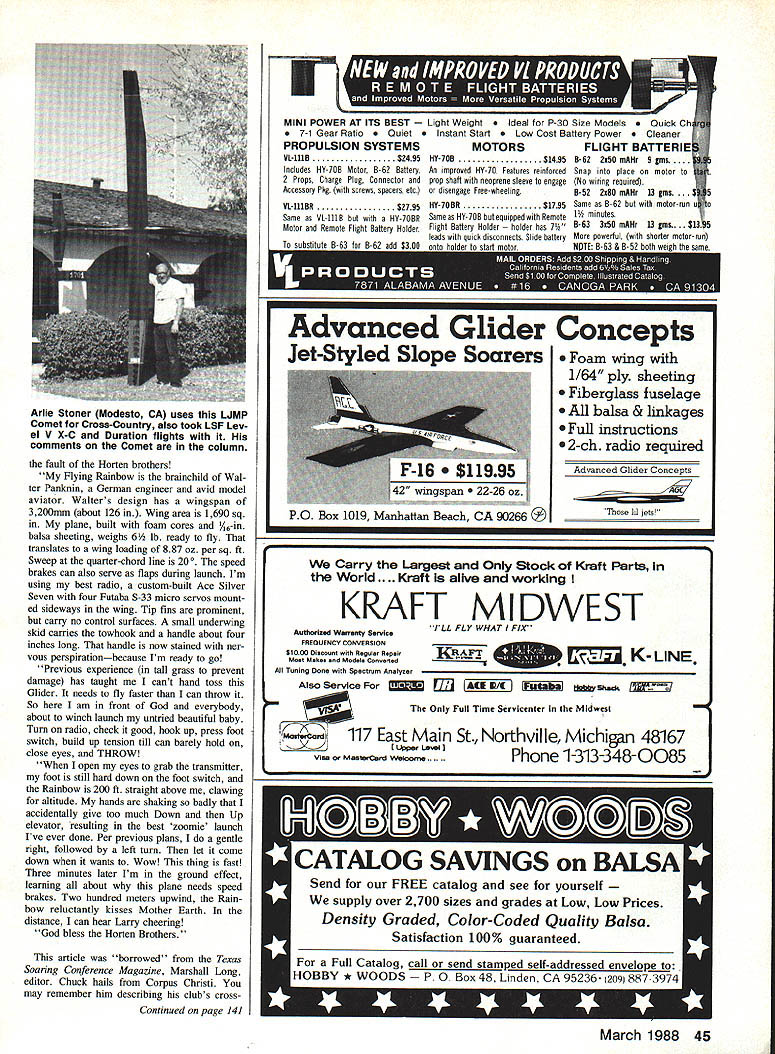
- After watching Larry Jolly fly his Comet at a cross-country contest, Stoner was impressed with the ship's speed and penetration. He had flown a Sagitta XC for two years but found its wing loading too low for speed and its penetration poor in winds over 5 mph. The Comet excelled in both areas.
- The Comet kit is large—the fuselage comes in a separate box—and is not a kit for the novice builder. At the time, instructions were not finished, but an experienced builder should have no trouble. Larry's advice: build the stab and rudder as light as possible and use only enough paint on the rear of the fuse to cover. Stoner built the stab following the Gemini construction method, producing a structure both light and strong.
- The wings go together easily. With no dihedral on assembly, careful alignment of tubes and rods is essential. The wing has two sets of spars and completely sheeted center panels, yielding a very strong wing. The drawings show provisions for flaps; Stoner initially omitted them but later wished he had included them—landings would have been easier since the plane glides very well even with large spoilers raised. Bernard Slimper prepared the fuselage for painting; smoothing the fuse join line took some putty and work.
- On the third flight Stoner reached good altitude and, with friends as spotters, completed a go-and-return flight. In one hour and thirty-one minutes they returned—an LSF level flight completed. Two weeks later, with the Thermic Sniffer hooked up, the ship went almost out of sight; after two hours and forty-two minutes Stoner landed having completed a two-hour LSF level flight and setting a new club record. The Comet cruises well, climbs in light lift, and shows excellent penetration.
F3B, Interglide '88 and International Duration
An observation on cross-discipline transition and an announcement:
- Pilots used to aerobatic or pylon models who practice regular fast turns may find F3B course flying a smaller step; however, pilots from flat-field thermal backgrounds may find the change more difficult because course flying isn't a natural everyday operation. Weather (limited lift) also affects willingness to switch disciplines.
- There has been discussion of dropping the Speed task in F3B; that change seems a long way off. The "ground war" (winch race) is another problem needing a solution for the event to survive.
- The flyer for World Interglide '88 (a BARCS biennial contest) has been released. This event is open to thermal fliers of all nations and could serve as an entree for an eventual FAI Thermal World Championships if held in even years between odd-year F3B events. The Coventry and District Model Aero Club sponsors the 1988 contest, to be held August 6–7 at the Warwick Race Course, Warwick, Warwickshire. The contest will include five rounds of percentage-slot flying to BARCS open-class rules, with special awards for best Vintage and best Tailless (flying wing) models, plus Scale and Hand-Launch competitions. A barbecue will be held Saturday evening. Information: Sam Hitchman, 7 Verney Close, Lighthorne, Warwickshire CV35 OA2, England. Sam requests a SASE or an International Reply coupon.
Letters — Bob Dodgson
Bob Dodgson commented on the "Ultimate Thermal Sailplane" column and the Windsong:
- Dodgson noted that the idea of a World Thermal Duration Championships is intriguing. He observed that heavy German foam-wing gliders with hardwood sheeting thermal well and have great penetration but are difficult to land precisely and can suffer in dead air or sink. Many F3B-type gliders fall into that category.
- Large British polyhedral floaters also might suffer if landing precision is a priority, though they perform well in dead air and have good range. Very large ships could have launching disadvantages on moderately powered winches.
- For contests where landing precision matters and conditions vary, a plane like the Windsong has advantages: large enough to be seen from afar, light enough for good tows on most winches, good range, and the ability to get top times in dead air while landing precisely.
- Dodgson emphasized that no single contest proves the best pilot or plane; each contest adds information. An international duration contest pitting different design types head-to-head would yield valuable insights and could accelerate design progress, possibly garnering grassroots support rather than pushing pure high-tech F3B trends.
Additional News from Dodgson Designs
- All of Bob Dodgson's fuselages are now made by Bob Sealy Quality Fiberglass using epoxy resin. This is good news: Bob Sealy produces excellent work, and switching from polyester to epoxy eliminates the need for polyester resin adhesives and the associated family-unfriendly odors.
- With epoxy-glass fuselages, one can use a good 30-minute epoxy to install wood parts. Prep: clean the fuselage areas to be glued with thinner, rough them well with coarse sandpaper, and clean again to remove the waxy surface and ensure good epoxy adhesion.
- Fiberglass cloth work can be done with an epoxy laminating resin such as Safe-T-Poxy (recommended by Burt Rutan for his fiberglass-and-foam home-builts). Safe-T-Poxy is available from Aerospace Composite Products.
A correction: a misprint in the January column stated the Windsong wingspan as 124 inches; it should have been 134 inches.
Roke Scale Kit Video Available
Roland Kern, maker of Roke Scale Glider kits from Germany, sent a two-hour videotape of flying shots of all his kits to U.S. importer Tony Amron. Tony converted the European tape to VHS and is offering rentals:
- Rental: $10 plus a $10 deposit. Purchasers of Roke kits get the rental fee refunded.
- Tony Amron address: 1744 N.W. 82nd Ave., Miami, FL 33126.
- The narration is in German, but the footage of quarter-scale birds in action is highly enjoyable.
Learning from Free Flight
Did you read Marty Cowley's report on the 1987 Free Flight World Champs in the January issue of Model Aviation? If not, you missed an exciting read and the chance to pick up very good pointers on flying RC sailplanes. Free-flighters often spend more time studying the ups and downs of the air than RC pilots do, so their insights are valuable. Many "old-timers" with an uncanny ability to read the air started in Free Flight. If you can, dig out the January issue—it's worth the read and the pointers.
Transcribed from original scans by AI. Minor OCR errors may remain.

