
Radio Control: Soaring
Dan Pruss
LSF/2000! In less than two years the League of Silent Flight roster has grown by 1000 members, and LSF/2000 went to Hans Dangelmeier, Switzerland. Even though this growth rate was predicted a couple of years ago, it is a remarkable increase. With 1500 in the aspirant files, the next thousand could just possibly take only half as long.
LSF Shortlines: Apparently some of the older PDVs (Performance Document Vouchers) are still out and a tinge of misunderstanding remains as to the method of launching for the precision spot landings. Section 9 should read, "...All precision spot-landing flights must commence with a launch meeting the specifications for towline lengths and methods outlined in Section 7." Please note that "rise off the ground" has been, and should be, deleted.
Contest requirements: In all cases in Levels II through V a minimum of six contests is required regardless of the points accumulated in less than six contests. Required points may be waived only if the required win or places are earned in Levels II through IV. Again, a minimum of six contests is required.
Where contest results are posted too late for a member to get a CD's signature, the contestant, when submitting his PDV form, may attach the printed results voucher in lieu of CD's signature. The member should also include the completed computations and circle his name on any attached contest forms.
Classes A, B and C: Since a breakdown of competition by plane size is usually at the discretion of a CD or hosting club, the final standing and points earned may be based on the final results after integrating the classes. This allows those flying in a class which is outnumbered by either of the other two classes to fulfill the minimum number of entrants' requirements.
Example (1): You are flying a Class A sailplane against 17 others but there are 36 in Classes B and C. If you are working towards Level V, the minimum required number of entrants for scoring contest points is 20. By combining the two classes you can now base your LSF points on 53 contestants. Please note! Integration must be by final contest score. If you were third with, say, 3740 points before combining classes and found yourself seventh afterwards, you must use that seventh place in your calculations.
Example (2): You are Level IV and you enter your Class A plane at a contest where you compete against 24 others. Classes B and C combined have 48 contestants. You place first in Class A. But, being the ace of the local base, you have already placed first in three other contests and you now need points. Integrating the standings, you find yourself third due to advantage in the LSF point department. If you hadn't had a win yet for Level V, obviously you would have accepted the required win and based your overall score on the other 24 contestants.
Main reason for the above changes—after much deliberation by your LSF Board of Directors—is that the U.S.A. is the only country where sailplanes are broken down by classes.
To date there are 22 foreign countries that have 338 sailplane fliers proudly wearing LSF insignia. If you are interested in joining write to: The League of Silent Flight; P.O. Box 39068, Dept. AM; Chicago, IL 60639 U.S.A.
San Fernando Valley Silent Flyers' Desert Dash. As mentioned in last month's column, the SFVSF were holding their second race in as many years. Rules are simple: (1) Pick a course for a downwind flight; (2) Fly to the established goal in less elapsed time than anybody else; (3) Try not to wreck the sailplane while accomplishing (2).
After trying the same course as last year, the 25-knot wind gusts called for a course change to a more favorable site. The course: Palmdale Blvd.—39th to 220th St. Wind: 3 knots.
Fliers and planes: Loren Blewett—Pierce 970, Barbara Henon—Cumulus, Pat Potega—Mother Goose, Mike Reagan—Paragon, Roy Stowers—Javelin. Contest Director: Ed Slobod.
As Ed tells it, he set up his official's stand at the finish and first to cross was Pat Potega's Goose—the time: 1:24 p.m. About a minute later Loren Blewett's 970 crossed the finish line. Loren had started out 38 minutes after Pat. The big difference—Loren's flight was without a relaunch and his total elapsed time was 47½ minutes. The 970's average speed was 25.26 mph despite the times it stopped to circle for more altitude. Third place went to Mike Reagan with an elapsed time of one hour and 49 minutes.
Overall reaction: fun even for the nonfinishers.
From a practical point of view, an event like this could be just the remedy for those weekends and holidays that see too large a crowd at the local flying field.
RC Soaring/Pruss
continued from page 26
going to have to sit and wait for your turn for the frequency clip, you might just as well get involved as part of a team and enter a club project as the SFVSF's did.
More from the TS? (Tri State Soaring Society). Not having flown enough during the day in the quarter-finals last May, a group which included Dick Beltz, Dr. Walt Good, Bill Cavanaugh, Jay Stargell, Gene Shelkey, and Dave Burt decided to venture into what a couple of other clubs have tried—night flying.
Burt lends some tips along with the story. 3M reflective tape and glow tube lights were attached to the ships and one light attached to the launch line. Most of the flying was done with one light on each wing panel—half way out and on the bottom. The 3M tape was not very effective, but the silver tape was far better than the orange-red tape. The tape doesn't work well until the light striking it is at 45° or greater to the tape surface. Launching was done in the normal manner with a spotlight shining on the ship. This aids the flier in determining the wing bow—or loading on the ship.
After a short period of time, most pilots don't require the spotlight but one should be aware that sharp turns and stalls could get the flier confused. On one flight two lights were mounted, one on the front and one on the rear of the fuselage. The result was instant confusion because the pilot couldn't tell if the wings were level.
The spotlight can be used for landings but several were made without it and when the ship got within two to three feet of the ground you could see a moving circle of light below the ship. Dave estimates nighttime launches to be 2½ to 3¼ of day-time heights (discretion being a factor no doubt). Flight times are 1½ to 4 minutes.
Only one mishap of the evening—Gene Shelkey demonstrated the how-to-fold-a-wing trick. However, the undamaged glider lights aided in finding the pieces. (Don't look now gang, but I think Burt is making noise to create a new task!)
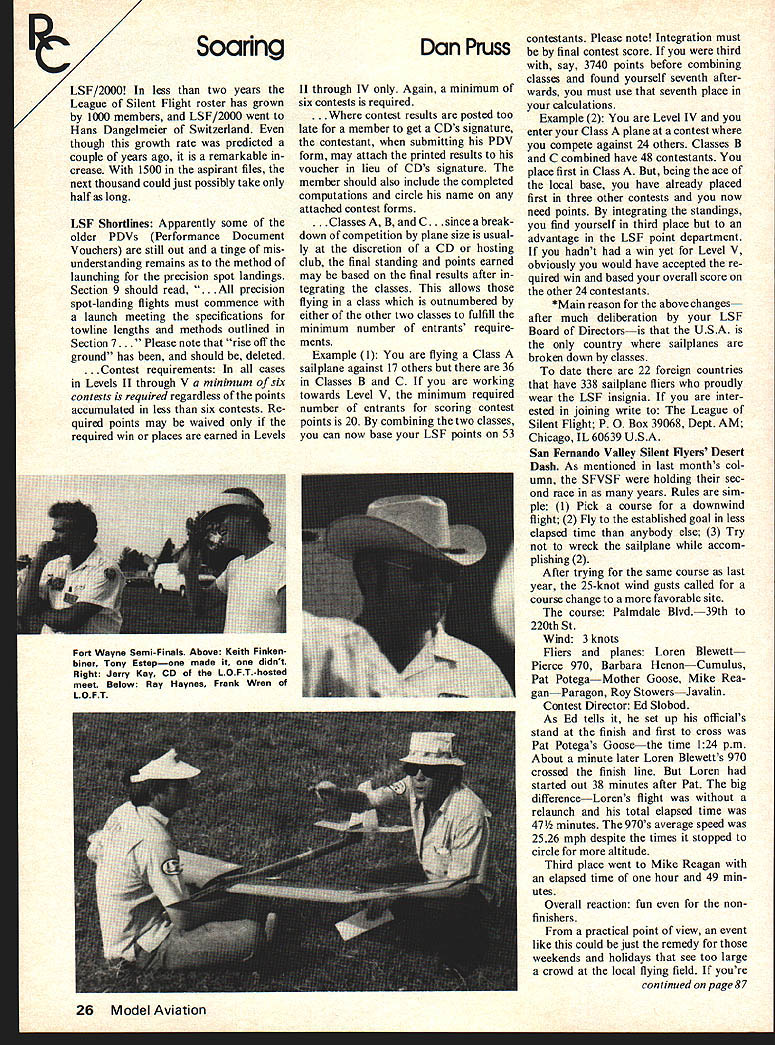
Stop the Presses! July 11, 1976. Los Angeles, CA; Fort Wayne, IN; Fort Worth, TX; Huntsville, AL; Elmira, NY; Spokane, WA. Over the July 4th weekend those that survived the FAI quarter-finals last May competed at one of the above sites in hopes of making it to the finals over the Labor Day weekend in Denver. Standings for the finals are:
California D. Thornburg M. Reagan R. Pearson P. Parszik K. Toplan R. Thacker J. Wiesman
Indiana D. Corven R. Gill J. Mrlik T. Estep R. Robinson
Texas L. Payne C. Haga D. Darnell G. Temple J. Hamilton J. Simpson D. Nutter C. Wade
Huntsville J. Gunsaulis F. Deis G. Smith B. Miller S. Pfost
Washington D. Banks B. Dodgson J. Christie R. V. Mullm G. Horstman G. Russo
New York L. Pike D. Law D. Burt J. Zeigenfuse
Nobody Ever Asked Me, But... Department: When mixing small amounts of epoxy paints for small parts or touch-up work, metal measuring spoons work great. Bend the handle 90° to the spoon end so that you have a miniature ladle. Dipping out small amounts keeps the rims of the paint cans clean. Just be sure to wash the "ladle" between parts A and B of the epoxy. And if it's just small amounts you are mixing, the bottom of most tin cans serve this purpose. Their saucer-like bottom, with the ridged edges, keep the mix confined.
As for mixing epoxy glues, a cheap note pad serves well as a mixing pallet. After using the glue, simply tear off that sheet of paper and you have a clean note pad again for glue or notes.
Acid swabs—available from hardware stores and plumbing shops—are inexpensive. They work well for "painting" epoxy and polyester resins for the fiberglass work. The brushes will have a hollow handle and 1/4" dowels fit readily to act as a handle extension. They can usually be purchased in gross lots and their low cost makes them almost a throw-away item.
A pad of foam, one inch or thicker and large enough to suit your own needs, does an excellent job protecting your next wood backer while sanding. Rest your fuselage, wings, etc., on the foam to prevent nicks and, if you want to avoid further nicks and scratches, remove watches and rings. And that shirt with buttons down the front—change it. Foam board, available through art stores, can be used as a building board. Make sure the building surface—bench or board—is flat.
Suds City Soar In Draws Fliers From Seven States
The Suds City (Milwaukee) Soar In sponsored by Old Milwaukee Beer and hosted by the Milwaukee Flying Electrons who held their annual "bash" July 10 and 11. And bash it was. Saturday saw temperatures near the 100° mark with winds of 25 to 35 knots!
Only the fittest survived and the final results showed John Czeszak the winner in Unlimited with an Astro—Jeff—John won the two-minute precision and the six-minute duration.
Grand champion was Jack Hiner. Flying an Aquila, Jack also won the two-minute precision and the ten-minute duration but outpointed Czeszak. Czeszak came back Sunday, however, and was high scorer and earned that day's grand champ.
Allen Epps was the highest soaring junior each day and won the traditional medals which Old Milwaukee sponsors.
Forty-five fliers from IL, WI, IA, IN, MN, MI and CO competed in what contest manager Ron Kopp says was the toughest test of fliers and sailplanes he has ever seen.
Dan Pruss, Rt. 2, Box 490, Plainfield, IL 60544
Transcribed from original scans by AI. Minor OCR errors may remain.

