
Radio Control: Soaring
Byron Blakeslee 3134 N. Winnebago Dr. Sedalia, CO 80135
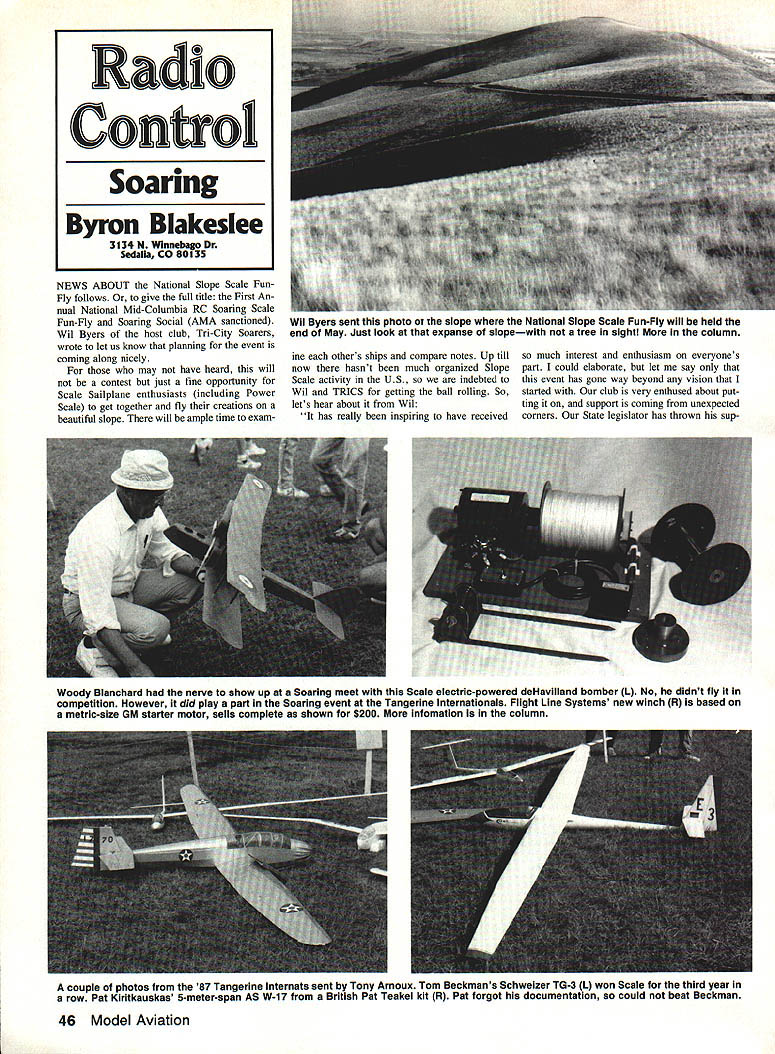
National Slope Scale Fun-Fly
News about the National Slope Scale Fun-Fly follows. Or, to give the full title: the First Annual National Mid-Columbia RC Soaring Scale Fun-Fly and Soaring Social (AMA sanctioned). Wil Byers of the host club, Tri-City Soarers, wrote to let us know that planning for the event is coming along nicely.
For those who may not have heard, this will not be a contest but a fine opportunity for Scale sailplane enthusiasts (including Power Scale) to get together and fly their creations on a beautiful slope. There will be ample time to examine each other's ships and compare notes. Up till now there hasn't been much organized Slope Scale activity in the U.S., so we are indebted to Wil and TRiCS for getting the ball rolling. Wil writes:
"It has really been inspiring to have received so much interest and enthusiasm on everyone's part. I could elaborate, but let me say only that this event has gone way beyond any vision that I started with. Our club is very enthused about putting it on, and support is coming from unexpected corners. Our State legislator has thrown his support behind the idea and has helped us clean up the site and perhaps make a small park for us. The site is 1,100 ft high; the distance is 650 ft — really nice places to fly. I'm sure everyone will enjoy the visit."
Thanks for the report and photo. I may be jumping the gun, but I'm looking forward to having the Slope Scale Fun-Fly as a regular event on the Soaring calendar. Interested parties can write Wil at 632 Meadows Drive East, Richland, WA 99352 or phone 509-627-5224.
D-Day at Disney — The 1987 Tangerine Crash Bash
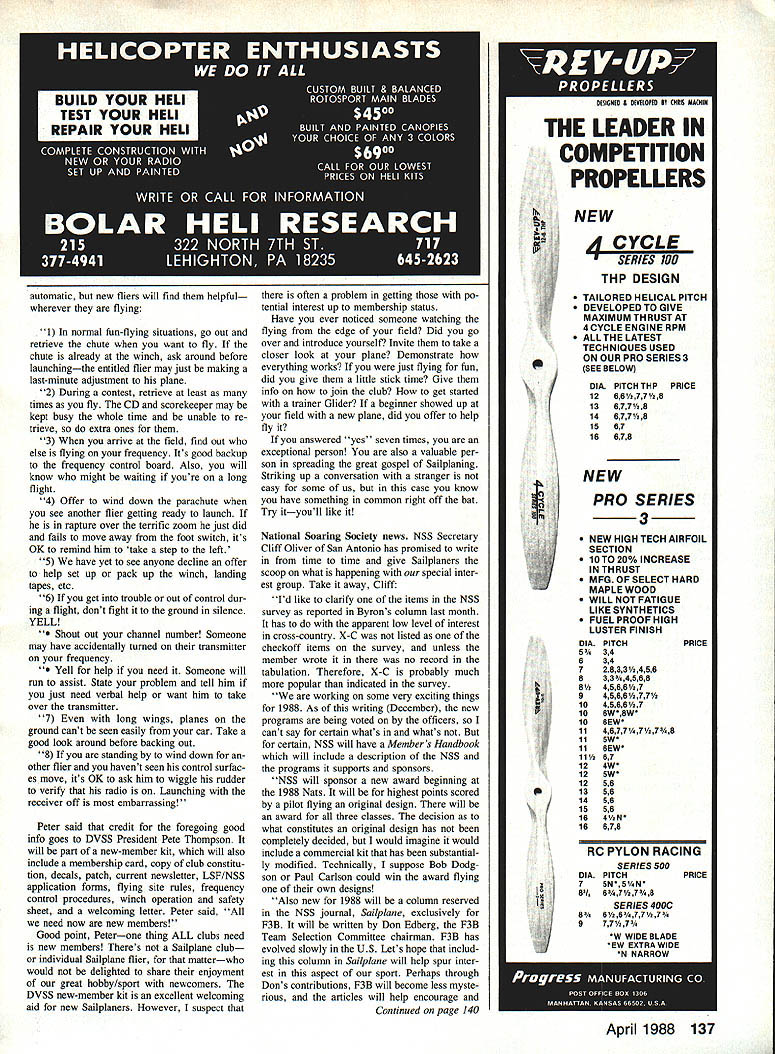
Tony Arnoux of Miami (the Roke kit man) sent in this report on the '87 Tangerine contest. It's not a contest report, but a horror story.
The 1987 Tangerine Crash Bash will go down in the history books as the most extraordinary and expensive event to date. If you put an average cost of $200 on gliders today, some 50 competitors managed, without the help of wind or inclement weather, to wipe out more than $6,000 worth of hard-earned bucks. It is not too unusual, albeit with a sickly stomach, to see a couple of crashes at any soaring contest. But when your normal reaction is dulled by the sound of exploding balsa and MonoKote to the point of "One more down, boys," you know things definitely aren't normal.
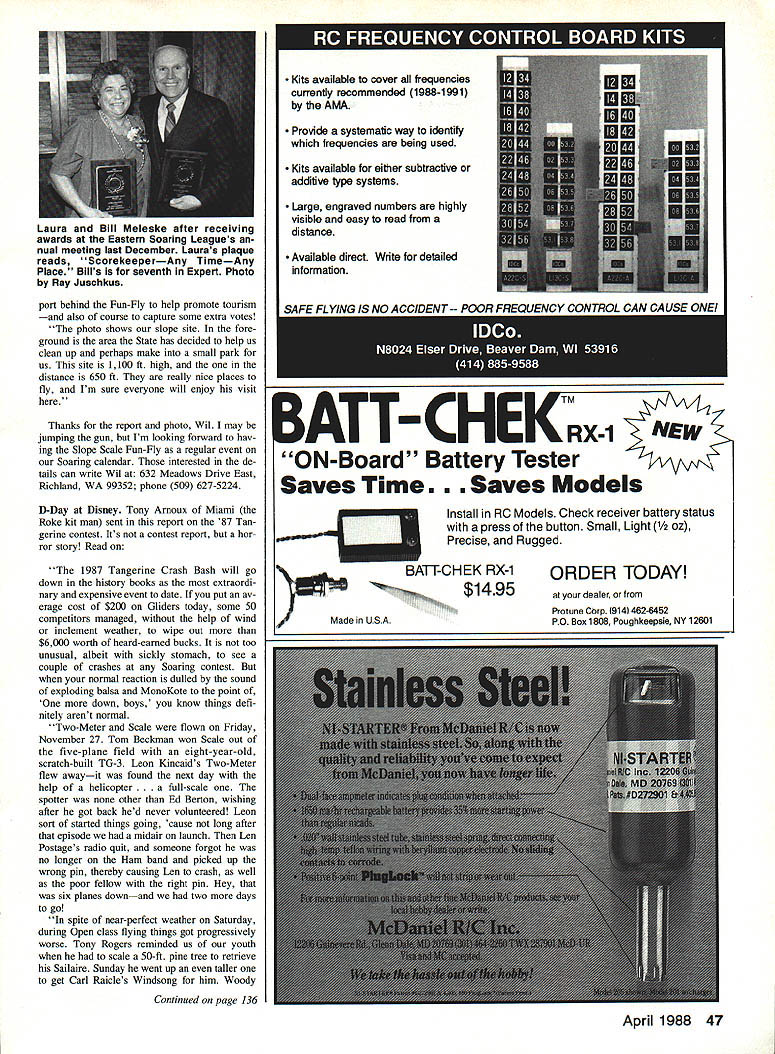
Two-Meter and Scale were flown on Friday, November 27. Tom Beckman won Scale out of the five-plane field with an eight-year-old, scratch-built TG-3. Leon Kincaid's Two-Meter flew away — it was found the next day with the help of a helicopter. A full-scale spotter was none other than Ed Berton, who later wished he'd never volunteered. Leon sort of started things going, because not long after that episode we had a midair on launch. Then Len Postage's radio quit; someone forgot he was no longer on the Ham band and picked up the wrong pin, thereby causing Len to crash, as well as the fellow with the right pin. Hey, that was six planes down — and we had two more days to go!
In spite of near-perfect weather on Saturday, during Open class flying things got progressively worse. Tony Rogers reminded us of our youth when he had to scale a 50-ft pine tree to retrieve his Sailaire. Sunday the wind went up and he went up an even taller one to get Carl Raicle's Windsong for him.
Blakeslee wasn't fazed by all this; he warmed up his engines (or was it charged his batteries?) and flew his DH-10 British bomber to give us a fix on the height of the haze. Woody took second in Expert Two-Meter. What the heck — second to Walt Good is not a bad day of flying after all! We didn't get to see Walt again, as he was the main attraction at RC World, flying a replica of a famous pioneer RC plane.
I lost track of events later on Sunday, especially the trophy awards, as we were knee-deep in swamp water trying to fish Tom Beckman's Sailaire out of the tallest oak tree I've ever seen. Later on they had to use a small-bore shotgun to shoot it out of the tree.
I have it from reliable sources that Ed Berton took first in Open; I was the Expert overall winner. Shaun Ernst won Sportsman Open, while Rust Smith was the overall winner in the category. Disaster at Disney or not, we all had a good time (between which and retriever break-downs) to share impressions that will make for consideration into the far, far future. Nobody told us until we were there that this was the Thirteenth Annual Tangerine!
Engine Detonation and a Gemini Cylinder Failure
Detonation and backfiring can cause fatigue in the long run, after years of abuse in a scale model for example. This could lead to a broken crankshaft, as happened to an acquaintance. On our Gemini 1-20 twin, there was a broken aluminum cylinder jacket after 100+ hours of operation. We can't be certain, but detonation at some time during the engine's life is a prime suspect in this problem.
There was a loss of power on the last flight. The model was landed with the engine running erratically, and one cylinder was perceived to be loose. A fracture had occurred along the sharply machined corner at the mounting flange, where the cylinder jacket is bolted to the crankcase. On full-size, air-cooled engines, this corner always has a large radius. There was no radius on the Gemini cylinder jacket.
Of the four lugs in the Gemini's mounting flange, only one remained intact, which prevented complete loss of the head, cylinder, and valves in the surrounding cornfields. A new cylinder, one our late friend made from 2024-T351 aluminum alloy, has a machined radius at the mounting flange. After inserting the old cylinder liner and adding the pistons and cylinder heads, the engine has returned to service, running good as new, with one cylinder polished aluminum and the other black anodized.
Internally, the engine showed no wear and no carbon or gum buildup after 100 hours, with castor oil as the only lubricant. For the future, we will certainly be more aware of detonation and its devastating effect. Four-stroke engines are too expensive to be abused.
New 12-Volt Winch
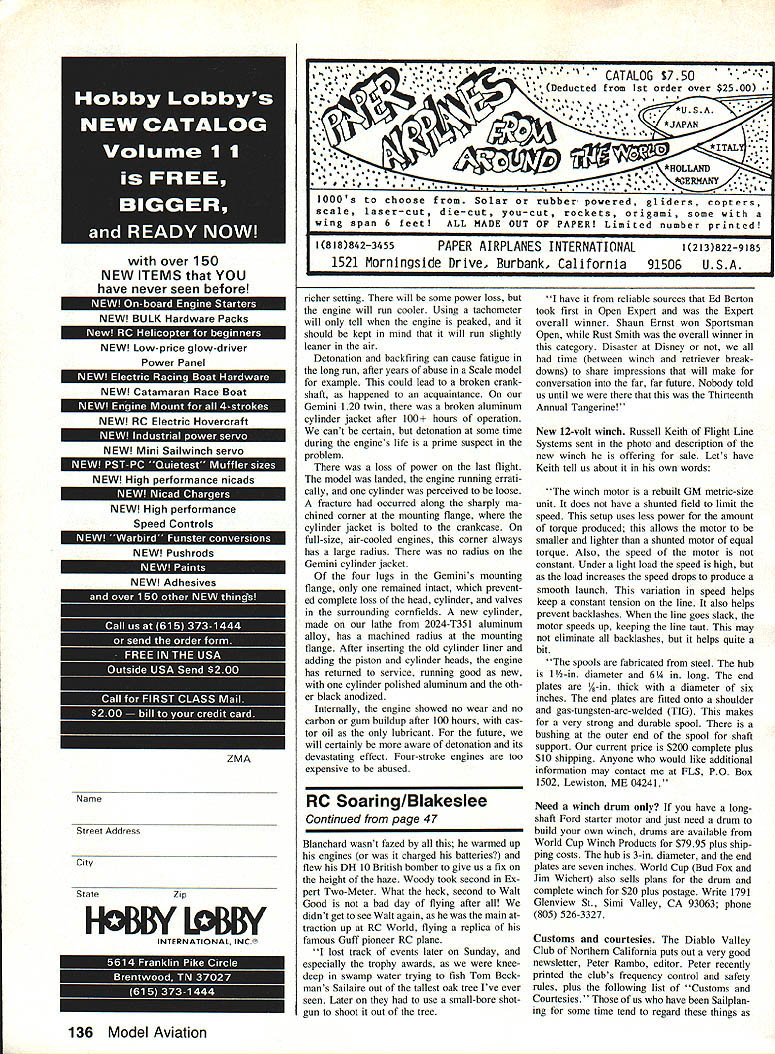
Russell Keith of Flight Line Systems sent in the photo and description of the new winch he is offering for sale. He explains why he designed it:
"The winch motor is a rebuilt GM metric-size starter. It does not have a shunted field to limit the speed. This setup uses less power for the amount of torque produced; this allows the motor to be smaller and lighter than the shunted motor of equal torque. Also, the speed of the motor is not constant. Under a light load the speed is high, but as the load increases the speed drops to produce a smoother launch. This variation in speed helps keep a constant tension on the line. It also helps prevent backlashes. When the line goes slack, the motor speeds up, keeping the line taut. This may eliminate all backlashes, but it helps quite a bit."
The spool is fabricated from steel. The hub is 1-1/2 in. diameter with a 6-1/4 in. length. The end plates are 1/4-in. thick with a diameter of six inches. The end plates are fitted onto a shoulder and gas-tungsten-arc-welded (TIG). This makes for a very strong and durable spool. There is a bushing at the outer end of the spool for shaft support. Our current price is $200 complete plus $10 shipping. Anyone who would like additional information may contact FLS, P.O. Box 1502, Lewiston, ME 04241.
Need a winch drum only? If you have a long-shaft Ford starter motor and just need a drum to build your own winch, drums are available from World Cup Winch Products for $79.95 plus shipping. The hub is 3-in. diameter and the end plates are 9-in. World Cup (Bud Fox and Jim Wichert) also sells plans for the drum and complete winch for $20 plus postage. Write World Cup Winch Products, 1791 Glenview St., Simi Valley, CA 93063; phone (805) 526-3327.
Customs and Courtesies
The Diablo Valley Soaring Society (DVSS) of Northern California puts out a very good newsletter (Peter Rembo, editor). A recent edition printed the club's frequency control sheet and safety rules, plus the following list of "Customs and Courtesies." Those of us who have been sailplaning for some time tend to regard these things as common sense. However, for the benefit of the beginner, they are included.
- In normal fun-flying situations, go out and retrieve the chute when you want to fly. If the chute is already at the winch, ask around before launching — the entitled flier may just be making a last-minute adjustment to his plane.
- During a contest, retrieve at least as many times as you fly. The CD and scorekeeper may be kept busy the whole time and be unable to retrieve, so do extra ones for them.
- When you arrive at the field, find out who else is flying on your frequency. It's good backup to the frequency control board. Also, you will know who might be waiting if you're on a long flight.
- Offer to wind down the parachute when you see another flier getting ready to launch. If he is in rapture over the terrific zoom he just did and fails to move away from the foot switch, it's OK to remind him to "take a step to the left."
- We have yet to see anyone decline an offer to help set up or pack up the winch, landing tapes, etc.
- If you get into trouble or out of control during a flight, don't fight it to the ground in silence. YELL!
- Shout out your channel number! Someone may have accidentally turned on their transmitter on your frequency.
- Yell for help if you need it. Someone will run to assist. State your problem and tell him if you just need verbal help or want him to take over the transmitter.
- Even with long wings, planes on the ground can't be seen easily from your car. Take a good look around before backing out.
- If you are standing by to wind down for another flier and you haven't seen his control surfaces move, it's OK to ask him to wiggle his rudder to verify that his radio is on. Launching with the receiver off is most embarrassing!
Credit for the foregoing good info goes to DVSS President Pete Thompson. It will be part of a new-member kit, which will also include a membership card, copy of the constitution, decals, patch, current newsletter, LSFF/NSS application forms, flying site rules, frequency control procedures with operation and safety sheet, and a welcoming letter. Peter said, "All we need now are new members!"
Good point, Peter — one thing all clubs need is new members! If you ever see someone watching from the edge of the field, introduce yourself, invite them to take a closer look at your plane, demonstrate how everything works, give a little stick time, and offer information on how to join the club or how to get started with a trainer glider. If you do that regularly, you're doing your part to grow the sport.
National Soaring Society (NSS) News
NSS Secretary Cliff Oliver of San Antonio has promised to write in from time to time and give sailplaners the scoop on what's happening with our special interest group. Cliff writes:
"I'd like to clarify one of the items in the NSS survey as reported in Byron's column last month. It has to do with the apparent low level of interest in cross-country. X-C was not listed as one of the checkoff items on the survey, and unless the member wrote it in there was no record in the tabulation. Therefore, X-C is probably much more popular than indicated in the survey."
"We are working on some very exciting things for 1988. As of this writing (December), the new programs are being voted on by the officers, so I can't say for certain what's in and what's not. But for certain, NSS will have a Member's Handbook which will include a description of the NSS and the programs it supports and sponsors."
"NSS will sponsor a new award beginning at the 1988 Nats. It will be for highest points scored by a pilot flying an original design. There will be an award for all three classes. The decision as to what constitutes an original design has not been completely decided, but I would imagine it would include a commercial kit that has been substantially modified. Technically, I suppose Bob Dodgson or Paul Carlsson could win the award flying one of their own designs!"
"Also new for 1988 will be a column reserved in the NSS journal, Sailplane, exclusively for F3B. It will be written by Don Ede, the F3B Team Selection Committee chairman. F3B has evolved slowly in the U.S. Let's hope that including this column in Sailplane will help spur interest in this aspect of our sport. Perhaps through Don's contributions, F3B will become less mysterious, and the articles will help encourage and cause excitement among the brotherhood. How about somebody volunteering to do a Cross-Country column?"
As in the past, NSS will sponsor the Excellence Achievement Program (EAP) and the NSS Soaring Achievement Program (SAP). The Soar-In program was revamped last year to run more efficiently. The NSS trophies from Winning Images are a big gain, and the contest receives national exposure in Sailplane, including pictures. So, if you are a contest director hosting a contest in '88, contact Marshall Long to check it out: Marshall Long, 824 Garden Meadow, Universal City, TX 78148; telephone (512) 659-3337.
Anyone interested in learning more about the NSS should drop Cliff a line and he'll send a complimentary copy of Sailplane. To sign up immediately, send $12 to Cliff Oliver, 8511 Broadway, San Antonio, TX 78209.
News from Sailplaners — Letter from Jim Deb and Response
When I started doing this column I said I wanted it to be a forum for all sailplaners — a place where people could express their opinions. I was glad to receive a letter from Jim Deb of East Chicago, IN, in which Jim expresses his views on a couple of topics. Jim's letter:
"First, what a treat to see my picture (with Dan Fink) in your Nats report in the November issue of MA. Second, may I take some time to put in my two cents' worth on a couple of topics?
"While I think F3B is interesting, I don't care to build a ship and participate. Why? Because I participate in RC soaring for relaxation. The occasional contest and Nats provides the opportunity for me to visit with other sailplaners — competition is secondary. Should local contests and the Nats go the F3B route, the relaxation factor would disappear. Surely, good thermal events and F3B can coexist!
"Wind at contests. Surely, the last three rounds of the '87 Nats didn't prove who could soar better — only who was willing to risk his plane. The number of sailplanes destroyed is a testimony to a rule revision to allow the CD to halt the competition at a wind velocity somewhat lower than that experienced at Lincoln.
"Here's something a little less political: At a recent contest, a good sailplane pilot (LSF level V) told me that, in his opinion, flaps beat spoilers as the choice for additional control on rudder/elevator ships. His reasoning was that spoilers only help in landing and de-thermaling, while flaps can also be used on launch and, with a little reflex, will help penetrate into the wind. He also felt that flaps were easier to 'plumb' in a smaller plane. Care to comment?"
Thanks for your letter, Jim. My replies:
- On F3B: Your feelings are probably shared by many sailplane fliers who regard the hobby as relaxation. Others are intensely competitive and enjoy world-class events. Thermal events for those who want relaxing competition and F3B for those who thrive on top-level competition can — and should — coexist.
- On wind at contests: This is a difficult problem because there will always be two points of view. Some fliers with very light wing loading fly beautifully in calm conditions and would like postponement when winds exceed, say, 15 mph. Others are prepared for stronger winds and want to continue. The current AMA criteria for cancellation at 40 mph is not realistic for sailplane competitions; probably any winds over 30 mph should stop a contest because planes are out of control and becoming very dangerous. The committee should take such experience into account when setting limits.
- On flaps versus spoilers: The controversy has been ongoing. The arguments in favor of flaps — additional control on launch, improved penetration into the wind with reflex, and easier rigging in smaller ships — are valid points worth considering. There are many successful setups. Planes using the "crow" (called "butterfly" in Europe) configuration (flaps down / ailerons up) are very effective for rapid descent without excessive speed buildup.
Bob Dodgson's 13.4-ft-span Windsong uses a crow, and its landing approach is impressive. It can come down at what looks to be a 40° angle and then round out and plop on the spot. Windsong pilots don't use much up aileron close to the ground, however, in order to maintain effective aileron (roll) control.
The secret to using flaps for landing is to make sure they come down at least 80° — although 90° is best. Less than 80° of deflection tends to add lift without the necessary braking action. Also, if you find you're short and want to stretch the approach glide, you can't just raise flaps like you can close spoilers, because the wing will lose lift and stall if the plane is not going fast enough.
So, flaps versus spoilers comes down to experimenting to find what works best for your area and the particular plane you are flying.
New Scale Model Research (SMR) List
Scale soaring enthusiasts will be happy to see Bob Barka's new list of Foto-Paaks and KoKu-Fan three-view sets he is offering. In last May's column we talked about Bob's previous list which contained 32 sailplanes and 14 motor gliders. The new SMR list has almost double the number of sailplanes — 57! Motor gliders are also up to a total of 19. Bob will dispatch his complete 40-page list for $3 sent to SMR, 2334 Ticonderoga, Costa Mesa, CA 92626.
If you are interested in only the sailplane portion of the list, send a large SASE to me and I'll return a Xerox copy of the sailplane/motor glider list.
Foto-Paak prices range from $10 to $20.50, depending on the number of photos included (eight to 29 photos). You'll find them invaluable for your next scale project!
American Sailplane Designs — Gary Anderson
Gary Anderson has started a mail-order sailplane business and sent a copy of his initial catalog. Gary writes:
"Like a lot of glider pilots, I wanted to build and fly something other than the 'usual' type of plane. So, I started this business to help modelers locate designs from cottage industries more easily — those designs which seldom get any notice outside the local flying areas. I am also very pleased to include American-made scale gliders. I personally produce the one-third-scale AS W-20 formerly made by Mark Smith.
"With the increased interest in scale here in America, I'm sure these models will be very popular. American-made means no worry about the devaluation of the dollar, and replacement parts are just a phone call away. For those who would like a copy of my catalog, it is $3 postpaid."
Order a copy of Gary's catalog from Gary Anderson, 2626 Coronado Ave. #89, San Diego, CA 92154. Phone (619) 429-8281. His catalog is separated into five sections: Thermal, Scale, Slope, Electrics, and Supplies. He specializes in kits from small makers as well as familiar names, and he can supply balsa-chi wood for wing skins and other supplies—ask about discounts and send a large SASE for details.
Upcoming Contests of Interest
- Texas National Tournament — Texas Soaring Conference: May 14-15 at the University of Texas, Dallas campus. Sponsoring clubs: Southwest Soaring League and the Eastfield Boomerang. Contact Pancho Morales, 2715 Eastbrook Dr., Mesquite, TX 75150; phone (214) 681-1098.
- Santa Maria Soaring Society — Eighth Annual Cross-Country Race: May 21-22. The task is a single-launch, 25-mile course; LSF levels 3, 4, and 5 goal-and-return courses will also be set up. Saturday night features the usual barbecue and raffle. Contact CD Mark Hadley, 813 E. El Camino, Santa Maria, CA 93454.
Transcribed from original scans by AI. Minor OCR errors may remain.

