
Radio Control: Soaring
Byron Blakeslee 3134 N. Winnebago Dr. Sedalia, CO 80135
New F3B Newsletter
Here’s important news for sailplaners interested in F3B competition: a new national newsletter devoted solely to F3B news — three-views, how-tos, rules updates, and words from top fliers both here and abroad: F3B-USA.
Background:
- After the ’87 World Championships in West Germany, U.S. Team members and others held a postmortem to see how performance could be improved.
- Two main problems were identified:
- We don't have enough competitors and competitions in this country to sharpen F3B skills.
- We suffer a technology/information gap — a few U.S. fliers design good planes but the word doesn’t get spread, so we lack a critical mass using up-to-date airplanes, radios, and launch equipment.
F3B-USA aims to narrow that gap by rapidly getting the latest information into fliers’ hands so more sailplaners will have the confidence to try F3B.
Editor and contributors:
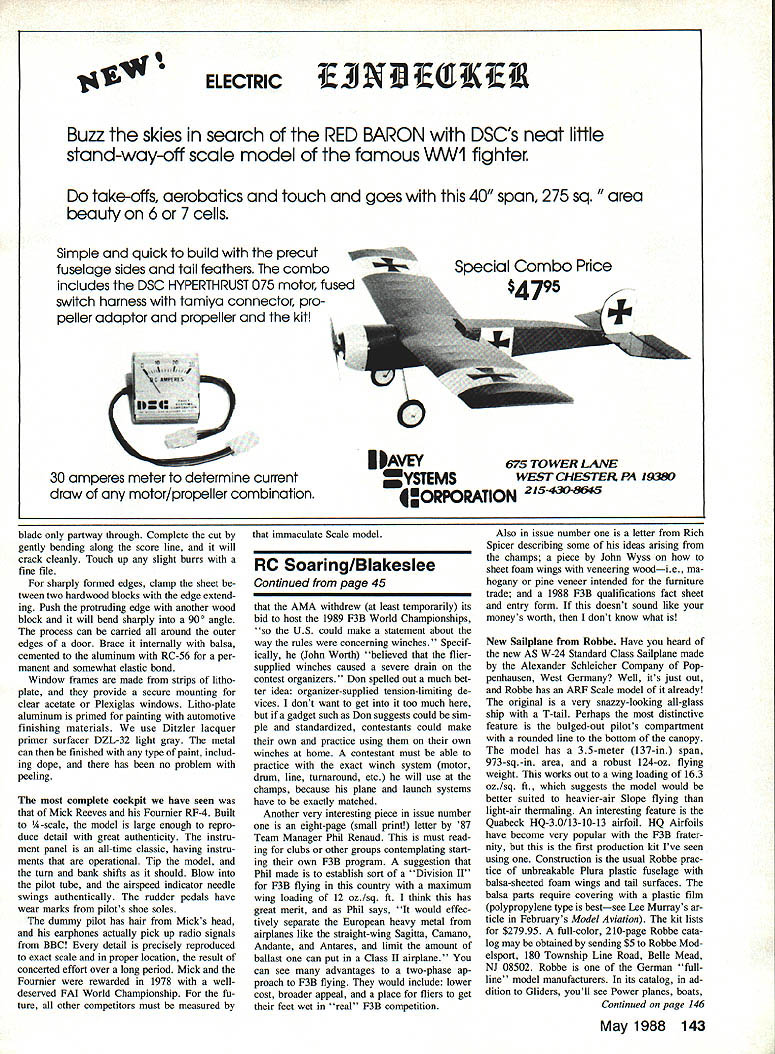
- Editor: Randy Reynolds, Colorado Springs. Randy is a longtime sailplane flier and editor of the Pikes Peak S.S. newsletter. He currently flies the Hans Mueller Comet (the same design Steve Work flew at the World Champs).
- Contributors will include past U.S. F3B team members, Don Edberg (Team Selection Committee chairman), and top European competitors.
- Contact Randy Reynolds: 122 East Uintah, Colorado Springs, CO 80903. Telephone: (303) 471-3160.
Distribution and subscriptions:
- Printing and distribution will be handled by AMA HQ.
- AMA’s F3B competitor list (paid past F3B fees) will automatically receive the newsletter.
- Others can subscribe by sending $5 to AMA HQ, Reston — attention Micheline Madison.
- Randy expects to publish six issues per year.
- Canadian, Mexican, and other international sailplane friends are invited to participate.
Contents of issue #1 (end-January):
- Don Edberg explains qualification procedures; team selection finals likely toward the end of the year (probably Labor Day weekend).
- An eight-page letter by ’87 Team Manager Phil Renaud (recommended reading for clubs starting F3B programs), including a proposal for a Division II with a maximum wing loading of 12 oz./sq. ft. to separate lighter, low-ballast airplanes from the heavier European-style ships.
- Articles by Rich Spicer, John Wyss (on sheeting foam wings with veneer backing), and a 1988 F3B qualifications fact sheet and entry form.
RC Soaring Notes
Working with thin aluminum:
- When cutting scored sheet aluminum, complete the cut by gently bending along the score line; it will crack cleanly. Remove burrs with a fine file.
- For sharply formed edges, clamp the sheet between hardwood blocks with the edge extending and push the protruding edge with another block to bend a 90° angle.
- Brace door panels internally with balsa cemented to the aluminum using RC-56 for a permanent, somewhat elastic bond.
- Window frames can be made from litho-plate strips to mount clear acetate or Plexiglas. Litho-plate takes primer and paint well (Ditzler lacquer primer surfacer DIZL-32 light gray has been used successfully).
Scale cockpit note:
- The most complete cockpit seen recently was Mick Reeves’ 1/4-scale Fournier RF-4. Instrumentation is operational (pitot tube, prop and turn-and-bank shifts, rudder pedal wear, etc.). The dummy pilot even has real hair; the model earned Mick an FAI World Championship in 1978 and sets the standard for Scale models.
Winch rules and championships:
- The AMA withdrew (at least temporarily) its bid to host the 1989 F3B World Championships to make a statement about winch rules. The issue centers on flier-supplied winches placing a burden on contest organizers.
- Don Edberg suggested organizer-supplied tension-limiting devices as a better idea. If a standardized device could be simple, contestants could practice with the exact winch system they’ll use at the champs.
New Sailplane from Robbe
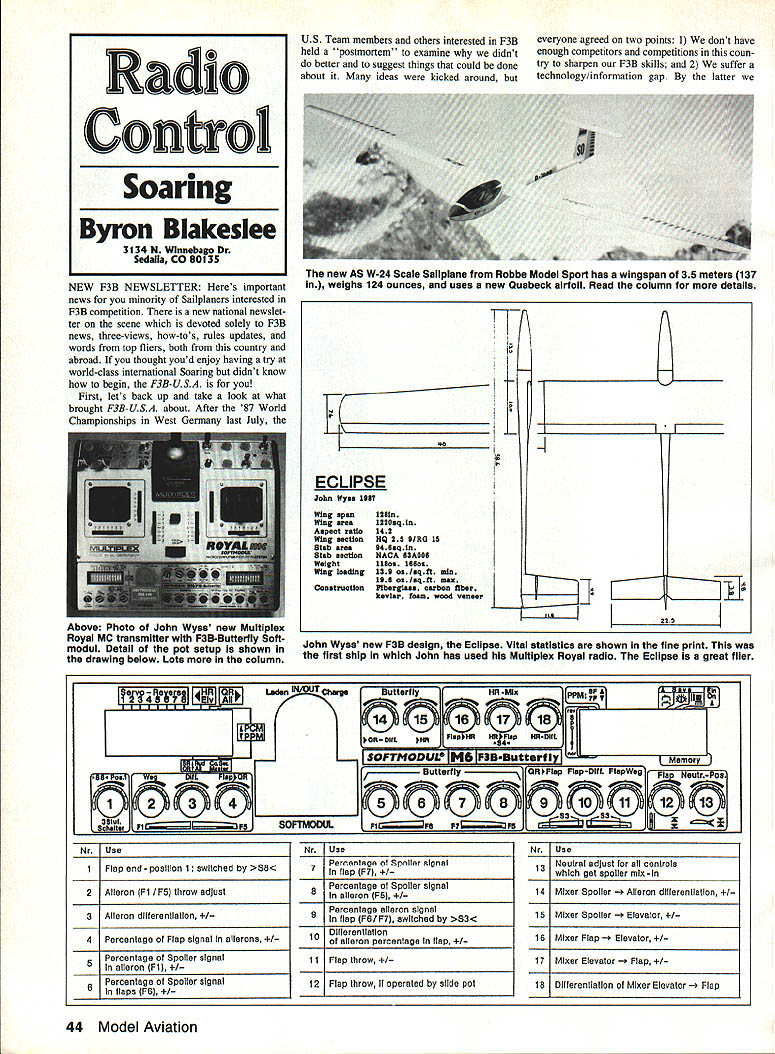
Robbe offers an ARF Scale model of the new ASW-24 Standard Class sailplane (Alexander Schleicher, Poppenhausen, West Germany).
Specifications:
- Span: 3.5 meters (137 in.)
- Area: 973 sq. in.
- Flying weight: 12.4 oz.
- Wing loading: ~16.3 oz./sq. ft. (better suited to heavier-air slope flying than light-air thermal)
- Airfoil: Quaback HQ-3.0/13-10/13
Construction:
- Unbreakable Plura plastic fuselage with sheeted foam wings and tail surfaces.
- Balsa parts require covering with plastic film (polypropylene recommended).
Price and catalog:
- Kit list price: $279.95.
- Robbe catalog (full-color, 210 pages) available for $5 from Robbe Modellimport, 180 Township Line Road, Belle Mead, NJ 08502.
National Scale Fun-Fly
Wil Byers reports on the first-ever Slope fun-fly for Scale Sailplanes and Power Scale planes in the U.S.:
Sponsors and support:
- New sponsors added; Wilshire will participate; Hobby Lobby will send a Scale kit; Gary Anderson (American Sailplane Designs) will support with a kit.
- Other sponsors: Circus Hobbies, Viking Models, Beemer R/C West, Beemer R/C West, Satellite City, and Model Builder Magazine.
Event:
- Dates: May 27–29
- Site: Near Richland, WA
- Info: Send a SASE to Wil Byers, 632 Meadow Dr. E., Richland, WA 99352.
Scale activity is growing in many areas (reports of various large projects and finished models).
Nonallergenic Cyanoacrylates
Cyanoacrylate (CYA) instant glues can cause allergic reactions for some modelers. Michael Foster (South Bay SS newsletter, Silent Flier) reports on Loctite “Prism” odorless CAs that have fewer fumes and less irritation.
Types and notes (Michael’s experience):
- Type 408: Low viscosity; clear; very low fumes. Good substitute for low-viscosity hobby CYAs; cures fast on balsa.
- Type 460: Low-to-medium viscosity; clear; very low fumes. Good all-around glue; stronger than hobby glues; short working time (10–15 sec on balsa, ~30 sec on other woods/fiberglass).
- Type 405: Medium viscosity; white; low fumes. Strong; good for fiberglass and gluing wood to fiberglass.
- Type 410: High viscosity; black; low fumes. Very tough; good for bonding metal and fiberglass.
- Type 411: High viscosity; clear; low fumes. Tough adhesive; higher viscosity often implies better resistance to vibration and landing shock.
- Type 406: Low viscosity; clear; medium fumes. Very liquid with excellent wicking — good for gluing dissimilar materials after assembly.
- Type 401: Low-to-medium viscosity; clear; low fumes. Very versatile; more brittle than toughened CYAs but tolerant of poor surface prep.
Viscosity and fumes descriptions (qualitative):
- Low viscosity: similar to water.
- Medium viscosity: syrup-like.
- High viscosity: forms a bead, like heavy corn syrup.
- Very low fumes: odor difficult to detect; irritation virtually nonexistent.
- Low fumes: odor detectable; irritation avoidable with reasonable ventilation.
- Medium fumes: distinct odor; irritation can occur when working closely.
- High fumes: strong odor; avoidable only with very good ventilation.
Notes:
- These adhesives are more expensive (an 0.7-oz bottle ~ $10).
- Available through Loctite distributors (check local White Pages). Hobby packaging may appear if demand warrants.
The Modern F3B Radio
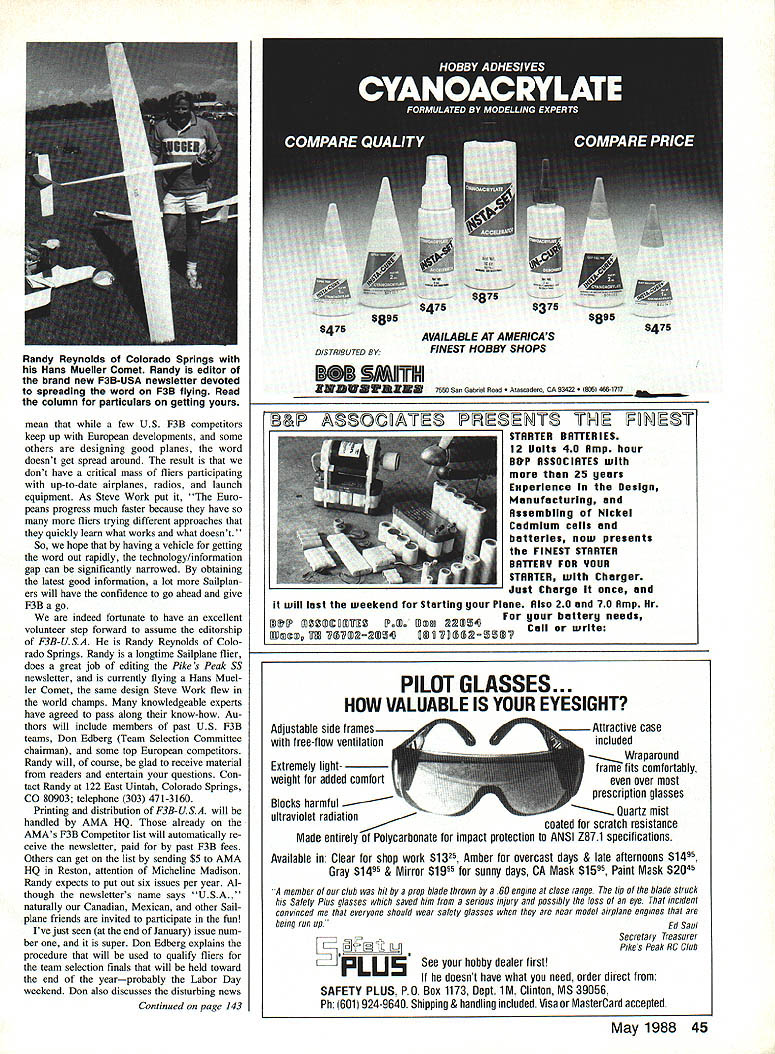
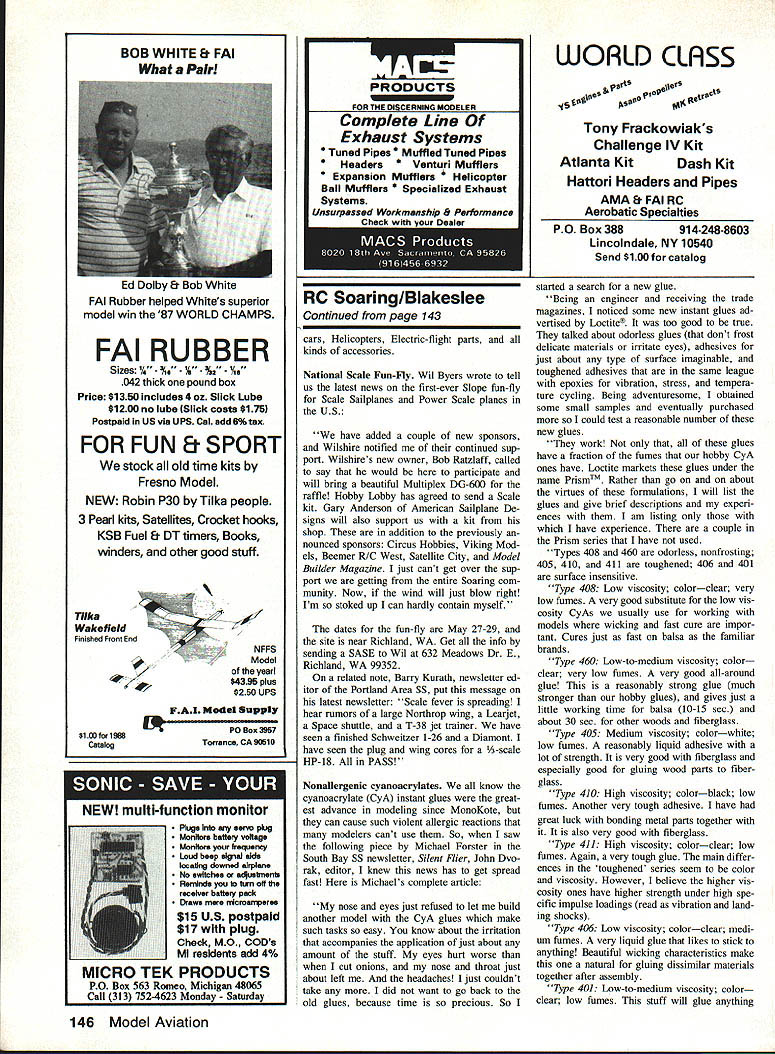
John Wyss reports on the Multiplex Royal MC Expert with the F3B “Butterfly” memory softmodule — a radio designed for the complex control mixing required in competitive F3B sailplanes.
Key features:
- Flexible mixer and control functions, designed for sailplanes.
- Eighteen adjustor pots located under a front cover permit detailed setup.
- Recommended: each control surface should have its own servo with slop-free linkage.
Control setup overview:
- Ailerons: Two adjustors set throw and differential.
- Flaps: Controlled by a three-position switch:
- Launch — flap position infinitely adjustable by spoiler trim lever.
- Thermal/Distance — flaps controlled by a sliding adjustor pot.
- Speed — end point of “Up flap” set by an adjustor pot.
- Aileron-to-flap mixing (and vice versa) provides true camber change across the trailing edge. Multiplex calls this “Quadra-flaps.”
- Landing configuration (“Butterfly,” aka crow or spoilers+flaps): controlled by the spoiler stick; as the stick is pulled back, ailerons deflect up and flaps down. Individual surfaces are adjustable via separate pots. A neutralizing spring on the spoiler stick can return surfaces to landing settings before touchdown.
- Elevator-to-flap mixing: compensates for pitch changes due to flap positions and Butterfly configuration; useful in high-speed turns.
- Aileron-to-rudder mixing: controlled by a two-position “Combo switch.” Rudder coupling is useful for slow-speed flight and launching; some fliers switch it off for fast flight to reduce drag.
User notes:
- The system is versatile but requires study to understand adjustors, pots, switches, and sliders.
- The softmodule is the software module that defines mixing and stores trim settings (memory module restores settings when swapped).
- At the 1987 World Championships, Multiplex radios were the most popular (7 of the top 12 finishers used Multiplex).
Importer and price:
- Importer: Beemer R/C West, 7725 E. Redfield Rd., Suite 102, Scottsdale, AZ 85260. Telephone: (602) 483-9537.
- English catalog: $5 (60 pages).
- Price (Royal set without servos and chargers): around $675 (subject to exchange-rate effects).
Team News and Pins
- A number of recognizable names were on recent winners lists: Don Edberg, Dave Peltz, Michael Selig.
- Matrix Enterprises (San Diego) contributed SpaceCases to carry team planes and equipment. Contact: Matrix Enterprises, 7015 Carroll Road, San Diego, CA 92121. Phone: (619) 450-9590.
- 1987 U.S. Soaring Team pins: a limited number were available at $2 plus $0.39 postage. To order, send a check to U.S. Soaring Team, P.O. Box 928, Albuquerque, NM 87119.
1988 Canadian Nationals (August 6–8)
- Venue changed to the Beverly Centre, Rockton, Ontario, to provide three full days of uninterrupted flying (over 28 hours).
- Site features: sod field, large parking area, washroom facilities, light refreshments. Located on Highway 8, midway between Hamilton and Cambridge, Ontario. Hotels/motels nearby; maps and hotel info will be mailed to entrants.
- Info/contact: Jack Nunn, R 1, Midhurst, Ontario L0L 1X0. Phone: (705) 728-4467.
1988 NSS Soar-In
Marshall Long (NSS Soar-In coordinator) invites clubs to hold an NSS Soar-In any time between May 7 and August 28. Events can be one- or two-day to complete two rounds of the T-4 Cumulative Duration task.
Event details:
- T-4: 15-minute “Add-’Em-Up” with the wrinkle that the three individual flights must not exceed 3, 5, and 7 minutes; going over deducts three points per second.
- L-4 Spot Landing will be used.
- Classes at the Contest Director’s choice (examples): Two-Meter, Standard, Unlimited; or Novice, Sportsman, Expert (any class of sailplane); or “Unlimited — fly what you bring.”
Costs and plaques:
- The National Soaring Society will not charge clubs to hold a Soar-In. Clubs only pay for NSS plaques to award winners.
- Plaques provided by Winning Image; color NSS logo; size ~10 x 12 in.
- Cost: $11.50 per plaque, including shipping to the Contest Director.
Contact to host a Soar-In:
- Marshall Long, 842 Garden Meadow, Universal City, TX 78148.
Note: Soar-In contests should be AMA sanctioned.
CASA 1988 Sailplane Classic
- Event: Capital Area Soaring Association’s 31.5-mile cross-country race
- Dates: May 21–22
- Site: Just off Route 28, 3.5 miles west of Dickerson, MD and 12 miles south of Frederick, MD.
- Info/contact: Guy Dickes, 6331 Paddington Lane, Centreville, VA 22020. Telephone: (703) 830-3631.
Congratulations:
- Guy Dickes completed Level V on October 13; Bob Sowder completed it in November.
Transcribed from original scans by AI. Minor OCR errors may remain.

