
Radio Control: Soaring
Byron Blakeslee 3134 N. Winnebago Dr. Sedalia, CO 80135
National Soaring Skills Symposium — May 28–29, 1988
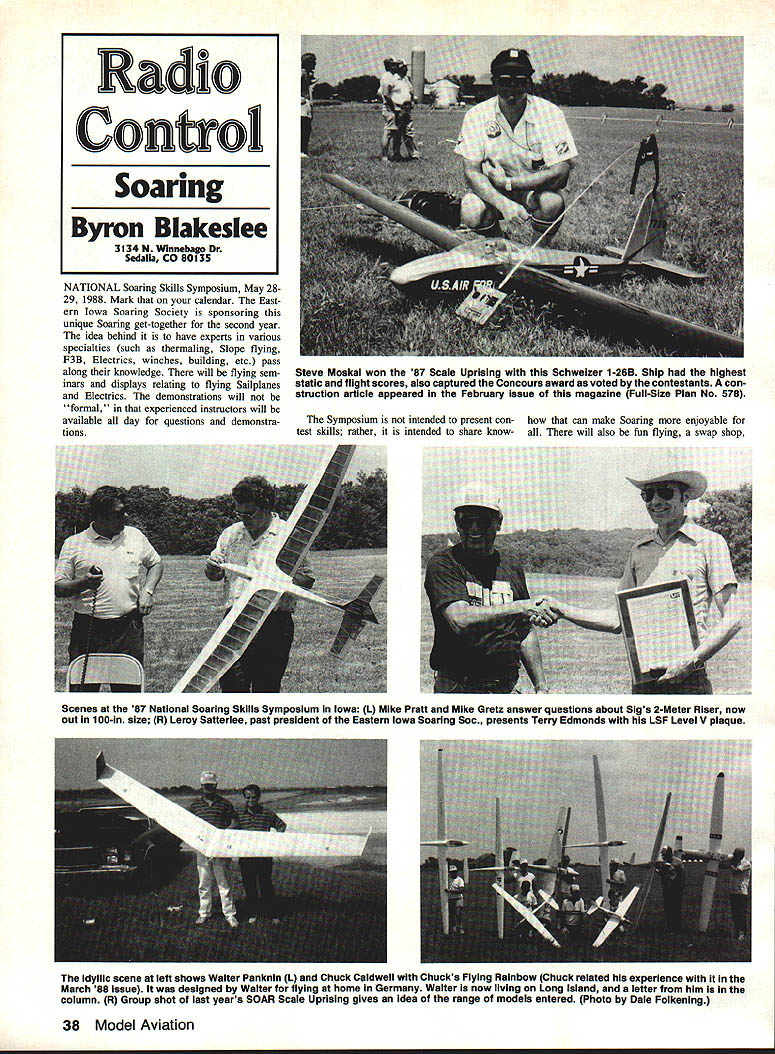
The Eastern Iowa Soaring Society is sponsoring the second annual National Soaring Skills Symposium. The idea is to have experts in various specialties (thermaling, slope flying, F3B, electrics, winches, building, etc.) share their knowledge. There will be flying seminars and displays relating to flying sailplanes and electrics. Demonstrations will be informal, with experienced instructors available all day for questions and demonstrations.
The Symposium is intended to share knowledge that makes soaring more enjoyable for all, not to present contest skills. Activities will include fun flying, a swap shop, a museum visit, and a big Saturday night barbecue. The site is the National Antique Airfield near Blakesburg, IA.
Contact:
- Jim Porter, 100 Bonnie Blvd., Hudson, IA 50643. Tel: (319) 988-4477.
- Alternate: Bob Ferguson, 1105 North Court St., Ottumwa, IA 52501. Tel: (515) 682-4326.
Dr. Panknin and his Flying Rainbow
In the March 1988 column, Chuck Caldwell (Corpus Christi, TX) wrote about the first flight of his flying wing, the Flying Rainbow, designed by Walter Panknin of Gummersbach, F.R. Germany. Walter temporarily moved to the New York City area and sent photos of himself and Chuck with the Flying Rainbow. They are old friends, and Walter traveled to Texas to see his design fly. He visited Terry Good in New Jersey and flew with Terry’s sailplane friends.
Walter is now settled on Long Island, has his workbench set up, and is flying with the Long Island Silent Fliers. If you wish to contact him: 9 Chelsea Place, Great Neck, NY 11021.
SOAR’s Scale Uprising II — September 10–11
This year’s all-Scale event will be held at SOAR’s sod farm in Oswego, IL. Three classes will be flown:
- Sport pre-1946
- Sport post-1946
- Motor Gliders (models must be electric powered)
There will be two events:
- AMA Sport Scale (all three classes)
- Thermal Duration (planes must have flown in Sport Scale)
Electric motor gliders will not have a limit on motor run or number of charges. Duration times will be five to ten minutes depending on conditions, with the objective of flying seven or eight rounds over the two days. For entry forms and additional information, contact:
- Jack Hiner, 2213 Prentis Creek A104, Downers Grove, IL 60516. Tel: (312) 852-0154.
Kevlar for Sailplanes (John Wyss)
Last month John Wyss described his new Multiplex Royal radio. This month he discusses his experiments using Kevlar to construct his latest F3B ship, the Eclipse.
Kevlar has gained popularity as a material for sailplane fuselages in place of fiberglass. Kevlar is an aramid fiber produced by DuPont, originally developed as belting material for automobile tires. It is woven into fabrics similar to fiberglass cloth and can be used in place of fiberglass for many parts.
Advantages and disadvantages:
- Kevlar has higher tensile strength, higher tensile modulus, and lower density than fiberglass — stronger and lighter.
- Negatives: lower compressional strength, more expensive, works poorly with polyester resins, and is generally more difficult to work with than fiberglass.
Test build: Two Eclipse fuselages were laid up using the same mold: one with multiple layers of E-type fiberglass, the other with multiple layers of Kevlar. Both used Safe-T-Poxy epoxy resin.
Problems encountered with Kevlar:
- Cutting: shop scissors and a “pizza-wheel” fiberglass cutter would not cut Kevlar. A special (expensive) set of Kevlar shears worked reasonably well, but not as easily as scissors on fiberglass.
- Trimming: trimming excess material at the mold joint during the rubbery epoxy stage required many single-edge razor blades (about a dozen) versus only four for fiberglass.
- Visibility: Kevlar does not become transparent when saturated with epoxy, making it difficult to see and eliminate air bubbles in the laminate.
- Sanding: Kevlar cannot be sanded; it fuzzes and becomes messy.
Weight and stiffness comparison:
- Fiberglass cones weighed 11 oz.
- Kevlar fuselage weighed 7.5 oz. — a 3.5 oz (32%) reduction in weight.
- Stiffness test: clamping the front portion in a jig and weighting the fin showed both fuselages deflected the same amount, appearing equally stiff.
- An objective strength test has not been devised; usual landing “stress test” will reveal weaknesses. A follow-up report is planned.
Supplier:
- Kevlar fabric and Safe-T-Poxy resin are available from Aerospace Composite Products, P.O. Box 16621, Irvine, CA 92714.
How to Get New Members (Barry Kurath, PASS)
The April ’88 column reported a New Member Kit by the Diablo Valley Soaring Society. Barry Kurath of the Portland Area Soaring Society (PASS) reports on recruiting new fliers by holding classes.
Inspired by a Model Aviation article about a class in building and flying Gentle Ladies, PASS arranged a class at the World Forestry Center. They expected low interest but filled a class of 16 paid students in three weeks by using flyers, newsletters, and E-mail bulletin boards. A second class was scheduled when another 16 were on the waiting list.
Mike Bancroft (in curriculum development at Intel) created a professional class outline. The Portland area has a population of about a million; if a small effort attracted over 30 people to RC soaring, other cities could do similarly. Community adult schools might schedule hobby classes, and classes could attract junior fliers via parent-child pairs. Retirees are also a natural audience.
Contact Barry Kurath for a copy of the PASS course outline:
- Barry Kurath, 3000 N.E. 29th, Portland, OR 97212.
NSS News
Pete Carr retained the NSS presidency over Bob Steele (Ft. Wayne, IN). Pete reported on the NSS Excellence Award Program (EAP):
- The 1987 EAP wrapped up successfully. NSS members compete in local contests and mail results to the coordinator for tabulation. Prizes donated by hobby manufacturers were awarded to top pilots: two radios, seven sailplane kits, and various accessories and hi-starts.
- There is no additional cost to members who want to participate in the EAP.
The 1988 EAP will be coordinated by Doug Dorton of Salt Lake City, editor of the NSS journal Sailplane. For a sample copy of Sailplane or information about the EAP, contact:
- Doug Dorton, 3058 Bernina Dr., Salt Lake City, UT 84118.
- Or Pete Carr, 329 Little Ave., Ridgeway, PA 15853.
The NSS is considering establishing a new national contest called the Soaring Masters, open only to sailplaners who qualify in defined ways. The idea is to bring top competitors together in one event similar to Pattern, Pylon, and Scale masters contests. Comments and interest are welcome.
R/C Soaring Digest
Jim Gray has retired from Model Airplane News and moved from New Hampshire to Arizona. He’s devoting much of his time to R/C Soaring Digest (R/C S.D.). Subscription:
- Normal: $16/year
- AMA special: $14/year for AMA members
Send checks to: Jim Gray, P.O. Box 1079, Payson, AZ 85547.
F3B/U.S.A.
This newsletter is devoted to F3B and advanced soaring. Randy Reynolds plans to mail the next issue about the first of May and requests material from interested fliers. To get involved or obtain an issue, send $5 to AMA HQ in Reston, VA, attention Michele Maddison. For material or correspondence:
- Randy Reynolds, 122 East Loma, Colorado Springs, CO 80903. Tel: (303) 471-3160.
Scale R/C Sailplane Fun-Fly — Richland, WA (May 27–29, 1989)
There will be a Scale R/C Sailplane fun-fly in Richland, WA. Although this column appears in the June issue, readers may still be within time to enter events at the end of May (depending on the year reference). Will Byers reports strong preregistration and entries from across the U.S. and Europe. The event offers the chance to see many large-scale ships up close. As a fun-fly rather than a contest, fliers will have time to discuss their models and answer questions.
Contact:
- Will Byers, 632 Meadows Dr. E., Richland, WA 99352. Tel: (509) 627-5224.
Transcribed from original scans by AI. Minor OCR errors may remain.

