
Radio Control: Soaring
Byron Blakeslee 3134 N. Winnebago Dr. Sedalia, CO 80135
Club of the Month — Long Island Silent Flyers (LISF)
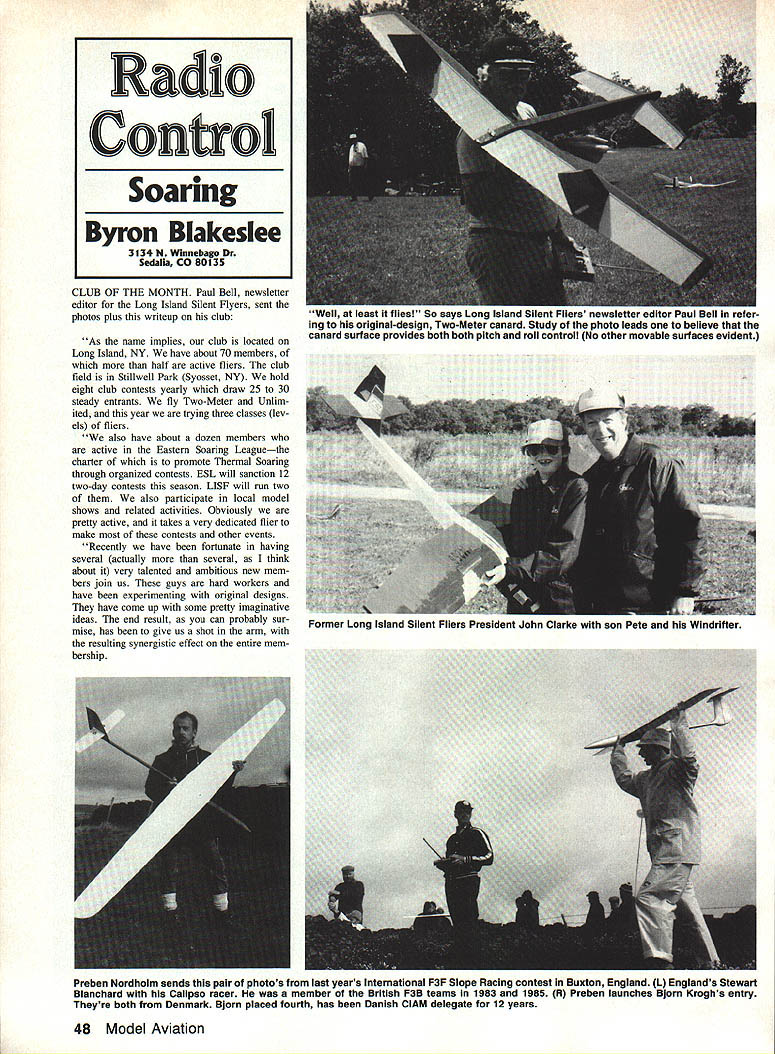
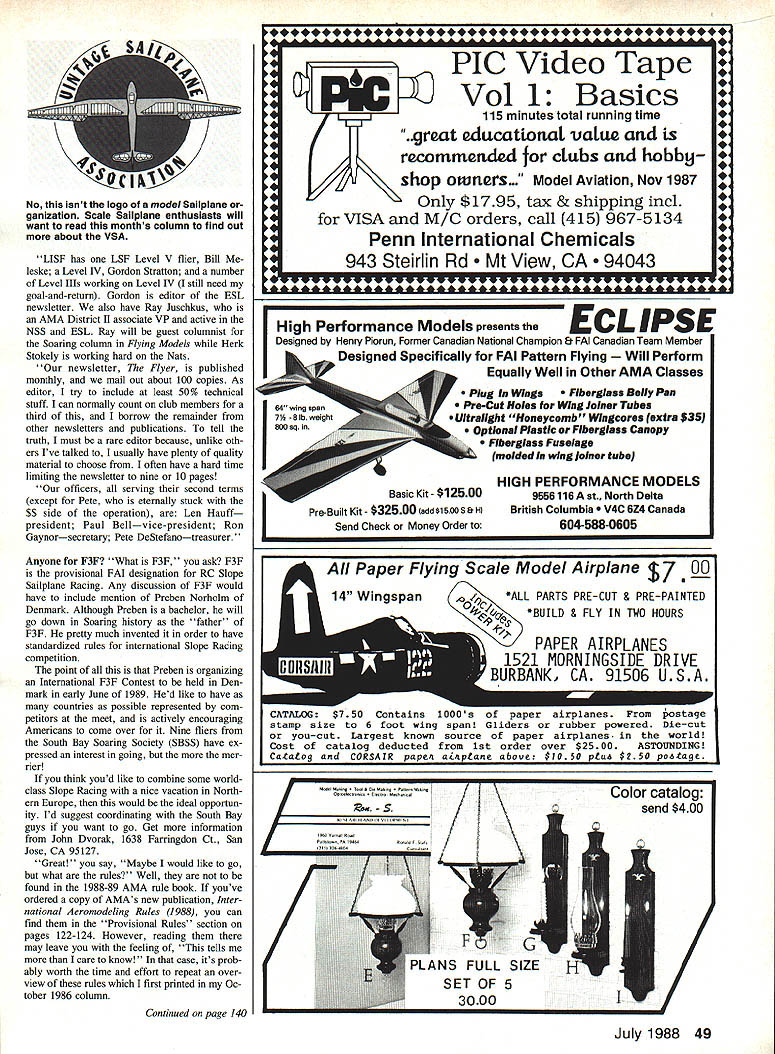
Paul Bell, newsletter editor for the Long Island Silent Flyers, sent photos and this write-up on his club.
As the name implies, our club is located on Long Island, NY. We have about 70 members, of which more than half are active fliers. The club field is in Stillwell Park (Syosset, NY). We hold eight club contests yearly, which draw 25 to 30 steady entrants. We fly Two-Meter and Unlimited classes, and this year we are trying three classes (levels) of fliers.
A dozen members are active in the Eastern Soaring League (ESL), whose charter is to promote thermal soaring through organized contests. ESL will sanction 12 two-day contests this season; LISF will run two of them. We also participate in local model shows and related activities. Obviously we are pretty active, and it takes a very dedicated flier to make most of these contests and other events.
Recently we have been fortunate in having several very talented and ambitious new members join us. These guys are hard workers and have been experimenting with original designs. They have come up with some imaginative ideas. The end result has given us a shot in the arm and produced a synergistic effect on the entire membership.
LISF notable fliers and volunteers:
- Bill Meleske — LSF Level V flier
- Gordon Stratton — LSF Level IV flier and editor of the ESL newsletter
- Several Level III fliers working toward Level IV
- Ray Juschkus — AMA District II associate VP; active in NSS and ESL; will be guest columnist for the Soaring column in Flying Models
Our newsletter, The Flyer, is published monthly and we mail out about 100 copies. As editor, Paul Bell tries to include at least 50% technical content. He normally gets about one-third of that from club members and borrows the remainder from other newsletters and publications. He often has a hard time limiting the newsletter to nine or ten pages.
Club officers (serving second terms, except Pete on the treasurer side):
- Len Hauff — president
- Paul Bell — vice-president
- Ron Gaynor — secretary
- Pete DeStefano — treasurer
If you have club news, contest write-ups, or pictures (people, contest workers, spectators), send them in — list top five finishers and number of entrants for each event if possible.
Anyone for F3F?
F3F is the provisional FAI designation for RC slope sailplane racing. Any discussion of F3F must include Preben Nordholm of Denmark, who is widely regarded as the "father" of F3F for having helped standardize the rules for international slope-racing competition.
Preben is organizing an International F3F Contest to be held in Denmark in early June 1989 and is encouraging wide international participation. Nine fliers from the South Bay Soaring Society (SBSS) have expressed interest in attending. If you want information or to coordinate with others, contact:
- John Dvorak, 1638 Farringdon Ct., San Jose, CA 95127
If you have AMA's International Aeromodeling Rules (1988), the F3F provisional rules are in the "Provisional Rules" section (pages 122–124). If you prefer a clearer overview, see the explanation first printed in my October 1986 column and reproduced below.
F3F rules (from Preben Nordholm)
These are the F3F Slope Racing rules used in the pilot stands in the center of a 330-ft. (100-meter) course. After launch, the pilot has 30 seconds to get the plane onto the course. Ten laps are then timed. The winner of each round receives 1,000 points — it's exactly like the F3B Speed task. A contest has a minimum of five rounds and a maximum of 10, with one throw-out round. It's very simple for the CD, but infinitely difficult for the competitor.
Top times in good weather range from 50 to 60 seconds. The best performance at the North Sea Cup was 45.4 seconds in a 22-mph wind with a wind direction 20° from one side. The Danish record is 40.3 seconds in a 40-mph wind.
A typical Danish Slope Racer has twin-wings for roll, flaps coupled to elevator, and no brakes. Wingspans average 8 to 8.5 ft., and popular modified airfoils include Eppler 180 or 374 (the E374 is thinned from 8.5% to 10%). A common "Thy Combination" uses an E180 root with E374 tips thinned to 10%. Turning technique and reduced ballast are the names of the speed game. Racing in high winds uses 13–15 oz./sq. ft. unballasted, up to 18–20 oz./sq. ft. when ballasted.
Jerry Arena of SBSS — one of California's most successful slope racers — prefers four-plane mass starts because of the excitement and spectator appeal, despite the higher risk of midairs. Preben's one-at-a-time format was chosen because top F3F planes are sophisticated and expensive, and the fastest slot on the slope can be a very narrow groove: simultaneous mass starts could become unacceptably expensive.
F3B/U.S.A. newsletter and F3B team selection
The newsletter F3B/U.S.A. is available to anyone who enters ($20 entry fee) or shows intent to enter (SS pre-entry fee) the 1989 U.S. FAI RC Soaring team selection program. Send the appropriate fee to AMA HQ (Attention: Micheline Madison) to be placed on the mailing list. The newsletter is produced to disseminate FAI soaring information to those interested in the F3B team selection process.
Below is an excerpt from the first issue by John Wyss on wood wing skins — a useful construction technique for fast, strong wings.
Wood wing skins — "Flexible Hardwood" (excerpt by John Wyss)
For builders seeking a material that is fast to build, extremely strong, and rivals high-quality wood wings, consider "Flexible Hardwood." This veneer laminate consists of a thin wood layer bonded to a paper backing. The wood is about 1/64 in. thick and the paper backing is either .005 or .010 in., for a total thickness of approximately 0.0217 in. (about 1/64 in).
- Material comes in 4 x 8 ft. sheets and is available in many wood types (pine and mahogany used successfully). A 4 x 8 ft. sheet of mahogany weighs about 44 oz. (1.38 oz. per sq. ft.), acceptable for F3B or cross-country ships (not recommended for floaters).
- To use: prepare wing cores (blue foam is common), install spars, servo wiring and joints, and save trimmed material to use as core beds. Make the core chord 3/8 to 1/2 in. less than the bed width to provide trailing-edge support. Trim and sand trailing edge sharp.
- Skin attachment method: place a layer of 3.7-oz. C-type glass cloth on the top side of the skin, saturate the cloth with Safe-T-Poxy (use sparingly), then place core between two wet skins on the core beds. Pin through skin and cores into the beds and clamp (vacuum bag also works).
- After cure: trim and sand the trailing edge, add a spruce leading edge, sand skin lightly with 400-grit, and spray with a clear wood finish. Final finish can be enhanced with extra-fine steel wool. Cut flaps and ailerons free after finishing coats.
- Stabs can be made by epoxying veneer to blue foam without glass cloth.
- Source: Flexible Hardwood available from Consolidated Hardwoods, Route 2, Box 109, Broomfield, CO 80020. Phone: (303) 666-1839. Material costs about $0.60 per sheet FOB; call for current prices and shipping.
Dodgson "skunk works" — Super Windsong and AFART
Bob Dodgson reports on the Super Windsong development and production choices for fuselages.
Super Windsong changes and testing:
- No sign of high-speed flutter so far (tow and flight).
- Significant increase in airframe strength (estimated ~40% stronger).
- Changes include: larger wing joiner rod (1/2 in.), larger stab pivot wire (1/4 in.), heavier L-2 flap linkage (1/8 in. stock), fully fiberglassed flap and aileron surfaces (4-oz cloth, thin epoxy), ~50% more spruce in main spar cross-section (main spars 3/8 x 3-1/2 in.), and smaller spruce spar extensions nearly to wing tip.
- Fiberglass skin on control surfaces removes need for 1/4-in. ply trailing-edge reinforcement, so no net gain in weight there; torsional strength is significantly increased.
- Test ship weight just under 70 oz.; estimated total weight gain under 2 oz.
- Ballast tubes included but ballast testing pending.
- New Windsong will include the four-channel AFART mixer (see below). If testing completes successfully, availability expected in June; price will increase slightly.
Production/fuselage materials:
- Dodgson considered epoxy fuselages but found polyester may be a better choice for production and supply. Polyester gives a better chemical bond for polyester fuselages; slow-cure epoxy gives a better bond to polyester than epoxy-to-epoxy glues on epoxy fuselages.
- Both polyester and epoxy fuselages must be sanded and wiped with acetone before bonding. Polyester-on-polyester repairs give the strongest repair bond.
- In composite fuselages, bond strength between materials is critical so wood and fiberglass act as one under load.
The new Windsong AFART mixer:
- AFART (ailerons-for-flap and reflex-trim) uses a fourth servo solely for aileron trim, connected to the dowel so it both pushes and pulls. Up trim on the flap servo moves both ailerons up about 6°, substantially increasing flying speed for the Eppler 214 wing.
- The AFART servo can also move ailerons UP about 45° for a "butterfly" (ailerons up / flaps down) spoiler configuration.
- Modern radios with electronic mixes can control both functions from a single input; otherwise one control input is required per function.
- For diagrams and Dodgson catalog, send two stamps for postage to: Dodgson Designs, 21230 Damon Rd., Bothell, WA 98021. Phone: (206) 776-8067.
Dodgson plans to include improved instructions and computer-generated leading-edge templates in the new kit and may begin a Dodgson Designs newsletter for kit buyers.
World Interglide 1988
While a formal FAI World Championship for Thermal Duration hasn't been established, the closest event is the Interglide contest sponsored by the British Association of RC Soarers (BARCS), held every other year. The 1988 Interglide will be in Warwick, England, on August 6–7. BARCS encourages international entries. For information, contact:
- Sam Hitchman, 7 Verney Close, Lighthorne, Warwickshire, CV35 0AZ, England
Hitachi Masters of Soaring (full-scale)
The second Hitachi Masters of Soaring (full-scale) meet was held at Estrella Sailport near Phoenix, AZ. The contest for Standard Class (15-meter) sailplanes featured high-quality air-to-air footage and interviews. Winner: Ingo Renner (Australia), a four-time world champion.
Two observations:
- Major sponsorship (Hitachi) gave excellent exposure and branding.
- Brian Spreckley (former British world champion) emphasized relaxation as critical to making correct decisions — a reminder that staying calm improves performance.
Vintage Sailplane Association (VSA)
The VSA supports preservation and flying of older full-size sailplanes and is also assisting RC scale modelers by providing documentation and photo kits.
VSA photo-kit program (from Bungee Cord, spring 1988):
- VSA archivist Lee Small is compiling an inventory of color photos of popular vintage sailplanes and specific ships.
- Owners are asked to send exposed but undeveloped rolls of color print film showing interior, instrument panel, trim details, markings, and multiple angles of the airframe. Lee will develop the film, make prints, and produce photo kits for scale model builders.
- Send exposed rolls to Lee; VSA will publish a list of available photo kits.
To join VSA:
- Send $10 to Scott Ahrarpk, Rt. 1, Box 239, Lovettsville, VA 22080. Jan Scott is editor of Bungee Cord.
SOAR Great Race and Scale Uprising
- The 1988 SOAR Great Race was held June 11–12, 1988. The souvenir booklet "The 1987 Dan Pruess Memorial Great Race XI" is available for $3 from SOAR, 23546 W. Fern, Plainfield, IL 60544.
- The 1988 Scale Uprising will be at the club field on September 10–11. For information, contact Steve Moskal, 30 S. Kensington Ave., La Grange, IL 60525. Phone: (312) 352-4083.
Contest awards
AMA member Jim Jennings offers a range of trophies and plaques designed especially for modelers. Request a free brochure from:
- Jennings Trophy Sales, 813 Walton Mall, P.O. Box 1121, Henderson, TN 37075. Phone: (615) 822-0857.
Miscellany / Notes
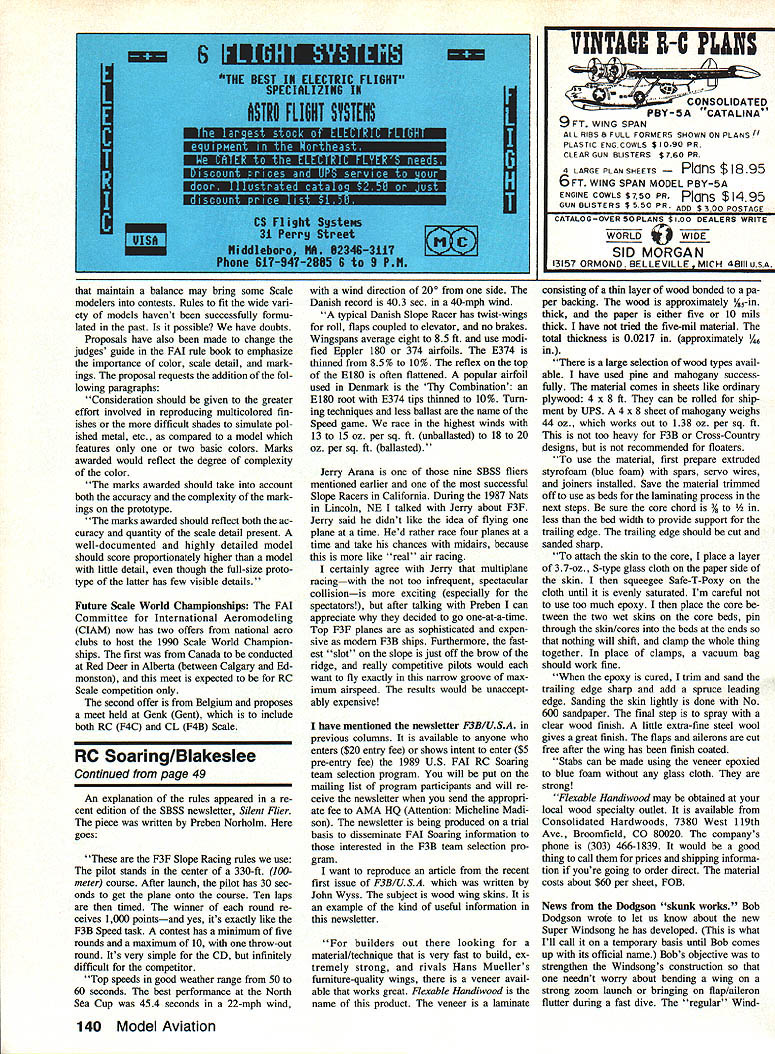
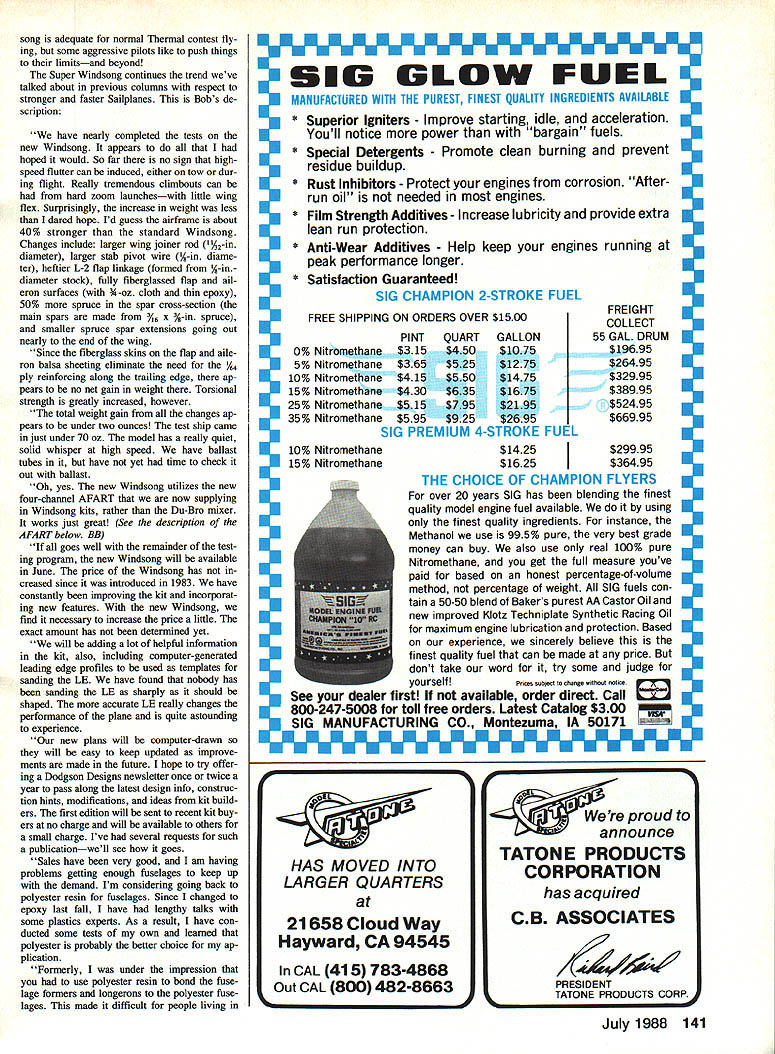
- Preben Nordholm sent photos from last year's International F3F slope racing contest at Buxton, England (featuring Stewart Blanchard's Calipso racer and Bjørn Krogh).
- A photo in the LISF newsletter shows an original-design Two-Meter canard that appears to use the canard surface for both pitch and roll control.
- Next month: Recommended RC frequencies for pylon racing.
When responding to advertisers, mention that you read about them in Model Aviation.
See you at the races!
Transcribed from original scans by AI. Minor OCR errors may remain.

