
Radio Control: Soaring
Byron Blakeslee 3134 N. Winnebago Dr. Sedalia, CO 80135
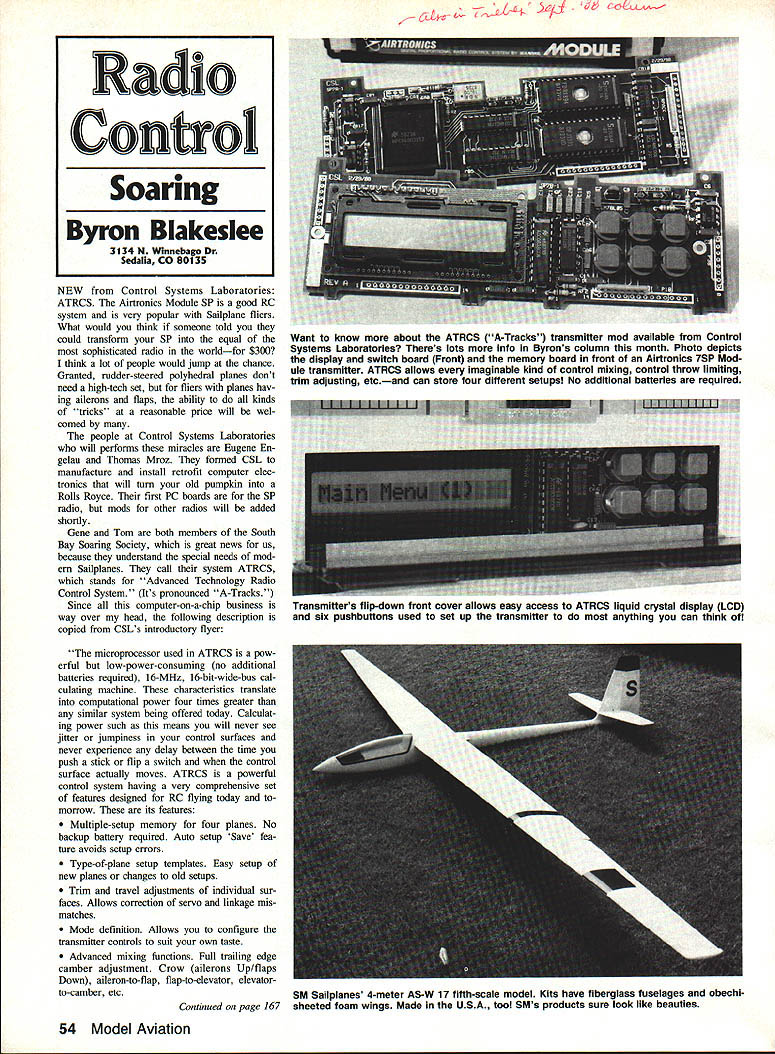
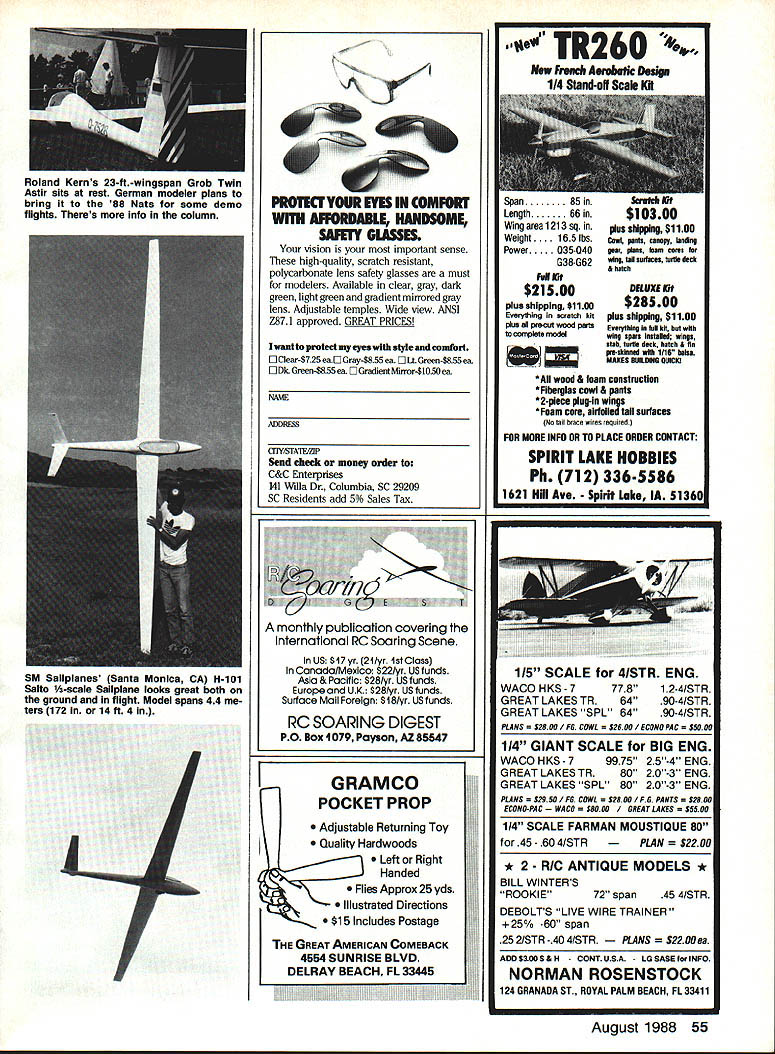
ATRCS (A-Tracks) — Advanced Technology Radio Control System
Control Systems Laboratories (CSL), formed by Eugene Engelau and Thomas Mroz, is offering a retrofit that installs computer electronics into existing Airtronics Module SP transmitters (and soon other radios) to add advanced features for roughly $300. Gene and Tom are members of the South Bay Soaring Society and designed ATRCS with modern sailplane needs in mind. The system is called ATRCS — Advanced Technology Radio Control System — pronounced “A‑Tracks.”
System description (from CSL flyer)
The microprocessor used in ATRCS is a powerful but low‑power‑consuming device (no additional batteries required). It is a 16‑MHz, 16‑bit‑wide‑bus processor whose computational power is about four times greater than similar systems available at the time. This computing power reduces jitter and delay between stick/switch input and control‑surface movement.
ATRCS features include:
- Multiple‑setup memory for four planes (no backup battery required).
- Auto setup “Save” feature to avoid setup errors.
- Type‑of‑plane setup templates for easy configuration of new planes or changes to existing setups.
- Trim and travel adjustments for individual surfaces (to correct servo/linkage mismatches).
- Mode definition to configure transmitter controls to personal preference.
- Advanced mixing functions: full trailing‑edge camber adjustment; crow (ailerons up / flaps down); aileron‑to‑flap; flap‑to‑elevator; elevator‑to‑camber; etc.
- Adjustable preset trims for Launch, Cruise, Speed — simple switch selection simplifies pilot workload during launch.
- In‑flight setup changing — switch plane configuration “on the fly” to try adjustments or enhance performance for particular events.
- Landing‑position flap/therm selection — set trip points to trigger aileron/spoiler deployment.
- Compatibility with Airtronics FM/PPM and FM/PCM receivers. Initially available for Module 7SP; other brands to follow.
Conversion process and contact
- Arrange a reservation with CSL; they will send a shipping kit for your transmitter.
- Conversion takes about 10 days.
- The modified transmitter is returned with a user’s manual and menu‑style setup prompts designed to help enter correct information and prevent accidental loss of setups.
Full information from: Control Systems Laboratories, 1361 Fallen Leaf Dr., Milpitas, CA 95035. Phone: (408) 946‑4142.
SM Sailplanes — Vince Parizek
Vince Parizek produces a limited number of mostly scale sailplane kits. Although called “kits,” many components are largely finished by Vince, so production is low and a waiting list of about four weeks may apply.
Background (from Vince)
- Grew up in Europe and became interested in scale gliders.
- After moving to the U.S. in 1968 he found few scale ships were made domestically, so he began offering a complete line at reasonable prices.
- He builds every kit himself, keeping production deliberately limited.
Models and construction
SM offers two scale models:
- Start & Flug H‑101 Salto — 4.4‑meter wingspan (approx. 1/3 scale of the full‑size Salto).
- Fuselage length: 67 in.
- Wing area: 1.48 m²
- Weight: ~8.5 lb
- Wing loading: 16–18 oz/sq ft
- Airfoil: modified Ritz II
- Model is aerobatic (Salto means “loop”).
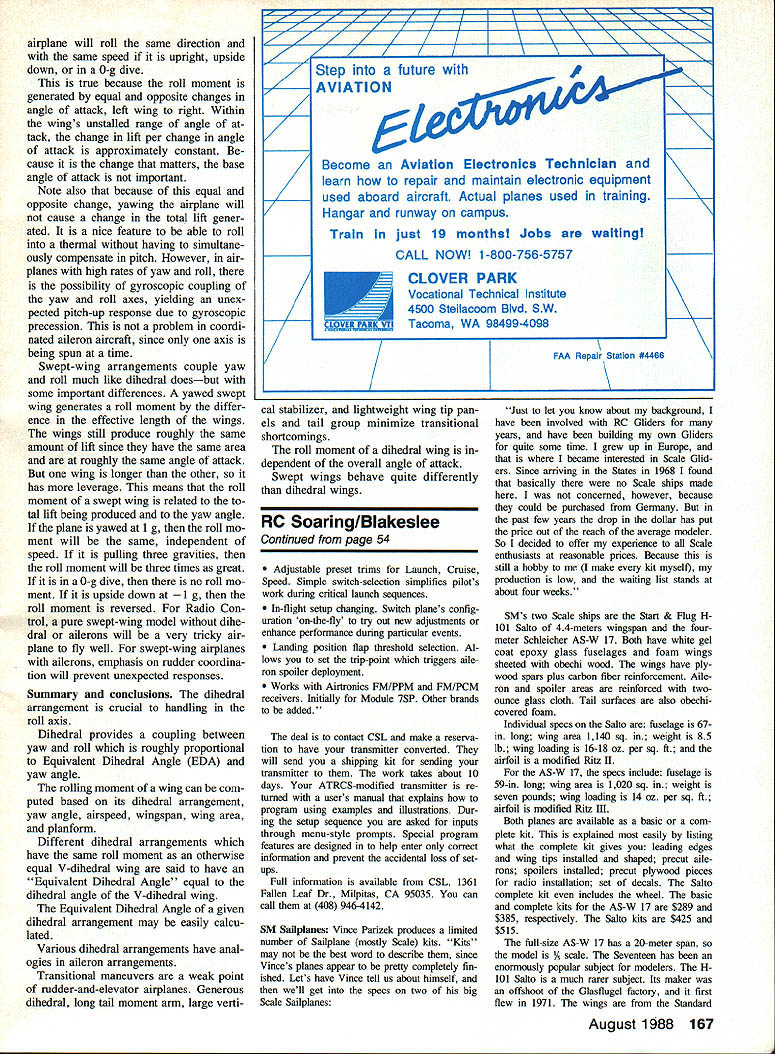
- AS‑W 17 — 4.0‑meter wingspan (approx. 1/5 scale of the full‑size 20‑m span Seventeen).
- Fuselage length: 59 in.
- Wing area: 1.00 m²
- Wing loading: ~14 oz/sq ft
- Airfoil: modified Ritz III
Construction notes (both models):
- Center section: spruce spars.
- Wings: foam cores sheeted with balsa; plywood nose ribs; glass‑cloth reinforcement.
- Aileron and spoiler servos enclosed in the wing.
- Tail surfaces: obeche‑covered foam.
- Available as a basic kit or a complete kit (complete includes preinstalled leading edges/wingtips, spoilers, wing joiners, preformed cowl, plywood parts for radio installation, decals, hardware, and plans).
Pricing (at time of writing):
- AS‑W 17: Basic kit $289; Complete kit $385.
- H‑101 Salto: Basic kit $425; Complete kit $515.
Contact: Vince Parizek, 2703 Santa Monica Blvd., Santa Monica, CA 90404. Phone: (213) 828‑2300.
Giant Sailplane — Roke Models / Twin Astir
Roland Kern of Roke Models (Wannweil, F.R. Germany), maker of the 23‑ft‑span Grob Twin Astir scale sailplane featured previously, plans to attend the AMA Nats in Virginia. He will give demonstration flights at the soaring site (before or after the day’s competition flying) and intends to enter the Scale competition with a 4‑meter ASK‑18 model. Multiplex is lending Roland radios on U.S. frequencies. Roland Kern will be taking orders for Twin Astir kits (estimated price about $2,500). Importer: Tony Arnox, Miami, FL.
Paris FA/CIAM Meeting — F3B Winch Rules and 1989 Worlds
John Grigg, chairman of the CIAM F3B Subcommittee, reported two items from the April meeting:
- New rules to limit winch power.
- The 1989 F3B World Championships will be in France, about 40 km south of Paris.
New winch rules
- Minimum internal resistance values for stalled‑winch condition:
- Winch motor: 15 milliohms.
- Battery: 6 milliohms.
- If a winch does not meet these minimums, permanent fixed resistance must be installed.
- These limits reduce winch power to about 1.6 kW and line pull to 40 kg or less.
- The weak‑link rule is dropped.
- The new rule is adopted immediately for safety reasons.
Notes from the subcommittee:
- The internal‑resistance idea came from the Czech delegation.
- Rolf Decker (two‑time World Champion) demonstrated a recording volt‑ammeter and a test method: allow the winch to start, then stall it quickly (in less than one revolution) and measure resistance before heat buildup skews readings.
- Contest organizers must test motor and battery together and seal resistances so nothing can be altered. U.S. F3B finalists will need to measure and adjust winches prior to finals. Schematics of the test apparatus will be provided ASAP.
- 1.6 kW is reportedly more than a stock Ford starter motor commonly used in the U.S. can produce, but less than the modified “souped‑up” Ford starters some teams have used. Stock Ford motors are said to have internal resistance around 18–19 milliohms.
- The long‑term goal is to reduce winch power to ~1.1 kW.
This approach appears to be a practical solution to the winch‑power problem and should improve safety and competition fairness.
League of Silent Flight (LSF) News
New officers:
- President: Bob Steele, Fort Wayne, IN.
- Vice‑President: Ray Hayes, Romeo, MI.
- Secretary: Jim Martin, Xenia, OH.
- Treasurer: Susie Lipp, Defiance, OH.
LSF priorities:
- Update mailing list: an “active” member is one who has communicated with LSF in the last two years (sent in a voucher) or is a Level IV or V with a current address. If you don’t meet these criteria and want to remain on the list, send a card to: LSF, P.O. Box 647, Mundelein, IL 60060, U.S.A., requesting “active” status.
- Promote regional LSF contests in August or September 1988. The goal is 15–20 regionals; winners receive LSF plaques and are invited to the 1989 LSF Internationals (tentatively July 31–Aug. 6).
For information about hosting a regional, contact Ray Hayes, 6598 Brookhill Dr., Romeo, MI 48065. Phone: (313) 752‑6163.
The executive board aims to revitalize LSF and restore the spirit of R/C soaring in the U.S. Please update your address by postcard.
National Soaring Society (NSS) — Excellence Award Program (EAP)
The 1988 NSS Excellence Award Program is managed by Ralph Dorow (Long Island). Winners will be announced at the Nats.
How EAP works:
- Contests from March through November that meet simple criteria and have at least 10 contestants are included.
- Your contest score is used as points toward the EAP.
- The member who accumulates the most points over six contests wins.
- After a contest, fill out a card, have the Contest Director sign it, and mail it to the EAP office.
For more information, call Ralph Dorow: (201) 966‑1625.
Sources for Materials and Supplies
A list of suppliers and what they offer:
- Aeropac — George Spar, P.O. Box 16621, Irvine, CA 92714. Sources for Kevlar and Safe‑T‑Poxy (used for Kevlar fuselages referenced by John Wyss).
- Viking Models U.S.A., 2026 Spring Lake Dr., Martinez, CA 94553. Phone: (415) 689‑0766. Large selection of fiberglass fuselages (including scale types). Catalog shows fuselage photos, wing profiles, and approximate usable wingspans. Includes clear canopies and top trays.
- Wilshire Model Center, 2386 Santa Monica Blvd., Santa Monica, CA 90404. Phone: (213) 822‑9362. Full sailplanes‑only catalog with a wide range of kits and accessories for scratch builders.
- SR Batteries, Box 287, Bellport, NY 11713. Phone: (516) 286‑0079. Supplies batteries, Deans connectors, piggy‑back transmitter packs for record or long flights, Ace RC chargers, and Heavy Duty Digipace cyclers (made specially for SR Batteries).
- Aircraft Spruce and Specialty Co., P.O. Box 424, 201 West Tuslow Ave., Fullerton, CA 92632. Phone: (800) 824‑1930. Supplier for full‑size aircraft builders; excellent catalog with cloths, resins, and specialized tools useful to modelers.
- Cadillac Plastics, Houston, TX. Phone: (713) 674‑2400. Sells items such as 1/4‑mil Mylar for covering and materials for vacuum‑bag wing construction.
- Hobby Woods, P.O. Box 48, Linden, CA 95236. Phone: (209) 887‑3974. Recommended for quality balsa and good service for scratch builders.
- Gougeon Brothers, P.O. Box X908, Bay City, MI 48707. Phone: (517) 684‑7286. Marine industry supplier; source for West System epoxy (105 resin with 205/206 hardener), vacuum pumps, epoxy dispensers, fiberglass cloth, and carbon fiber.
Princeton Low‑Reynolds‑Number Airfoil Tests — Progress Report
Michael Selig and John Donovan report progress on wind‑tunnel tests of low‑Reynolds‑number airfoils. Current status:
- Instrumentation and support equipment are in place.
- Lift will be measured with a specially designed one‑component force balance.
- Drag will be measured by the “wake rake” method, traversing the airfoil wake with a miniature total‑head‑pressure probe.
- Other measurements: angle of attack, free‑stream dynamic pressure, static pressure upstream and downstream of the model.
- Data will be digitized via a 12‑bit A/D converter connected to an IBM PC/XT for storage and analysis.
- A detailed description of apparatus and procedures will be published in a forthcoming Soaring article.
Acknowledgments and contributions:
- Equipment, time, and funding contributions from David Fraser (Fraser‑Volpe Corp.), Professor A.J. Smith, S.H. Lam, H.C. Curtis (Princeton University), Ray Olsen (AZ), Professor M.D. Maughmer (Penn State), and Preben Norholm (Denmark).
- Many volunteers offered to build wind‑tunnel models (extensive list of names and locations). The project expresses thanks and will report when measurements begin.
These experiments are important for validating and improving Selig airfoils; any improvements will significantly impact model sailplane performance.
Electrostatic Stabilizer
Maynard Hill’s October 1987 column described electrostatic stabilizers and generated interest. Ready‑made stabilizers are available from Maynard for $17.45 plus $2 postage.
Contact: Aero Probe Technology, 2001 Norvale Rd., Silver Spring, MD 20906.
1988 Ohio Cup Contests
The Dayton Area Thermal Soarers (DARTS) will host a series of four contests; the Ohio Cup will be awarded based on the total of a flier’s best two scores.
Dates:
- June 18–19, 1988
- August 20–21, 1988
Contest Directors:
- Jim Martin — CD for the June contests. Phone: (513) 376‑9046.
- Gale Leach and Jerry Shamp — CDs for the August contests. Phones: Gale Leach (513) 429‑2543; Jerry Shamp (513) 843‑5085.
Statewide bragging rights are at stake.
Transcribed from original scans by AI. Minor OCR errors may remain.

