
Radio Control: Soaring
Byron Blakeslee 3134 N. Winnebago Dr. Sedalia, CO 80135
Mid‑Columbia Slope Scale Fun‑Fly and Soaring Social (Richland, WA — Memorial Day Weekend, 1988)
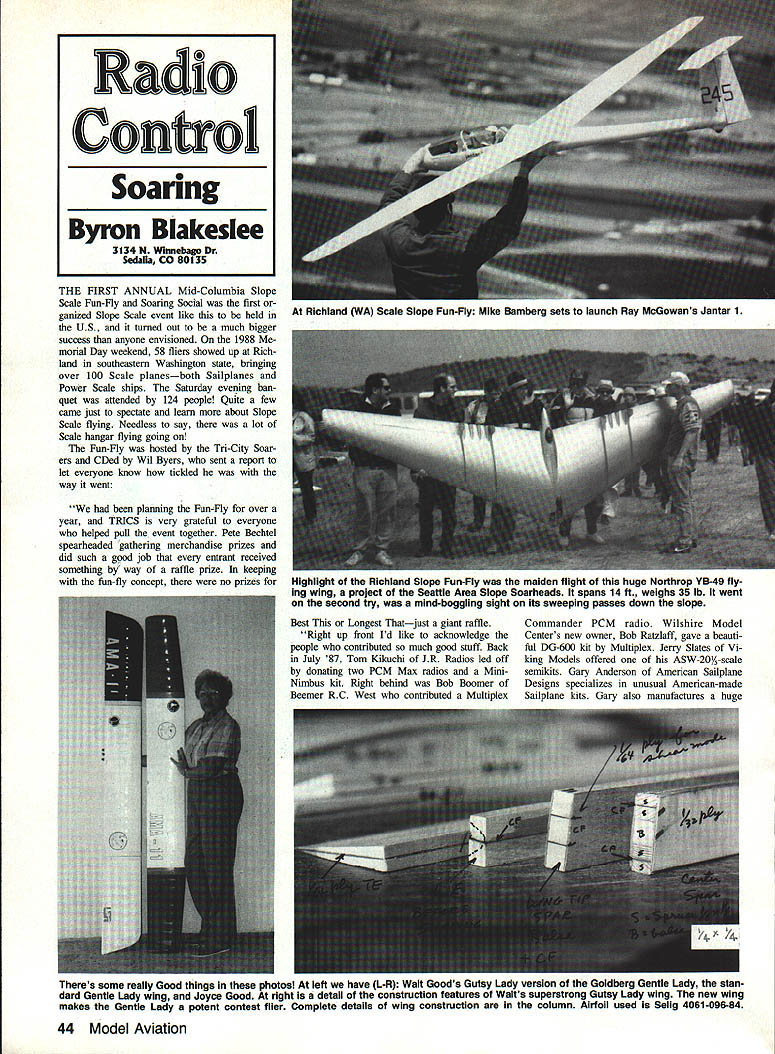
The first annual Mid‑Columbia Slope Scale Fun‑Fly and Soaring Social — the first organized slope‑scale event of this type in the U.S. — was a much bigger success than anyone envisioned. On the 1988 Memorial Day weekend, 58 fliers converged on Richland in southeastern Washington, bringing over 100 scale planes (both sailplanes and powered scale ships). The Saturday evening banquet was attended by 124 people. Many came simply to spectate and learn about slope‑scale flying.
The Fun‑Fly was hosted by the Tri‑City Soarers (TRICS) with CD Wil Byers. Wil sent this report and thanks for the help that made the event possible:
"We had been planning the Fun‑Fly for over a year, and TRICS is very grateful to everyone who helped pull the event together. Pete Bechtel spearheaded gathering merchandise prizes and did such a good job that every entrant received something by way of a raffle prize. In keeping with the fun‑fly concept, there were no prizes for Best This or Longest That—just a giant raffle."
Major donated items and contributors
- Tom Kikuchi, J.R. Radios: donated two PCM Max radios and a Mini‑Nimbus kit (July 1987).
- Bob Boomer, Beemer R.C. West: donated a Multiplex Commander PCM radio.
- Bob Ratzlaff, Wilshire Model Center: donated a DG‑600 kit (Multiplex).
- Jerry Slates, Viking Models: donated an ASW‑20/5 semi‑kit.
- Gary Anderson, American Sailplane Designs: provided large American‑made sailplane kits.
Other contributors: Robbe Model Sport; Combat Models; S.R. Batteries; Mark Foster Videos; Lone Star Models; Model Airplane News; Williams Brothers; Hobby Lobby; Vinylwrite Lettering; Sig Manufacturing; RC Soaring Digest; Model Builder; Satellite City; RCM; Bill Liscomb Retracts; Pete Bechtel.
Weather
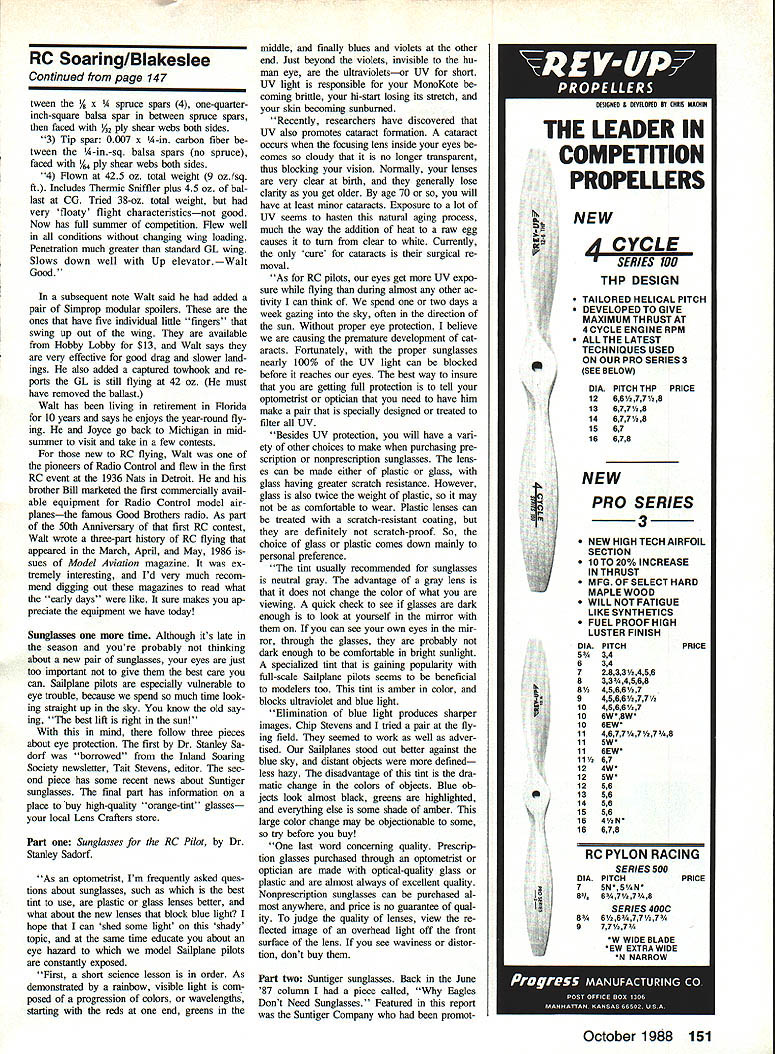
Weather records back to 1942 show May typically has many windy days in the area. The day before the event, a front promised good breezes. Friday dawned partly cloudy with forecast 15‑mph winds and temperatures in the 80s — conditions that would produce both slope lift and nice thermals.
Notable first flights and models
- Gene Cope (Marysville, CA) — fully detailed DG‑101G (Viking Models kit).
- Brad Smith — Air Macchi power‑scale jet.
- Ed Mason (Idaho group) — P‑51 Penetrator (GMG/Lascraft) and a Micro‑Mold U‑2 (purchased from Wilshire Model Center).
- Pete Marshall — highly modified, detailed F‑16 (Combat Models).
- Bill Liscomb — two quarter‑scale ships: a Fiberglassflugel ASW‑20 and an ASK‑21 two‑place glider.
- Bob Ratzlaff — Multiplex Ka‑6E (good penetration capability).
- Scratch‑built models (RCM&E plans): Grunau Baby by Frank Smith and Schweizer 1‑26 by Randy Holzapfel (both Spokane, WA).
- Three Jantar 1s: Ray McGowan (Napa, CA) — detailed cockpit; Steven Pepke (Issaquah, WA) — model Colditz glider.
Saturday rain and banquet
Saturday morning brought the unusual sight of heavy rain in the normally desert‑like area. The rain persisted until about 2:45 pm, delivering approximately 1.7% of the area's annual rainfall. Once the wind picked up, some stalwart fliers took to the slope; a few flew until 7:00 pm to prepare for the 8:00 pm banquet. The banquet’s highlight was a slide presentation and talk by local full‑size glider pilot Bob Moore.
Sunday — good slope conditions
After Saturday’s rains, Sunday delivered the promised good slope weather. The lift was strong and spirits were high.
Seattle Area Slope Soarheads (SASS) — Northrop YB‑49 flying wing
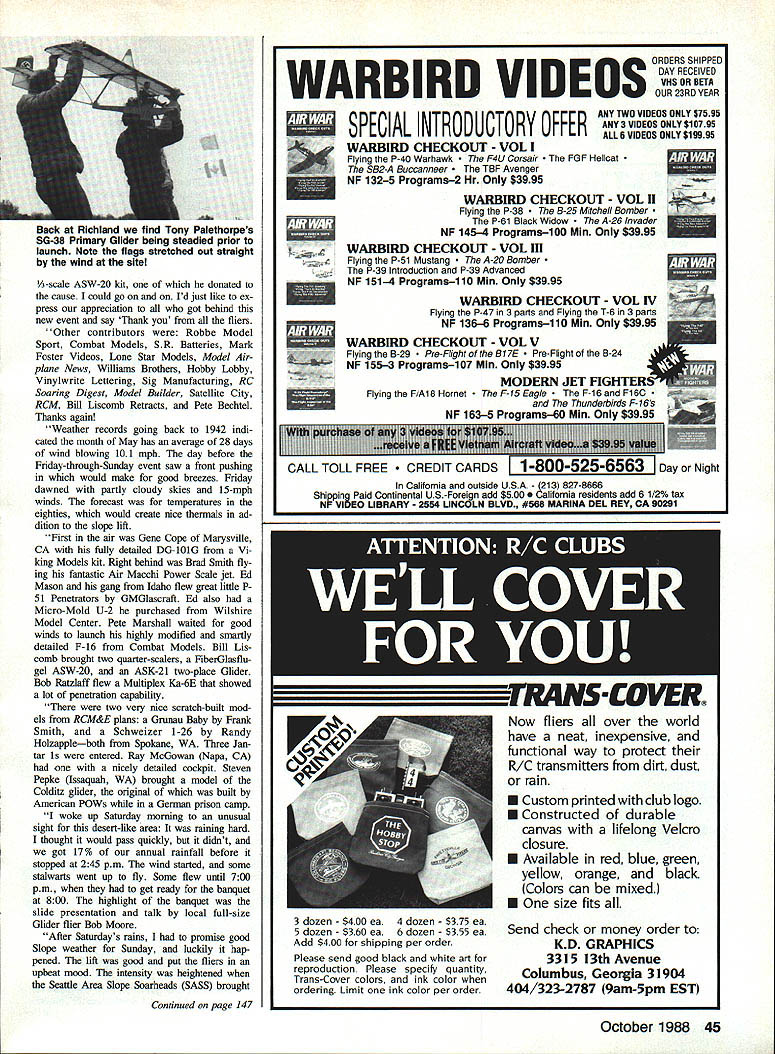
SASS brought a huge Northrop YB‑49 flying‑wing project: 14 ft span and 35 lb. The crowd gathered anxiously. The first launch stalled and resulted in a minor crash; the wing was repaired and readied for a second attempt. On the second try the flight was smooth and impressive — the wing whooshed past with a realistic sound and sweeping passes down the slope. Pilot: Ken Stuhr. Wing men: Jim Rauch, Rick Edris, Bill Vukonich.
A 1/3‑scale ASW‑20 kit was also donated during the weekend.
Looking ahead — Memorial Day 1989
Organizers hope to make the Scale Soar Fun‑Fly even bigger in 1989 (Memorial Day weekend, May 25–28, 1989). Rules: your model must be a scale replica of a full‑size glider or a glider that replicates a full‑size powered ship. AMA Safety Code applies; the event is meant to be fun. Organizers are seeking international participation and expect to combine a manufacturer trade show with the Friday night social.
Video
A one‑hour VHS video of the Slope Scale Fun‑Fly is available from Mark Foster Videos (filmed much of the action). Price: $25 (postage, handling, and tax included). Note: the tape described many good flying shots but did not include footage of the YB‑49 flying wing in the copy the author watched; that tape also had some spots with a red tint. To order, send check or money order to: Mark Foster Videos 826 Oneonta Dr. So. Pasadena, CA 91030
Walt Good’s "Gutsy Lady"
Walt Good’s Gutsy Lady attracted a lot of interest at the 1987 Nats and continued to perform well in 1988. Bob Nelson (Florida Soaring Society newsletter) described Walt's success and experimental wing development. Excerpts and Walt's notes follow.
Bob Nelson’s comments:
- Doc (the pilot of a Gentle Lady) had success at Tangerine (Two‑Meter) contests and finished strongly in the FSS contest season.
- In 1987 the Gentle Lady impressed at Tangerine when it launched with such acceleration it broke the winch line and performed a dramatic relaunch.
- Doc experimented with a new wing and provided full‑size ribs, spar construction details, sketches of airfoil and planform, and building/flying notes — available for anyone to duplicate.
Walt Good’s wing notes:
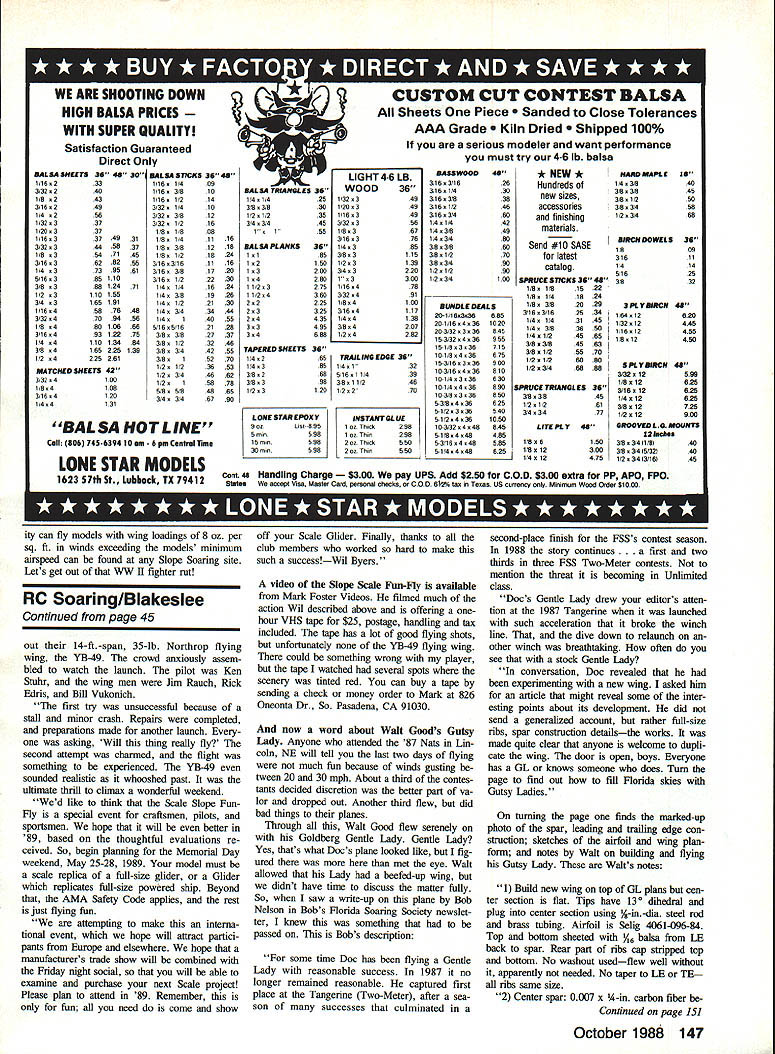
- Build the new wing on top of Gentle Lady plans but make the center section flat. Tips have 13° dihedral; tips are built in on the center section using 1‑in. diameter spar and brass tubing. Airfoil: Selig 4061‑096‑84. Top and bottom sheeting of 1/16" balsa from leading edge back to spar. Rear part of ribs: cap strips stop at spar and bottom. No washout used. No taper to leading or trailing edge — all ribs same size.
- Center spar: .007 x 4‑in. carbon fiber placed between 1/4" x 3/4" spruce spars (four). A 1/4‑inch‑square balsa spar between the spruce spars, then faced with 3/4‑ply shear webs on both sides.
- Tip spar: .007 x 1/4‑in. carbon fiber between a 1/4‑in.‑square balsa spar (no spruce); faced with 1/4‑ply shear webs both sides.
- Flown at 42.5 oz total weight (approximately 9 oz/sq ft). Configuration included a Thermic Sniffer plus 4.5 oz of ballast at the CG. At 38 oz total the flight was very "floaty" and not good. At 42.5 oz the wing had much better penetration and flew well in a full summer of competition; slows down well with up elevator.
Walt later added a pair of Simprop modular spoilers (five small "fingers" that swing up). Available from Hobby Lobby for about $13; Walt found them effective for drag and slower landings. He also added a captured tow hook and reported the GL was still flying at 42 oz (he presumably removed the extra ballast).
Background: Walt Good has lived in retirement in Florida for 10 years and enjoys year‑round flying. He was one of the pioneers of Radio Control, flying in the first RC event at the 1936 Nats in Detroit. He and his brother Bill marketed the first commercially available RC equipment (the Good Brothers radio). Walt wrote a three‑part history of RC flying that appeared in Model Aviation (March–May 1986), recommended reading for those interested in the early days of RC.
Sunglasses and eye protection for RC pilots
Sailplane and RC pilots spend much time looking upward, often near the sun, and are at risk of significant UV exposure. Below are three parts on eye protection.
Part one — "Sunglasses for the RC Pilot" by Dr. Stanley Sadorf
- UV light (invisible beyond violet) contributes to material degradation and promotes cataract formation. Cataracts are a clouding of the eye’s lens and the only current cure is surgical removal. Regular, unprotected sky‑gazing likely accelerates cataract development.
- Proper sunglasses can block nearly 100% of UV. For maximum protection, have your optometrist or optician provide lenses treated or designed to filter all UV.
- Lens material: glass offers better scratch resistance but is heavier; plastic is lighter and can have scratch‑resistant coatings. Choice depends on comfort and preference.
- Tint: neutral gray is recommended if you do not want color shifts. Amber (orange) tints are gaining popularity with full‑size sailplane pilots and can help reduce haze and make sailplanes stand out against the blue sky by blocking blue light. However, amber tints dramatically change color perception (blues, blacks, and greens highlighted; other colors shown in amber tones), so try before you buy.
- Quality check: for nonprescription sunglasses, inspect the reflected image of an overhead light or the lens surface. Waviness or distortion indicates poor optical quality. Prescription sunglasses from an optometrist/optician are usually of high quality.
Part two — Suntiger sunglasses
Suntiger popularized amber‑tint lenses (mentioned in the author’s June 1987 column "Why Eagles Don't Need Sunglasses"). Amber tints are available from several suppliers and are noted for improving contrast against the sky; individual preference varies.
Part three — where to buy
- High‑quality prescription and nonprescription orange/amber tint glasses can often be purchased through local LensCrafters stores or from your optometrist/optician.
- Simprop spoilers and some accessories are available through Hobby Lobby and other hobby retailers.
Byron Blakeslee Richland, WA
Transcribed from original scans by AI. Minor OCR errors may remain.

