
Radio Control: Soaring
Byron Blakeslee 3134 N. Winnebago Dr. Sedalia, CO 80135
New Multiplex radio: Profi MC 3030
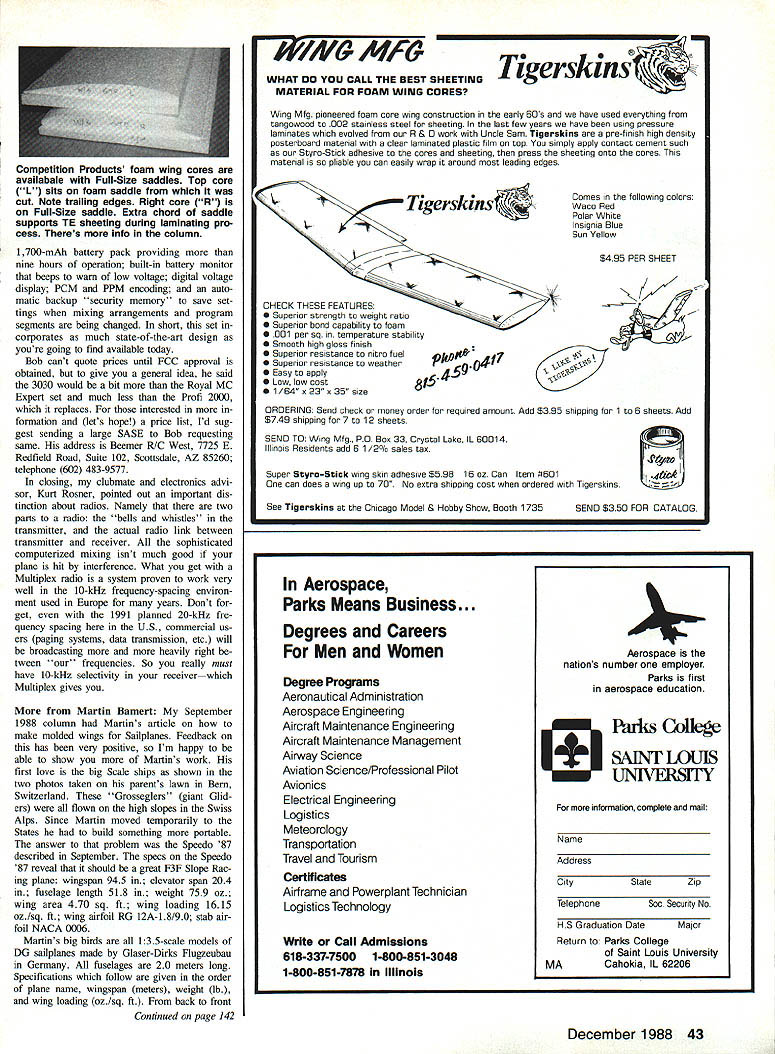
Bob Beemer of Beemer R/C West should have FCC approval to begin selling the new Multiplex Profi MC 3030 nine-channel radio. Made in Germany, this top-of-the-line transmitter represents a third generation of RC microcomputer technology, following Multiplex's Profi 2000 (1980) and Royal MC (1984).
- The Profi MC 3030 stores all program software in its integral microcomputer (no removable soft modules). Multiplex calls the software BOSS (Benutzer-Orientierte Sender-Sprache — "User-Oriented Transmitter Language").
- A four-line, 64-character liquid-crystal display communicates with the user/programmer (display text is in German; Beemer will supply translations and instructions).
- Programming is straightforward: install receiver, battery, and servos in the airplane, tell the transmitter the plane name, and save the setup. The radio can store setups for up to 15 different planes.
- The system offers 17 fixed "concepts" or templates (crow/butterfly, flaperon, elevator compensation, etc.). The integral programmer interconnects and superimposes functions as needed. Input is via eight keys under a plate on the front of the transmitter.
- Final setup steps include setting servo direction, adjusting servo travel, and setting mixing ratios.
Notable features:
- Six-cell, 700‑mAh battery pack (about nine hours operation)
- Built-in battery monitor with low-voltage beeper
- Digital voltage display
- PCM/PPM encoding
- Automatic backup "security memory" to preserve settings while changing program segments
Bob cannot quote prices until FCC approval is final, but expects the MC 3030 to cost a bit more than the Royal MC Expert set and much less than the Profi 2000. For information or a price list (when available), send a large SASE to: Beemer R/C West, 7725 E. Redfield Road, Suite 102, Scottsdale, AZ 85260. Telephone: (602) 483-9577.
Note from Kurt Rosner (club electronics advisor): a radio has two parts — the transmitter's features and the actual radio link between transmitter and receiver. Sophisticated computerized mixing is of little use if the receiver is susceptible to interference. Multiplex receivers provide good 10‑kHz selectivity (the spacing used in Europe), which will be important in the U.S. even with the planned 1991 move to 20‑kHz spacing because commercial users will occupy spectrum between channels.
Martin Bamert and Speedo 87
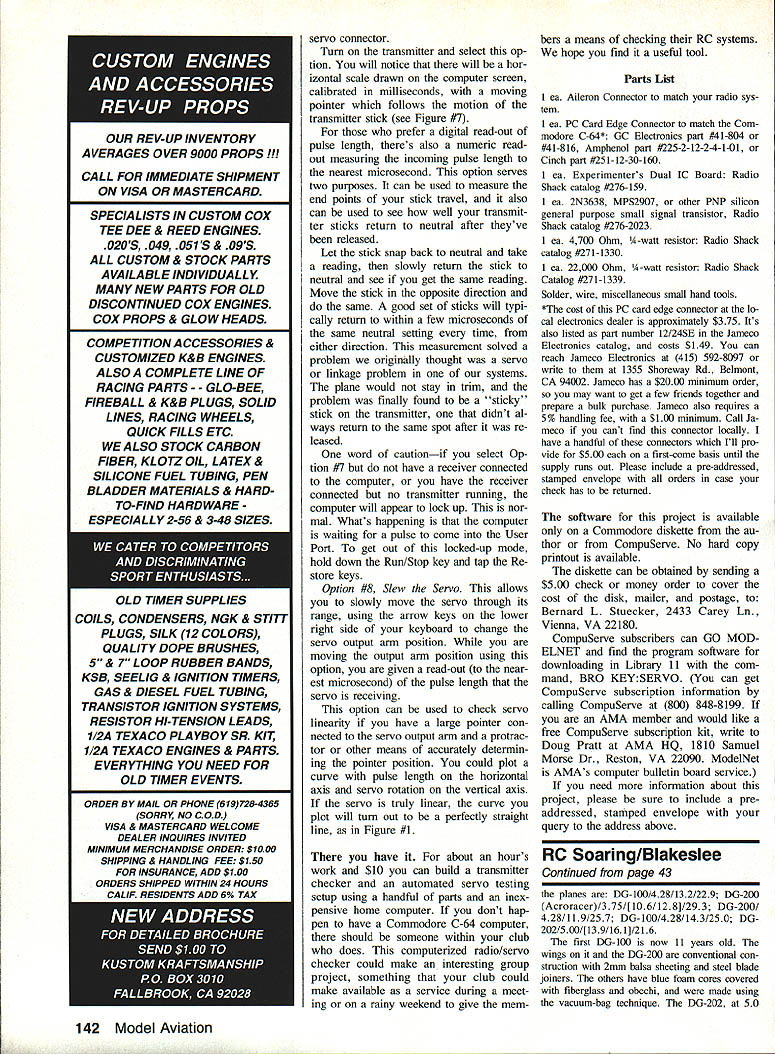
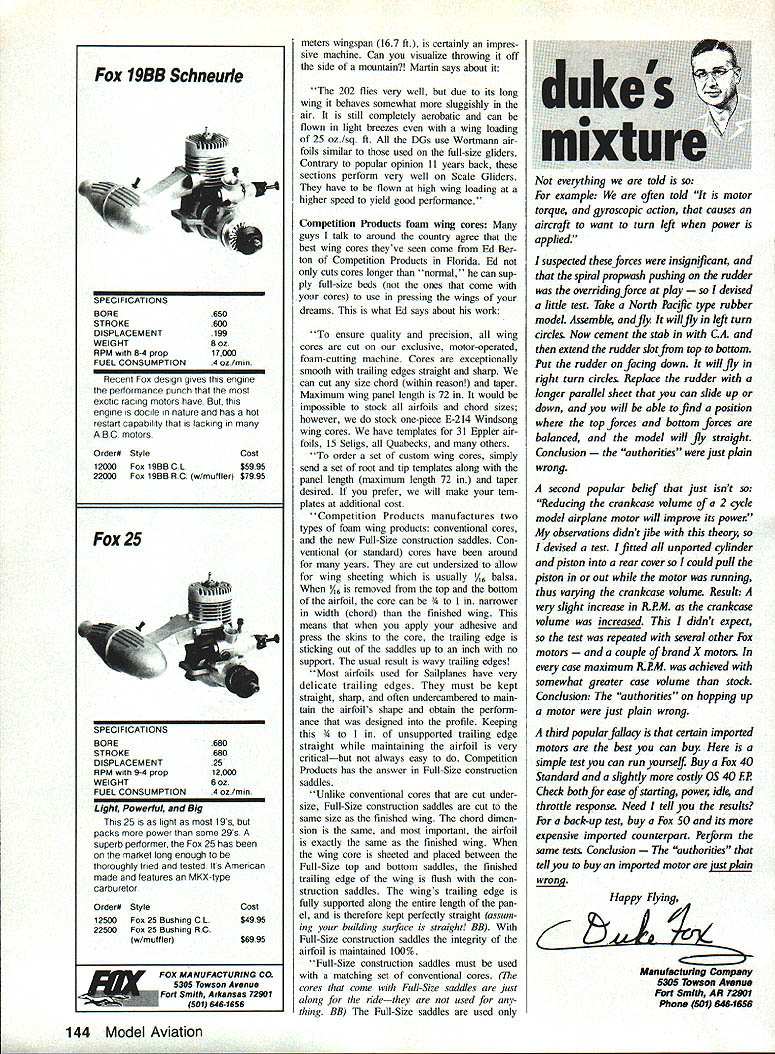
Martin Bamert’s article on molded wings (Sailplanes Feedback) drew a very positive response. Martin’s first love is large-scale sailplanes; photos show his models on his parents’ lawn in Bern, Switzerland. The large "Grossegler" gliders are flown on high Swiss slopes.
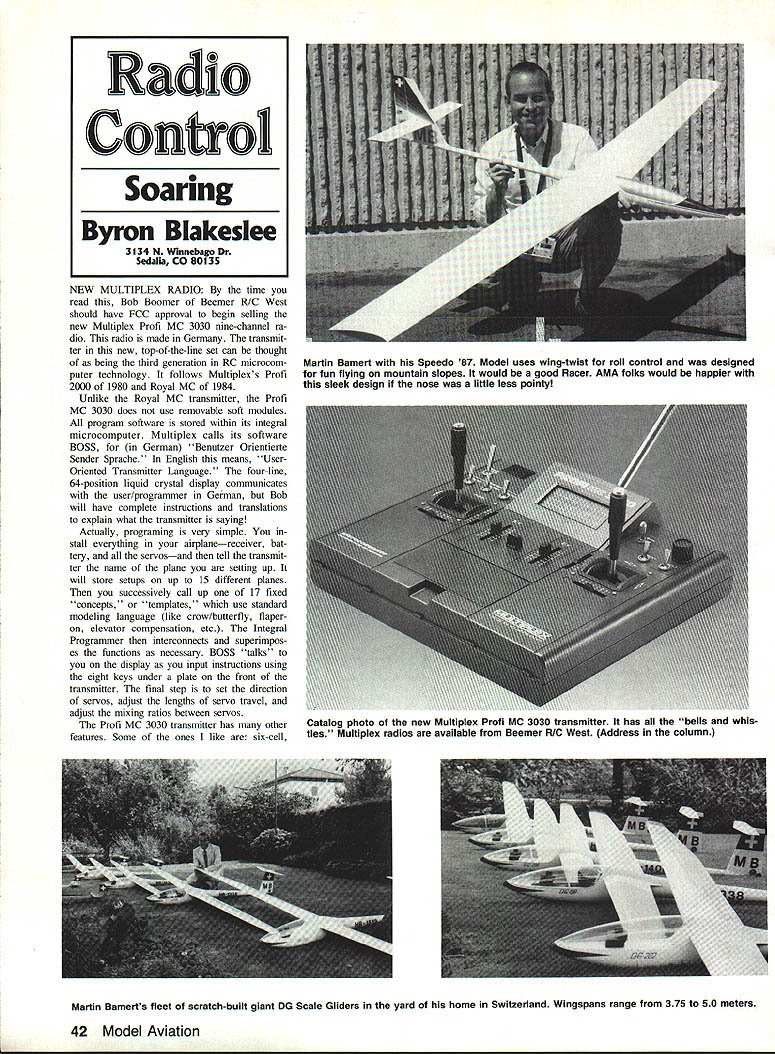
Since moving temporarily to the U.S., Martin built a portable slope racer — the Speedo 87 — described in the September issue. It appears well suited for F3F slope racing. Reported specifications (as given) include:
- Wingspan: 945 mm
- Elevator span: 204 mm
- Fuselage length: 518 mm
- Weight: 7.59 lb
- Wing area and loading (reported): wing area 470 (units unclear), wing loading 16.15 oz/sq ft
- Wing airfoil: RG 12A-18/90
- Stabilizer airfoil: NACA 0006
Martin’s large-scale models are roughly 1:3.5-scale replicas of DG sailplanes (Glaser-Dirks Flugzeugbau); full-size fuselages measure about 20 meters. Martin reports the DG sections perform well on scale gliders, particularly when flown at higher wing loading and speed.
Competition Products — foam wing cores
Many modelers recommend Competition Products (Ed Be) in Florida for foam wing cores. Highlights:
- Cores are cut on a motor-operated foam-cutting machine; trailing edges are straight and sharp.
- Maximum wing panel length: 72 in.
- Templates available: 31 Eppler airfoils, 15 Seligs, all Quabecks, and many others. One-piece E-214 Windsor wing cores are stocked.
- Two product types:
- Conventional cores: cut undersize to allow for 1/16 in. sheeting; this can leave the trailing edge unsupported during sheeting, often causing wavy edges.
- Full-Size construction saddles: cut to the finished wing size so the trailing edge is fully supported during sheeting/pressing, maintaining airfoil integrity.
- Full-Size saddles are used during sheeting/pressing and must be used with a mating set of conventional cores. Washout can be built into both cores and saddles for matched panels.
- Materials: 1-lb density white virgin foam (re-ground material not used). Two-lb density blue foam available at extra cost.
- Shipping: UPS only (no COD, no P.O. Box deliveries).
Prices:
- Conventional cores and Full-Size saddles: $45 per set, plus UPS
- Matched wing cores: $22.50 per pair, plus UPS
- Custom templates: $30 per pair
To order or request an information/order sheet, send a SASE to: Ed Be, 921 Birdie Way, Apollo Beach, FL 33570. Telephone: (813) 645-5171.
ATRCS follow-up (Airtronics Module 7SP retrofit)
Our August 1988 column covered the Airtronics Module 7SP transmitter and Control Systems Laboratories’ Advanced Technology Radio Control System (ATRCS) retrofit. A detailed user report from Asher Carmichael (Daphne, AL) describes his experience converting a 7SP with ATRCS.
Summary of Asher’s experience:
- Asher initially used the Airtronics 7SP with external mixing but found in-flight operation awkward because many functions were not at the sticks’ fingertips.
- He sent his 7SP to Control Systems Laboratories (CSL) for the ATRCS retrofit (about two weeks turnaround, including shipping).
- ATRCS replaces pots and switches with a digital encoder, LCD readout, and keypad. It asks setup questions on the display; you respond and set travel/mixing with increment/decrement buttons.
- The system includes seven templates covering most configurations (F3B to flying wings) and can store setups for four different planes. A switch on the transmitter lets you change between compatible setups in flight.
- Key functions achieved on Asher’s Windsong: spoiler/winglet control, three-position trailing-edge presets (Launch/Cruise/Land), aileron differential, spoiler-to-aileron mix, crow, exponential curves, elevator/pitch compensation blends, and programmable camber via the side pot.
- ATRCS handles servo reversing electronically and provides travel-volume readouts in percentages for easy resetting.
- The retrofit works with Airtronics flight packs and with new Airtronics Spectra PCM receivers as well as standard PPM/PCM receivers.
- CSL returned the transmitter with a professionally printed manual and a one-year warranty on ATRCS components and workmanship.
CSL contact: Control Systems Laboratories, 1361 Fallen Leaf Dr., Milpitas, CA 95035. Telephone: (408) 946-4142.
Asher concludes ATRCS was a major improvement for his Windsong and recommends it for anyone wanting full electronic mixing capability.
Hi-Performance Sailplanes (Ron Wagner)
Ron Wagner has started Hi-Performance Sailplanes to supply materials for molding and vacuum-bagging wings without large minimum orders. Current offerings:
- HP Cell wing skins: engineered to replace 2mm Rohacell; density ~5 lb/cu ft; thickness .060 in. (1.5 mm); sheet size 24 x 96 in. Ideal where glass cloth is used over foam.
- Three epoxies:
- Type 1: thin-viscosity laminating epoxy for bonding lightweight cloths
- Type 2: wing-skin bonding adhesive for HP Cell or blue foam
- Type 3: structural bonding epoxy
- Available in quart sizes with hardeners; formulas consider compatibility with blue foam.
- Aramid/carbon laminates:
- Unidirectional carbon .007 x 1 x 72 in.
- Unidirectional carbon .014 in. thick
- Tapered laminate from .030 in. at root to .007 in. at tip (72 in. long)
- Custom cutting available.
- Nomex HP honeycomb: 3-lb, 1/4-in cell-structure, .080 x 12 x 96 in.
- Fiberglass cloth: 1.4-oz treated E-Glass (for HP Cell), also 2-oz treated E-Glass.
- Mylar sheets: .014 in. thick, for vacuum-bagging; minimum 48 x 36 in.
Contact: Hi-Performance Sailplanes, 17902 NE 156th St., Woodinville, WA 98072. Telephone: (206) 487-1721. Send a SASE requesting a price list and describe your intended application.
NSS update (Cliff Oliver, Secretary/Treasurer)
- Membership is up 15% from this time last year.
- Interest in host clubs sponsoring Soar-In competitions is up, thanks to efforts by Marshall Long. If interested in hosting a Soar-In next year, contact Marshall: 824 Garden Meadow, Universal City, TX 78148; telephone (512) 659-3337.
- New bimonthly Plane columns: Don Edberg (F3B) and Miles Moran (Cross-Country).
- The NSS Handbook project has been postponed while a suitable format agreeable to all is developed. If you want a free copy of Sailplane (includes NSS membership application), contact Cliff: 8151 Broadway, San Antonio, TX 78209; telephone (512) 821-6299.
League of Silent Flight (LSF) news
- Level V achievers account for about 1% of LSF’s ~6,000 members; the roster now has 62 names.
- New Level V members and dates:
- No. 57 — Dennis Chall #3833 — 8/8/87
- No. 58 — Guy Dickens #3300 — 10/13/87
- No. 59 — Bob McGowan #2286 — 10/24/87
- No. 60 — Bob Sowder #3795 — 11/17/87
- No. 61 — Brian Agnew #3140 — 12/18/87
- No. 62 — Douglas Barry #1644 — 4/30/88
Congratulations to all.
The July issue of LSF Shortlines went to about 1,200 members. If you didn’t receive a copy and want to keep up with LSF, send a postcard with your name and address to: LSF, P.O. Box 647, Mundelein, IL 60060.
New monthly magazine — Slope Soaring News
A new journal devoted solely to slope soaring has launched: Slope Soaring News, published out of Signal Hill, CA, by Charlie Maury, Chuck Korroland, and Mark Brezicz. Fans of slope soaring should find focused content relevant to the discipline.
(End of column.)
Transcribed from original scans by AI. Minor OCR errors may remain.

