
Radio Control: Soaring
Byron Blakeslee 3134 N. Winnebago Dr. Sedalia, CO 80135
Late News Flash
There's a new Masters contest in our future. Word has just arrived about a new limited-entry soaring contest designed to determine who is the "Best of the Best." The AMA Nats is a fun contest, but with open entry and its sheer size, it's really more like old-home week than an all-out competition to determine a national champion. The Pattern and Scale fliers have annual Masters contests—why shouldn't soaring? Many sailplaners think this is a concept whose time has arrived. I hope you agree!
Those are the preface; these are the details: The National Soaring Society (NSS), under president Pete Carr, and the Thousand Oaks Soaring Society (TOSS), Miles Moran, president, have teamed up to put on the First Annual Soaring Masters, also known as the World Thermal Championships, March 25–26, 1989 at the TOSS club field in Chatsworth, CA. Chatsworth is about 30 miles north of Los Angeles International Airport.
The task on Saturday will be four rounds to garner a total of 25 minutes, with no flight over nine minutes, all flights with special landing option.
Sunday will have four- and eight-minute precision-duration flights, again with special landing option. There will be no sailplane class distinction; i.e., Unlimited Class only under AMA rules. Winches with retrievers will be used. The entry fee is $25. Trophies will be awarded to fifth place, plus prizes.
Entry will be limited to just 60 of the most highly qualified fliers in the country (five per RC frequency). To gain an entry slot a flier must meet at least one of the following criteria:
- LSF Level V.
- LSF Level IV with required Level V contest wins.
- Winner of Nats or regional/multiclub championships such as NSS E.A.P., Ohio Cup, ESL Season Points Champs, etc.
To be considered for entry, fliers should submit a photocopy of their LSF papers, proof of winning score in a regional event, or other documents for committee review. Pre-registration ends March 1. For forms, site maps, full information, and to have your name considered, contact either Miles Moran, 10428 Oso Ave., Chatsworth, CA 91311 (tel. 818/882-4687), or Pete Carr, 329 Little Ave., Ridgway, PA 15853 (tel. 814/772-4851).
I think the Soaring Masters will prove to be a very popular concept with sailplaners, and they will strongly vie to fly in it. With the proven caliber of the competition, the winner of this contest will truly earn and deserve the prestige the Masters will carry.
NATS news
Wil Byers called to let us know that the Tri-Cities area of southeastern Washington State was selected to host Nats next year, July 15–23, in three cities—Richland, Kennewick and Pasco—located on the Columbia River. Wil said local governments, businesses and the Governor were enthusiastic. As you know, last year Wil helped organize the very successful first annual Scale Slope Fun-Fly on the beautiful Eagle slope just outside Richland. The possibility of the Nats coming was first mentioned, and it was asked if the fun-fly should be cancelled in '89 because of the extra workload on local fliers. Everyone was adamant the fun-fly must go on as planned at the end of May. There's just no way they'll cancel, so we'll have two big soaring events at the same location next year.
The Nats Soaring Event Director will be Tom Culmsee of Gresham near Portland, OR. Soaring will have a huge field of mowed alfalfa; the local airport will be shut down for the week. Pattern and other power flying, Free Flighters, will have plenty of wide-open spaces. Looks like '89 is shaping up to be a banner year. Nats participants and sailplaners will see some extra added attractions. Since the famous Eagle slope is handy there will be informal sessions of slope flying and slope demonstrations. A cross-country event is also being planned. One can envision packing several thermal contest ships, a couple of slope racers, big X-C planes and the old wagon. Wil says to expect pleasant weather somewhere between 75°–90°. We'll let you know later about the Slope Scale Fun-Fly.
Slope Scale Fun-Fly
The "other" event in Washington State this year is (to give it its proper name) the Mid-Columbia RC Soaring Scale Fun-Fly and Soaring Social. It will be held May 26–28 near Richland, WA. You've heard how enthusiastic everyone was about the inaugural affair last year. This year promises to be even bigger and better. It is a true fun-fly for scale ships only (both sailplane and power types) on a world-class slope. Fly when you want and if you want (frequencies permitting, of course!). As Wil says, "No judging, no rules, no hassles—only flying, looking, swapping, and talking."
Flying will be by pre-registration only and closes April 29. The fee is $30, which includes an entry to the raffle and the Saturday evening banquet. Additional models are $5 each; additional dinners $18 each. Out-of-towners get a special rate at the Clover Island Inn: $30 for a single, and $35 for a double room. Call (800) 833-1800 for reservations. This is where the banquet will be held. The evening will also include a slide presentation and guest speaker.
Get your entry, check and frequency (or frequencies) off now to Wil Byers, 632 Meadow Drive East, Richland, WA 99352. Send SASE if you'd like more information and an entry form. His phone number is (509) 627-5224.
The Nordic Championships
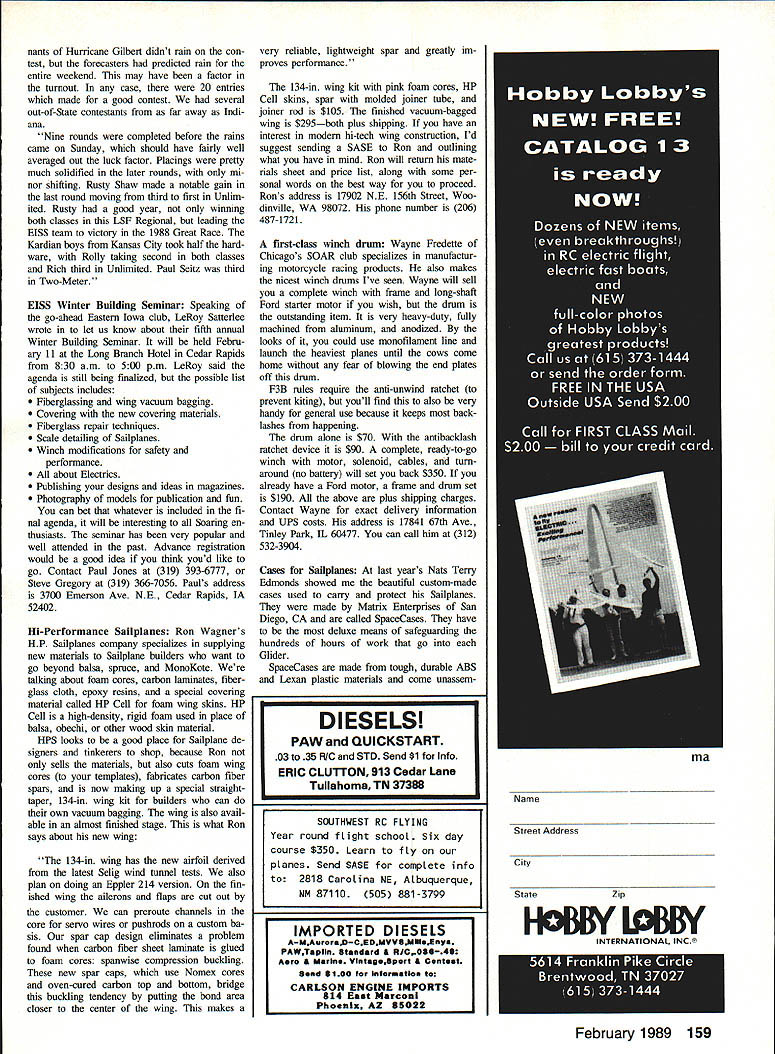
Every year sailplane pilots from Denmark, Sweden, Norway, Finland, and sometimes Iceland get together for the Nordic Championships. They use F3B rules and rotate the contest among the countries. In 1988 it was held in Norway. My friend Preben Norholm, who lives in Copenhagen, sent the pictures and an interesting description of what happened. This is part of Preben's letter:
- "The green bird is the Grover designed and flown by Joakim Stahl of Sweden. He was Nordic Champion in 1986, '87, and won again this year. Joakim is the perfect F3B pilot. He is cool, but aggressive and always willing to take calculated strategic risks.
- "The white plane is called Safir 2 and was designed and flown by Karsten Jeppesen of Denmark. Karsten was Nordic Champion in 1985 and runner-up this year. He was leading the game until the last round, but lost due to inferior judgments by his 'Primary Strategic Distance Task Helper' (me!). I did lead him to a good thermal in his last Distance flight, but I judged the lift to be weaker than it actually was and consequently told him to initiate speeding up too late in the fourth minute slot. To make matters worse, he was up against Stahl. Karsten had weather for 24 legs, but lost with 22 to Stahl's 23. I was told afterward it was the most spectacular slot of the contest.
- "You wonder what language we use at the Nordic Championships? It's very simple—we speak English. Well, at least when the Finns are listening, or those Icelanders who don't speak Danish in addition to their native language. Danish, Norwegian, and Swedish are still so closely related that we understand each other if we talk slowly and clearly. In the Viking age we all spoke the original Nordic language, which is at most identical to Icelandic today (which nobody else understands now). Since then we have been influenced by German, English, and Dutch. Also, Danish was especially influenced by French during the 17th and 18th centuries. So, we're lucky everyone understands English nowadays.
- "The '88 F3B Nordics took place on the full-scale gliding center at Elverum, some 100 miles north of Oslo and close to the Swedish border. By the way, the Norwegian-Swedish border may be the easiest one to cross in the world. First you meet a blue sign saying, 'Border 1 km.' Shortly before reaching the border there is a 50 km (30 mph) speed limit sign. Then a red sign saying, 'Goods to Declare—Turn Right.' There's also a green one, 'Nothing to Declare—Keep Straight On.' Finally there's a sign canceling the speed reduction, and you're in Sweden. That's how the world should be."
Eastern Iowa LSF Regional contest
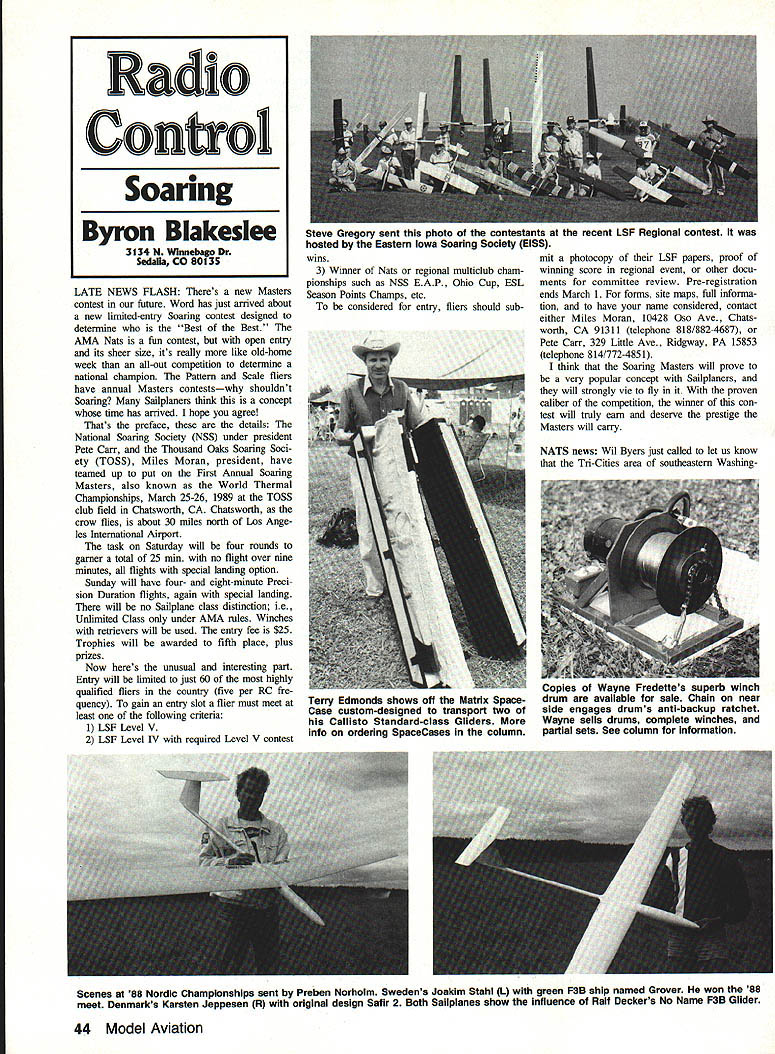
Terry Edmonds, co-contest director of the regional, sent in the photo of all the fliers and reports on the two-day contest:
Remnants of Hurricane Gilbert didn't rain on the contest, but the forecasters had predicted rain for the entire weekend. This may have been a factor in the turnout. In any case, there were 20 entries which made for a good contest. We had several out-of-State contestants from as far away as Indiana.
Nine rounds were completed before the rains came on Sunday, which should have fairly well averaged out the luck factor. Placings were pretty much solidified in the later rounds, with only minor shifting. Rusty Shaw made a notable gain in the last round moving from third to first in Unlimited. Rusty had a good year, not only winning both classes in this LSF Regional, but leading the EISS team to victory in the 1988 Great Race. The Kadarians boys from Kansas City took half the hardware, with Rolly taking second in both classes and Rich third in Unlimited. Paul Seitz was third in Two-Meter.
EISS Winter Building Seminar
LeRoy Santee wrote to let us know about the fifth annual Winter Building Seminar. It will be held February 11 at the Long Branch Hotel in Cedar Rapids from 8:30 a.m. to 5:00 p.m. LeRoy said the agenda is still being finalized, but possible subjects include:
- Fiberglassing and vacuum bagging.
- Covering with the new covering materials.
- Fiberglass repair techniques.
- Scale detailing of sailplanes.
- Winch modifications for safety and performance.
- All about electrics.
- Publishing your designs and ideas in magazines.
- Photography of models for publication and fun.
The seminar has been very popular and well attended in the past. Advance registration is a good idea. Contact Paul Jones at (319) 393-6777, or Steve Gregory at (319) 366-7056. Paul's address is 3700 Emerson Ave. N.E., Cedar Rapids, IA 52402.
Hi-Performance Sailplanes
Ron Wagner's H.P. Sailplanes company specializes in supplying new materials to sailplane builders who want to go beyond balsa, spruce, and MonoKote. We're talking about foam cores, carbon laminates, fiberglass cloth, epoxy resins, and a special covering material called HP Cell for foam wing skins. HP Cell is a high-density, rigid foam used in place of balsa, obeche, or other wood skin material.
H.P. Sailplanes looks to be a good place for sailplane designers and tinkerers to shop, because Ron not only sells the materials, but also cuts foam cores (to your templates), fabricates carbon fiber spars, and is now making up a special straight-taper, 134-in. wing kit for builders who can do their own vacuum bagging. The wing is also available in an almost finished stage. This is what Ron says about his new wing:
"The 134-in. wing has the new airfoil derived from the latest Selig wind tunnel tests. We also plan on doing an Eppler 214 version. On the finished wing the ailerons and flaps are cut out by the customer. We can precut channels in the cores for servo wires or pushrods on a custom basis. Our spar cap design eliminates a problem found when carbon fiber sheet laminate is glued to foam cores, sparwise compression buckles. These new spar caps, which use Nomex cores and oven-cured carbon top and bottom, bridge this buckling tendency by putting the bond area closer to the center of the wing. This makes a very reliable, lightweight spar and greatly improves performance."
The 134-in. wing kit with pink foam cores, HP Cell skins, spar with molded joiner tube, and joiner rod is $105. The finished vacuum-bagged wing is $295—both plus shipping. If you have an interest in modern hi-tech wing construction, send a SASE to Ron describing what you have in mind. Ron will return his materials sheet and price list, along with advice on the best way to proceed. Ron's address is 17902 N.E. 156th Street, Woodinville, WA 98072. His phone number is (206) 487-1721.
A first-class winch drum
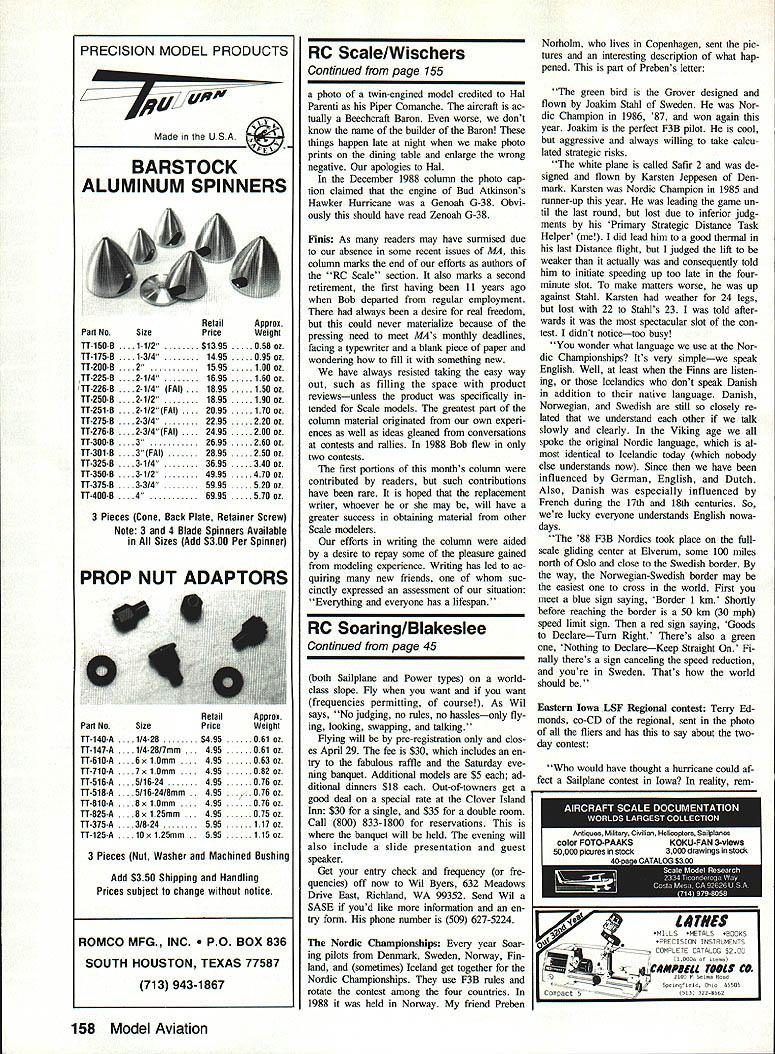
Wayne Fredette of Chicago's SOAR club specializes in manufacturing motorcycle racing products. He also makes the nicest winch drums I've seen. Wayne will sell you a complete winch with frame and long-shaft Ford starter motor if you wish, but the drum is the outstanding item. It is very heavy-duty, fully machined from aluminum, and anodized. By the looks of it, you could use monofilament line and launch the heaviest planes without fear of blowing the end plates off this drum.
F3B rules require the anti-unwind ratchet (to prevent kiting), but you'll find this also handy for general use because it keeps most backlashes from happening.
- The drum alone is $70.
- With the anti-backlash ratchet device it is $90.
- A complete, ready-to-go winch with motor, solenoid, cables, and turn-around (no battery) is $350.
- If you already have a Ford motor, a frame and drum set is $190.
All prices are plus shipping. Contact Wayne for exact delivery information and UPS costs. His address is 17841 67th Ave., Tinley Park, IL 60477. You can call him at (312) 532-3904.
Cases for Sailplanes
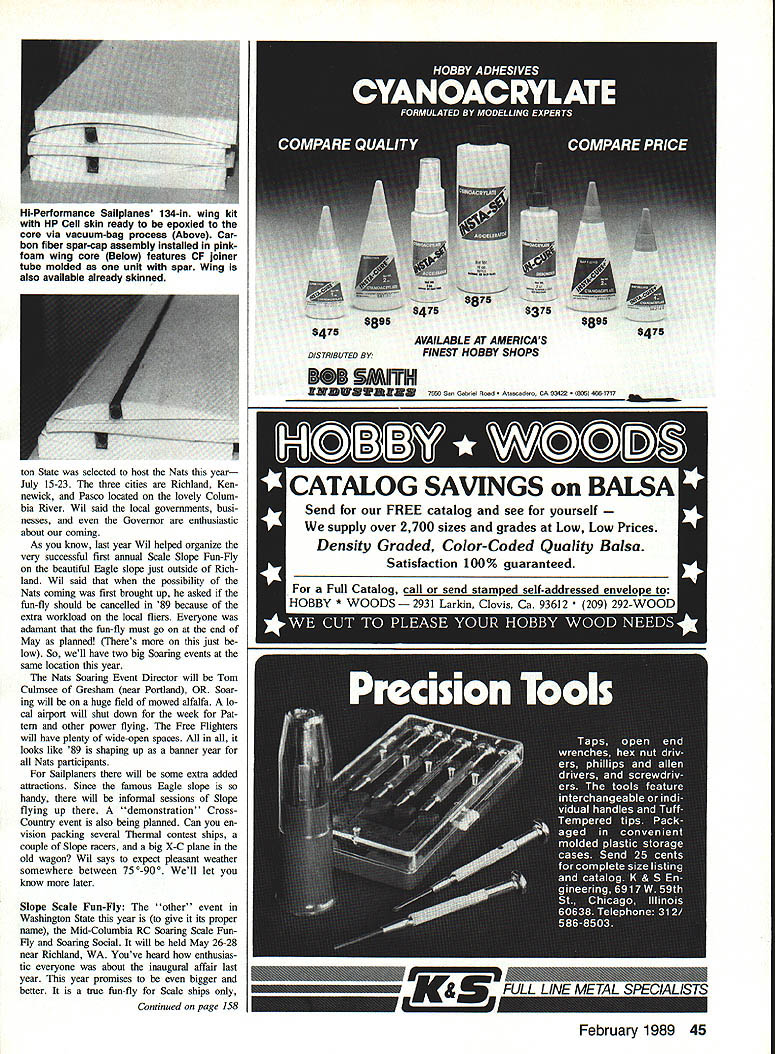
At last year's Nats Terry Edmonds showed me the beautiful custom-made cases used to carry and protect his sailplanes. These were made by Matrix Enterprises of San Diego, CA and are called SpaceCases. They are a deluxe means of safeguarding the hundreds of hours of work that go into each glider.
SpaceCases are made from tough, durable ABS and Lexan plastic materials and come unassembled. You put the parts together and bond them with the adhesive provided. Terry said everything fit so perfectly that assembly was no problem. Toggle-type latches secure the top of the case to the bottom. Terry requested a few nonstandard design features, and Alan Berg and Michael Anderson at Matrix were happy to work with him. The price of Terry's case to hold two Standard-size planes was about $100, but check with Matrix for the price of a case cut to your exact requirements.
They also make special cases for transmitters and can fabricate a custom box for almost any need. Matrix's address is 7015 Carroll Road, San Diego, CA 92121. Telephone messages: (619) 450-5090.
Computer programs for sailplanes
I want to mention two interesting programs from sailplaner Lee Murray. The one for IBM compatibles is called PC-Soar, and the companion program for Macintosh is called MaxSoar. These appear to be the most sophisticated sailplane performance-prediction programs yet available. Their features include:
- On-line documentation.
- Use the polar and sailplanes provided, or enter your own.
- Multiple Reynolds numbers on airfoil polars.
- Metric/English capability.
- Plots sink rate and lift/drag versus flying speed.
- Overlay plots to compare aircraft performance.
- Calculates standard design parameters such as areas, aspect ratios, aerodynamic centers, average chords, tail volumes, instability factors, and more.
I'm trying out PC-Soar on my Epson PC clone now and will have a complete review next month. PC-Soar is $34.95, and MaxSoar is $49.95, both plus $3 P&H. Lee Murray's address is 1300 N. Bay Ridge Road, Appleton, WI 54915-2854. His phone number is (414) 731-4848.
Moving up to the middle ground
This piece was written by Randy Reynolds of Colorado Springs and appeared in the Pikes Peak SS newsletter, of which Randy is the editor. Randy is also editor of the F3B-U.S.A. newsletter published by AMA for the F3B team selection program participants. His thoughts are geared to stir up some controversy—also to make you think. A hobby/sport without controversy would be pretty dull, and without forward thinking would be headed for extinction.
"The winds of change are blowing. They are swirling through the ranks and file of AMA thermal competition, and they promise to reshape a sport that needs a breath of fresh air. Let's evaluate some facts, trends, and subjective opinions to see if there is anything more than just another dust devil:"
- "AMA thermal competition is good because anyone can experience reasonable success independent of exotic equipment ... there is no 'horsepower race' evident. Use simple, reliable equipment, practice a lot, and you can be a winner. Competitions are easily managed, and the rules are simple, nonsubjective, and fair. Thermal competition is the bedrock foundation of our sport and a phenomenon of the North American climate."
- "AMA thermal competition is not good because it does not offer sufficient depth as a sport. As a consequence, we fail to develop and retain strong leadership in the long term. We are a little more than an organized body of sport fliers. AMA rules for RC sailplanes haven't changed since their inception. AMA contest kit sailplanes reached the end of their evolution five years ago. LSF and NSS are both long in the tooth and in dire need of vitality."
- "F3B is good, because it represents the ultimate challenge. It makes incredible demands on pilots, builders, designers, and teammates. F3B is significant depth, which tends to create long-term interest and causes development of leading participants. F3B generates a lot of technical development that migrates to all branches of our sport."
- "U.S. F3B competitors are at a severe disadvantage, because airframes, motors, and controls are unavailable except through excessive cost and/or exposure. AMA pilots feel that F3B is a remote branch of the sport that is irrelevant to their world. Lack of exposure to F3B perpetuates that lack of interest, which assures low commercial interest from radio and airframe manufacturers. F3B at the world-class level is not for the masses, except for purposes of supplying inspiration and role models. We should not lose that."
- "Notice that there is no middle ground between AMA thermal competition and F3B. There is no progression of skill levels, or a way to build interest for those who need something more than precision-duration tasks. A development of new tasks and competitions is needed to extend interest and provide training ground for pilots to the practice fields."
- "A recent CIAM ruling reduced winch power to about that of a club winch, or less. Airplanes of the future will continue to be aerodynamically advanced, but the need for exotic structural strength to withstand high-power winch launching will be gone. Airframes will be lighter and perhaps smaller. They will be less intimidating to AMA pilots, and therefore we will see more F3B ships in AMA competition."
- "In a recent AMA contest in Denver, the only F3B airplanes entered took the top three places in a four-round competition consisting of 4/6/10/6-minute tasks. The weather was mild in the morning with gradually increasing 5–15 mph winds in the afternoon. It was a typical day for thermal competition, with average lift and sink conditions. Among the 33 planes entered were Windsongs, Meteors, and the standard mix of Sagitta/Cumulus. The winner flew from a standard club winch with an F3B Eclipse having an empty weight of 11.03 oz., for a wing loading of over 15 oz. per sq. ft. In areas where F3B airplanes are regularly flown in AMA competition, local pilots would agree that these results are, if not typical, at least plausible."
- "The perception is growing that properly flown high-performance airplanes with 11-oz.-plus wing loadings are competitive with 6-oz.-class-of-the-art AMA thermal airplanes. Eventually, today's fanatics devoted to light wing loadings may be challenged in numbers by fanatics who prefer heavier loadings. Pilots should make choices between flying styles/airframes dictated by the types of events they are flown in, rather than conforming to a 'Light is Right' standard."
I submit that the winds of change are being created by AMA thermal fliers acquiring appreciation of the higher-performance, heavier, faster airframes. Further, this will create more impact than just a simple refinement of equipment. If any of this logic results in a breath of fresh air for the future, it might take this path:
- AMA pilots begin to build airframes which resemble F3B ships, but are optimized for AMA competition. Since they now have an appropriate airplane, more AMA pilots become interested in multitask events such as AMA Distance mixed with rounds of Percentage Slot and Man-on-Man events. More scratch-building is observed. Kit designers introduce fresh, new designs that feature higher performance. Radio manufacturers, finding more of a market for advanced radios, offer competitive F3B-class equipment for general use at inexpensive but still affordable prices. More entrants are seen participating at the local, simplified F3B-style contests. F3B gets much stronger due to an infusion of numbers, but still remains a sport for the achiever.
- At last the middle ground has been developed. Glider flying as a sport now has depth, resulting in a continuum that allows room for more advanced, dedicated career participants to develop in greater numbers. Competitors can select from Sportsman (AMA Thermal), Intermediate (Multitask), or Advanced (F3B) skill-level classes. NSS, as the sport's AMA-designated sanctioning body, must offer a ranked schedule of tasking and rules which will generate larger membership. LSF should be revamped and updated to include relevant achievement tasks for the modern era.
Thanks for your time. I hope we can discuss creative multitask events and possible design parameters for those higher-performance AMA airframes in future articles.
Hands cold?
Those of us living in northern climates who like to fly in the winter often find keeping hands warm is the biggest problem. A "cozy" works fine, but is often more of a nuisance than a help when you're making a lot of short flights. I've tried cutting the ends of the thumbs off gloves in order to keep the feel of the sticks on my thumbs. Although acceptable, it doesn't seem very elegant.
Last winter I saw some gloves in the grocery store that looked interesting (and cheap). I tried them and believe they're quite serviceable for all but the coldest weather. They are stretch-knit brown jersey gloves with "sure-grip plastic dots" on the palms and insides of the fingers. They're good because you can really get a grip for launching, while they are thin enough to fly with the thumbs intact. Not much stick feel is lost, and it sure beats numb thumbs! Try them and let me know what you think.
1989 Segelflug Bildkalender
Every year I purchase one of these German calendars for the club contest for which I'm the CD. I get mats made at the local frame shop, mount the 11 x 19-in. high-quality prints of full-size sailplanes, and voila—12 attractive month awards for the contest. The price has been stable for about 10 years, and some of the more successful guys must have a wall covered with them. The '89 version has some really nice photographs. The price is $14.50 plus $4.50 for packing and USPS shipping. Send your check to Sandby Bassen at Aero Stiftung, 4420 Dartmouth Court, Charlotte, NC 28226. You might want to phone at (704) 365-0621.
Please send me a SASE if you expect a reply to your letter.
Transcribed from original scans by AI. Minor OCR errors may remain.

