
Radio Control: Soaring
Dan Pruss
LEMON PAYNE, Skip Miller and Dale Nutter truly earned their way to the World Championships in 1977. Some details of their efforts are printed in the "Competition Newsletter" of this issue, but it is worthy to point out here that while Payne and Miller took the lead in round three of the five-round fly-offs, they had to earn their keep through rounds four and five. Meanwhile, Nutter was steadily scrambling his way through at least a dozen others that had a shot at at least third place.
An interesting note is that although Payne and Nutter both have been on the competition circuit for years, Miller is a relative newcomer to RC Soaring. With less than two years of experience, Miller devoted this past summer to FAI type of flying and, thanks to his club, the Rocky Mountain Soaring Association which staged a series of FAI club contests, Miller was able to gain the experience necessary to be in the top three. Most of the other 38 contestants from 11 different states asked at the start of the contest, "Who is Skip Miller?" Now they know.
It should also be pointed out that of the 39 ships entered, 11 were original designs yet the top three were from kits. Payne flew a Legionair, Miller an Aquila, and Nutter a Grand Esprit. Thornberg and Gunsaullus did miss third place by only a few points and their original designs could have wound up in the top money. However, the fact remains that the kit manufacturers in this country turn out some pretty fine flying machines, and steady practice and a competitive spirit is what it takes to be a winner.
And so Lemon Payne, Skip Miller, and Dale Nutter, the fraternity of soaring salutes you and wishes you good luck and good lift.
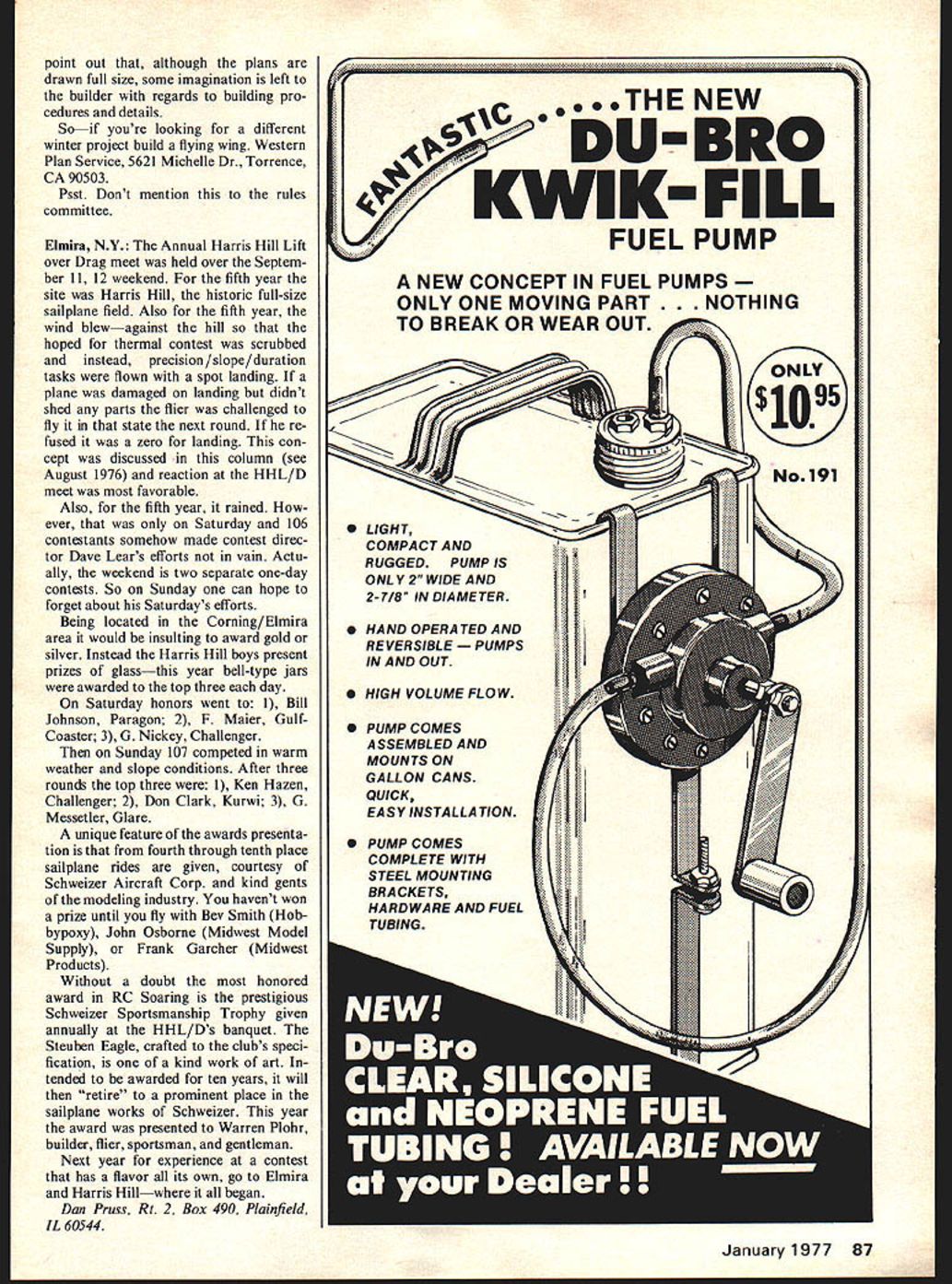
New RC Sailplane Speed Record: The claim of 188 mph by Werner Sitar of Austria has been homologated by the FAI and the record shatters the old one held by Aldochine of Russia of 113.24 mph. That record was established in 1971. Sitar's plane had no dihedral and some lateral stability was achieved with a swept-back wing of 11.5 degrees.
FAI rules for speed include a 50-meter course which must be traversed in both directions within 30 minutes without any intermediate landing. Also, the altitude of the model must remain below 40 meters and above 20 meters.
According to an excerpt from the dossier submitted by Sitar: "The model was dived from 400 meters (1300 ft.) having reached this height by using thermals. The pass in the opposite direction also started at this height, again by using thermals." The glider, which more closely resembles a missile than the average—let's go and get our Level III duration flight sailplane—has a span of six feet and a chord of 7½ inches. That's a wing area of 540 sq. in. Weight was 2.85 pounds which made the wing loading slightly more than 12 oz./sq. ft. Controls were limited to ailerons and elevator and no construction details are available at this time.
As with all FAI categories current records must be broken by at least two percent in order to be recognized. So, anyone out there that can get 191.76 mph out of that old crate in the rafters, the record is yours.
Fred Weaver, LSF/283, Reaches Level V: Only the third of nearly 2200 members to achieve this, the highest of soaring accomplishments, was Weaver as he joined the ranks of John Baxter and Steve Work. Although many who are working towards this goal have accomplished some of the tasks, a specific task itself is not only a stumbling block but the means to that end are also. Fred gives us a few hints.
For the eight-hour slope flight many feel that C-size nicads are the sure way of enduring without the receiver and servos giving up the ghost. That is a solution that usually requires a larger than standard class ship. Weaver used four alkaline Ever-ready pencells in a standard Aquila. Before the flight the voltage was at six volts but only dropped to 5.3 after eight hours. For the transmitter he did use eight C-cell nicads which Fred admits was a case of overkill.
For all of his contest work and the two-hour thermal task Fred used his White Trash. For distance (goal and return) he tried his original design, Lucky Lady. The ship weighed 6 lbs. 14 oz. which included the ballast. Wing loading was 10 oz./sq. ft. and Fred estimates the ship flew at about 25 mph when he wasn't thermalling. Other specs: wingspan, 152 in.; wing area, 1606 sq. in.; aspect ratio, 14:1; airfoil, 8-1/2% flat bottom, high point 35%; dry weight, 5 lbs. 14 oz.
As others have claimed, Fred also says that of all the tasks the goal and return is the most fun and the most rewarding. For the eight hours on the slope make sure you can endure! Suntan lotion, water, sandwiches, an AM/FM radio or tapes, a lounge chair, and witnesses with a sense of humor. Attesting that Weaver was still alive at the end of eight hours were Chris Christen, Jon Lowe, Tom Christian, and Jerry Arana.
Tired of building fuselages? And tails for that matter? Or do the fuselages you build look like the first half started a roll while the second half decided to stay straight and level?
Build flying wings!
Well, that's not a cure-all, but a gent on the West Coast, Dave Jones of Western Plan Service, has some interesting designs. The catalog lists conventional looking birds and the one that's a "grabber" is a 99-inch flying wing called Raven. Area is 1505 sq. in. At 45 ounces that gives it wing loading of 4.3 oz./sq. ft.
Some interesting features include a three-piece wing. The center section is built flat and the tip panels, which each account for slightly more than a third of the wing span, provide the polyhedral. The panels plug in and detach for easy transporting. Elevator and rudder are the only controls but the rudder is split down the center (between the leading edge and trailing edge). This, as a third function, splits open and acts as a speed brake.
This scribe has seen a model of the Raven fly at the 1976 LSF Tournament and was impressed with its maneuverability and its thermalling ability. Catalogs are 50¢, refundable with plan purchase. Plans for the Raven are $5.50. It is only fair to point out that, although the plans are drawn full size, some imagination is left to the builder with regards to building procedures and details.
So—if you're looking for a different winter project build a flying wing. Western Plan Service, 5621 Michelle Dr., Torrance, CA 90503.
Psst. Don't mention this to the rules committee.
Elmira, N.Y.: The Annual Harris Hill Lift over Drag meet was held over the September 11, 12 weekend. For the fifth year the site was Harris Hill, the historic full-size sailplane field. Also for the fifth year, the wind blew—against the hill so that the hoped for thermal contest was scrubbed and instead, precision/slope/duration tasks were flown with a spot landing. If a plane was damaged on landing but didn't shed any parts the flier was challenged to fly it in that state the next round. If he refused it was a zero for landing. This concept was discussed in this column (see August 1976) and reaction at the HHL/D meet was most favorable.
Also, for the fifth year, it rained. However, that was only on Saturday and 106 contestants somehow made contest director Dave Lear's efforts not in vain. Actually, the weekend is two separate one-day contests. So on Sunday one can hope to forget about his Saturday's efforts.
Being located in the Corning/Elmira area it would be insulting to award gold or silver. Instead the Harris Hill boys present prizes of glass—this year bell-type jars were awarded to the top three each day.
On Saturday honors went to: 1), Bill Johnson, Paragon; 2), F. Maier, Gulf-Coaster; 3), G. Nickey, Challenger.
Then on Sunday 107 competed in warm weather and slope conditions. After three rounds the top three were: 1), Ken Hazen, Challenger; 2), Don Clark, Kurwi; 3), G. Messetler, Glare.
A unique feature of the awards presentation is that from fourth through tenth place sailplane rides are given, courtesy of Schweizer Aircraft Corp. and kind gents of the modeling industry. You haven't won a prize until you fly with Bev Smith (Hobby Shop), John Osborne (Midwest Model Supply), or Frank Garcher (Midwest Products).
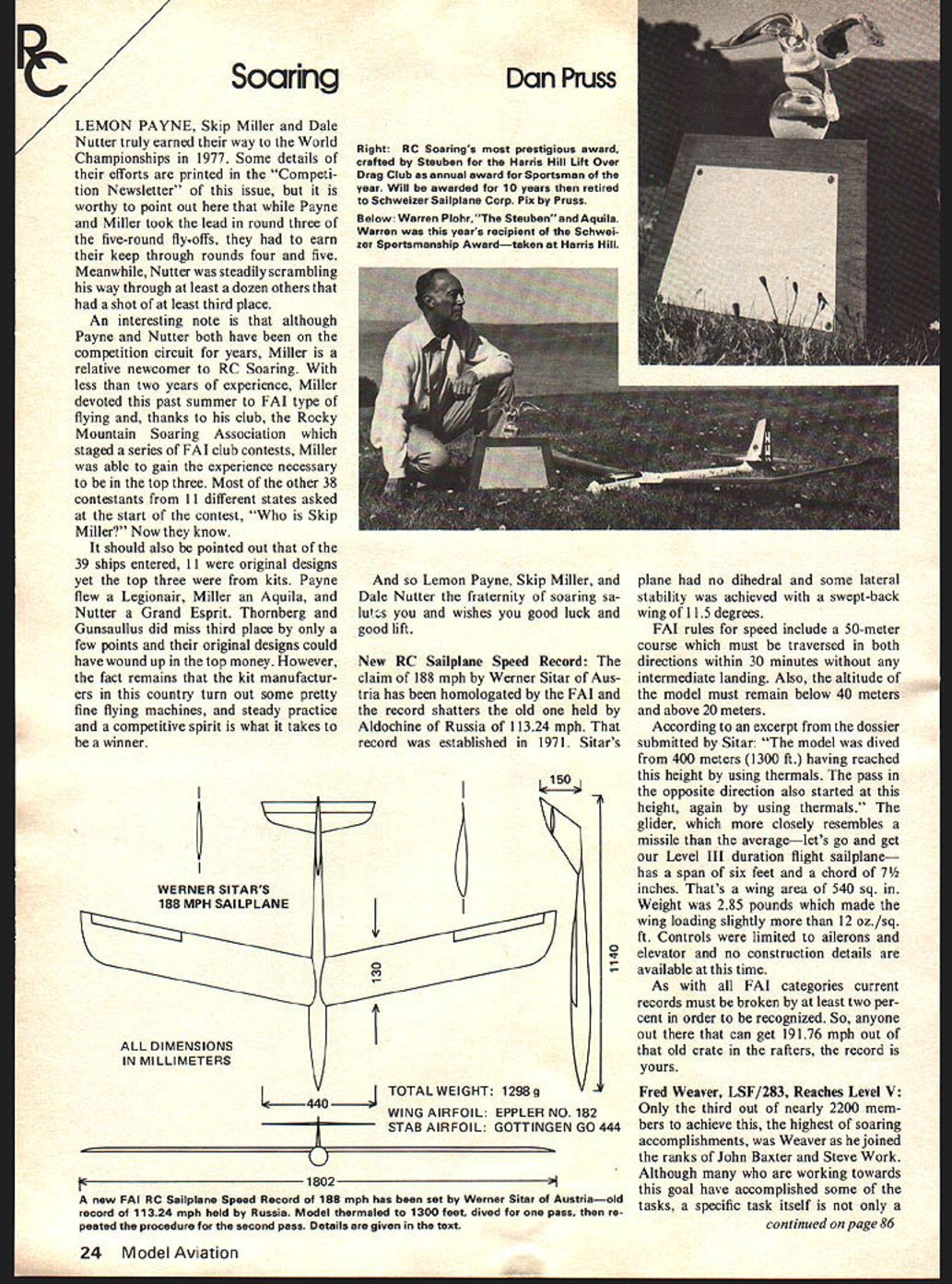
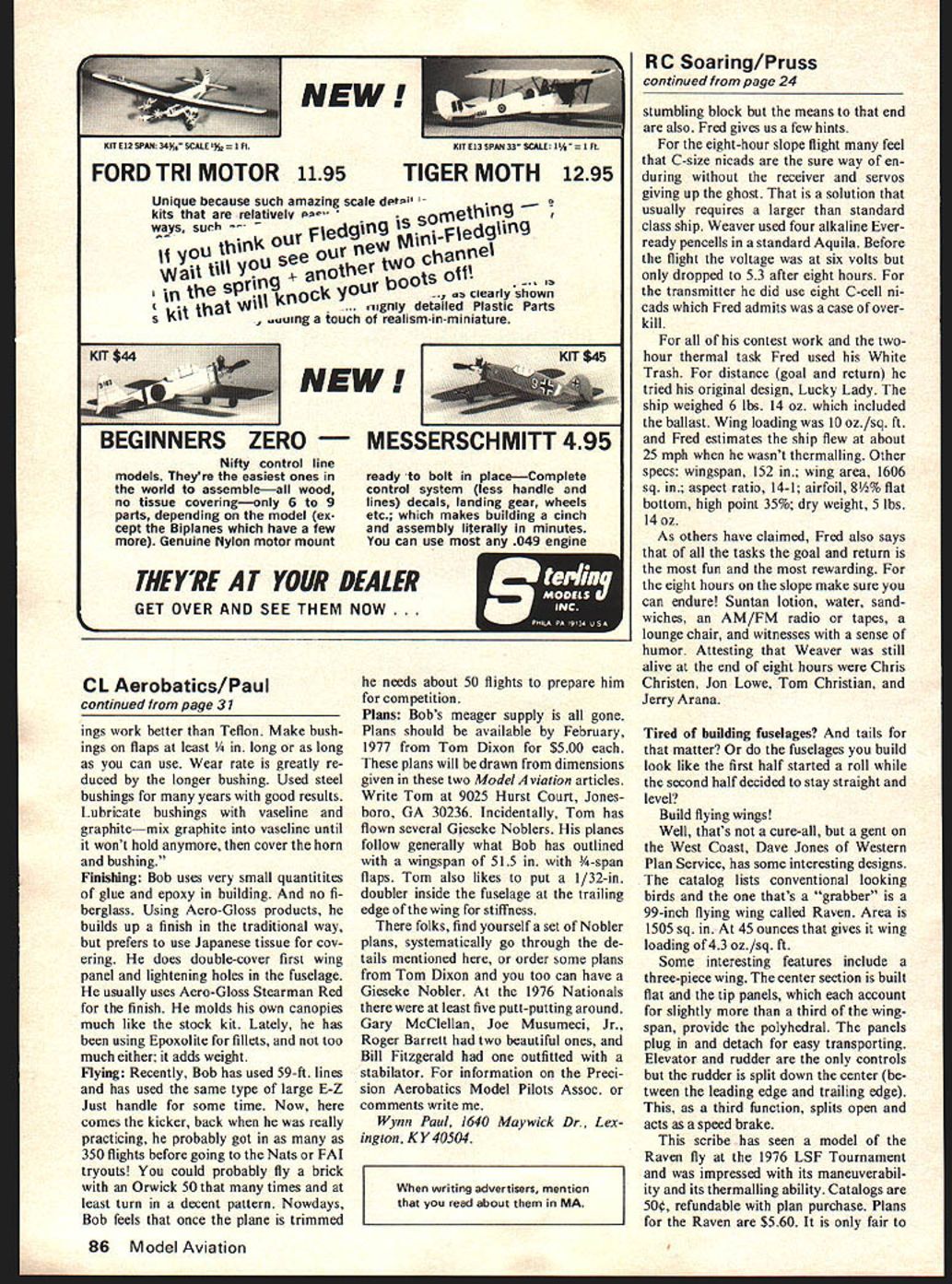
Without a doubt the most honored award in RC Soaring is the prestigious Schweizer Sportsmanship Trophy given annually at the HHL/D's banquet. The Steuben Eagle, crafted to the club's specification, is one of a kind work of art. Intended to be awarded for ten years, it will then "retire" to a prominent place in the sailplane works of Schweizer. This year the award was presented to Warren Plohr, builder, flier, sportsman, and gentleman.
Next year for experience at a contest that has a flavor all its own, go to Elmira and Harris Hill—where it all began.
Dan Pruss, Rt. 2, Box 490, Plainfield, IL 60544.
Transcribed from original scans by AI. Minor OCR errors may remain.

