
Radio Control: Soaring
Byron Blakeslee 3134 N. Winnebago Dr. Sedalia, CO 80135
NATS NEWS
Tom Culmsee, Event Director for Soaring at this year's AMA Nats, called to let everyone know the schedule. It's quite a bit different from past years, so please read carefully.
Soaring at the Nats will run Monday, July 18 through Saturday, July 23. Flying will be on a large field near Richland, WA (southeast corner of the state). Daily events:
- Monday: Cross-Country race. AMA-sanctioned; flown to provisional F3H rules. Fliers not into X-C can go up to Eagle Butte for slope fun-flying.
- Tuesday: Hand-Launch event. Transmitter check 1:00–5:00 pm.
- Wednesday: Scale and F3B events. Transmitter check 1:00–5:00 pm.
- Thursday: Unlimited Class event.
- Friday: Standard Class event.
- Saturday: Two-Meter Class event.
The NSS banquet will be in the evening at the Cloverland Inn; awards will be presented for all events.
This schedule adds two days to the Tuesday-through-Friday program used in recent years. New are the Hand-Launch event and the chance to participate in a Cross-Country race during Nats week. Both types of flying are gaining popularity; Nats exposure should boost them. Running one sailplane class per day is new, but we should still get nearly the same number of flights as before (three classes plus Scale were previously flown over four days). The sites and facilities are reported to be first class.
With the expanded schedule and the opportunity for families to combine the Nats with a Northwest vacation, this could be a very popular Nats for sailplaners. Get your entry in early.
Questions (with SASE) to:
- Tom Culmsee, 2190 S.W. 8th Dr., Gresham, OR 97080. Tel: (503) 667-4532.
- Wil Byers, 632 Meadows Drive East, Richland, WA 99352. Tel: (509) 627-5224.
North Alabama Silent Fliers
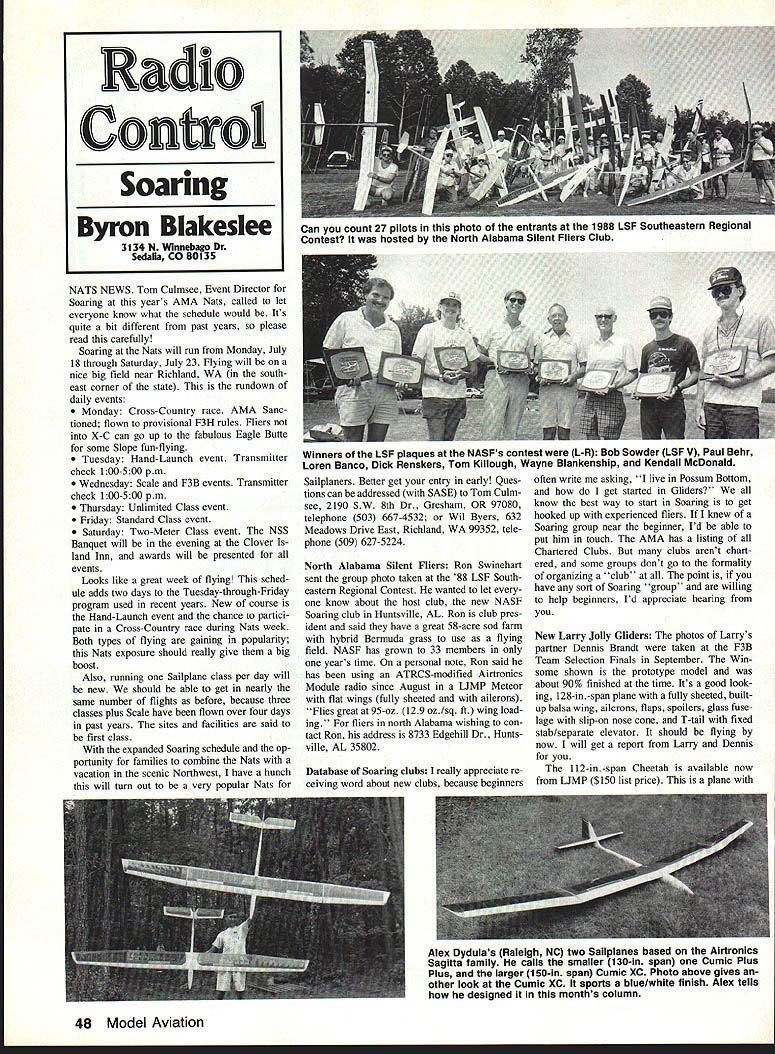
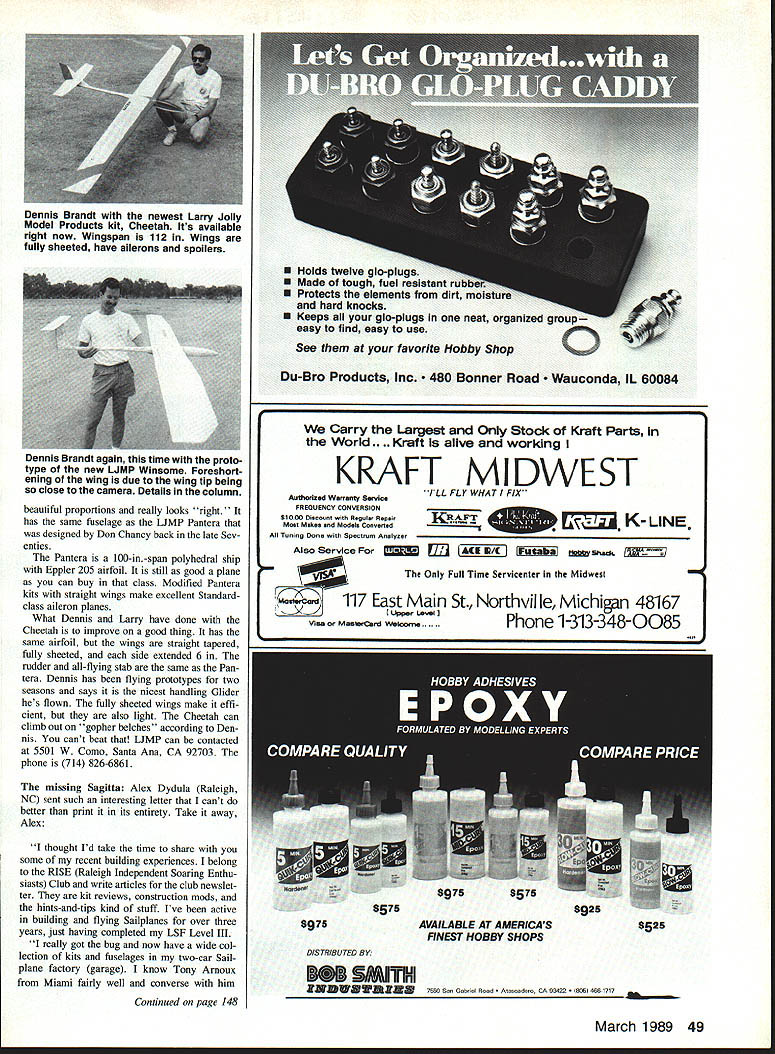
Ron Swinehart sent a group photo taken at the 1988 NASF Southeastern Regional Contest and described his host club — the new North Alabama Silent Fliers (NASF) Soaring Club in Huntsville, AL. Ron, club president, reports a 58-acre sod farm (hybrid Bermuda grass) available as a flying field. NASF grew to 33 members in less than a year.
Personal note: Ron has been using an ATRCS-modified Airtronics Module radio since August in an LJMP Meteor with flat, fully sheeted wings and ailerons. "Flies great at 95 oz. (12.9 oz./sq. ft.) wing loading." Contact Ron at 8733 Edgehill Dr., Huntsville, AL 35802.
Database of Soaring Clubs
I appreciate receiving word about new clubs because beginners often write asking how to get started. Knowing where clubs are helps put beginners in touch with experienced fliers. AMA maintains a listing of chartered clubs; some groups aren't chartered and don't formalize as a "club." If you are organizing a soaring group or know of one willing to help beginners, please let me know.
New Larry Jolly Gliders
Photos of Larry Jolly's partner Dennis Brandt were taken at the F3B Team Selection Finals in September. The winner shown was the prototype and was about 90% finished at the time. It’s a 128-inch-span plane with a fully sheeted built-up balsa wing, ailerons, flaps, spoilers, glass fuselage, slip-on nose cone, and a T-tail with fixed stab and separate elevator. It should be flying now; a report will follow.
The 112-inch-span Cheetah is available now from Larry Jolly Model Products (LJMP), list price $150. The Cheetah has excellent proportions and uses the same fuselage as the LJMP Pantera (designed by Don Chancy in the late 1970s).
The Pantera is a 100-inch-span polyhedral ship with an Eppler 205 airfoil and remains a strong performer. Modified Pantera kits with straight wings make excellent Standard-class aileron planes.
Dennis and Larry improved on the Pantera with the Cheetah: same airfoil, straight-tapered fully sheeted wings, each side extended 6 inches, same rudder and all-flying stab as the Pantera. Dennis has been flying prototypes for two seasons and calls it the nicest handling glider he's flown. The fully sheeted wings are efficient and light; the Cheetah climbs on very small lift. LJMP contact: 5501 W. Compo, Santa Ana, CA 92703. Tel: (714) 626-6861.
The Missing Sagitta
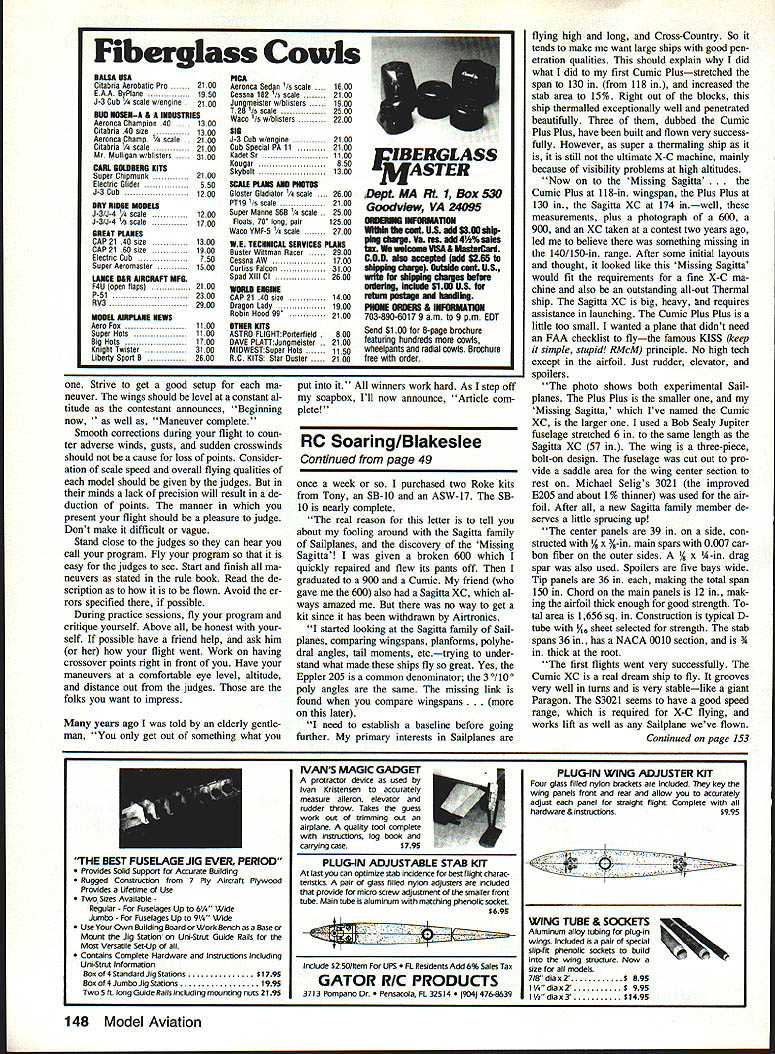
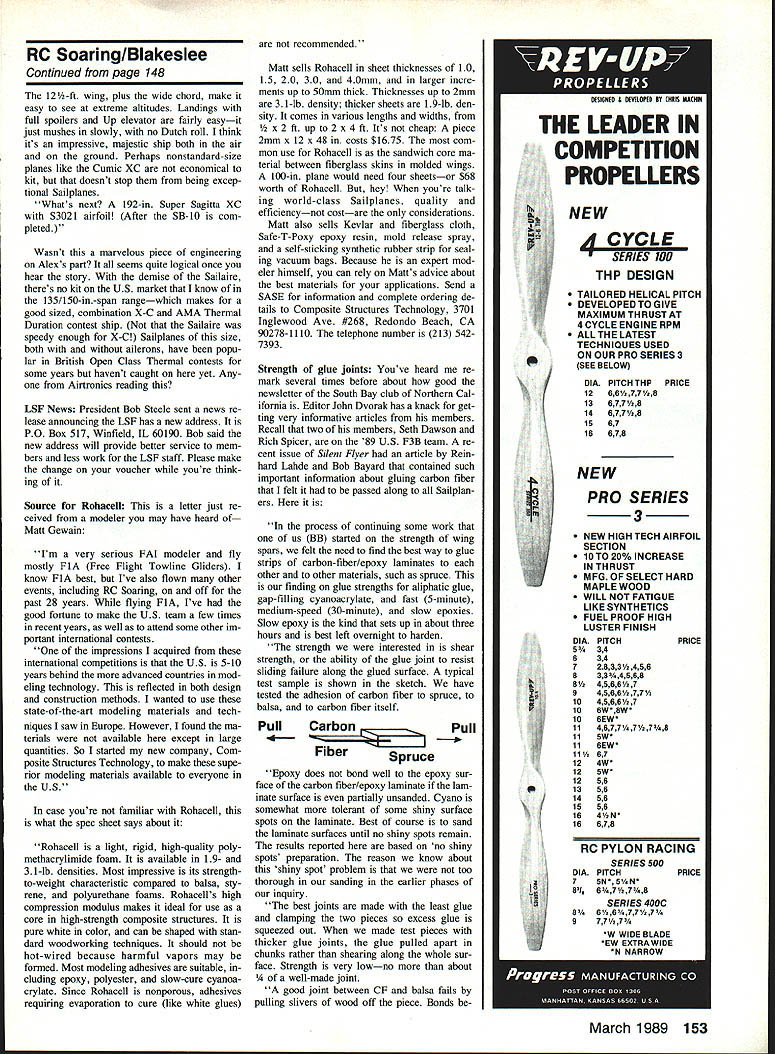
Alex Dydula (Raleigh, NC) sent a detailed letter about his building experiences and his exploration of the Sagitta family of sailplanes. Excerpts and a summary:
Alex belongs to RISE (Raleigh Independent Soaring Enthusiasts) and has been building and flying sailplanes for over three years (LSF Level III completed). He purchased two Roke kits (an SB-10 and an ASW-17). The SB-10 is nearly complete.
His main story concerns experimenting with the Sagitta family and discovering the "Missing Sagitta." After repairing and flying a Sagitta 600, then progressing to a 900 and a Cumic, he noted the Sagitta XC (174-inch span) but found no kits available. Comparing wingspans and geometry suggested a gap in the 140–150-inch range that would make an excellent cross-country (X-C) and thermal ship.
Alex built a "Cumic XC" to fill that gap. Key details:
- Fuselage: Bob Sealy Jupiter fuselage stretched to 61 in. (same length as Sagitta XC).
- Wing: Three-piece, bolt-on design. Main panels 39 in. each side with 3/8 x 7/8 in. main spars and 0.007 carbon fiber on the outer sides; 1/8 x 1/4 in. drag spar. Tip panels 36 in. each. Total span: 150 in.
- Airfoil: Michael Self's 3021 (an improved Eppler 205, about 1% thinner).
- Chord: Main panels 12 in.; total area 1,656 sq. in.
- Construction: D-tube with 3/16-in. sheet chosen for strength. Spoilers five bays wide.
- Stabilizer: Span 36 in., NACA 0010 section, 3/4 in. thick at the root.
First flights were very successful. The Cumic XC glides well in turns and is very stable—likened to a giant Paragon. The 3021 airfoil provides a useful speed range for X-C flying. Alex plans a 192-inch Super Sagitta XC with the 3021 after he finishes the SB-10.
With the Sailaire gone from the U.S. market, there are few kit options in the 135–150-inch span range for combined X-C and thermal duration contest ships; Alex’s Cumic XC fills that niche.
LSF News
LSF President Bob Steele announced the LSF's new address: P.O. Box 517, Winfield, IL 60190. Update your records.
Source for Rohacell
Matt Gevatt (Composite Structures Technology) writes as an experienced FAI modeler (mostly F1A towline gliders) and U.S. team member. He began Composite Structures Technology to make advanced modeling materials (common in Europe) available in the U.S.
Rohacell is a light, rigid polymethacrylimide foam available in 1.9- and 3.1-lb densities. Highlights:
- Excellent strength-to-weight compared to balsa, styrene, and polyurethane foams.
- High compression modulus; ideal as a core in high-strength composite structures.
- Fine, uniform pore structure; can be shaped with standard woodworking techniques.
- Do not hot-wire (harmful vapors may form).
- Most modeling adhesives are suitable: epoxy, polyester, and slow-cure cyanoacrylates. Avoid adhesives that require evaporation to cure (e.g., white glue) because Rohacell is nonporous.
Available sheet thicknesses: 1.0, 1.5, 2.0, 3.0, and 4.0 mm; thicker increments up to 50 mm. Sheets up to 2 mm are 3.1-lb density; thicker sheets are 1.9-lb density. Sizes range from 2' x 2' up to 8' x 4'. Example price: 2 mm x 12 x 48 in. costs $16.75. Typical use is as sandwich core between fiberglass skins in molded wings.
Matt also sells Kevlar and fiberglass cloth, Safe-T-Poxy epoxy resin, mold release spray, and a self-etching synthetic rubber strip for sealing vacuum bags. For information and ordering details (send SASE): Composite Structures Technology, 3701 Inglewood Ave. #268, Redondo Beach, CA 90278-1110. Tel: (213) 542-7933.
Strength of Glue Joints
From an article by Reinhard Lahde and Bob Bayard (Silent Flyer, South Bay club): tests on glue strength for carbon-fiber (CF) laminates bonded to wood and CF to CF. Focus was on shear strength (resistance to sliding failure along the glued surface). Key findings:
- Epoxy does not bond well to the epoxy surface of CF/epoxy laminates unless the laminate surface is thoroughly sanded (no shiny spots). Cyanoacrylate is somewhat more tolerant, but sanding is best.
- Best joints use the least glue and clamp to squeeze out excess. Thick glue layers reduce shear strength.
- CF-to-balsa joints fail by pulling slivers of wood off (balsa is weak in tension). CF-to-spruce joints are stronger; spruce fibers rip out before glue failure.
- CF-to-CF joints typically fail at the glue-laminate interface even with well-sanded surfaces. Overall CF/CF strength is close to CF/spruce.
Average breaking shear stress (psi):
- Aliphatic: 1,220
- Epoxy — fast (5 min): 1,530
- Epoxy — medium (30 min): 2,190
- Epoxy — slow (3 hr): 3,410
- Cyanoacrylate: 6,560
Conclusions:
- Do not use aliphatic glues with carbon fiber.
- Slow-curing epoxy gives better strength than fast epoxies.
- Slow cyanoacrylate (slow CA) produced the strongest joints in these tests—about twice the strength of slow epoxy.
- Preparation matters: sand until no shiny spots, clean with acetone, apply adhesive sparingly, clamp and squeeze out excess.
Practical notes: glue strength and cure speed can degrade with age; unopened cyano lasts indefinitely in the freezer, but opened bottles should be used within a few months.
Upcoming Cross-Country Races
- Fifth Annual Sugarloaf Classic: May 20–21 in Dickerson, MD (about 40 miles NW of Washington, DC). Sponsored by the Capital Area Soaring Association. Popular event; some frequencies already taken. Last year’s winner: Pat Flinn (Detroit). For info: CD Guy Dickes, 6331 Paddington Lane, Centreville, VA 22020. Tel: (703) 830-3631.
- Dash For Cash (Central Ontario Glider Group): Scheduled July 1–3 near Cookstown, Ontario. The group will try to obtain an FAI sanction to make it an official F3H International contest. Entries will not be accepted before April 15 to keep frequency allocation fair, but entry forms are available now. Contact Neil Tinker, 35 Cairnside Crescent, Willowdale, Ontario M2J 3M9, Canada.
Soaring and High Finance
I've described the Airtronics Vision 8SP radio (with ATRCS — pronounced "A-Tracks") previously. ATRCS provides the features needed for multiaxis soaring. List price is about $850 with four servos; street prices from retailers may be substantially less.
For basic flying (Gentle Ladies, Oly IIs) a good four-channel set like an Airtronics Vanguard or Futaba Conquest (~$150) suffices. Many competitive thermal-duration ships can be flown on three channels. Moving up to ailerons and flaps with electronic mixing makes a Vision 8SP attractive. It is less costly than comparable U.S. options, except for an Airtronics Module 7SP converted to ATRCS (about $300) by Control Systems Laboratories.
Perspective: first digital proportional radios appeared around 1963; prices have become more reasonable due to competition and integrated electronics. If you take soaring seriously and want to step up to a "full-house" plane, a first-class radio is a worthwhile investment. You might even buy a whole transmitter-per-plane for less than separate receivers, servos, switch harness, and battery.
Transcribed from original scans by AI. Minor OCR errors may remain.

