
Radio Control: Soaring
Byron Blakeslee 3134 N. Winnebago Dr. Sedalia, CO 80135
United States Soaring Team — F3B 1989 (Fundraiser)
The official logo of the U.S. FAI RC Soaring Team is being offered as embroidered patches, enameled pins, and Mylar decals to raise funds to support the team's effort at the Soaring World Championships in France this August.
Items and pricing
- Patch: $5
- Pin: $5
- Decal: $2
- All three (set): $10
Purchasers will have their names entered in a giant raffle; the top prize is an Airtronics Vision 8.5P radio. Final prizes will include kits, building supplies, and accessories. The raffle drawing will be held in July.
To order (send $10, or more): U.S. Soaring Team P.O. Box 19608-489 Irvine, CA 92713
Why the fundraiser matters
- The AMA pays airfare, entry fees, and room and board during the week of the championships, but additional funds are needed for transportation to practice sessions (in California) and for practice in France before the champs.
- Pilots have already invested heavily in planes, winches, and equipment; community support will help ensure the U.S. team can practice and compete effectively.
- Team members: Seth Dawson, Larry Jolly, Rich Spicer, and Team Manager Don Edberg — all world-class fliers preparing for a team effort.
F3B News — Winch Rules Update
At its December meeting in Paris, the FAI Bureau voted to overturn CIAM President Sandy Piminoff's earlier ruling that rescinded the new winch rules for the 1989 Soaring World Championships. Background and outcome:
Timeline and rationale
- April 1988: CIAM voted to institute new rules to drastically reduce winch power, aiming to end the costly "ground war" of ever-more-powerful winches and give teams a more even launching opportunity.
- The new rules specified minimum internal resistances measured with a "black box" (motor stalled): 15 milliohms for motors and 6 milliohms for 12‑volt batteries.
- Some teams protested that internal resistance was difficult to measure accurately and that there wasn't sufficient time to build legal winches and matching planes. In August, CIAM President Sandy Piminoff indicated the new rules would be off for 1989.
- Several teams were unhappy with that reversal, so the FAI Bureau was asked to decide.
Final decision (compromise)
- Motors must meet the 15‑milliohm minimum internal resistance.
- Batteries will continue to be limited by external physical dimensions rather than internal resistance measurements.
Implication: Everyone will be using new winches and launching to lower heights; the 1989 World Championships should be interesting as top-placing planes will likely set the direction for high‑tech design and construction in competitive RC soaring.
German Glider Accessories
Tony Arnoux (Miami) supplied two useful German accessories for quarter-scale and larger ships.
Magnetic pushrod connectors
- Description: Strong magnetic connectors that attach to pushrod ends (steel balls soldered to pushrods or threaded connectors). They make wing and control hookups simple—just "snick" the magnets together.
- Applications: Especially useful where servos are in inaccessible areas (e.g., shoulder-mounted wings or K-18 installations). Use one servo arm arrangement for differential aileron movement or spoiler configurations.
- Size reference: Example servo (Graupner linear-output) is about 2.3 in. long.
- Prices: Aileron type $12; spoiler type $15.
Liftfix-Schleppkopplung (aero-tow hook)
- Description: A clever towhook assembly for aero-towing. A tube with two internal diameters is epoxied into the glider nose; the ball engages in the tube and is held by a wedge-shaped part. The wedge is moved by a tow-hook servo to release the ball. The spring ensures positive engagement. Little load on the servo required.
- Price: $6.50.
Tony Arnoux contact: 1740 N.W. 82nd Ave. Miami, FL 33126
Kyosho Melody 1500 — Modifications and Beginner Advice
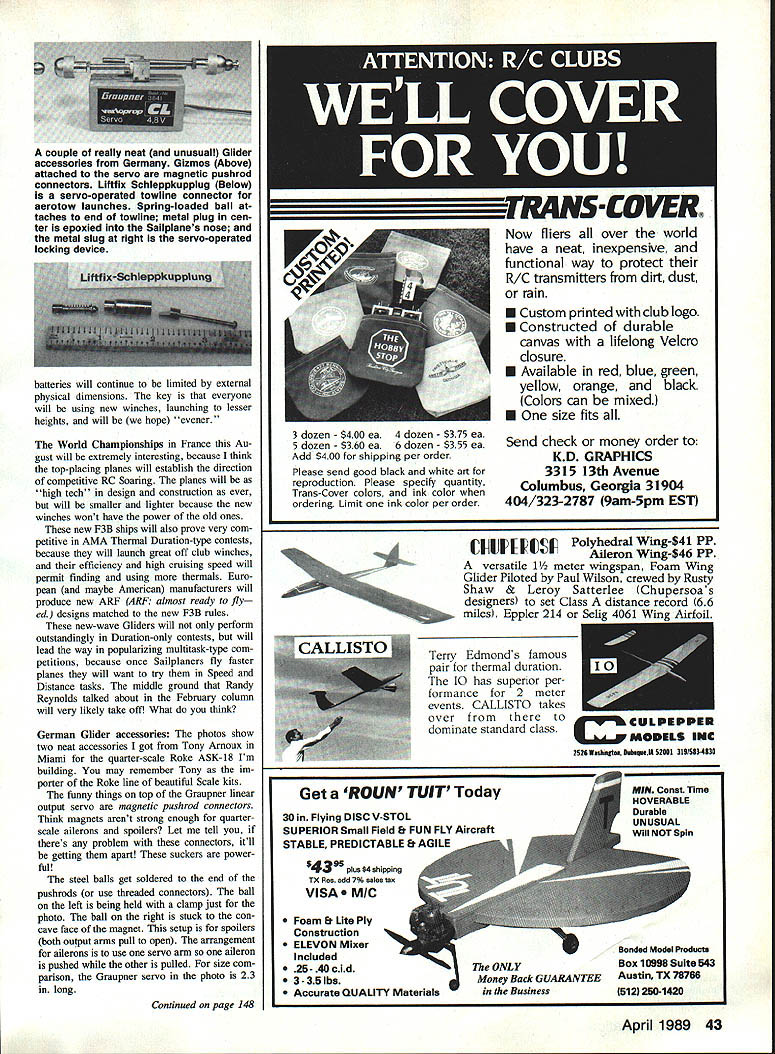
Renny Schoonmaker (Falls Church, VA) modified a Kyosho Melody 1500 for his girlfriend Nancy Rowzie. The Melody 1500 is an almost-ready-to-fly 59 in. span ship with a T-tail and good durability, commonly sold around $89.95 in ads.
Renny's experience
- The Melody's fuselage and tail are good, but the foam wing was the weak link: underpowered launches and folding under pull.
- After modifications (reinforcing wing, adjusting dimensions), the plane launched and flew much better.
Advice for beginners
- Small, prefabricated gliders (under ~60 in. span) can be very sensitive and tricky to fly for novices. They are more twitchy than stable, built-up two-meter trainers (e.g., Airtronics Olympic 650 or Carl Goldberg Gentle Lady).
- Beginners are often better off starting on a rock‑stable trainer even if it requires building a kit.
The Chuperosa Project (Hand‑Launched Kit)
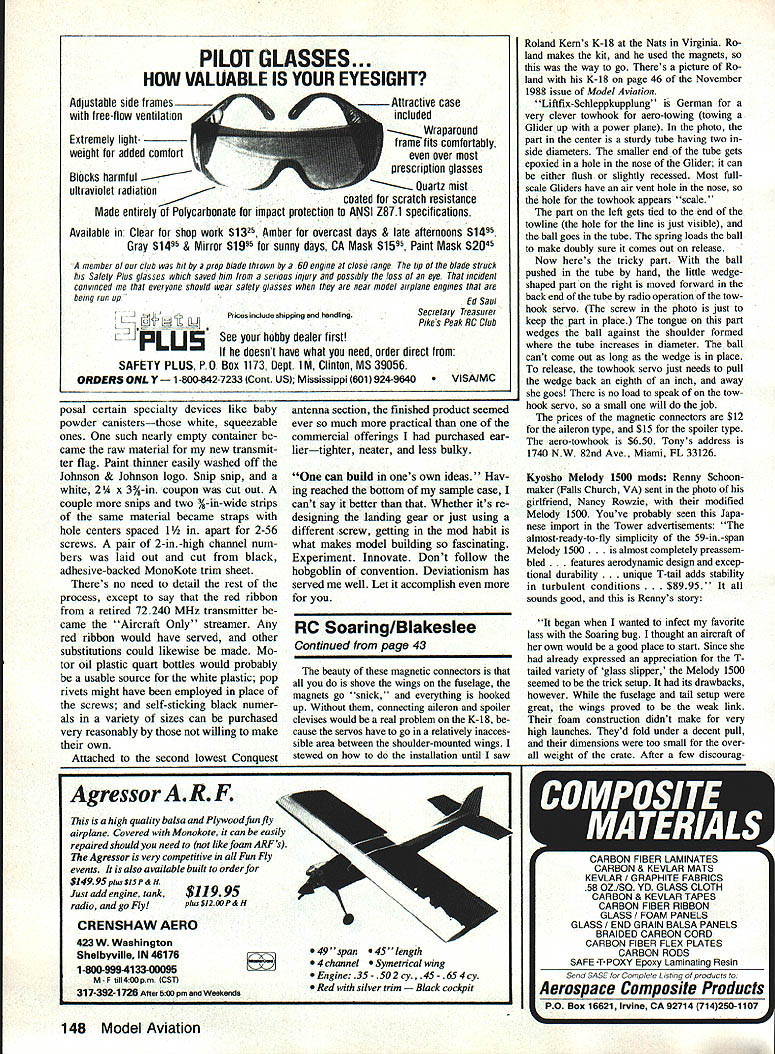
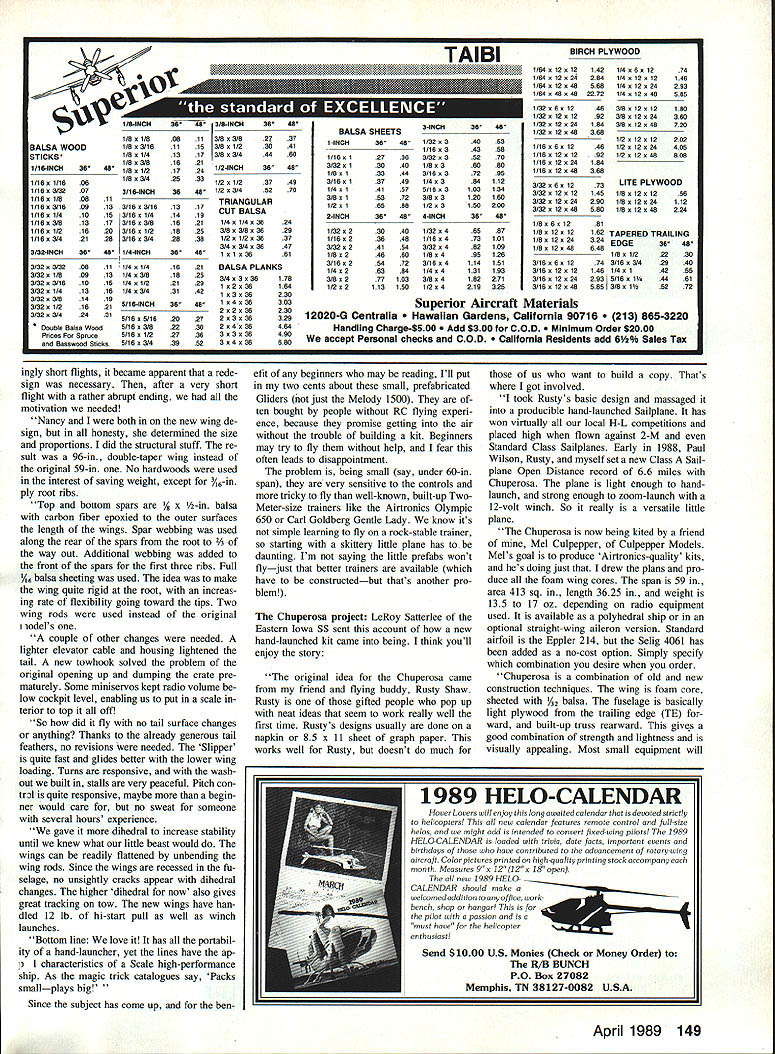
LeRoy Satterlee (Eastern Iowa SS) describes the Chuperosa, a hand-launched sailplane developed from Rusty Shaw's original idea and now kitted by Mel Culpepper (Culpepper Models).
Design and performance
- Origin: Rusty Shaw sketched the original; LeRoy refined it into a producible H-L sailplane.
- Competition results: Won many local H-L competitions; placed well against 2‑M and Standard Class sailplanes. In early 1988 achieved a Class A open-distance record of 6.6 miles.
- Versatility: Light enough for hand-launch, strong enough for zoom-launch with a 12‑volt winch; works for winch-launch and slope soaring.
Specifications
- Wingspan: 59 in.
- Area: 413 sq. in.
- Length: 36.25 in.
- Weight: 13.5–17 oz. (depending on radio equipment)
- Airfoils: Standard Eppler 214; Selig 4061 available as no-cost option.
- Versions: Polyhedral (standard) or optional straight-wing aileron version; two-servos-only mini-systems work best.
Construction
- Wing: Foam-cored sheathed with 1/32" balsa.
- Fuselage: Light plywood forward from TE, built-up aft — strong, light, and attractive.
- Uses small servos; easy to sand and cover.
Kits and pricing
- Polyhedral version: $41 (postpaid)
- Aileron version: $46 (postpaid)
Both prices include shipping and handling.
Order from: Mel Culpepper / Culpepper Models 2526 Washington Dubuque, IA 52001 Tel: (319) 583-4830
Dealers: American Sailplane Designs, Ace R/C, Hobby Shack.
Other upcoming kits
Mel is working on kits for Terry Edmonds' Standard Class Callisto and Two-Meter Jo: fiberglass fuselages, E-193 foam core wings, and all hardware. Target prices (unconfirmed): Callisto $169, Two-Meter Jo $139 (postpaid).
Nats and Second Annual Scale Slope Fun-Fly (Richland, WA)
Both events will be in the Richland area this year. The Scale Slope Fun-Fly is over Memorial Day weekend; the Nationals are in July.
Schedule (tentative)
- Monday, July 17 — Cross‑Country and Slope
- Tuesday — Hand‑Launch and Slope
- Wednesday — Scale and F3B
- Thursday — Unlimited Duration
- Friday — Standard Duration
- Saturday — Two‑Meter Duration and banquet (Clover Island Hotel)
Notes: Hand‑Launch will be a provisional event on a different field because of helicopter traffic.
Event organization and support
Contest Directors and coordinators:
- Slope CD: Hal Byers (Richland, WA)
- Hand‑Launch CD: Bob Nelson
- Cross‑Country: Mike Bamberg
Raffle contributors and supporters already committed include:
- Gary Anderson / American Sailplane Designs
- Viking Models
- Wilshire Models
- Vinyl Write
- Beemer RC West
- JR's Tom Klukich
For more info or to participate in the Scale Slope Fun-Fly, send a SASE to: Hal Byers 632 Meadows Drive E. Richland, WA 99352
Computer Sailplane Design — PC‑Soar and MaxSoar
Lee Murray's sailplane design program PC-Soar (for IBM PC) and the complimentary MaxSoar (for Apple Macintosh) help analyze and compare designs.
Features
- Input design parameters: areas, airfoils, aspect ratios, tail volumes, etc.
- Outputs plots and performance data: sink rate, lift/drag vs. speed, minimum sink (ft./sec.), best glide ratio and speed.
- Compare up to four designs on the same graph; comes with sample gliders and airfoils; allows custom designs.
Pricing and ordering
- PC‑Soar: $34.95 + $3 P&H
- Library diskettes: $29.95 each, or $29.95 for both when ordered with PC‑Soar
- MaxSoar (Mac): $49.95
Contact: LJM Associates (Lee Murray) 1300 N. Bay Ridge Road Appleton, WI 54915-2854
Make checks payable to John Hohensee and send orders to: 9924 West Metcalf Place Milwaukee, WI 53222
NSS News — Excellence Award Program and Soar‑In
NSS Excellence Award Program (1988)
National Soaring Society President Pete Carr reported the 1988 results of the NSS Excellence Award Program (EAP), where members earn points by flying local contests and submitting scorecards.
Top five finishers (1988):
- Royse Salamon
- Brian Smith
- Larry Rice
- Al Sicadore
- Eric Henderson
Prizes were donated by Airtronics, World Engines, Satellite City, Tower Hobbies, Carl Goldberg, Ace R/C, Leisure Products, Futaba, and Corvair.
NSS members can request 1989 program cards from: Doug Dorton 3058 Bernina Drive Benton, UT 84118
For NSS membership information: Cliff Oliver 8151 Broadway San Antonio, TX 78209
1989 NSS Soar‑In
Marshall Long is coordinating Soar‑In contests and hopes to double participating clubs. Soar‑Ins allow clubs across the country to compete using identical tasks, scoring, and landing requirements.
Key points:
- Local Contest Directors choose classes and dates (contests must be AMA sanctioned).
- Eligible dates: March 31 to October 28 (no requests after August 31).
- Task: three rounds of F3B-style 10‑minute tasks with six graduated runway landings.
- Awards: NSS plaques to top placers.
For more information: Marshall Long 824 Garden Meadow Universal City, TX 78148
Final Note
With the new winch-rule compromise and the U.S. team's fundraising and preparation, the 1989 competitive season — culminating in the Soaring World Championships in France — promises to be an important year. Expect to see advances in high‑tech sailplane design and tight team coordination shaping the future of competitive RC soaring.
Transcribed from original scans by AI. Minor OCR errors may remain.

