
Radio Control: Soaring
Byron Blakeslee 3134 N. Winnebago Dr. Sedalia, CO 80135
NATS NEWS
Overview
The Richland Nats in Washington State will be a very full week for sailplaners. If you want to fly more than just Duration at the Nats, this is a good opportunity to come out and support your special interest. Official events will include:
- Unlimited, Standard, and Two‑Meter Duration (each flown one whole day)
- Scale (included for the first time)
- F3B provisional events
- Cross‑Country
- Hand‑Launch
- Slope Soaring
The schedule runs Monday through Saturday (see the March column and the official Nats schedule posted in the April Competition Newsletter). In past years the three Duration classes and Scale were flown over four days (Tuesday–Friday); running one class per day may reduce the number of flights somewhat, but with good organization and retrievers it should work out.
Cross‑Country (X‑C) — rules and scoring
Cross‑Country details were gleaned from the Portland Area Soaring Society newsletter (Pat Chewning, editor). The Nats X‑C event will conform to the FAI F3H provisional rules except for these changes:
- Two rounds will be flown the same day on different courses.
- Scoring will be modified to encourage completion of the course:
- For racers finishing the course: 750 points to finish, plus 250 points × (finish time ÷ fastest time).
- For racers not finishing when someone has finished: 750 points × (distance completed ÷ course distance).
- If no one completes the course: 1000 points × (distance completed ÷ longest distance completed).
Mileage markers will be positioned on the course to help determine distance flown. The timer is the final authority on distance flown, finish time, and validity of turn‑points/turns, and will also report safety violations.
Minimum team: 3 persons — pilot, copilot/spotter, and timer/driver. If you cannot bring a full team, organizers will try to provide extra personnel. Entry fee: $25 per team.
Please pre‑register by June 15, indicating preferred frequency and at least one alternate, and any help you may need.
Contact:
- Mike Bamberg, 1059 NW Darnielle St., Hillsboro, OR 97124; telephone (503) 640‑5926.
Other questions: Tom Culmsee, Soaring Event Director, 2190 SW 8th Dr., Gresham, OR 97080; telephone (503) 667‑4532.
Safety / Vehicle rules
State of Washington law requires all occupants of a vehicle to use seat belts. For the race:
- Chase vehicles must have seat belts for all occupants (pilot, spotter/copilot, etc.).
- No standing in moving vehicles.
- No riding in the back of pickups without seat belts.
These rules will be strictly enforced.
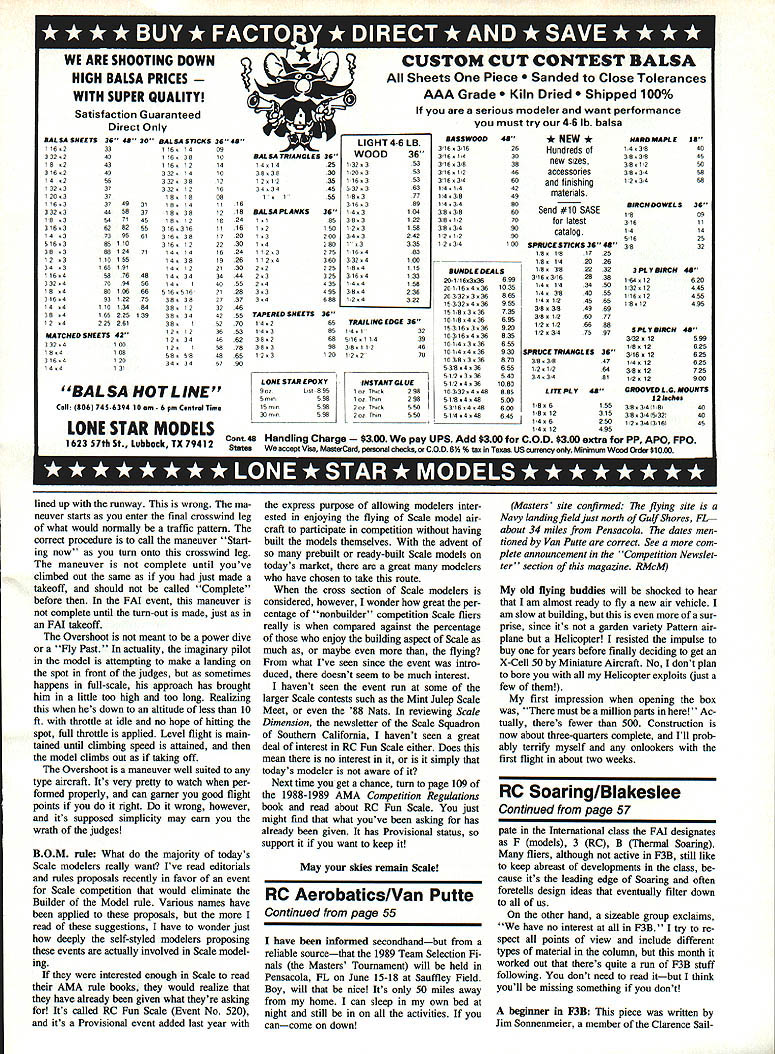
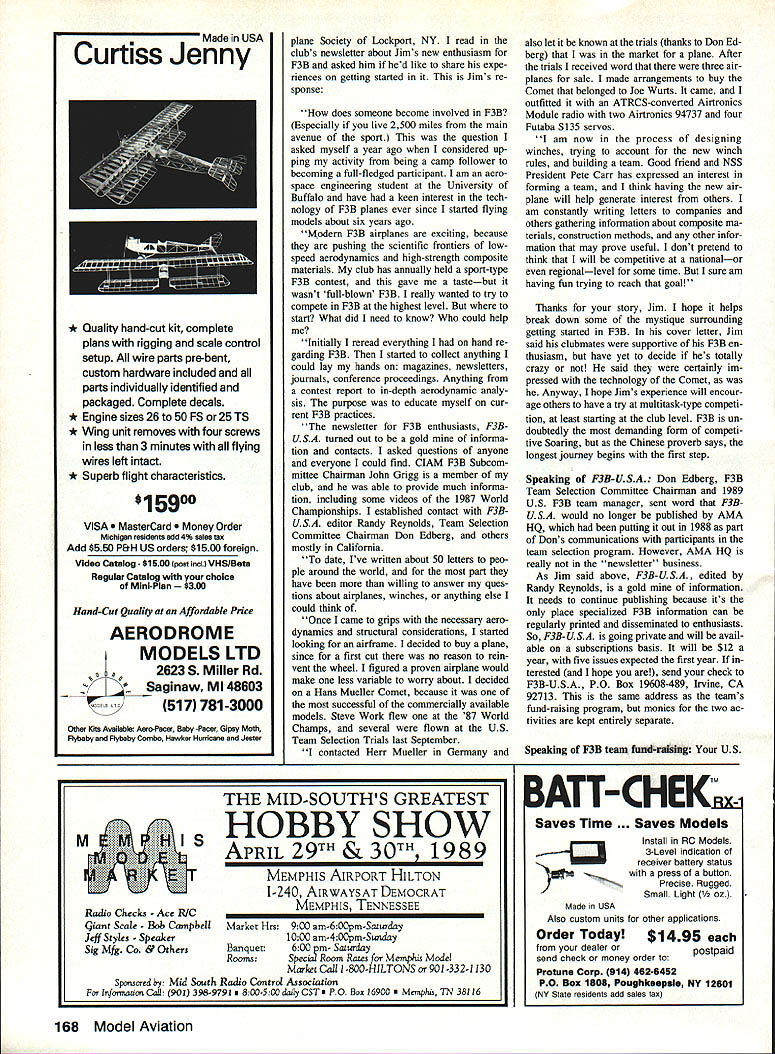
Erik Eiche’s Grunau Baby
Wil Byers sent photos of Erik Eiche’s magnificent quarter‑scale Grunau Baby 2B, scratch‑built from Cliff Charlesworth plans. Erik (Richmond, B.C., near Vancouver) is a member of the Northwest Soaring Society. The original photos are in color; black‑and‑white reproductions do not do justice to the beautiful varnished finish. It’s clearly a labor of love—varnish doesn’t hide mistakes, so every joint must be perfectly made.
We hope Erik will fly his Baby at the Richland Scale Slope Fun‑Fly on Memorial Day weekend so we can get more pictures.
Historical notes on the Grunau Baby
According to Martin Simons in The World’s Vintage Sailplanes:
- The Baby was designed and first built by Edmund Schneider’s factory at Grunau, Silesia, in 1931 (span 12.87 m).
- A major redesign in 1933 produced the Baby 2 (span 13.5 m).
- The 2A added improved ailerons and a semi‑enclosed canopy/windscreen.
- The 2B was the first with full airbrakes and a slightly longer wing (13.57 m).
- Over 4,000 Baby 2Bs were built for the NSFK pilot training program from 1940–1944.
On page 59 of Simons’ book is a photo of the actual glider Erik modeled (registration D‑8‑100) being bungee‑launched at the Wasserkuppe, painted in the NSFK cream scheme. Perhaps the ship was later refinished in varnish postwar.
Cliff Charlesworth and quarter‑scale plans
Cliff Charlesworth lives in Somerset, England, and is a longtime proponent of quarter‑scale vintage gliders, publishing several designs in British magazines. His plans are often worked from factory drawings and are very accurate. Cliff can also provide canopies for some designs. If you would like a list of plan sets available from Cliff, send a large SAE and the list will be mailed. Ordering from Cliff may require an international money order.
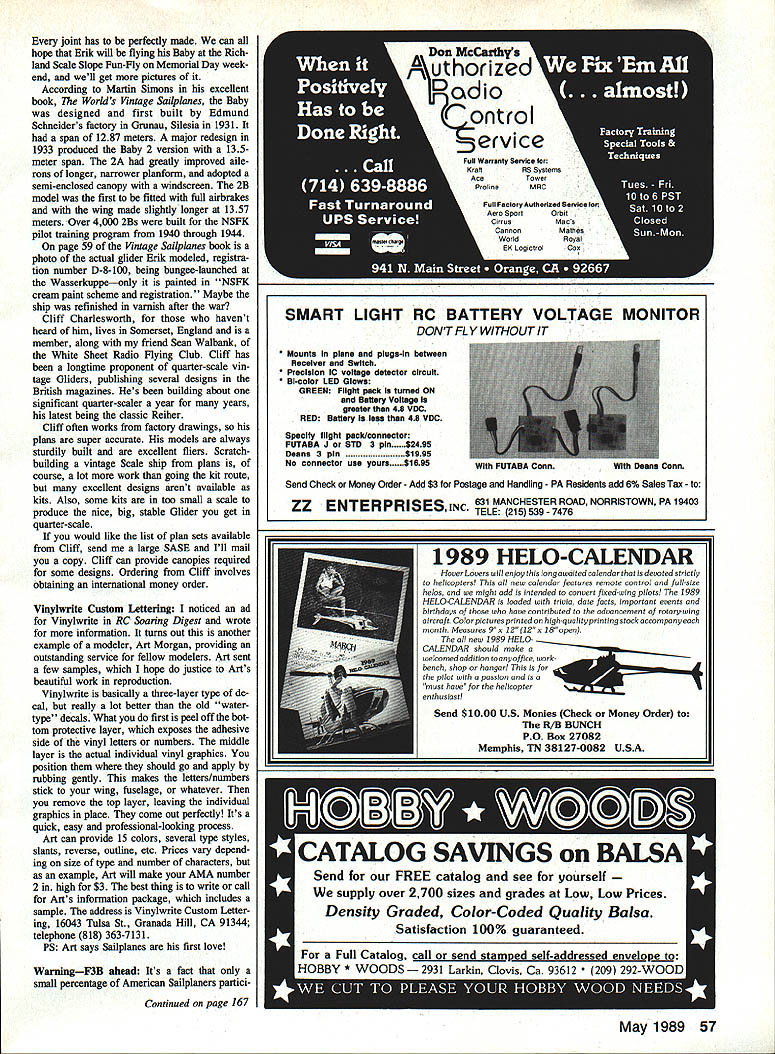
Vinylwrite Custom Lettering
I contacted Vinylwrite (Art Morgan) after seeing an ad in RC Soaring Digest. Vinylwrite produces a three‑layer vinyl lettering/numbering system that is superior to old water‑type decals:
- Peel off the bottom protective layer to expose the adhesive.
- Position the middle layer (the vinyl graphics), rub gently to adhere, then remove the top layer leaving the individual graphics in place.
They offer 15 colors, various type styles, slants, reverse and outline options. Prices vary by size and character count; example: an AMA number 2 in. high for $3. Request Art’s information package (includes a sample).
Contact: Vinylwrite Custom Lettering, 16043 Tulsa St., Granada Hills, CA 91344; telephone (818) 363‑7131. PS: Art says sailplanes are his first love!
Getting Started in F3B — Jim’s story
A club member wrote about getting into F3B after following the sport for years. Key points from his experience:
- Start by reading everything available on F3B: magazines, newsletters, contest reports, technical papers, aerodynamic analyses.
- F3B‑U.S.A. newsletter is an excellent source of information and contacts. The author used contacts from F3B‑U.S.A., club F3B subcommittee members, and other enthusiasts to learn more.
- He wrote many letters to people around the world; most were helpful.
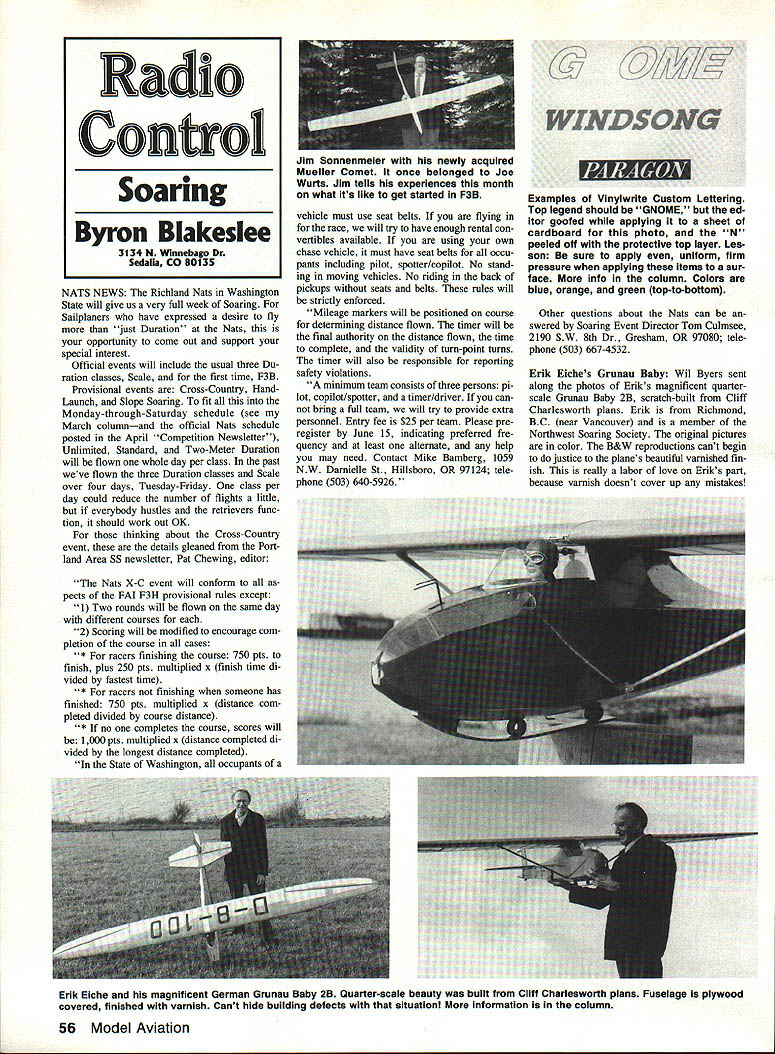
- After studying aerodynamics and structural needs, he bought a proven airframe rather than starting from scratch. He chose a Hans Mueller Comet and purchased one that previously belonged to Joe Wurts.
- He equipped the Comet with a converted Airtronics module and a mix of servos, and began designing winches to meet new winch rules and building a team.
- He emphasized that getting competitive will take time, but the process is rewarding and educational.
Thanks to Jim for sharing his experience—hopefully it demystifies getting started in F3B. F3B is demanding, but the first step is what counts.
F3B‑U.S.A. newsletter
F3B‑U.S.A., edited by Randy Reynolds, will be going private and available by subscription (AMA HQ will no longer publish it). Subscription: $12 per year; five issues expected in the first year.
Send checks to: F3B‑U.S.A., P.O. Box 19608‑489, Irvine, CA 92713.
U.S. Team and Fundraising
A U.S. team (pilots Seth Dawson, Larry Jolly, and Rich Spicer; Team Manager Don Edberg; backup pilot Gene Englegau; helpers Richard Tillman and Brian Chan) will go to France in August to compete in the Seventh World Championships for RC Soaring. This is the highest international competition in the sport.
European teams—especially the Germans—have dominated in recent years, but with training and teamwork the U.S. team hopes to be competitive. To fund training, the team is selling embroidered team patches and enameled pins ($5 each) and Mylar decals ($2). All three for $10.
For each $5 donation, your name enters a giant raffle (first prize: an Airtronics Vision 8SP radio), plus other radios, kits, supplies, and accessories.
Send donations to: U.S. Soaring Team, P.O. Box 19608‑489, Irvine, CA 92713.
Miscellany
H.L. catalog / Graupner kits
The H.L. catalog carries sailplane accessories and many Graupner gliders (spans from 94 in. up to large four‑meter ships). Highlights:
- Schempp‑Hirth Discus (S449)
- Grob G‑103A Twin Astir (S835)
- New Graupner ASW‑22B 270 sailplane kit: 106‑in. span, ABS fuselage, balsa‑sheeted foam wings, modified E‑205 airfoil, trailing edge airbrakes. Price noted at $219.
Contact H.L. (see ad in the magazine for ordering details).
Santa Maria X‑C Race
The ninth annual Santa Maria Cross‑Country Race will be held Saturday and Sunday, May 20–21, 1989. This is a 25‑mile, single‑launch (per attempt) race. LSF Level 3, 4, and 5 goal‑and‑return distances will be ranked off for pilots needing them. Saturday evening BBQ and raffle. Entry is by pre‑registration only.
Contact: Contest Director Mark Hadley, (805) 922‑5147.
Transcribed from original scans by AI. Minor OCR errors may remain.

