
Radio Control: Soaring
Byron Blakeslee 3134 N. Winnebago Dr. Sedalia, CO 80135
New from Bob Sealy: Pulsar (100 in. span)
Bob Sealy's Sailplane Shop has introduced the 100‑in. span Pulsar, a Standard‑class version of his 129‑in. Ultima kit. The Pulsar incorporates many Ultima features with a few new ideas and a simpler, easier-to-build approach.
- Shortened version of the Ultima fuselage with the same slip‑on nose cone for easy radio access and a clean installation.
- Conventional stabilizer location (rather than the Ultima's T‑tail), simplifying construction.
- Two‑panel, plug‑in wings (departure from Ultima's three‑piece, bolt‑on wing) — simple and sturdy.
- Molded fuselage fairings match the wing for a smooth transition.
- Wing planform follows the popular Schuemann layout: straight trailing edge and swept‑back leading edge.
- Roll control options: ailerons (with flaps), or polyhedral with spoilers — builder's choice. Ailerons/flaps suit moderately advanced or contest pilots; polyhedral/spoilers suit weekend fliers seeking extra stability.
Airfoil and flying characteristics
- Pulsar uses the Selig 3021 airfoil (Michael's version of the Eppler 205). It thermals extremely well, handles winds up to 15+ mph (often without ballast), and is easier to build than the thinner Selig 4061 used on the Ultima.
- Flight testing shows excellent thermal performance and all‑around capability. The aileron/flap configuration is preferred for performance; the polyhedral/spoiler version offers extra stability and is great for fun flying.
Kit price and specifications
- Kit price (including shipping): $129.95.
- Construction: fully balsa‑sheeted foam‑core wing (sheeting by builder); epoxy‑fiberglass fuselage with removable nose cone.
- Airfoil: Selig 3021; wingspan: 100 in.; area: ~900 sq. in.
- Heavy‑duty wing joiner rod (5/16 in.).
- Standard controls: rudder, elevator, spoilers. Optional: ailerons and flaps.
- Estimated flying weight: 52 oz.; wing loading: ~8.5 oz./sq. ft.
Ultima and other Sealy projects
- Ultima kits have been available for about a year; Ultima price: $190 ppd.
- Other Bob Sealy projects:
- Laser — a stretched Pulsar: 124‑in. wingspan, ~1,110 sq. in., ~62 oz. flying weight, wing loading ~8.0 oz./sq. ft.
- A 72‑in. span flying wing (~600 sq. in.) for Thermal Duration: partially sheeted foam wing, all‑wood fuselage; simple to build and fly. (No name yet.)
Vacuum‑bagging with Keith Kindrick
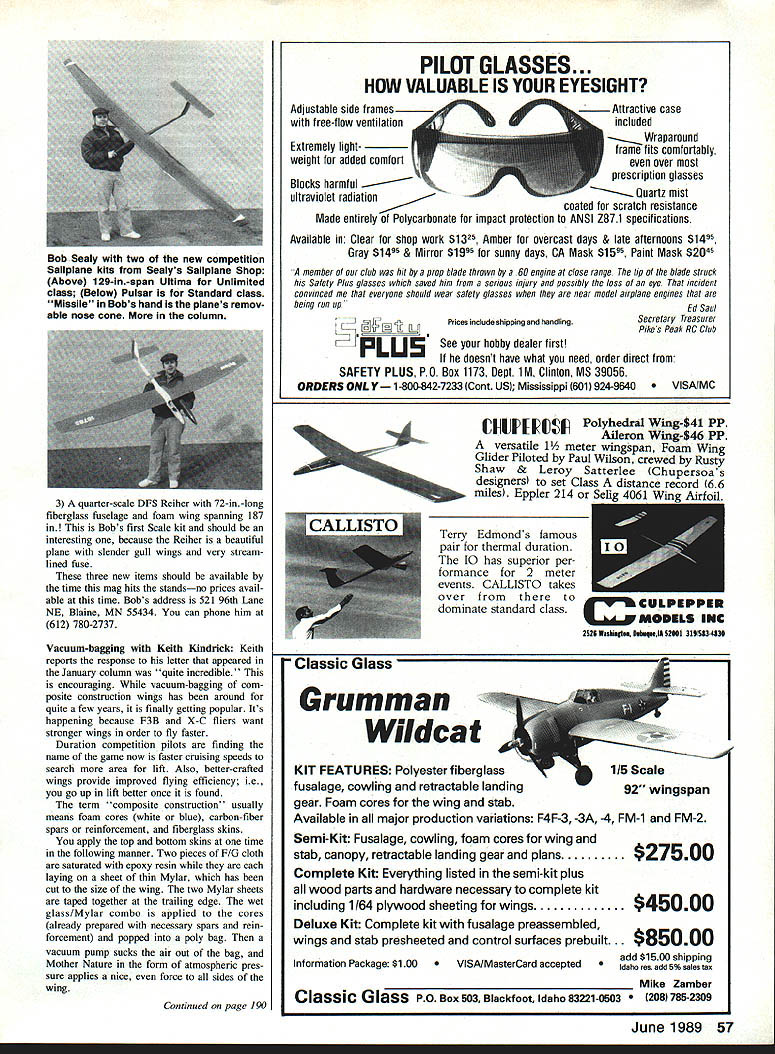
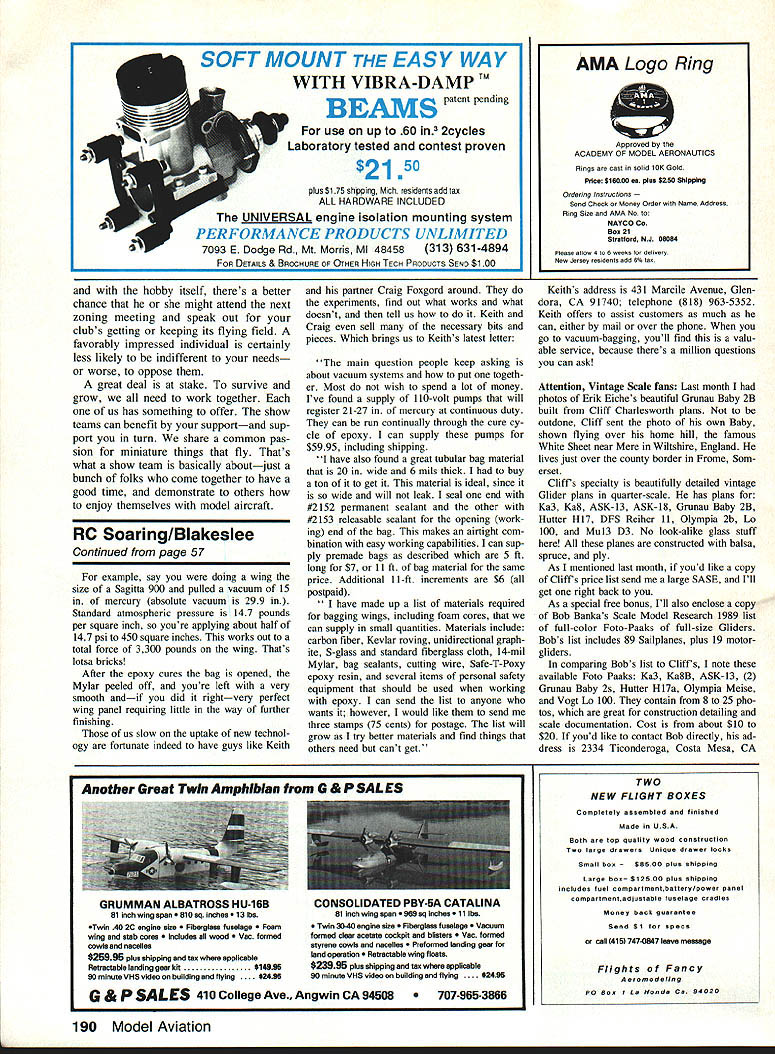
Vacuum‑bagging and composite wing construction (foam cores, carbon/graphite reinforcement, fiberglass skins) are becoming more popular as F3B, X‑C, and Duration pilots seek stronger, more efficient wings.
Basic process overview
- Two pieces of 4‑oz. fiberglass cloth are saturated with epoxy and laid on thin Mylar (waxed for release). The Mylar sheets are taped together at the trailing edge.
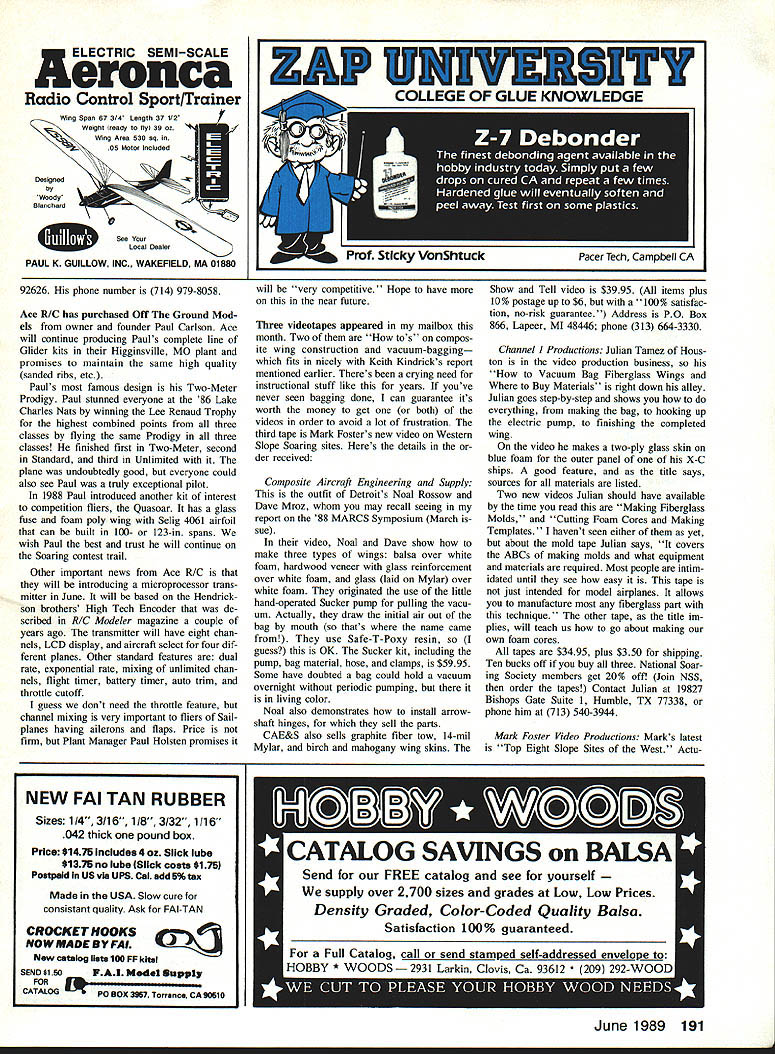
- The wet glass/Mylar assembly is applied to prepared foam cores (with spars/reinforcement installed), placed in a poly bag, and evacuated with a vacuum pump.
- Atmospheric pressure squeezes the bag, consolidating the laminate and producing a very smooth, accurate wing after cure. After curing, peel off the Mylar and finish lightly.
Pressure example
- If you pull a vacuum of 15 in. Hg (absolute vacuum ≈ 29.9 in. Hg), you apply about half of standard atmospheric pressure (14.7 psi) to the part. On a 450 sq. in. wing panel this is roughly 3,300 lb of total force — plenty of consolidation pressure.
Keith Kindrick's supplies and services Keith Kindrick (431 Mahalie Avenue, Glencoe, CA 91234; phone (818) 963‑5352) reported great interest after his January column and offers materials and advice for vacuum‑bagging:
- Vacuum pumps: 110‑volt pumps that will evacuate 27 in. Hg at continuous duty, suitable for epoxy cure cycles. Price: $59.95 (including shipping).
- Bag material: 20‑in. wide tubular bar material (6 mil) — very wide and reliable.
- Pre‑made bags: 5 ft. long — $7 (postpaid).
- 11 ft. of bag material — $7; additional 11‑ft. increments — $6 (postpaid).
- Bag sealing: he uses #152 permanent sealant for one end and #153 re‑sealable sealant for the working end to make airtight, reusable bags.
- Materials available in small quantities: carbon fiber, Kevlar roving, unidirectional graphite, biaxial S‑glass, standard fiberglass cloth, Mylar (1–4 mil), bag sealants, cutting wire, Safe‑T‑Poxy resin, and safety gear.
- Keith will mail materials lists on request (send 75¢ postage).
Keith offers help by mail or phone and is a useful resource for newcomers to vacuum‑bagging.
Vintage Scale and photo packs
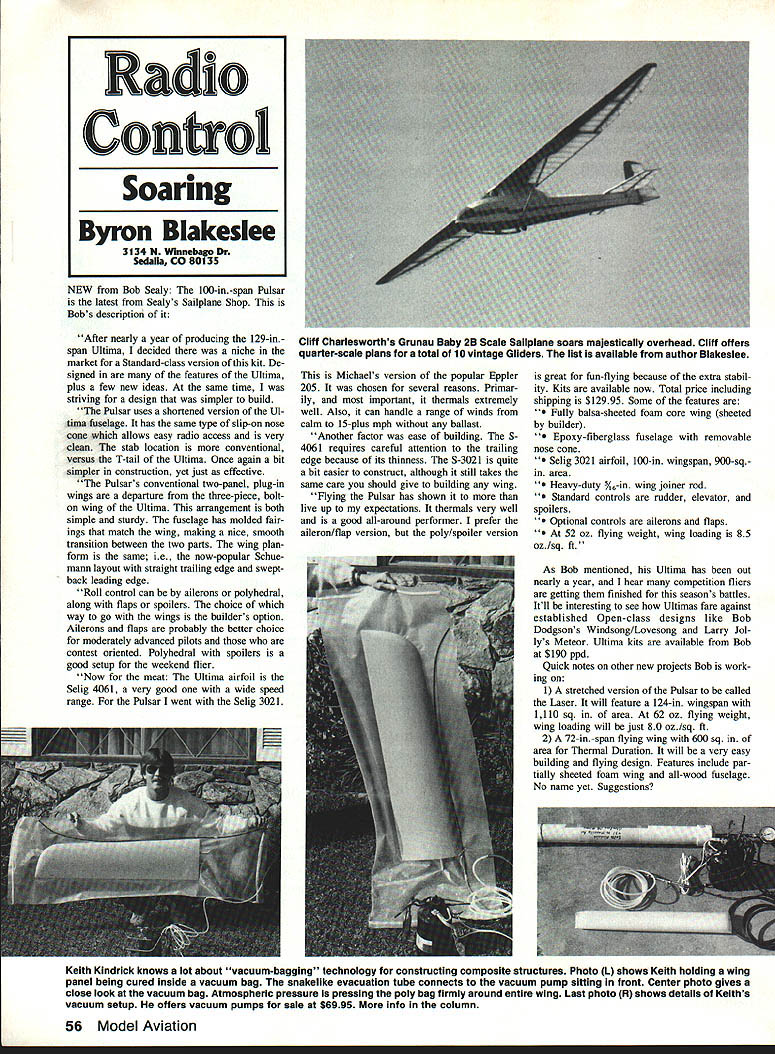
- Cliff Charlesworth (Frome, Somerset, England) produces detailed quarter‑scale plans for vintage gliders built with balsa, spruce, and ply (no glass look‑alikes). Available plans include Ka3, Ka8, ASK‑13, ASK‑18, Grunau Baby 2B, Hutter H17, DFS Reiher II, Olympia Meise, Lo 100, and Mu‑13 D3.
- To get Cliff's price list, send a large SASE to the columnist (Byron Blakeslee at the address above) and it will be returned.
- As a bonus, a copy of Bob Banak's Scale Model Research 1989 list of full‑color Foto Packs (88 sailplanes + 19 motor‑gliders) is available. Foto Packs (8–25 photos each) are useful for scale detailing; prices range from ~$10–$20.
- Bob Banak: 2334 Ticonderoga, Costa Mesa, CA 92626; phone (714) 979‑8058.
Industry news: Ace R/C and Old Man Grundy Models
- Ace R/C has purchased Old Man Grundy Models from Paul Carlson and will continue the glider kit line at their Higginsville, MO plant, maintaining quality (sanded ribs, etc.). Paul Carlson's notable designs include the Two‑Meter Prodigy and the Quasar (glass fuse, foam/poly wing, Selig 4061 airfoil, available in 100‑ or 123‑in. spans).
- Ace R/C will introduce a microprocessor transmitter (June) based on the Hendrickson High Tech Encoder with eight channels, LCD display, aircraft select for four planes, dual rate, exponential, mixing of unlimited channels, flight timer, battery timer, auto trim, and throttle cutoff. Price to be competitive.
Instructional videotapes and suppliers
Three videotapes of interest arrived covering composite wing construction, vacuum‑bagging, and slope sites:
- Composite Aircraft Engineering & Supply (Noel Rossow & Dave Mroz)
- Demonstrates balsa‑sheeted foam wings, hardwood veneer + glass over foam, and glass on Mylar over blue foam.
- Introduces a hand‑operated "Sucker" pump for vacuuming. Sucker kit (pump, bag material, hose, clamps): $59.95.
- Show & Tell video: $39.95. Address: P.O. Box 866, Lapeer, MI 48446; phone (313) 664‑3330.
- Channel 1 Productions (Julian Tamez, Houston)
- "How to Vacuum Bag Fiberglass Wings and Where to Buy Materials": step‑by‑step bag making, electric pump hookup, and finishing. Also tapes on "Making Fiberglass Molds" and "Cutting Foam Cores and Making Templates."
- Tape price: $34.95 each, plus $3.50 shipping. $10 off if you buy all three. National Soaring Society members get 20% off.
- Contact: 19827 Bishops Gate, Suite 1, Humble, TX 77338; phone (713) 540‑3944.
- Mark Foster Video Productions
- "Top Eight Slope Sites of the West" (Mark's two‑hour tape): includes more than eight sites, personal rankings of eight notable slopes (mostly CA, plus CO, WA, OR, HI), and map directions. Two‑hour tape price: $25.
- Address: 826 Oneonta Drive, South Pasadena, CA 91030.
These tapes are recommended for anyone who wants to avoid frustration and learn proven techniques.
Sportsman F3B and the RCSD Challenge
Sportsman F3B is a proposed middle ground between basic Duration and full F3B competition — lower cost, simpler logistics, and exciting tasks (Speed, Distance, Duration) for intermediate‑to‑advanced pilots.
RCSD Challenge (Jim Gray, R/C Soaring Digest)
- Purpose: design contest to produce the best kit to suit Sportsman F3B rules. Winner chosen by committee in June. The design can be an existing kit, a modified kit, or a new kit design.
- Proposed parameters:
- Complete kit price: $150 or less.
- Maximum ballast wing loading: 12 oz./sq. ft.
- Maximum ballasted weight: 70 oz. (possibly 80 oz.).
- Tasks (based on F3B, simplified for clubs):
- Speed — Fly four laps (two circuits) of a 150‑meter course as fast as possible.
- Distance — Fly as many laps of the 150‑meter course in four minutes as possible.
- Duration — Six‑minute Precision Duration with a 100‑point spot landing.
- Success depends on clubs running tryouts and contests; an RCSD Challenge winner will serve as a prototype kit to reduce guesswork for clubs and fliers.
Club news: Memphis Area Soaring Society
Bob Sowder (1489 Wood Trail Circle, Cordova, TN 38018) reports the formation of the Memphis Area Soaring Society (MASS). They plan monthly events, AMA‑sanctioned contests, and development of Junior membership.
Aerotowing and continental practice
- Aerotowing (towing model gliders aloft with RC power planes) is practiced actively in some U.S. areas (e.g., a Denver group) and more widely in Europe.
- Robin Lehman (Long Island) has written a Model Aviation article describing his aerotow technique.
- France has at least two clubs flying gliders exclusively by aerotow; they started a French Championship in 1981. The 1989 Open European Cup (Club Des Remis Chartraud) was scheduled for June 25–July 1 in St. Sauves D'Auvergne.
- Typical rules cited: glider weight limit 6 kg; wingspan > 3.3 m; many scale DG‑300/Discus types compete. Some events use special tow planes that release at 200 m (via radio altimeter). The 1988 event had 70+ contestants with no crashes.
- Aerotowing could be an invigorating addition to U.S. club events and Scale fun‑flies.
Handbook of Soaring Meteorology
Charles Lindsay (retired National Weather Service, chairman of the Meteorology Committee of the Soaring Society of America) authored Handbook of Soaring Meteorology (211 pages, privately printed). Though written for full‑scale pilots, the book contains meteorological principles useful to model glider pilots (especially LSF Level IV and above). Price: $19.95. Contact: Charles Lindsay, 1030 Colonial Meadows Way, Virginia Beach, VA 23454; phone (804) 481‑7180.
1989 Soaring Skills Symposium
Eastern Iowa Soaring Society (EISS) — third annual Soaring Skills Symposium:
- Date: May 27–28.
- Location: Antique Aircraft Airfield, Blakesburg, IA (eight miles west of Ottumwa).
- Format: Soaring/Electric kits fun fly with EISS members available to help with soaring‑related problems.
- Notable attendees/helpers: three LSF Level IV fliers (Jim Porter, Terry Edmonds, Basen Shipps), a Nats winner (Terry), and the 1988 Great Race winner (Rusty Shaw).
- Activities: Cross‑Country work, F3B, Thermal Soaring, Electric flying, continuous flying, Saturday evening fun‑fly and swap meet, catered food, on‑site camping.
- Contact: Leroy Satter, 1604 Huntington Road, Waterloo, IA 50701.
Fifth Annual Orange Blossom Soaring Special (1989 Rabble Rally)
- Host: South Dade Soaring Society.
- Date: May 27–28.
- Location: Goodwin Model Ranch, ~20 miles northwest of Ocala, FL (50 acres of cut grass).
- Events: Two‑Meter, Unlimited, and Scale; Saturday evening cookout.
- Contacts:
- Tom Beckman: (305) 252‑0014
- Ken Goodwin: (904) 528‑3744
- Tony Arnoux (Scale): (800) 327‑7278
Closing notes
If you have questions or want more information on any of the topics above (kits, vacuum‑bagging, tapes, events, or aerotowing), send mail to the columnist at the address above.
Transcribed from original scans by AI. Minor OCR errors may remain.

