

Radio Control: Soaring
Byron Blakeslee
3134 N. Winnebago Dr. Sedalia, CO 80135
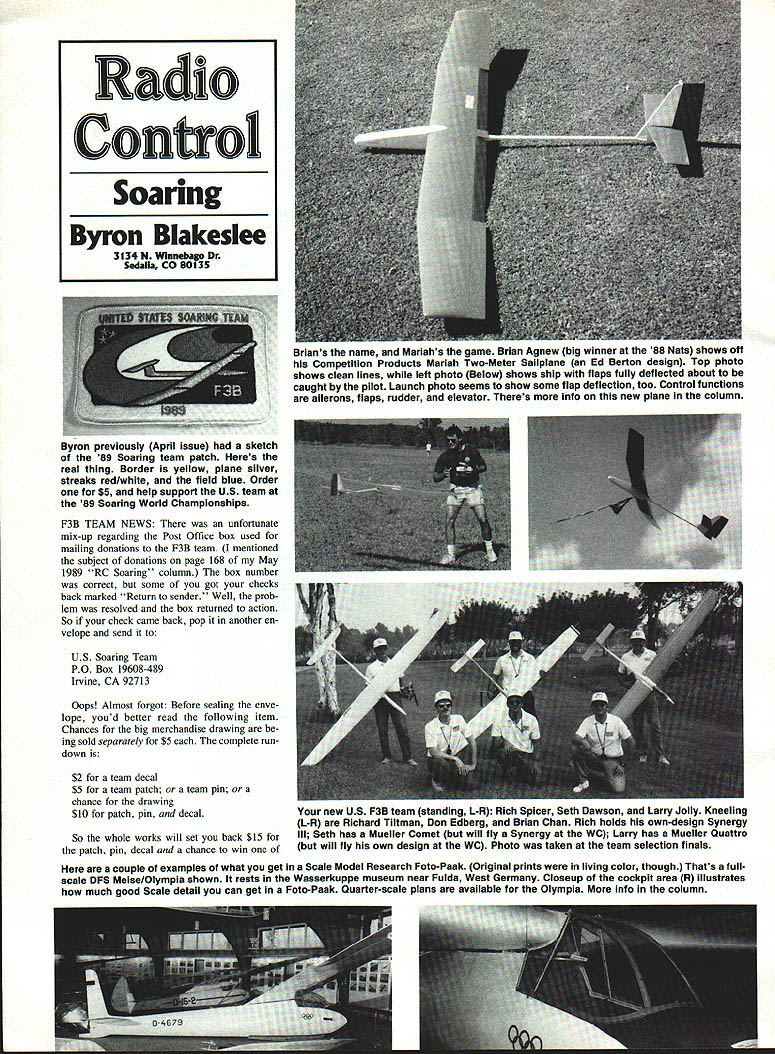
Byron previously (April issue) ran a sketch of the '89 Soaring team patch. Here's the real thing: border yellow, plane silver, streaks red/white, and the field blue. Order one for $5 and help support the U.S. team at the '89 Soaring World Championships.
F3B TEAM NEWS
There was an unfortunate mix-up regarding the Post Office box used for mailing donations to the U.S. F3B team (this was mentioned in the May 1989 "RC Soaring" column). The box number printed was correct, but some checks were returned marked "Return to sender." The problem has been resolved and the box is back in service. If your check came back, put it in another envelope and send to:
U.S. Soaring Team P.O. Box 19608-489 Irvine, CA 92713
Before sealing the envelope, read the following item about team merchandise and the big drawing. Items and prices:
- $2 — team decal
- $5 — team patch
- $5 — team pin
- $5 — one chance in the big merchandise drawing (drawing chances sold separately)
- $10 — patch, pin, and decal (package)
- $15 — patch, pin, decal, and one chance in the drawing (package + drawing chance)
Top prize in the drawing is a new Airtronics Vision 8SP radio. Other radios, kits, supplies and accessories will also be given away. The F3B team is committed to doing well at the World Championships in France in August; practice and travel expenses are high. Please help the team make a strong showing.
Mariah Competition Products
Ed Berton recently introduced a new high-performance Two‑Meter contest ship, the Mariah. It is a relatively expensive kit aimed at competition pilots who want top performance and materials with no compromises — not intended for casual or "gentle" fliers.
Design and development highlights (from Ed Berton):
- Mariah prototypes flew from 1985; four different models were built while testing airfoils and wing planforms.
- In early 1988, the Selig S-4061 airfoil was used and performed well; further refinements were made to the airfoil, fuselage, tail, and overall design.
- Stability increased by extending the tail moment; stabilizer area was reduced while aspect ratio was increased; rudder area was increased.
- Pull‑pull cables were replaced by pushrods to save weight and increase efficiency.
- One-piece, top-mounted wing retained for clean aerodynamics; wing mounting is 100% concealed.
- Individual aileron servos replaced by bellcranks driven by a single wing-mounted servo.
- Fiberglass fuselage combined with the other changes saved about 7 oz, resulting in a no‑compromise 35.5‑oz (355‑oz in the text appears to be a typo — see weight below) high-performance Two‑Meter named Mariah.
Kit and construction details:
- Kit includes full-size computer-drawn plans, a 30‑page building instruction book, all hardware, bellcranks, pushrods, control horns, and machine-cut plywood parts.
- Fuselage is laminated with two layers of cloth using polyester resin (one 6‑oz and one 4‑oz layer), giving greater strength and reduced brittleness without builder fiberglass work. Fuselage halves are joined with 6‑oz, 1‑in. wide fiberglass tape.
- Tail boom available in carbon fiber or fiberglass. Carbon fiber gives a superior strength‑to‑weight ratio but costs more and the receiver antenna should not be run inside a carbon boom. The fiberglass boom is slightly larger and adds about 1/2 oz to flying weight but is cheaper and allows the antenna inside the boom.
- Wing construction uses full‑size templates and precise jigs; saddles are cut oversize to match finished wing sheeting and preserve the S‑4061 undercamber. Contest‑quality balsa (9–10 lb density) used on ailerons and flaps. Spar cutouts in the foam cores are precise; little work is required on cores before sheeting.
- Controls: rudder, elevator, ailerons, and flaps. Typical flying weight with four servos and a 500 mAh battery is 35.5 ounces. With a carbon tail boom and the receiver mounted under the wing leading edge area (CG at 40% chord), Mariah may require little or no nose weight.
- Price: $160 with carbon‑fiber tail boom; $140 with fiberglass boom (shipping included).
Flying impressions: Mariah penetrates well, turns sharply, thermals easily, and has effective flaps for precise landings. Ed reports strong endorsements from top pilots; Brian Agnew (winner at the '88 Nats) reportedly liked the plane and demonstrated impressive hand‑launch thermal flying with it.
Scale Model Research
The photo of the DFS Meise/Olympia comes from a 14‑color‑picture Foto‑Paak set sold by Bob Banka of SMR. The Olympia was the winner of a competition to select a one‑design 1.5‑meter ship for the 1940 Olympic Games (which never occurred). D-4679 was photographed in the new museum on the Wasserkuppe gliding hill in Germany.
Nats News
Soaring Event Director Tom Cumber reports:
- The F3B event was inadvertently left off the contest entry form — it will be held. To enter F3B, write in event #45 and circle it; cost is $20. F3B and Scale will each have their own midweek "days." The Soaring banquet will be Saturday night so trophies for all events, including F3B, can be awarded together.
- CompuServe users can find up‑to‑date Nats Soaring news and frequency assignments in the ModelNet library #13. Filenames are:
- SOARIN.FRE — frequency assignments for official Nats events
- SORIN2.FRE — frequency assignments for unofficial Nats events
- NATSOR.TXT — news and general Nats Soaring info
- Official Soaring HQ motel for Nats week: Clover Island Inn, Kennewick. Reservations: 1‑800‑541‑7628. Mention "Nats Soaring group" for a special discount.
- Tom Cumber can be reached at (503) 667‑4532.
"Fifty Ways To Win at Gliders" and F3B‑U.S.A.
Randy Reynolds (Colorado Springs) wrote "Fifty Ways To Win at Gliders," originally in the Pikes Peak SS newsletter (Ron Watts, editor). Randy admits to "making every mistake possible" and shares many practical pointers. He is also editor of F3B‑U.S.A., a newsletter for F3B enthusiasts; it covers Sportsman F3B as well. Subscription: $12 for five issues. Make checks payable to "F3B‑U.S.A." and send to the U.S. Soaring Team P.O. Box address above.
Randy's introduction: he was baffled by competitive glider flying at first despite being good at other things. He read rules and talked to locals, still made mistakes, and now shares the lessons learned. Below are his 50 tips condensed under topic headings.
Tips for success
The Glider
- Pick any reasonably competitive, proven design; don't chase theoretical "demon tweaks."
- Commit to flying that ship until you reach your objectives over several seasons.
- Build it straight, flat, and clean — be a fanatic about alignment.
- Use quality radio gear, especially servos.
- Know your batteries — they are your glider's best friend.
- Flying surfaces should always return to precise neutral.
- Be knowledgeable about CG and express it as a percentage of wing chord, not vague measurements.
- Develop a workshop checklist and inspect everything before each flying season.
The Practice Session
- Fly with a purpose — set objectives.
- Fly with someone timing you, as though in contest conditions.
- Always use a landing tape and practice both right and left patterns.
- Participate in LSF programs — they help.
- Help others; teaching/assisting improves your own skills.
- Aim to fly twice per week during contest season.
The Launch
- File a mental flight plan before launching.
- Before launching, think "PPSS": Pin for frequency? Plane OK? Settings in trim? Stick — move all flying surfaces?
- Planes launched with radios off are caused by mistakes while preparing to launch — repeat PPSS.
- First third of the launch is for height — go nearly vertical at medium winch speed.
- Second third builds speed and positions you toward the flight pattern area.
- Final third is for final speed, dive, and zoom; save some zoom for glide‑ratio (L/D) toward the search area.
- If you fly through lift during the launch (line tension increases and height gain improves), continue the launch and then return to the lift area.
- Practice downwind launches; go fast.
- The best launches are in wind.
- Don't relax early — always try for maximum height; ask flying buddies for feedback.
The Thermal
- Search for thermals at medium to high speed, ideally at your ship's best L/D.
- Use minimal control input when you detect lift to avoid "stick lurch."
- Don't turn immediately when you detect lift — explore to find the core to assure sufficient altitude. Low thermals are small and may require immediate, aggressive action.
- Remember thermals drift with the wind; if you lose contact, search downwind.
- Watch which side of the circle has stronger lift and move that way.
- Thermals can exist in wind — use ballast and wind techniques as needed.
- Watch for wave lift; use S‑turns rather than circling.
- Don't convince yourself a thermal exists if your glider won't sustain it.
- Ground wind shifts can indicate local thermal formation.
- Ask local experts about thermal patterns and reasons behind them.
The Landing
- Communicate with your timer about countdown routine, watching other planes, and landing tape placement; make them part of your training team.
- Be at the landing circle at least two minutes before landing.
- Hit desired checkpoints at one minute to go (about 75 ft.) and at 30 seconds (about 30 ft.).
- At 30 seconds, visualize and commit to the landing. Enter a U‑shaped pattern (downwind, crosswind, final) started upwind enough for a stable final approach.
- Fly with reduced elevator and manage speed with crow or spoilers; glide slope should be steep enough to reach the spot while maintaining airspeed for corrections.
- Use rudder and aileron to control final approach.
- Approach into the wind when possible and keep the plane centered.
- Most bad landings are from improper altitude/speed control and poor setup — practice patterns until routine.
The Contest
- Ensure the glider is in top tune; avoid changes since the last practice flight.
- Know the task rules and attend the pilot's meeting.
- Consider task specifics, site, and weather.
- Find a buddy for timing and line retrieval; moral support helps.
- Evaluate thermal search options; watch where other fliers find lift and consider joining them.
- Monitor one or two expert competitors to learn techniques; study entire flights as if you were flying them.
- Take periodic quiet time to relax and observe — preserve perspective.
- Take care of yourself: avoid dehydration, use sunscreen, and protect eyes with UV sunglasses.
- Set attainable goals during the contest; if you start poorly, reset goals for the day.
- Maintain concentration even when lucky or leading; don't give up after bad luck.
Randy concludes: "Bobby Fischer said that 'Chess is life.' Flying RC sailplanes can be as compelling as chess to some, but remember perspective — this is for fun."
F3B news (CIAM meeting and rules)
- The '89 FAI CIAM meeting was held in Paris in early April. John Grigg (U.S. F3B Subcommittee representative) was unable to attend; Terry Edmonds attended as his substitute. (Initial reports were to be published in the Competition Newsletter.)
- French proposal: adopt Aerotow Distance/Duration contest rules as a new FAI class. This proposal faces hurdles because the format is not widely known outside France.
- British proposal: create an International Thermal Duration class based on percentage‑slot scoring. This has potential support because many fliers prefer Duration‑only competition; one British idea (hand‑towing only) was noted as unlikely to be popular internationally.
- Motor resistance rule discussion: West Germany and Switzerland proposed lowering the internal resistance limit for the wind‑microturbine (motor) rule from 15 to 12 millionths (the proposal sought to better match actual running motor resistance, which can be higher than stalled tests due to brush losses). The 15‑millionths limit was found to cause some motors to be less efficient than intended; the aim is to limit maximum power near 1.1 kW. For reference, stock Ford long‑shaft motors test around 6 to 9 milliohms on certain German test equipment, indicating that common "standard" motors may be more powerful than the proposed limit. A "good" general motor (e.g., a Bosch with ball bearings) would perform similarly to a Ford club motor in practice.
Careful eye care
A study by Johns Hopkins University (reported in the New England Journal of Medicine) found that long‑term exposure to strong midday sunlight can increase the risk of cataracts more than threefold. The harmful agent is ultraviolet (UV) radiation, strongest between 10:00 a.m. and 2:00 p.m. UVB (280–315 nm) is most harmful. Recommendations:
- Wear sunglasses that block UV (look for lenses that block through 400 nm).
- Use a brimmed hat for additional protection.
- Use sunblock on exposed skin and protective clothing to reduce cutaneous damage.
- Be aware of blue light (about 400–500 nm) mentioned in some reports and protect eyes accordingly.
Transcribed from original scans by AI. Minor OCR errors may remain.

