
Radio Control: Soaring
Byron Blakeslee 3134 N. Winnebago Dr. Sedalia, CO 80135
Toledo Show — 35th Annual Radio Control Exposition (April 7–9, 1989)
The Toledo show, started in 1955, was held April 7–9, 1989. Crowds were the usual huge size, and many exhibitors said business was better than ever. The RC hobby, in all its facets, just keeps growing and growing. However, there were relatively few genuinely new items on the glider front.
Bob Sealy — Pulsar and Laser
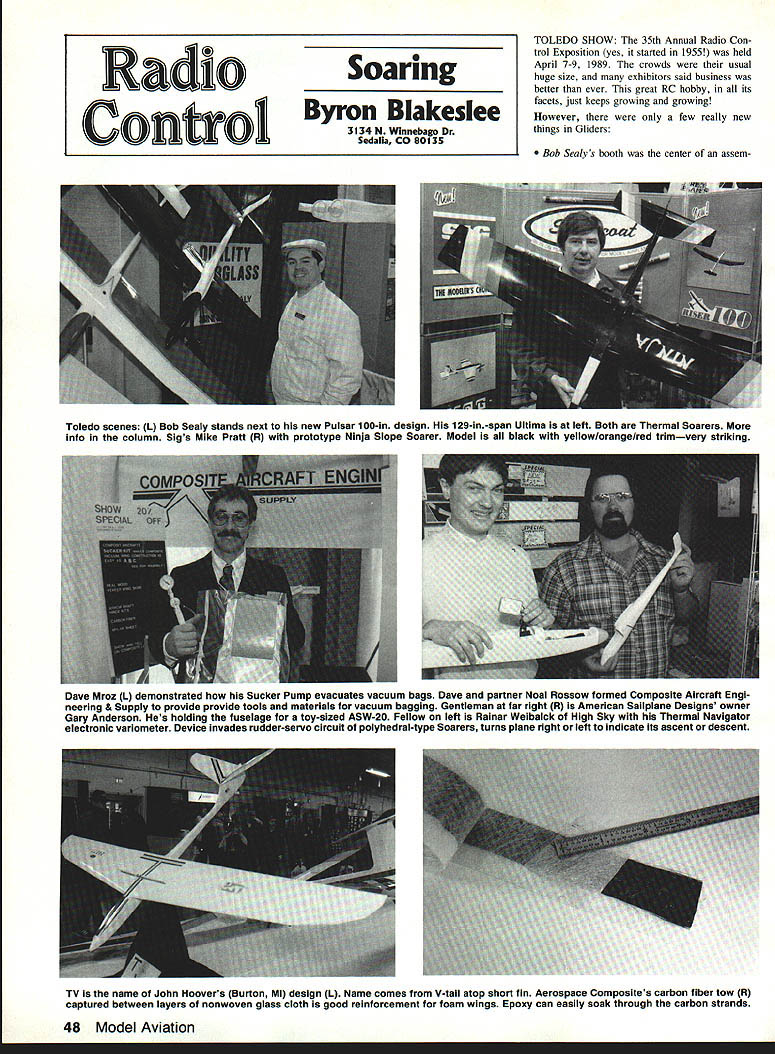
- Bob Sealy's booth drew many sailplane fanatics to see and discuss his new design, the Pulsar. Seeing it in person highlights what a fine-looking, nicely proportioned ship it is.
- The Pulsar resembles a 100-inch version of Sealy's Ultima and shares the Schuemann-style wing planform. Its balsa-sheeted, foam-core, two-piece wings plug into the fuselage, and the stabilizer is mounted low on the fin. The one-piece fiberglass fuselage is light and has the same type of slip-on nose cone used on the Ultima.
- (Note: Ultima fuselages come in two pieces — forward and rear — with a slip joint just behind the wing; the builder epoxies and fills the joint prior to painting.)
- The Pulsar can be built with a polyhedral wing and rudder/elevator control, or with straight wings and ailerons. Straight wings will likely be popular because ailerons and flaps add construction time but increase versatility and enjoyment. It should be suitable for the new Sportsman F3B (S3B) class.
- Bob is offering a stretched-wing version called the Laser (124 in. span). Builders can also modify cores to other spans (e.g., 112 or 118 in.). Prices: Pulsar kit $129 postpaid; Laser $149 postpaid. Both available direct from Bob Sealy.
- Bob is also working on a quarter-scale Reiher. Contact: 521 96th Lane NE, Blaine, MN 55434; tel. 612/780-2737. Bob and Pam expected to move to Tennessee in late summer (new address to be announced).
Sig Manufacturing Co. — Ninja
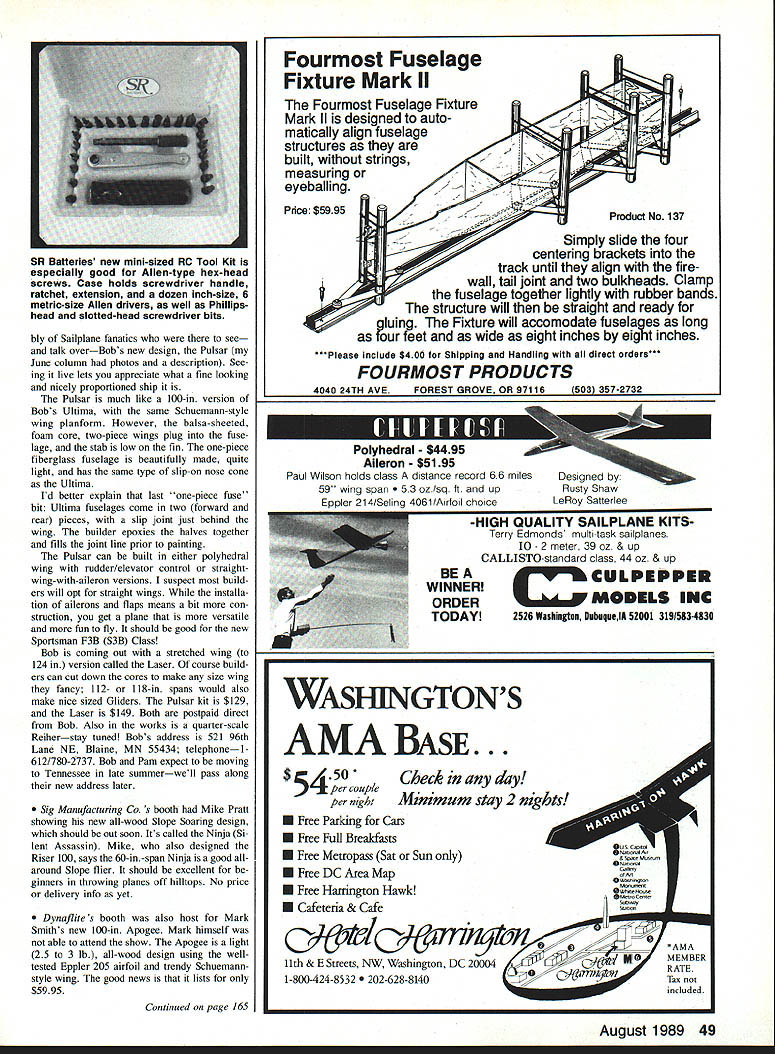
- Mike Pratt (designer of the Riser 100) showed a new all-wood slope-soaring design called the Ninja (Silent Assassin). The 60-inch-span Ninja is intended as a good all-around slope flier and should be excellent for beginners launching from hilltops. No price or delivery information yet.
Dynaflite — Apogee (Mark Smith)
- Dynaflite was featuring Mark Smith's new 100-inch Apogee (Mark was unable to attend). The Apogee is a light (2.5–3 lb.) all-wood design using the Eppler 205 airfoil and Schuemann-style wing. The kit lists for $59.95.
- Mark flew the Apogee in the recent Soaring Masters and was near the lead until a touch-and-go landing attempt failed; he dropped to eighth place. The kit's performance is promising, and Mark’s skill certainly showcases the design.
American Sailplane Designs (ASD)
- Gary Anderson (San Diego) reported steady business and improvements (including a telephone for customer inquiries).
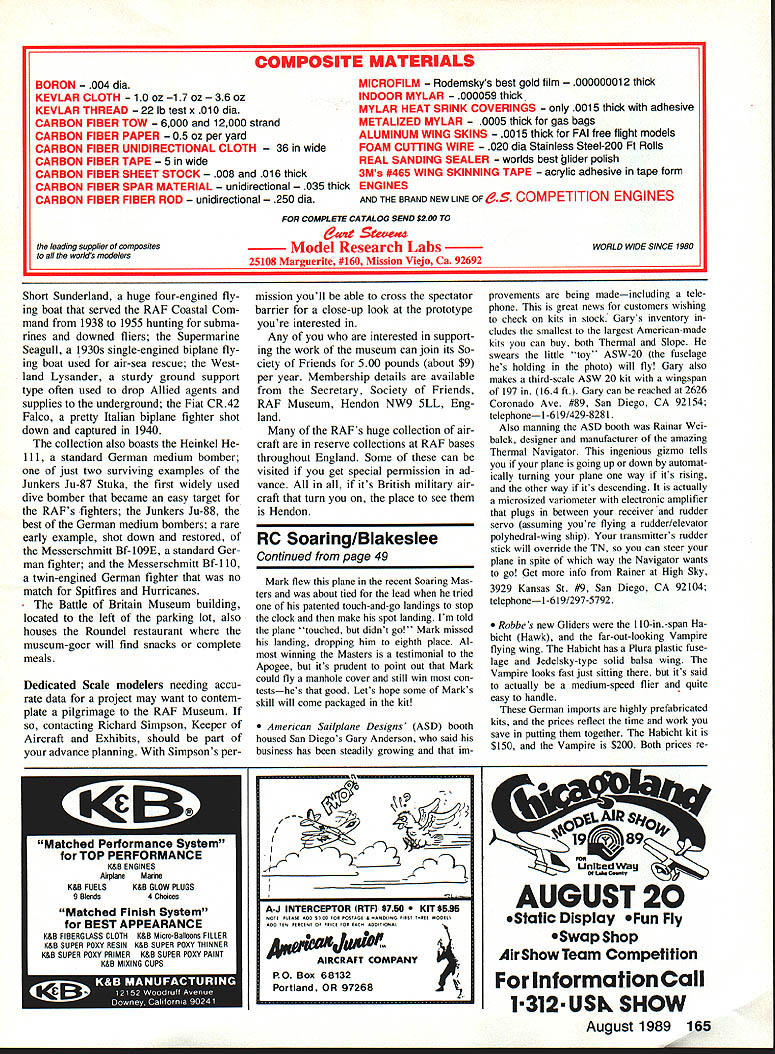
- ASD's inventory ranges from small to very large American-made kits for thermal and slope flying. Gary claims even the small ASW-20 “toy” fuselage will fly. ASD also offers a third-scale ASW-20 kit with a 197-inch (16.4 ft.) wingspan.
- Contact: 2626 Coronado Ave. #89, San Diego, CA 92154; tel. 619/492-8282.
High Sky — Thermal Navigator (Rainer Weibaick)
- Rainer Weibaick demonstrated the Thermal Navigator (TN), a microminiature variometer with electronic amplifier that plugs between the receiver and rudder servo (for rudder/elevator polyhedral ships). The TN automatically turns the plane one direction when rising and the other when descending; the transmitter rudder stick overrides the unit. More info: High Sky, 3929 Kansas Ave. #9, San Diego, CA 92104; tel. 619/297-5792.
Robbe — Habicht and Vampire
- Robbe introduced two new gliders: the 110-inch Habicht (Hawk) and the unconventional Vampire flying wing. The Habicht features a Plura plastic fuselage and a Jedelsky-type solid tailplane with tube joiner. The Vampire looks fast and is reported to be a medium-speed, easy-to-handle flier.
- These German imports are highly prefabricated; prices reflect the convenience. Habicht: $150; Vampire: $200. Prices reflected approximate 15% “Toledo Special” reductions for buyers who mentioned seeing them at the show.
Hobby Shack
- Hobby Shack became the U.S. distributor for the Sailplanes International line from Britain, initially offering five slope ships and three thermal kits. Prices range from $75 for the 100-inch all-wood Osprey to $340 for the 118-inch glass-and-foam ASW-20 scale ship.
SR Batteries and SR RC Tool Kit
- SR Batteries (Larry Sribnick) introduced a new 700 Series cell (AA-sized, 725 mAh). Designed for transmitters where space is limited but longer life is desired. An eight-cell pack costs $46.95 (plus $4 for a connector if required).
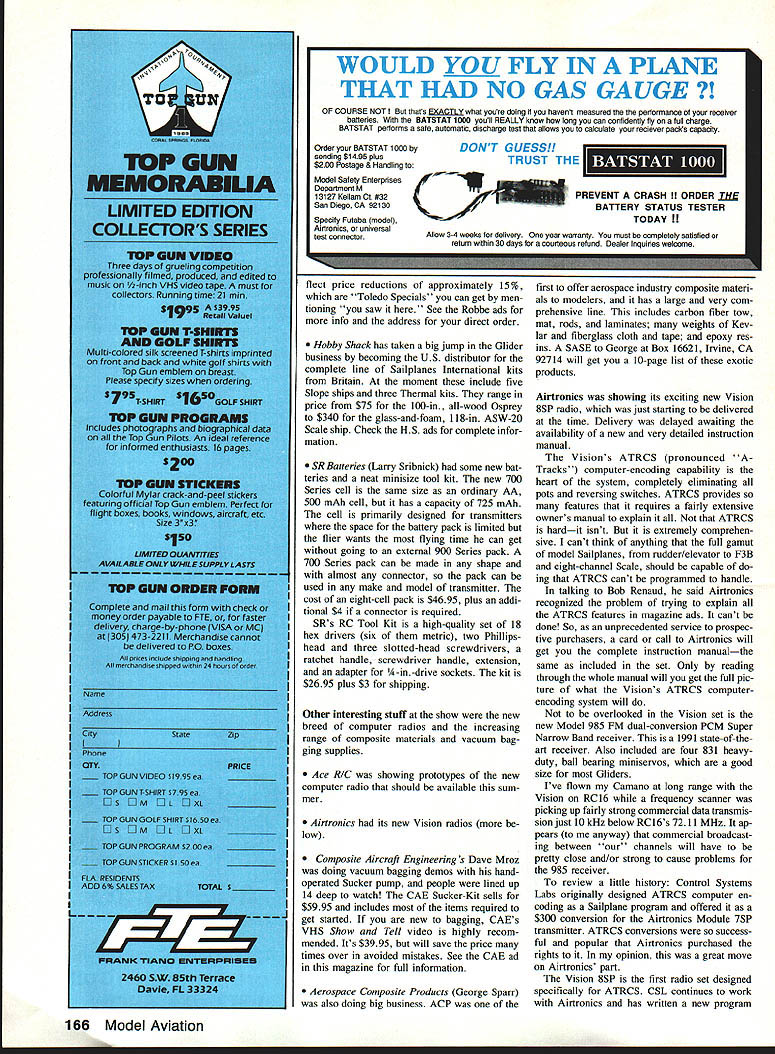
- SR's RC Tool Kit: an 18-piece high-quality set (including metric tools, Phillips and slotted screwdrivers, ratchet handle, extension, and 1/4-in. drive adapter). Kit price: $26.95 plus $3 shipping.
Other show highlights
- New breed of computer radios and more composite materials and vacuum bagging supplies were notable trends.
- Ace R/C showed prototypes of a new computer radio expected that summer.
- Airtronics introduced the Vision radios (see next subsection).
- Composite Aircraft Engineering (Dave Mroz) performed vacuum bagging demos using his hand-operated Sucker Pump; demos drew long lines. The CAE Sucker-Kit sells for $59.95 and includes most items needed to start bagging. CAE also produces a VHS instructional video ($39.95) recommended for newcomers.
- Aerospace Composite Products (George Sparn) offered a comprehensive line of composite materials (carbon fiber tow, mats, rods, laminates; various Kevlar and fiberglass cloths/tapes; epoxy resins). Send inquiries to Box 16621, Irvine, CA 92714 for a 10-page product list.
Airtronics — Vision 8SP and ATRCS
- Airtronics was showing the Vision 8SP radio. Delivery was beginning but delayed pending a detailed instruction manual.
- ATRCS (computer-encoding capability) is built into the Vision, eliminating pots and reverse switches. ATRCS offers extensive features (mixes for modern sailplanes, F3B, multi-channel scale setups) and requires a comprehensive manual to explain usage.
- Airtronics offered a six-week trial card and the complete instruction manual separately so prospective buyers could fully evaluate ATRCS before purchase.
- The Vision 8SP set includes the ATRCS system, the Vision 8SP dual-conversion PCM super-narrow band receiver (state-of-the-art), four ball-bearing mini servos, a spare case, and a competitive price for many glider pilots.
- Background: Control Systems Labs originally developed ATRCS as a sailplane program and offered it as a $300 conversion for Airtronics Model 7SP transmitters. Conversions proved popular and Airtronics purchased the rights. CLS continues to work with Airtronics and has produced other programs (e.g., Pattern version, and plans for a Helicopter version). The Vision 8SP is the first radio set designed specifically for ATRCS and may become the popular choice for sophisticated sailplane pilots.
First Annual Soaring Masters Contest
The first Soaring Masters was conceived as a championship-level thermal duration contest for top fliers. Sponsored by the National Soaring Society (NSS — Pete Carr, president) and the Thousand Oaks Soaring Society (Miles Moran, president and contest director), the event required qualifications for entry: contestants had to be LSF Level IV or V or have won a significant contest such as the Nats.
- There were 23 entrants in 1989, mostly from California, representing a Who’s Who of soaring (many names date back to the sport’s early days).
- The Masters format allowed top competitors to compete head-to-head in a fair shootout.
Top 10 finishers (score — percentage of a 4,900-point perfect score):
- Joe Wurts — 4,822.8 (98.4%)
- Fred Weaver — 4,811.1 (98.2%)
- Larry Jolly — 4,805.7 (98.1%)
- Chris George — 4,791.6 (97.8%)
- Keith Kindrick — 4,754.6 (97.0%)
- Don Edburg — 4,752.6 (97.0%)
- Bob McGowan — 4,749.1 (96.9%)
- Mark Smith — 4,741.4 (96.8%)
- Rich Spiker — 4,734.4 (96.6%)
- Bill Nibley — 4,727.0 (96.5%)
Other finishers in order: Terry Koplan, Craig Foxord, Todd Billman, Jim Thomas, Ed Hipp, Jay Siren, Don Vickers, Ian Douglas, Tony Kay, John Brown, Pete Carr, Don Tantum, and Steve George.
Miles Moran (CD) sent a letter to contestants highlighting contest format ideas and soliciting feedback:
- Run as many rounds as can be started before 3:00 p.m. Saturday and 1:00 p.m. Sunday.
- Implement more precise landing scoring.
- Increase penalties for not being on time (under or over).
- Ask whether competitors want the event to continue, preferred timing and location, and if they would participate next year.
Thanks to the sponsors: Ace R/C, Airtronics, Control Systems Labs, Futaba, Gator R/C, RCM, Sig, SR Batteries, and World Engines. Special thanks to Helen Olsen for scoring.
The weather was flawless with excellent lift. Landings were the deciding factor: top pilots performed steep, precise approaches to the 100-point target, raising ailerons and dropping flaps for vertical-style landings. Warm winches and retrievers, powered by a quiet Honda generator, kept operations smooth. NSS also thanked TOSS for facility use.
More on Joe Wurts
A short piece by Dave Swain in TOSS Up (Thousand Oaks club newsletter) celebrated Joe Wurts’ victory:
- “So Joe Wurts went out and did it again! He won the NSS-TOSS Masters. OK, so how does this Soaring guru do it? Purple thermals? Don't believe it. Heat waves are visible—but not that far away. Smells them? Hardly. He might smell fresh landmine (horsepucky), but that never indicated a thermal blanket or anything. It's all simple physics. He was born lucky! That's as good as it gets for some. He must build a superior sailplane.”
- The write-up concludes that this is perhaps the best humorous explanation of Joe's success.
Soartech #8 and the Princeton Project
- John (unnamed) and Michael have written up results from the Princeton Project for Soartech, the RC soaring technical journal edited and published by Herb Stokely.
- The report was expected to run close to 200 pages (originally planned at 50–90 pages). It will include graphical polars, numerical tables, and written insights.
- Soartech #8 price increase: from $5 to $10 for the expanded issue. Orders: send $10 (U.S. & Canada) or $15 (other countries) to H.A. Stokely, 1504 N. Horseshoe Circle, Virginia Beach, VA 23451.
FAI News (CIAM Highlights)
Terry Edmonds’ report from the April CIAM meeting in Paris summarized key points:
- Rolf Griesberger (Switzerland) will replace John Grigg as chairman of the F3B Subcommittee (John resigned due to travel obligations).
- The new U.S. F3B representative would be either Terry Edmonds or Don Edberg.
- A proposal to lower winch motor resistance from 15 milliohms to 12 milliohms was defeated amid concerns it would increase winch power. (For reference, stock Ford long-shaft winch motors have internal resistances around 9–10 milliohms.)
- A French proposal for an Aero-Tow Soaring class was provisionally accepted as F31. This event calls for fairly large, scale-like gliders to be towed to 200 meters and perform speed and duration tasks.
- A British proposal for a Thermal Duration class was provisionally accepted as F3J. This proposal used BARCS “percentage slot” rules (man-on-man fixed times; launch and landing must occur within the slot).
- F3J could become a popular FAI Duration World Championship event; however, the U.S. faces a snag because current rules permit hand launching only — lobbying for winch launching or learning aero-tow methods may be necessary.
"Magical" Computer Design Programs
- Jeff Raskin had raised concerns about some design programs; Lee Murray (coauthor of some of these programs) responded that such programs are engineering tools, not magic. Programs like MaxSoar and PC-Soar are based on established sailplane design equations and reference many experts (Michael Selig, Ron Van Putte, Chuck Anderson, Alex Strojnik, Eric Lister, Helmut Wahren, Martin Simmons, Lynn Cromer, Blaine Boren-Rowden).
- Developers are improving programs in response to user feedback (incorporating effects like dihedral, polyhedral, sweep, etc., on L/D, sink rate, and stability).
- Customers receive improved versions and libraries often at minimal cost for postage/handling.
Contact for Lee Murray: 1300 Bay Ridge Road, Appleton, WI 54915; tel. 1-414/731-4848.
Dodgson Designs — Second Wind Newsletter
- Bob Dodgson introduced a biannual newsletter, Second Wind ($1 per copy). It’s recommended for current Dodgson fliers and those considering their kits.
- Dodgson Designs address: 21230 Damson Road, Bothell, WA 98021; tel. 1-212/776-8067.
- The first issue (10 pages) includes reader tips (“Titillating Tips” with 25% off certificates), a description of the Orbiter kit (59 in. span hand-launcher by Eric Jackson; $65), Bob’s kit-making history (since 1972), and more.
Transcribed from original scans by AI. Minor OCR errors may remain.

