
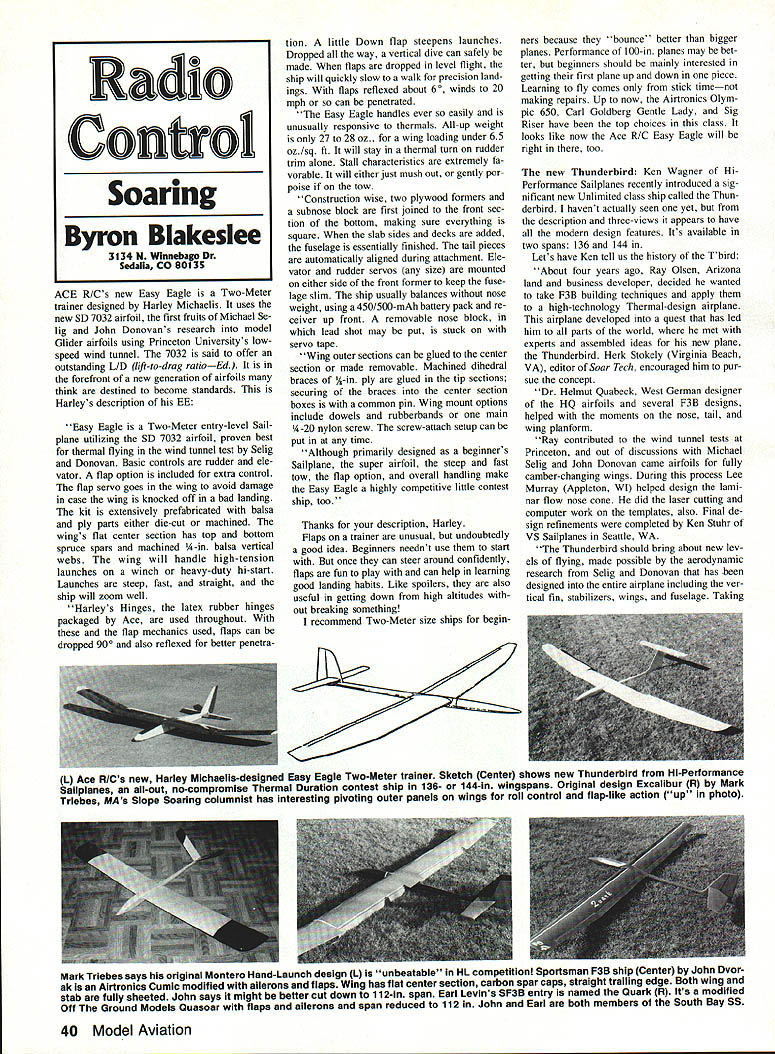
Radio Control: Soaring
Byron Blakeslee 3174 N. Winnebago Dr. Sedalia, CO 80135
---
Ace R/C Easy Eagle (Two-Meter trainer)
Ace R/C's new Easy Eagle, designed by Harley Michaelis, is a Two-Meter entry-level sailplane using the SD 7032 airfoil — the first product of Michael Selig and John Donovan's Princeton low-speed wind-tunnel research. The SD 7032 is reported to offer an outstanding lift-to-drag ratio and is at the forefront of a new generation of model-glider airfoils.
Harley Michaelis' description:
- Controls: rudder and elevator as standard; optional flaps.
- Flap servo is mounted in the wing to avoid damage if the wing separates in a bad landing.
- Kit: extensively prefabricated; balsa and plywood parts die-cut or machined.
- Wing: flat center section with top and bottom spruce spars and machined 1/8-in. balsa vertical webs. Wing will handle high-tension launch methods (winch) and heavy-duty hi-start. Launches are steep, fast, straight and the ship will zoom well.
- Hinges: Harley’s latex rubber hinges are used throughout.
- Flaps: can be dropped to 90° or reflexed for better wind penetration. A small down-flap steepens launches; fully dropped, a vertical dive can be safely made. Dropped flaps in level flight slow the ship for precision landings. Reflexing the flaps about 6° improves penetration in winds up to roughly 20 mph.
- Handling and performance: very easy to fly and unusually responsive to thermals. All-up weight about 27–28 oz, giving a wing loading under 6.5 oz/sq. ft. The Easy Eagle will stay in a thermal turn on rudder trim alone. Stall characteristics are favorable — it will either mush out or gently porpoise on tow.
Construction notes:
- Join two plywood formers and a subnose block to the front bottom section, ensuring everything is square.
- Add slab sides and decks; the fuselage becomes essentially finished and tail pieces align during attachment.
- Mount elevator and rudder servos on either side of the front former to keep the fuselage slim.
- Typical balance is achieved without additional nose weight when using a 450–500 mAh battery pack in the nose. A removable nose block allows for lead shot ballast attached with servo tape.
- Wing options: outer sections can be glued or made removable. Machined dihedral braces and 1/8-in. plywood glued tip sections secure the braces to the center section. Wing-mount options include dowels, rubber bands, or the main A-20 nylon screw-attach setup.
Although designed as a beginner's sailplane, the advanced airfoil, steep/fast tow capability, and flap option make the Easy Eagle competitive in small contests as well.
Commentary: Flaps on a trainer are unusual but useful. Beginners need not use them initially; once comfortable, flaps help develop good landing technique and are useful for descending from high altitude without damage. I recommend Two-Meter ships for beginners because they "bounce" better than larger planes — learning to fly comes from stick time, not repairs.
Current popular Two-Meter choices include the Airtronics Olympic 650, Carl Goldberg Gentle Lady, and Sig Riser. The Ace R/C Easy Eagle looks to be a strong new contender.
---
Thunderbird (Hi-Performance Sailplanes)
Ken Wagner of Hi-Performance Sailplanes has introduced a new Unlimited-class sailplane called the Thunderbird, available in 136- and 144-inch spans. The design incorporates modern features and high-technology thermal concepts.
Background (as told by Ken):
- About four years ago Ray Olsen (Arizona) set out to apply F3B building techniques to a high-technology thermal-design airplane. The project led him to meet experts and assemble ideas that became the Thunderbird.
- Contributors included Herk Stokely (SoarTech), Dr. Helmut Quabeck (HQ airfoils and F3B designs), Michael Selig and John Donovan (airfoils for fully camber-changing wings), and Lee Murray (laminar-flow nose cone design and laser-cut/computer templates).
- Final design refinements were completed taking advantage of new lightweight composite materials, producing a potent combination for an exciting flight experience.
Design and kit features:
- Removable nose cone for easy radio access.
- Flaps and ailerons driven by servos in the wings.
- Double-taper wing available in built-up or all-composite forms.
- New Selig airfoil on the main wing; elliptical tips use a different airfoil for improved characteristics.
- Expect light wing loadings.
Kit and manufacturing:
- All plug and mold work and manufacturing by Ron and Karen Wagner, Hi-Performance Sailplanes, 17902 N.E. 156th St., Woodinville, WA 98072; telephone 1-206/487-1721.
- Kit features: one-piece fiberglass pressure-bagged fuselage; blue foam cores for wings and stabilizers; choice of balsa/ply or HP Cell sheeting for wing covering; molded rudder; carbon-fiber spar assembly; and basic hardware.
- Controls: ailerons, flaps, rudder, elevator.
- Price: $250 plus COD shipping.
Ken and Karen also produce other kits, fuselages, finished wings, and supplies for vacuum and pressure bagging. Materials include fiberglass cloth, carbon laminates, braided tubing, honeycomb, Mylar, and several epoxy resins. A SASE to Ken will get the full details.
Recommended tape: If you’re interested in the Thunderbird or HP Cell sheeting, consider Ken’s two-hour VHS videotape demonstrating step-by-step HP Cell wing construction and vacuum-bagging using Mylar as a carrier sheet. Price: $20 plus $2.50 shipping. The tape also includes bonus footage of the 1988 Richland Scale Soar Fun Fly and the giant Northrop YB-49 flying wing filmed by the SASS club of Seattle.
---
New designs by Mark Tribes
Mark Tribes (MA slope columnist) described two recent projects:
- Prototype 1: Thermal/F3B design with pivoting tips for roll control and "flaps" — both tips pivot trailing edge up to slow the plane for landings. The method works but needs more throw to fully slow the plane. The photo shows the pivoting tips in the up position.
- Prototype 2 (planned): pure F3B ship with beefier construction, smaller stab, faster airfoil, and conventional aileron and flap controls. Pivoting tips and their servos would likely not survive F3B loads.
Design specifics for Prototype 1:
- Three-piece wing with foam core and balsa sheeting, carbon fiber spars.
- 106-in. span, 850 sq. in. area, 42 oz. all-up weight — 7.1 oz./sq. ft. wing loading.
- Selig 4061 airfoil.
Initial flight tests are promising.
---
RCSD Challenge and design considerations
The RCSD Challenge aims to allow designers/builders to fly ships around 90–115 in. wingspans with wing loadings of roughly 10–13 oz./sq. ft. These sizes should perform well in club thermal contests, slope flying, and Sportsman F3B (SF3B). Design trade-offs:
- Smaller ships with heavier wing loadings are better for Speed but not as good for Duration and Distance.
- Larger, more lightly loaded planes might be better for Duration but not as good for Speed.
- Many designs will have ailerons and flaps, but high-performance polyhedral ships are still a consideration.
Example: Don Chancey’s Conquest (derived from Bounty Hunter) — 100-in. span, 930 sq. in. area, aspect ratio 10.7; best flying weight about 70 oz., or 10.7 oz./sq. ft.
Table (wing area / wing loading / indicative span for aspect ratios):
- Wing area 1000 sq.in.: wing loading 10.1 oz/sq.ft. (70 oz. total) or 11.5 oz/sq.ft. (80 oz.); spans for aspect ratios 14,12,10,8 → 119, 110, 104, 95 in.
- Wing area 900 sq.in.: wing loading 11.2 (70 oz.) / 12.8 (80 oz.); spans → 112, 104, 95, 86 in.
- Wing area 800 sq.in.: wing loading 12.6 / 14.4; spans → 106, 98, 88, 80 in.
- Wing area 700 sq.in.: wing loading 14.4 / 16.5; spans → 99, 92, 84, 75 in.
Notes: The "Total Weight" figures correspond to wing loading in oz./sq. ft. for the wing areas shown. The "Aspect Ratio" figures are indicative wingspans in inches for the areas and aspect ratios shown. Designers should consider wing area and loading versus aspect ratio and Reynolds number. Choosing an area between 800 and 950 sq. in. and an aspect ratio from 11–14 can yield reasonable speeds and wingspans (roughly 100–112 in.).
Other designs in the RCSD Challenge include Mark’s Excalibur, Don Chancey’s Conquest, Don Edberg’s Hustler, Mark Allen’s Falcon 880, and possibly an entry from Ed Berton. Kits suitable for SF3B (or modifiable) include Airtronics Cumulus and Sagitta 900, Bob Sealy Pulsar, Bob Dodgson Camano, Edmonds Models Algebra 2.5 Racer (England), Larry Polk (sic) and Chevron, Offshore Ground Models Quasar, and Pierce Aero Gemini MTS.
Stay tuned for the Challenge winner and recommended rules. The Sportsman F3B program is intended to give clubs and pilots a low-cost, fun way to try F3B-style flying.
---
Brian Agnew on his Mariah
Brian Agnew (Fort Myers) reported on flying Ed Berton’s Two-Meter kit, the Mariah. Brian is an accomplished contest pilot (Tidewater Nats 1988 winner in multiple classes) and praises the Mariah highly.
Key points:
- The Mariah may become a classic alongside designs such as the Windmere, Aquila, Bird of Time, Sagitta, Windsong, and Prodigy.
- Ed Berton designed and refined the Mariah over three years. Two versions are offered: fiberglass (F/G) tail boom or carbon-fiber (C/F) tail boom. The C/F boom is stronger and lighter but more expensive.
- Specs and features: Selig 4061 airfoil; ailerons and flaps; pod-and-boom fuselage; clean one-piece wing with flat center section and sheeted tips. Wing built in-mold and sheeted with .040 balsa; tips have 1/16-in. built-in washout in the cores.
- Flight characteristics: excellent speed range, superb handling in step, thermaling, and landing; docile yet capable.
- Kit quality: high-grade packaging, wood selection, instructions, and CAD/computer-assisted design. The kit includes virtually everything; the builder mainly assembles the supplied parts. Two sets of foam core wings are supplied in some kits.
Recommendation: The Mariah is a high-performance Two-Meter ship well suited to intermediate-to-expert builders/fliers seeking contest performance. It can serve as a first-aileron ship for those transitioning from polyhedral to ailerons, but it is not a beginner’s project.
Contact: Competition Products, 921 Birdie Way, Apollo Beach, FL 33570; telephone 1-813/645-5171. Kit price: $160 with C/F tail boom; $140 with F/G boom (both include UPS shipping).
---
Videos and resources
Video on cutting foam cores:
- Julian Tamez — "How to Cut Foam Cores." Contact: Julian Tamez, P.O. Box 437, Kenilworth, NJ 07033. Price: $12.
Vacuum-bag fiberglass wings and where to buy materials:
- Julian Tamez also produced a tape titled "Cutting Foam Cores and Making Templates" (and a third tape, "Making Fiberglass Molds"). These tapes include instructions on foam cutting, vacuum/pressure bagging, and even plans for an automatic foam-cutting machine (Jim Faris design). Julian’s tapes (Channel 4 Productions) are priced at $34.95 plus $3.50 shipping. NSSS and LSF members may receive a 20% discount. Contact: Channel 4 Productions, 19827 Bishops Gate, Suite 1, Humble, TX 77338; phone (713) 540-4575.
Vacuum-bagging explanation (summary):
- Pressure-bagging uses a full mold with epoxy-wetted glass/Kevlar cloth laid inside and a large inflatable balloon inside the mold. Inflating the balloon forces the cloth into good contact with the mold, producing a one-piece fuselage in a single operation (instead of joining two halves). Supplies for sale include fiberglass cloth, carbon laminates, braided tubing, honeycomb, Mylar, and various epoxies.
---
Seventh National Sailplane Symposium
The MARS club (Madison) will host the seventh annual symposium on the weekend of November 4–5. Highlights include:
- Michael Selig, John Donovan, and David Fraser — report on Princeton low–Reynolds-number airfoil tests.
- George Steiner — contemporary radio problems.
- Larry Jolly — sailplane design (recent F3B Worlds competitor).
- Walter Panknin (W. Germany) — tailless sailplane design.
- Ed Ellerton (Univ. of Wisconsin Meteorology Dept.) — thermal development.
- Walt Good — Militky Cup competition in Switzerland.
- Table clinics, demonstrations, and a Saturday night banquet.
Attendees arriving Friday mid-morning are invited on a guided tour of the EAA Museum in Oshkosh. Make reservations early at the Ramada Inn (conference site): 3841 E. Washington Ave., Madison, WI 53704. For more information, write Bill Vogelgang, 5933 Mayhill Dr., Madison, WI 53711.
---
SOAR Great Race XII souvenir issue
The SOAR Great Race XII souvenir issue (16 pages) — a recap of the 1988 race — is available by mail for $3. To obtain a copy, send $3 to John McIntire, 2213 Prentiss Creek, Apt. 104, Downers Grove, IL 60516. The 1989 Great Race will be held in June; sending $3 will place you on the list for the souvenir issue when available.
---
Transcribed from original scans by AI. Minor OCR errors may remain.

