
Radio Control: Soaring
Byron Blakeslee 3134 N. Winnebago Dr. Sedalia, CO 80135
Falcon 880
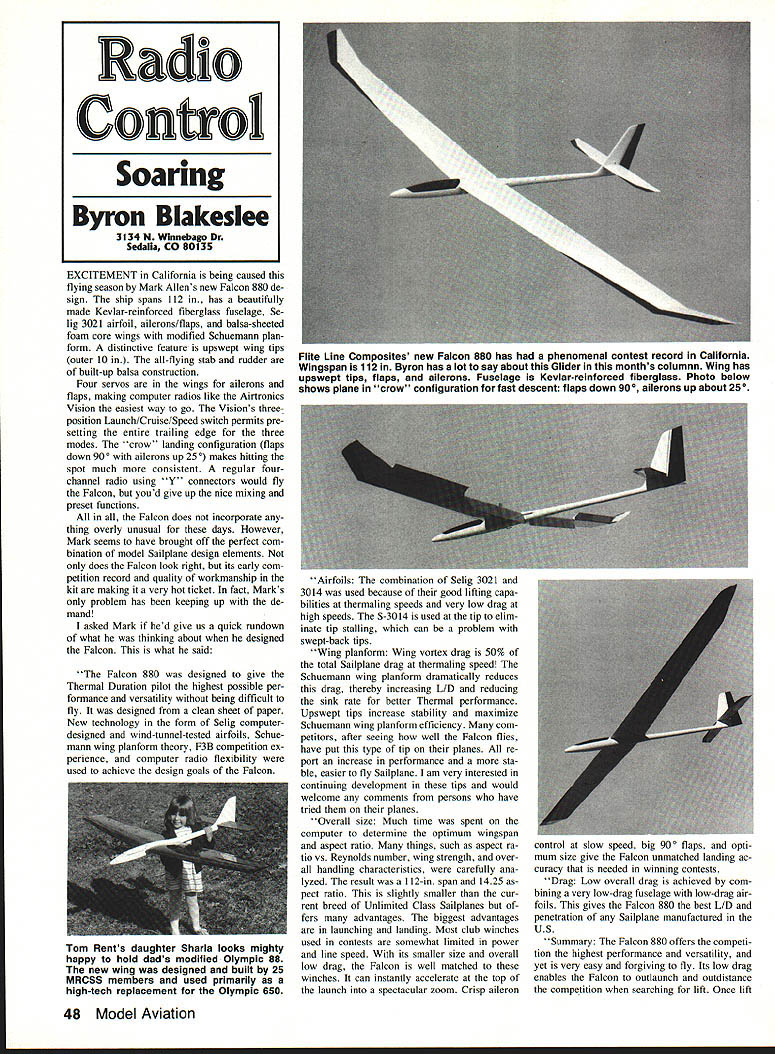
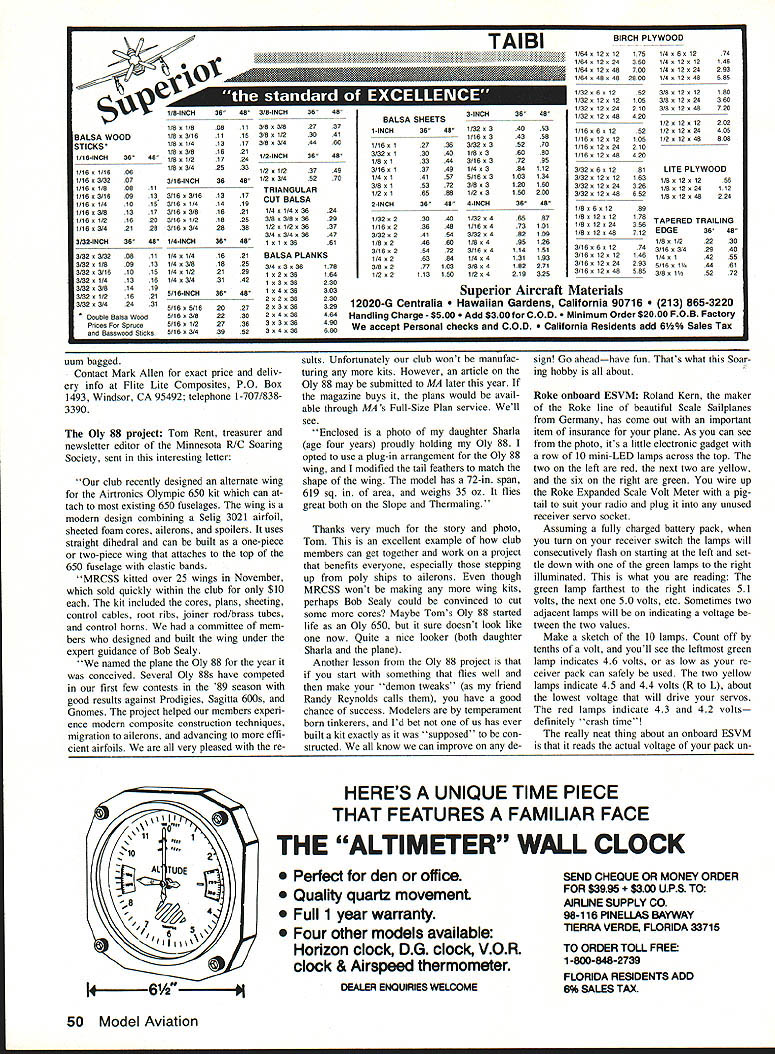
Excitement in California this flying season centers on Mark Allen's new Falcon 880 design. The ship spans 112 in., has a beautifully made Kevlar-reinforced fiberglass fuselage, Selig 3021 airfoil, ailerons/flaps, and balsa-sheeted foam-core wings with a modified Schuemann planform. A distinctive feature is upswept wing tips (outer 10 in.). The all-flying stab and rudder are of built-up balsa construction.
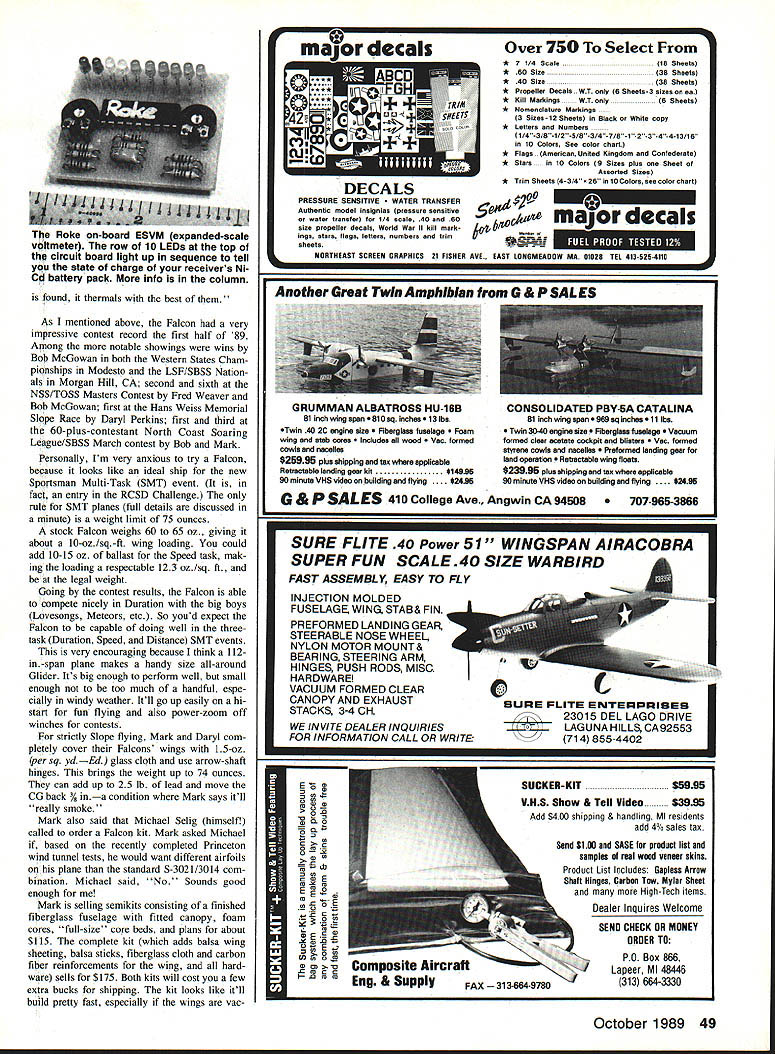
Four servos are in the wings for ailerons and flaps, making computer radios like the Airtronics Vision the easiest way to go. The Vision's three-position Launch/Cruise/Speed switch permits presetting the entire trailing edge for the three modes. The "crow" landing configuration (flaps down 90° with ailerons up 25°) makes hitting the spot much more consistent. A regular four-channel radio using "Y" connectors will fly the Falcon, but you'd give up the convenient mixing and preset functions.
All in all, the Falcon does not incorporate anything overly unusual for these days. However, Mark seems to have brought off the perfect combination of model sailplane design elements. Not only does the Falcon look right, but its early competition record and the quality of workmanship in the kit are making it a very hot ticket. In fact, Mark's only problem has been keeping up with demand.
Designer Mark Allen on the Falcon 880
Mark provided a quick rundown of his design thinking:
- Airfoils: The combination of Selig 3021 and 3014 was used because of their good lifting capabilities at thermaling speeds and very low drag at high speeds. The 3014 is used at the tip to eliminate tip stalling, which can be a problem with swept-back tips.
- Wing planform: Wing vortex drag is about 50% of the total sailplane drag at thermaling speed. The Schuemann wing planform dramatically reduces this drag, increasing L/D and reducing sink rate for better thermal performance. Upswept tips increase stability and maximize Schuemann planform efficiency. Many competitors who added this type of tip report increased performance and a more stable, easier-to-fly sailplane.
- Overall size: Extensive computer work determined the optimum wingspan and aspect ratio considering aspect ratio vs. Reynolds number, wing strength, and handling characteristics. The result was a 112-in. span and 14.25 aspect ratio. This is slightly smaller than the current breed of Unlimited Class sailplanes but offers advantages in launching and landing. Most club winches used in contests are somewhat limited in power and line speed; at this size and lower drag the Falcon matches these winches well. It can instantly accelerate at the top of the launch into a spectacular zoom. Crisp aileron control at slow speed, big 90° flaps, and the optimum size give the Falcon unmatched landing accuracy needed in contests.
- Drag: Low overall drag is achieved by combining a very low-drag fuselage with low-drag airfoils. This gives the Falcon 880 excellent L/D and penetration among U.S.-manufactured sailplanes.
- Summary: The Falcon 880 offers high performance and versatility while remaining easy and forgiving to fly. Its low drag enables it to outlaunch and outdistance the competition when searching for lift. Once lift is found, it thermals with the best of them.
Contest record and suitability for SMT
The Falcon had an impressive contest record in the first half of 1989. Notable showings include:
- Wins by Bob McGowan at the Western States Championships in Modesto and the LSF/SBSS Nationals in Morgan Hill, CA.
- Second and sixth at the NSS/TOSS Masters Contest by Fred Weaver and Bob McGowan.
- First at the Hans Weiss Memorial Slope Race by Daryl Perkins.
- First and third at the North Coast Soaring League/SBSS March contest (60+ contestants) by Bob and Mark.
Personally, Byron is anxious to try a Falcon for the new Sportsman Multi-Task (SMT) event (it is an entry in the RCSD Challenge). The only plane rule for SMT is a weight limit of 75 oz.
A stock Falcon weighs 60 to 65 oz., giving about a 10 oz./sq.ft. wing loading. You could add 10–15 oz. of ballast for the Speed task, making the loading a respectable 12.3 oz./sq.ft. and remain within the legal weight.
The Falcon is able to compete well in Duration with larger designs. A 112-in. span plane is a handy all-around glider: big enough to perform but small enough not to be a handful, especially in windy weather. It will go up easily on a hi-start for fun flying and also power-zoom off winches for contests.
For strictly slope flying, Mark and Daryl cover their Falcons' wings with 1.5-oz. glass cloth and use arrow-shaft hinges, bringing the weight up to 74 oz. They can add up to 2.5 lb. of lead and move the CG back 3/8 in.—a condition where Mark says it will "really smoke."
Michael Selig reportedly ordered a Falcon kit and, based on recent wind-tunnel tests, he wanted no change to the standard S-3021/3014 airfoil combination.
Kits and contact
Mark sells semi-kits consisting of a finished fiberglass fuselage with fitted canopy, foam cores, full-size core balsa, and plans for about $115. The complete kit (adding balsa wing sheeting, balsa sticks, fiberglass cloth and carbon-fiber reinforcements for the wing, and all hardware) sells for $175. Both kits will cost a few extra dollars for shipping. The kit looks like it'll build pretty fast, especially if the wings are vacuum-bagged for shipping.
Contact Mark Allen for exact price and delivery info at: Flite Line Composites, P.O. Box 343, Windsor, CA 95492; telephone 1-707-838-3390.
The Oly 88 project
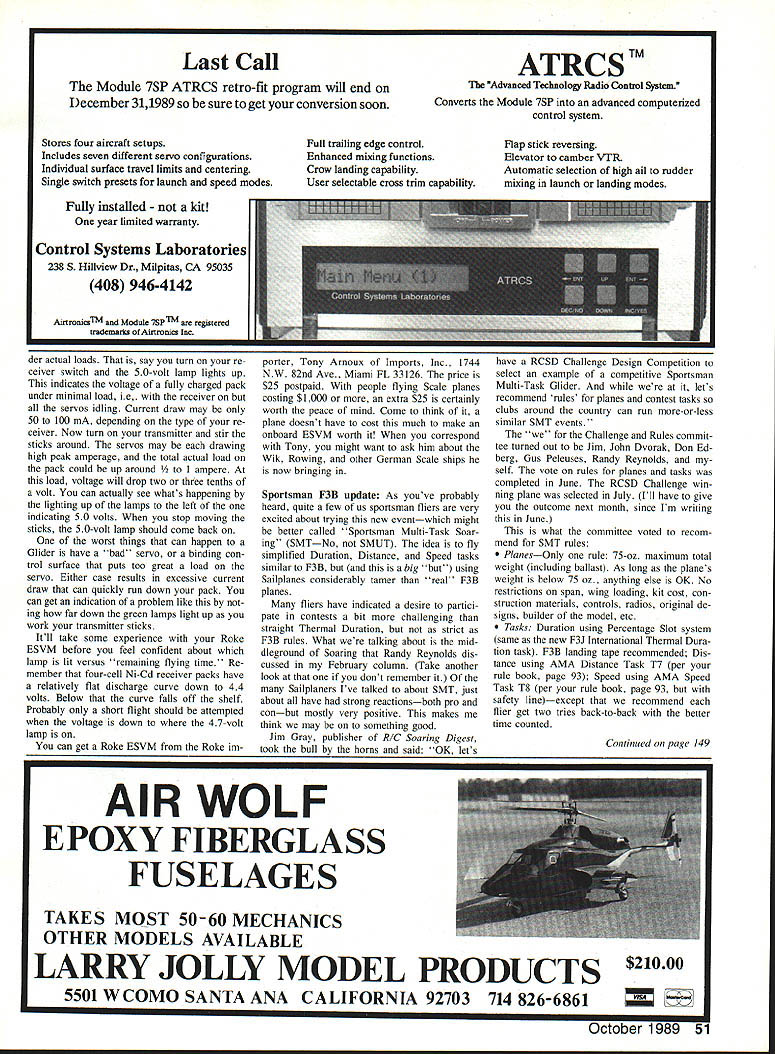
Tom Rent, treasurer and newsletter editor of the Minnesota R/C Soaring Society (MRCSS), reported on an alternate wing their club designed for the Airtronics Olympic 650 fuselage. The wing is a modern design combining a Selig 3021 airfoil, sheeted foam cores, ailerons, and spoilers. It uses straight dihedral and can be built as a one-piece or two-piece wing that attaches to the top of the 650 fuselage with classic bands.
MRCSS kitted over 25 wings in November, which sold quickly within the club for only $10 each. The kit included cores, planks, sheeting, control cables, root ribs, joiner rods/brass tubes, and control horns. A committee of members designed and built the wing under the guidance of Bob Sealy.
They named the plane the Oly 88 for the year it was conceived. Several Oly 88s have competed in early 1989 contests with good results against Prodigies, Sagitta 600s, and Gnomes. The project helped members learn modern composite construction techniques, migrate to ailerons, and adopt more efficient airfoils. Although MRCSS won't manufacture more kits, an article may be submitted to Model Aviation (MA) later, and if published, plans could be available through MA's Full-Size Plan service.
Tom included a photo of his four-year-old daughter Sharla proudly holding his Oly 88. Tom used a plug-in wing arrangement and modified the tail feathers to a one-piece stab in the wiring. The model has a 72-in. span, 619 sq. in. area, weighs 35 oz., and flies well both on the slope and thermaling.
The Oly 88 illustrates how starting with something that flies well and making targeted improvements can produce successful results—and how club projects can benefit members stepping up from dolly ships to aileron ships.
More onboard ESVM
Roland Kern, maker of the Roke line of scale sailplanes from Germany, offers an onboard Expanded Scale Volt Meter (ESVM) to monitor receiver pack voltage. The ESVM is a small electronic gadget with a row of 10 mini-LED lamps: two red (left), two yellow, and six green (right). You wire the ESVM with a pigtail to suit your radio and plug it into any unused receiver servo socket.
The lamps light consecutively from right to left as the battery discharges. The rightmost green lamp indicates 5.1 volts, the next 5.0 volts, etc. Sometimes two adjacent lamps light to indicate a voltage between the two values.
Typical voltage indications:
- Rightmost green lamp: 5.1 V
- Leftmost green lamp: about 4.6 V (still usable)
- Yellow lamps: 4.5 V and 4.4 V — about the lowest voltage that will reliably drive servos
- Red lamps: 4.3 V and 4.2 V — definitely "crash time"
The ESVM reads the actual pack voltage under actual loads. With the receiver on and servos idling, current draw may be only 50–100 mA; under active control the total load could rise to 0.5–1 A, and the voltage will drop several tenths. Watching the lamps while operating the transmitter shows the load effects. A binding control surface or a bad servo that draws excessive current will be evident by a larger voltage drop under stick movement.
Experience with your ESVM will help you learn which lamp corresponds to "remaining flying time." Four-cell NiCd receiver packs have a relatively flat discharge curve down to about 4.4 V; below that the curve falls off rapidly. Probably only a short flight should be attempted when the 4.7 V lamp is on.
You can get a Roke ESVM from the Roke importer: Tony Arnoux, Imports, Inc., 1744 N.W. 82nd Ave., Miami, FL 33126. Price: $25 postpaid. With many scale planes costing $1,000 or more, an extra $25 is a small price for peace of mind.
Sportsman F3B update (Sportsman Multi-Task — SMT)
Many sport fliers are excited about a new event sometimes called Sportsman Multi-Task Soaring (SMT). The idea is to fly simplified Duration, Distance, and Speed tasks similar to F3B but using tamer sailplanes suitable for Sportsman-level pilots.
Jim Gray (R/C Soaring Digest) organized an RCSD Challenge Design Competition to select a competitive SMT glider and recommended rules for planes and contest tasks. The rules committee included Jim Gray, John Dvorak, Don Edberg, Gus Pelseus, Randy Reynolds, and Byron Blakeslee. The vote on rules was completed in June.
The committee's recommended SMT rules:
- Planes:
- Only one rule: 75 oz. maximum total weight (including ballast). As long as the plane's weight is below 75 oz., anything else is allowed: span, wing loading, kit, construction materials, controls, radios, original design, builder, etc.
- Tasks:
- Duration using the Percentage Slot system (same as the F3J International Thermal Duration task). F3J landing tape recommended.
- Distance using AMA Distance Task T7 (per your AMA rule book).
- Speed using AMA Speed Task T8 (per your AMA rule book), but with a safety line — the committee recommends each flier get two back-to-back tries with the time counted.
Additional rules and guidance:
- Note that none of the tasks uses working or preparation time. The Contest Director (CD) assembles the flight group, and when everyone is ready he says "Go." No rehearsals are allowed except in case of winch or organizer (timer or flagger) failure.
- An ideal SMT contest would have equal numbers of each task, but CDs may run "mini-matches" or vary the task mix (for example, three rounds of Duration and two of Distance). Each task is normalized to 1,000 points; contest points are the sum of task points.
- Duration and Distance are flown man-on-man, except when a contest is too small (fewer than, say, nine entrants) to mix up flight groups.
- Club winches can be used and should be of about equal power. A contestant's own winch may be used if it can be made available to all and is about the same power as others.
- Ballast can be added or removed at any time, as long as total weight does not exceed 75 oz.
Byron hopes SMT will gain broader appeal because it is easier for Sportsman-level fliers to enter and simpler for clubs to run. The 75-oz. rule is easy to understand and administer. Pilots who practice Distance and Speed will find these tasks fun and useful for improving flying skills. If all goes well, clubs can run full SMT contests with Novice/Intermediate/Expert classes to encourage beginners.
More on "magical" design programs — MaxSoar and PC-Soar
John Hohensee wrote to clarify the controversy over his design program, MaxSoar, and to explain what MaxSoar (and Lee Murray's PC-Soar) actually do. He emphasized that these programs are tools to explore designs and estimate performance; they are not magic and do not replace test flying.
What MaxSoar and PC-Soar do:
- Based on about 30 input design measurements (wingspan, chord, airfoil, etc.), the programs calculate 23 aircraft design parameters including:
- Wing: area, equivalent dihedral, aspect ratio, recommended dihedral, average chord, angle of incidence, aerodynamic center, loading.
- Horizontal tail: area, average chord, aspect ratio, aerodynamic center, longitudinal stability factor.
- Vertical tail: area, average chord, aspect ratio, aerodynamic center, tail volume, sideslip instability factor.
- Miscellaneous: forward CG limit, rear CG limit, aircraft neutral point.
- The programs generate a table of flight speed, Reynolds number, total airframe drag coefficient, sink rate, and lift-to-drag ratio at about 10 coefficients of lift. Generating this table requires access to an airfoil polar data file (about 40–50 numbers). MaxSoar and PC-Soar include about 70 airfoil polar data files and more are being added.
- The programs can plot aircraft polars and overlay several polars for comparison, making it easy to observe the effects of design changes or ballast. Output can be printed for documentation.
John responded to criticisms:
- Small changes in dihedral produce negligible projected area changes; MaxSoar consciously disregards these tiny area reductions but does calculate equivalent induced drag and related effects.
- Wing sweep is not treated as affecting performance unless it changes projected area or effective chord; sweep effects on aerodynamic center, neutral point, and tail volume are calculated.
- MaxSoar greatly reduces design calculation time. Tasks that formerly took many hours by hand now take minutes. A knowledgeable beta tester found MaxSoar's calculated performance correlated well with his flight experience.
John and Lee view these programs as useful tools that provide a practical basis for comparing designs and avoiding poor choices before building.
John Hohensee contact: 522 W2400 Fox Way Drive, Waukesha, WI 53186; telephone (414) 251-2472.
New Soaring club
George Voss reports the Oklahoma City Silent Fliers club is now in operation. For information, contact George at 1403 Lincolnshire Road, Oklahoma City, OK 73159; telephone 1-405-793-9213.
Transcribed from original scans by AI. Minor OCR errors may remain.

