
Radio Control: Soaring
Byron Blakeslee 3134 N. Winnebago Dr. Sedalia, CO 80135
NEAT constant-tension winch
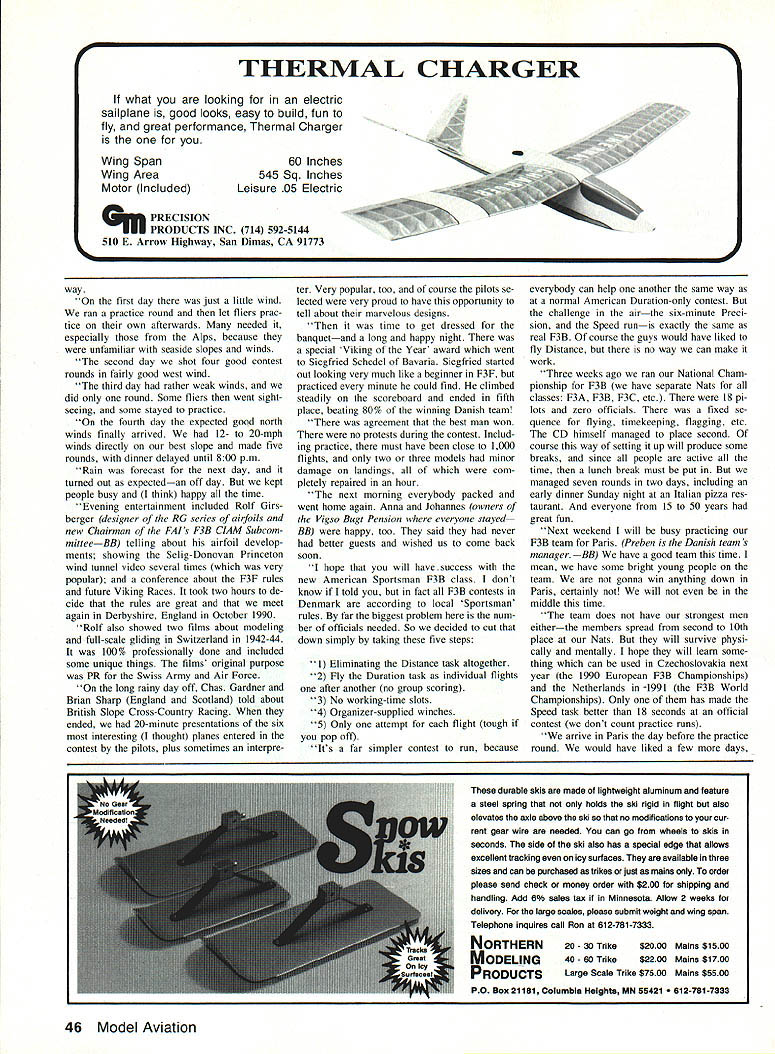
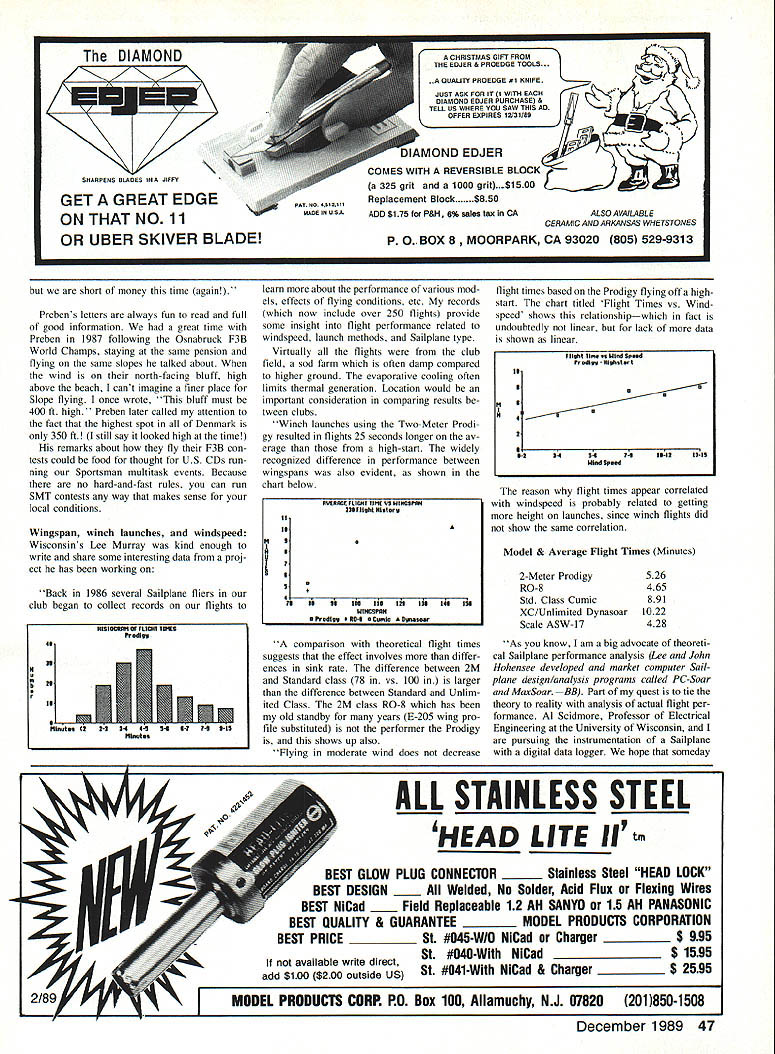
Jack Perecman (Golden Valley, MN) sent excellent photos and a description of a constant-tension (CT) winch he designed and built. The winch is in its second season of use with the Minnesota R/C Soaring Society and has proven reliable for club fun-flys and contests.
Jack's design highlights and operation:
- Motor: Starter motor from a Johnson outboard — high torque with a long shaft, threaded end, and splines near the motor face for easy drum mounting.
- Transport/operation: Wheels flip out underneath the frame for transport; frame rests on the ground in operating position. A T-handle on the battery is an emergency kill switch.
- Treadle control: A foot treadle (connected by bicycle brake cable) controls line tension — the farther the treadle is pressed, the greater the tension.
- Drum alignment: A threaded rod and crank below the motor pivots the motor/drum assembly for fine adjustment of line-level winding.
Constant-tension mechanism:
- Pressing the foot treadle pulls a cable which pivots a switch arm away from spring-loaded roller arms.
- A microswitch (normally closed) and a solenoid control motor power. When the switch is pulled away, the solenoid energizes the motor. As line tension increases, roller arms pivot back toward the switch, counterbalanced by two springs.
- When desired tension is reached, a roller arm touches the microswitch, opening it and turning off the solenoid. The solenoid remains off until tension decreases.
- The operator can increase maximum tension by pressing the treadle farther, which requires the springs to stretch more before the roller arm recontacts the switch. The damping effect of the line causes the motor to pulse on and off automatically, mimicking manual foot-switch operation.
Other features:
- One-way clutch roller that can be engaged/disengaged via a small black lever above the center shaft. The clutch uses a Torrington one-way roller bearing.
- A small triangular piece of urethane rubber mounted on the roller arm rubs the drum rim slightly to brake the drum and prevent backlash.
Purpose and applicability:
- Jack built the winch to produce a simple, reliable CT device suitable for F3B competition and club use.
- The CT mechanism can be adapted to other winches, though some careful machine work would be required. Jack offered to make drawings available if there's sufficient interest. Contact: Jack Perecman, 224 Natchez Ave. N., Golden Valley, MN 55422.
Safety note:
- Winches should have a readily accessible kill switch to cut battery power in an emergency (for example, a stuck solenoid during a turnaround). RV shops sell big copper knife switches for about $20; mount them at the battery for quick operation.
The Danish connection
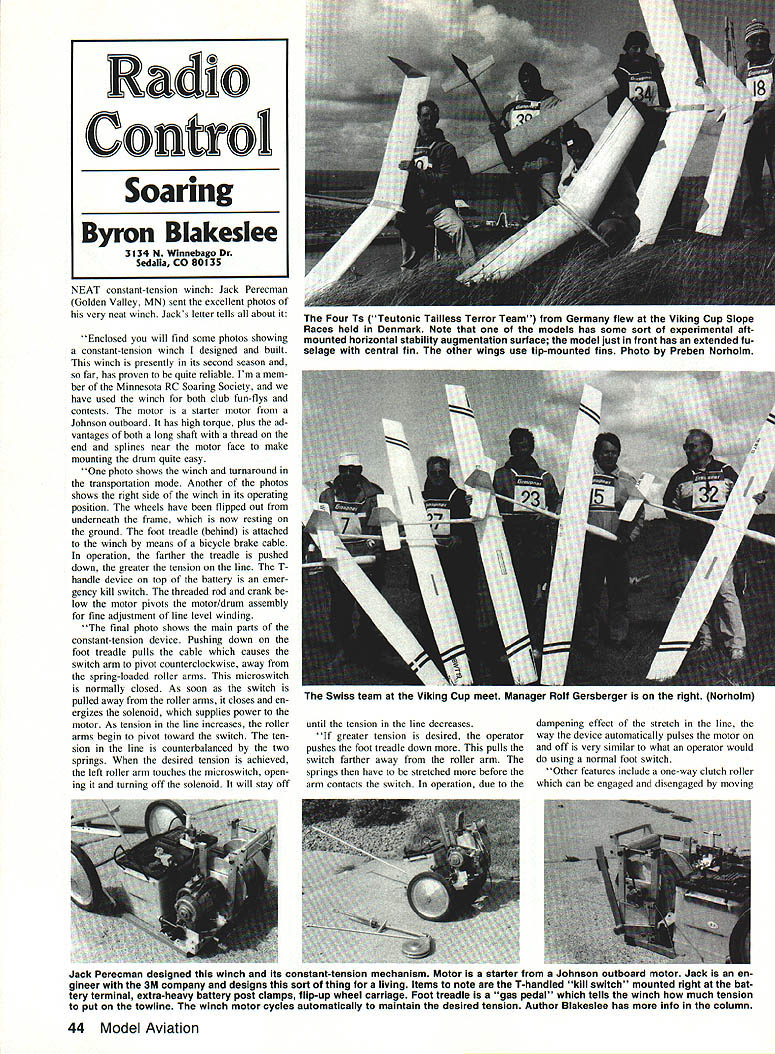
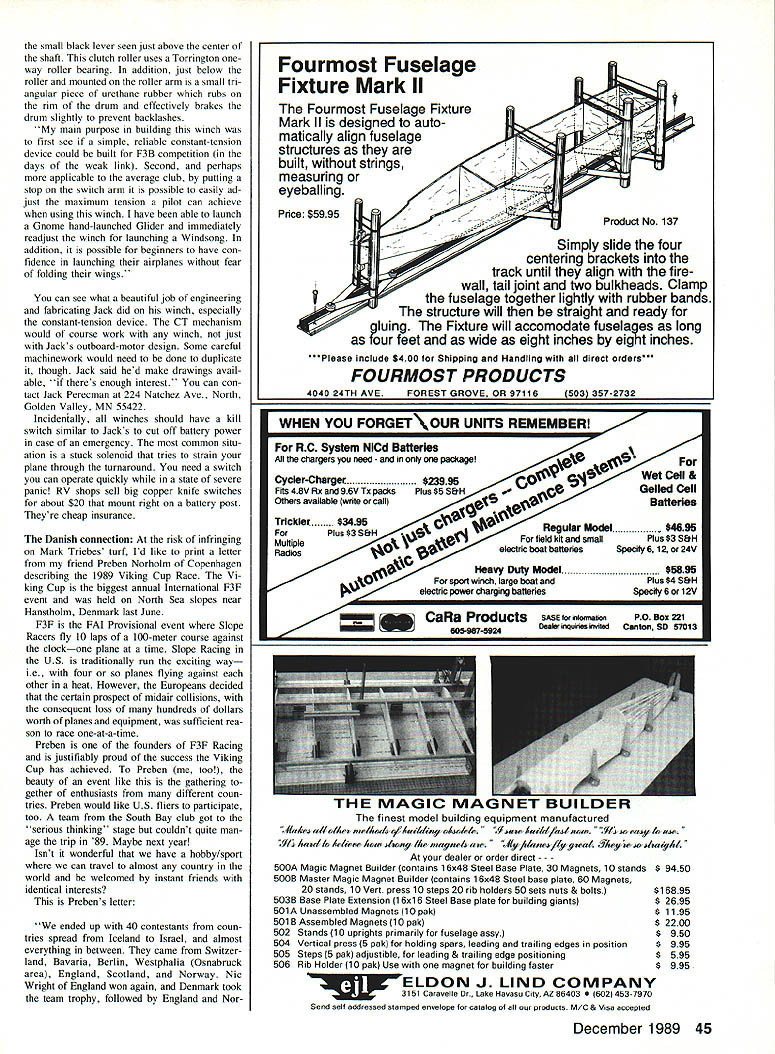
At the risk of infringing on Mark Triebes' turf, here is a letter from Preben Norholm of Copenhagen describing the 1989 Viking Cup Race. The Viking Cup is the biggest annual international F3F event and was held on North Sea slopes near Hanstholm, Denmark.
Background:
- F3F is an FAI provisional event in which slope racers fly 10 laps of a 100-meter course against the clock, one plane at a time. Europeans prefer single-plane runs to reduce midair-collision risk and preserve equipment.
- The Viking Cup gathers enthusiasts from many countries. Preben (one of the founders of F3F racing) encourages U.S. participation; a South Bay club team considered attending in 1989 but couldn't manage the trip.
Preben's letter (excerpt): "We ended up with 40 contestants from countries spread from Iceland to Israel, and almost everything in between. They came from Switzerland, Bavaria, Berlin, Westphalia (Osnabruck area), England, Scotland, and Norway. Nic Wright of England won again and Denmark took the team trophy, followed by England and Norway."
Personal note:
- Preben's letters are informative and entertaining. The Hanstholm bluff (north-facing, high above the beach) is an excellent slope-flying site.
Wingspan, winch launches, and windspeed
Lee Murray (Appleton, WI) shared data from a project collecting flight records to study performance effects of wingspan, launch methods, and flying conditions. His records now include over 250 flights, mostly from a sod-farm field with evaporative cooling that tends to limit thermal generation.
Key findings:
- Winch launches (using the Two-Meter Prodigy) averaged 25 seconds longer per flight than high-start launches.
- Wingspan differences are evident; the performance gap between 2M and Standard class (78 in. vs. 100 in.) is larger than between Standard and Unlimited class.
- The Two-Meter Prodigy outperformed Lee's long-time RO-8 (even with an E-205 wing profile substituted).
- Flight times from high-start launches showed a correlation with windspeed (likely due to gaining more height on launches); winch flights did not show the same correlation.
Model average flight times (minutes):
- 2-Meter Prodigy — 5.26
- RO-8 — 4.65
- Standard Class Cunic — 8.91
- XC/Unlimited Dynasoar — 10.22
- Scale ASW-17 — 4.28
Instrumentation project:
- Lee and Al Scidmore (Prof. of Electrical Engineering, Univ. of Wisconsin) are developing a small digital data logger to instrument sailplanes (altimeter, temperature sensor, supply voltage monitor, and velocity sensor). The current sensor outputs are 0–2.0 VDC; improvements to altitude and velocity sensors are in progress.
- The equipment aim is to fit inside many X-C or Scale ships or be pod-mounted on smaller models, with the eventual goal of ground transmission of digitally encoded data.
- Contact: Lee Murray, 1300 Bay Ridge Road, Appleton, WI 54915; phone 1-414/731-4848.
Logbook tip:
- Keep a logbook for each glider. Lee records date, place, number of flights, windspeed, flying conditions, ballast weight, and results of trim changes. He usually does not record the time of every flight during practice sessions, since practice often focuses on technique rather than maximum time.
How-to-make-models video
Julian Tamze’s instructional videos include "How to Vacuum Bag," "Cutting Foam Cores," and a 1.5-hour tape titled "Making Fiberglass Molds." The mold-making tape covers:
- Making the plug
- Making fiberglass molds
- Laying up two fuselage halves and joining them
The tape provides the basics (ABCs) of mold-making, tools, materials, and many practical tips. It is particularly useful if you plan to make your own FG fuselages. Pricing: $34.95 per tape (20% discount for NSS and LSF members), plus $3.50 shipping. Contact: Channel 1 Productions, 19827 Bishops Gate, Suite No. 1, Humble, TX 77338. Phone: 1-713/443-1253 days, 540-3944 evenings.
Sportsman Multi-Task (SMT) and the winner
Jim Gray's R/C Soaring Digest Challenge Design contest for Sportsman Multi-Task (SMT) sailplanes produced many good entries. The winner was Mark Allen's Falcon 880.
Other designs entered (alphabetical):
- Bob Dodgson — Camano
- Terry Edmonds — Callisto
- Don Chancey — Conquest
- Don Ederg — Hustler
- Jeremy Teo — Odyssey
- Bob Sealy — Pulsar
- Paul Carlson — Quasar
- Max Mills — Westwind
- (Winner) Mark Allen — Falcon 880
About SMT:
- SMT is a simplified, flexible take on F3B Duration/Distance/Speed tasks, aimed at the middle ground between AMA Thermal Duration and full international F3B competition.
- SMT restricts aircraft weight to 75 oz. (with ballast) to keep entries sportsman-friendly; this excludes typical F3B planes but allows most market kits and original designs in roughly the 2-meter to ~115-inch span range.
- Suggested SMT contest rules were published previously; clubs are encouraged to try SMT contests or practice sessions to see how it works locally.
Scale Slope Fun Fly / SSN
Organizers hope to feature manufacturer demonstrations during the meet, with two or three demo flights and show-and-tell sessions by designers and builders (examples: Byron Bruce, Marty Silberstein, Steve Peacock, Brian Laird, Paul Masura). The event format is expected to be informal, similar to the successful Richland Scale Slope Fun Fly — fly when you can and attend other activities as time permits.
Info: Charley at SSN, 2601 E. 19th St. #29, Signal Hill, CA 90804; phone 1-213/494-3712.
1990 Soaring contests
Ray Hayes, Vice President of the LSF, reminds clubs to plan for next year's big contests: the even-year LSF Regionals and the annual NSS Soar-Ins. Ray hopes to continue awarding the LSF plaques at the Regionals and also encourages spreading the three "super" contests (NSS Masters, LSF Nationals, and AMA Nationals) around the country in 1990 so East Coast fliers don't feel left out.
Contacts:
- LSF Regionals: Ray Hayes, 6998 Brookhill Dr., Rome, MI 48065; phone 1-313/752-6163.
- NSS Soar-Ins: Marshall Long, 824 Garden Meadow, Universal City, TX 78418.
Note: The 1990 AMA Nationals are scheduled for Lawrenceville, IL.
Transcribed from original scans by AI. Minor OCR errors may remain.

