
Radio Control: Soaring
Byron Blakeslee 3134 N. Winnebago Dr. Sedalia, CO 80135
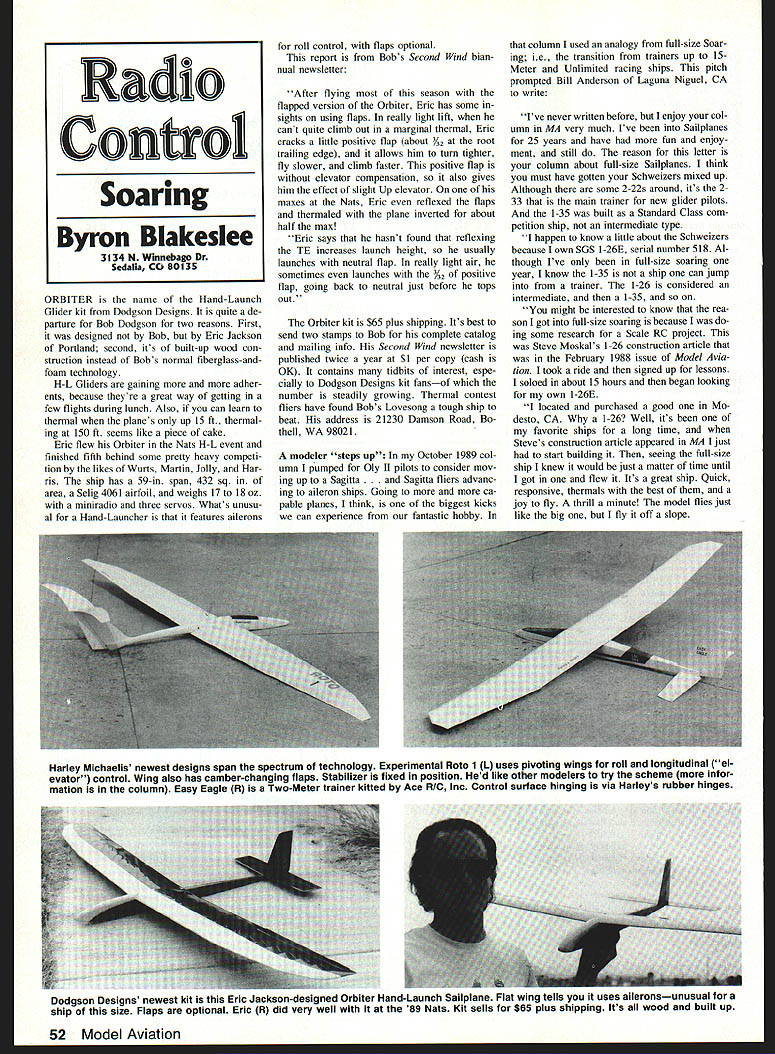
ORBITER — Hand‑Launch Glider kit
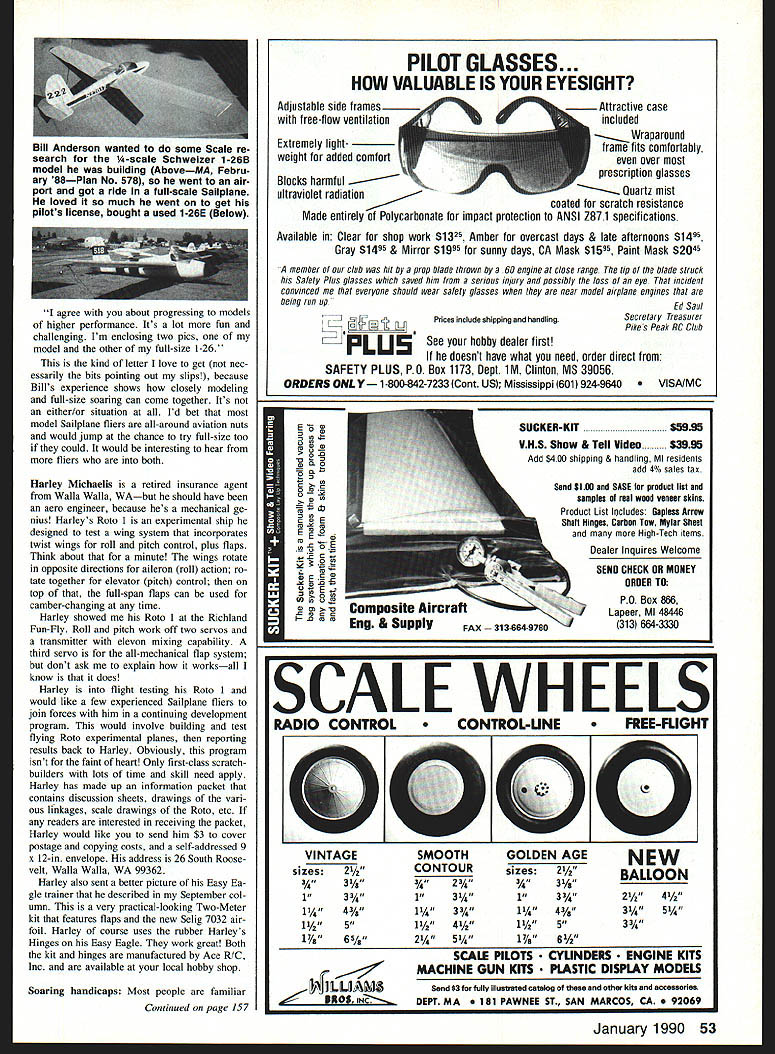
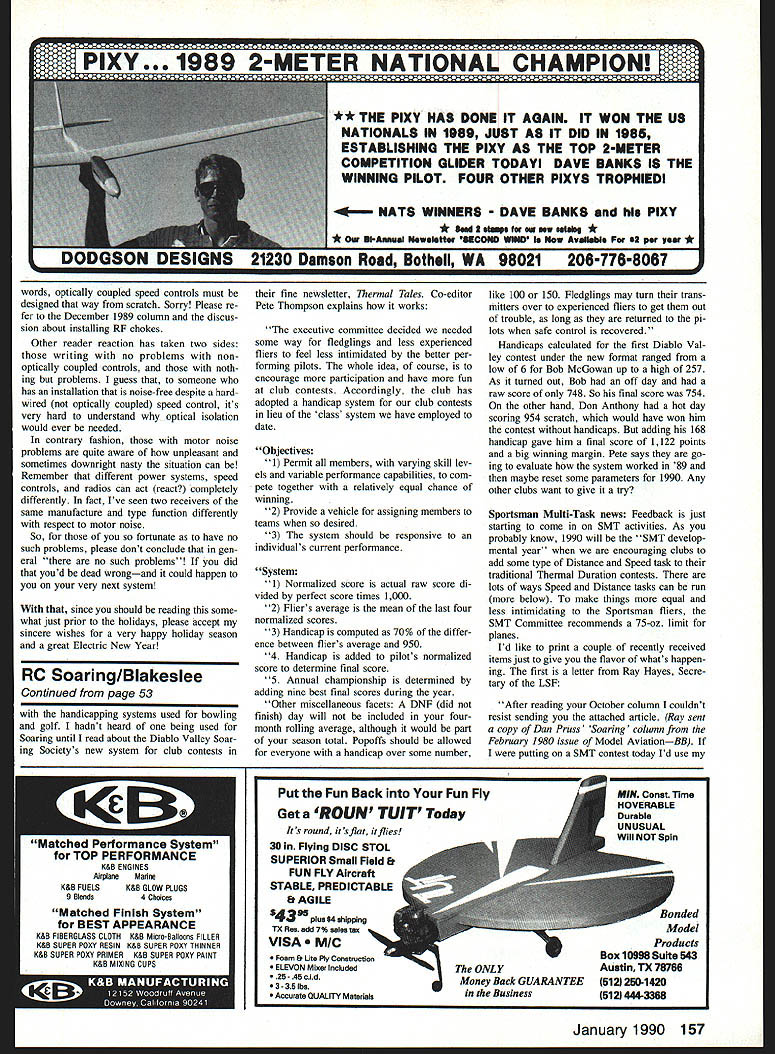
The Orbiter is a hand‑launch glider kit from Dodgson Designs — a departure for Bob Dodgson for two reasons: it was designed by Eric Jackson of Portland, and it is built‑up wood construction rather than Dodgson's customary fiberglass‑and‑foam technology.
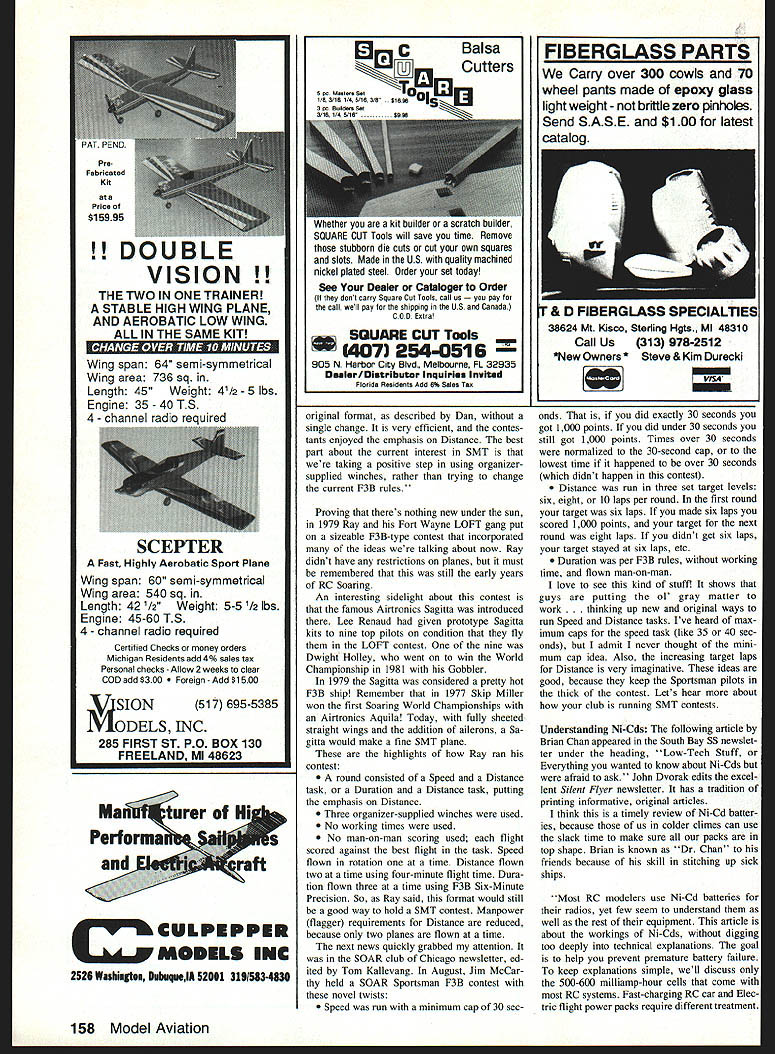
Hand‑launch gliders are gaining adherents because they make it easy to get a few flights during a lunch hour. Once you learn to thermal at 15 ft, thermaling at 150 ft seems much easier. Eric flew his Orbiter in the Nats H‑L event and finished fifth against heavy competition. The ship has a 59‑in span, about 432 sq in area, a Selig 4061 airfoil, and weighs roughly 17–18 oz with a mini radio and three servos. Unusually for a hand‑launcher it features ailerons for roll control; flaps are optional.
From Bob Dodgson’s Second Wind biannual newsletter:
"After flying most of this season with the flapped version of the Orbiter, Eric has some insights on using flaps. In really light lift, when he can't quite climb out in a marginal thermal, Eric cracks a little positive flap at the root trailing edge, and it allows him to turn tighter, fly slower, and climb faster. This positive flap, without elevator compensation, also gives the effect of slight up elevator. On one of his maxes at the Nats, Eric even reflexed the flaps and thermaled with the plane inverted for about half the max!
"Eric says he hasn't found that reflexing the trailing edge increases launch height, so he usually launches with neutral flaps. In really light air he sometimes launches with the small positive flap, going back to neutral just before he tops out."
The Orbiter kit is $65 plus shipping. For complete catalog and mailing information, send two stamps to Bob. Second Wind is published twice a year; single issues are $1 (cash OK). Dodgson Designs fans will find useful tidbits in the newsletter. Mail: 21230 Damson Road, Bothell, WA 98021.
Moving up — modeler progression and full‑size inspiration
In an October 1989 column I encouraged Oly II pilots to consider moving up to a Sagitta, and Sagitta pilots to consider aileron ships. Progressing to more capable planes is one of the great pleasures of the hobby. That column prompted a letter from Bill Anderson of Laguna Niguel, CA, correcting some full‑size Schweizer identifications and describing how a scale RC project led him into full‑size soaring.
Bill points out that the Schweizer 2‑33 is the common trainer (not the 2‑22) and the SGS 1‑35 was built as a Standard Class competition ship. He owns an SGS 1‑26E (serial no. 518). After reading Steve Moskal's 1‑26 construction article in Model Aviation (Feb 1988) Bill took a ride, signed up for lessons, soloed in about 15 hours, and then bought a 1‑26E. He says the 1‑26 is a favorite: quick, responsive, and excellent at thermaling. He notes that the model flies much like the full‑size ship and that he flies his model off a slope.
Harley Michaclis — Roto I and Easy Eagle
Harley Michaclis of Walla Walla, WA, a retired insurance agent and mechanical talent, has two interesting designs:
- Roto I: An experimental ship featuring pivoting wings that provide roll and pitch control plus full‑span camber‑changing flaps. The wings rotate in opposite directions for roll and together for elevator; the flaps change camber as needed. Roll and pitch are driven by two servos with an elevon‑mixing transmitter; a third servo operates the mechanical flap system. Harley has an information packet containing discussion sheets, linkage drawings, and scale drawings. To receive the packet send $3 (postage and copying) and a self‑addressed 9" x 12" envelope to: 26 South Roosevelt, Walla Walla, WA 99362.
- Easy Eagle: A practical two‑meter trainer kitted by Ace R/C, Inc., featuring flaps and the Selig 7032 airfoil. Harley uses rubber hinges on his Easy Eagle; they work well. The kit and rubber hinges are available through hobby shops.
Motor noise and speed‑control isolation
A continuing discussion concerns motor noise and the need for optically coupled speed controls. Points to note:
- Optically isolated speed controls must be designed that way from the start; they cannot simply be adapted after the fact.
- Refer to the December 1989 column for details on installing RF chokes.
- Reader experience is split: some have no problems with non‑optically coupled controls, others experience significant interference. Different power systems, speed controls, and radios can interact in unexpected ways — even two receivers of the same make and type may behave differently with the same motor noise source.
- If your installation is currently noise‑free, don't assume problems can't occur in other setups or in future changes to your system.
With that, best wishes for a happy holiday season and a great Electric New Year.
Diablo Valley Soaring Society — club contest handicap system
The Diablo Valley Soaring Society adopted a handicap system to encourage less experienced fliers to compete and to make club contests more fun and inclusive. Co‑editor Pete Thompson explains the system:
Objectives:
- Permit all members, with varying skill levels and variable performance capabilities, to compete together with a relatively equal chance of winning.
- Provide a vehicle for assigning members to teams when desired.
- The system should be responsive to an individual's current performance.
System:
- Normalized score = (actual raw score / perfect score) × 1,000.
- Flier's average = mean of the last four normalized scores.
- Handicap = 70% of the difference between flier's average and 950.
- Handicap is added to pilot's normalized score to determine final score.
- Annual championship is determined by adding a member's best final scores during the year.
Other rules: A DNF day is not included in the rolling four‑score average, though it counts in the season total. Popoffs should be allowed for pilots with handicaps over a set threshold (e.g., 100–150). Less experienced fliers may hand transmitters to more experienced fliers to recover the model, provided control is returned to the pilot when safe.
In the first contest using the new format, handicaps ranged from 6 to 257. Example results: Bob McGowan had a raw score of 748 and, with a small handicap, a final score of 754. Don Anthony scored 954 scratch; with his 168 handicap his final score was 1,122 and he won decisively. The club planned to evaluate the system after 1989 and possibly adjust parameters for 1990.
Sportsman Multi‑Task (SMT) news
Feedback on SMT activities is starting to arrive. For 1990 the SMT Committee encourages clubs to add Distance and Speed tasks to traditional Thermal Duration contests; there are many ways to run Speed and Distance tasks. To keep the Sportsman class approachable, the committee recommends a 75‑oz. plane weight limit. Further reports and sample contest formats will follow as clubs experiment with SMT events.
Transcribed from original scans by AI. Minor OCR errors may remain.

