
Radio Control: Soaring
Dan Pruss
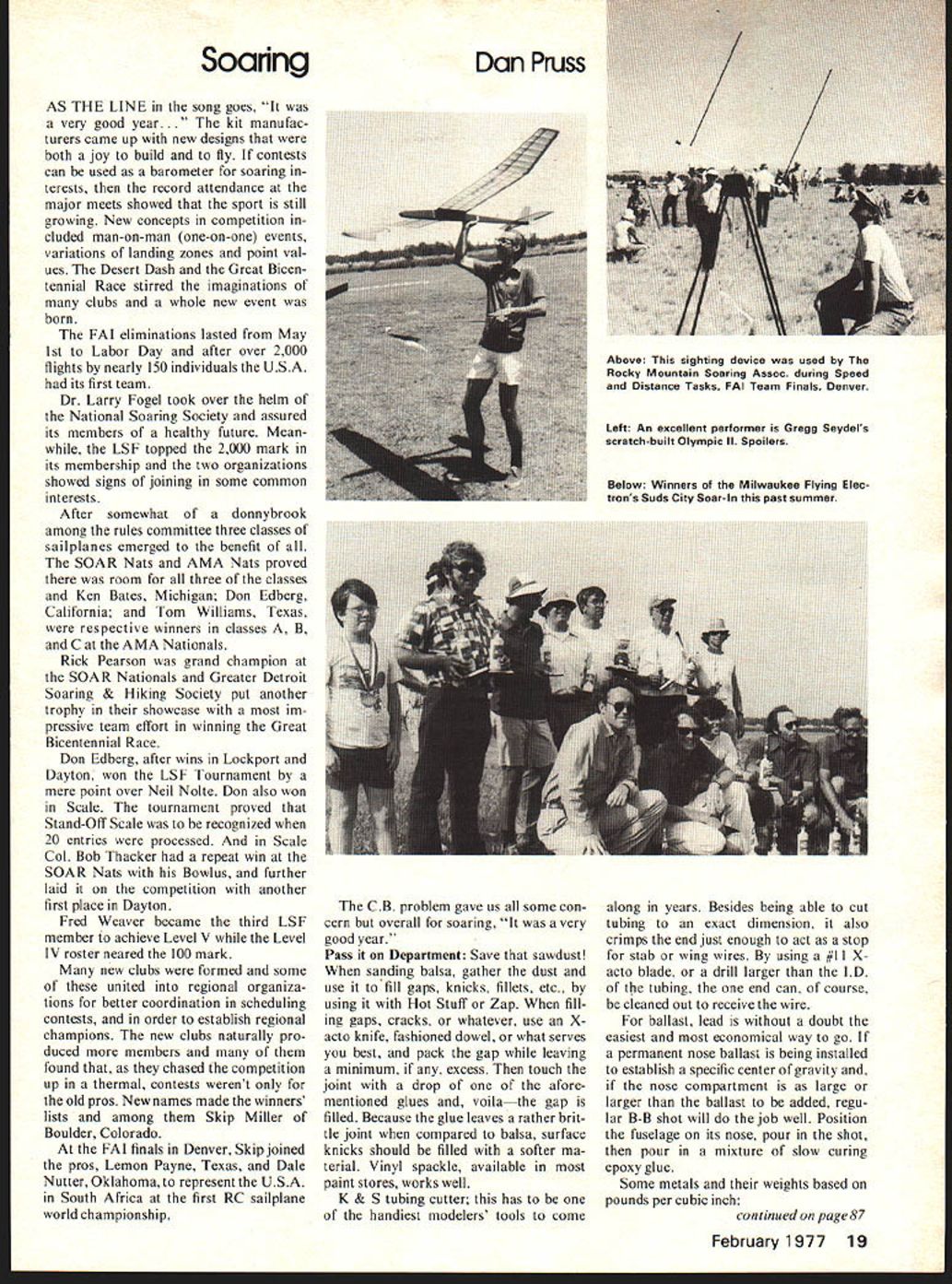
AS THE LINE in the song goes, "It was a very good year..." The kit manufacturers came up with new designs that were both a joy to build and to fly. If contests can be used as a barometer for soaring interests, then the record attendance at the major meets showed that the sport is still growing. New concepts in competition included man-on-man (one-on-one) events, variations of landing zones and point values. The Desert Dash and the Great Bicentennial Race stirred the imaginations of many clubs and a whole new event was born.
The FAI eliminations lasted from May 1st to Labor Day and after over 2,000 flights by nearly 150 individuals the U.S.A. had its first team.
Dr. Larry Fogel took over the helm of the National Soaring Society and assured its members of a healthy future. Meanwhile, the LSF topped the 2,000 mark in its membership and the two organizations showed signs of joining in some common interests.
After somewhat of a donnybrook among the rules committee three classes of sailplanes emerged to the benefit of all. The SOAR Nats and AMA Nats proved there was room for all three of the classes and Ken Bates, Michigan; Don Edberg, California; and Tom Williams, Texas, were respective winners in classes A, B, and C at the AMA Nationals.
Rick Pearson was grand champion at the SOAR Nationals and Greater Detroit Soaring & Hiking Society put another trophy in their showcase with a most impressive team effort in winning the Great Bicentennial Race.
Don Edberg, after wins in Lockport and Dayton, won the LSF Tournament by a mere point over Neil Nolte. Don also won in Scale. The tournament proved that Stand-Off Scale was to be recognized when 20 entries were processed. And in Scale Col. Bob Thacker had a repeat win at the SOAR Nats with his Bowlus, and further laid it on the competition with another first place in Dayton.
Fred Weaver became the third LSF member to achieve Level V while the Level IV roster neared the 100 mark.
Many new clubs were formed and some of these united into regional organizations for better coordination in scheduling contests, and in order to establish regional champions. The new clubs naturally produced more members and many of them found that, as they chased the competition up in a thermal, contests weren't only for the old pros. New names made the winners' lists and among them Skip Miller of Boulder, Colorado.
At the FAI finals in Denver, Skip joined the pros, Lemon Payne, Texas, and Dale Nutter, Oklahoma, to represent the U.S.A. in South Africa at the first RC sailplane world championship.
The C.B. problem gave us all some concern but overall for soaring, "It was a very good year."
Pass it on Department: Save that sawdust! When sanding balsa, gather the dust and use it to fill gaps, knicks, fillets, etc., by using it with Hot Stuff or Zap. When filling gaps, cracks, or whatever, use an X-acto knife, fashioned dowel, or what serves you best, and pack the gap while leaving a minimum, if any, excess. Then touch the joint with a drop of one of the aforementioned glues and, voila—the gap is filled. Because the glue leaves a rather brittle joint when compared to balsa, surface knicks should be filled with a softer material. Vinyl spackle, available in most paint stores, works well.
K & S tubing cutter; this has to be one of the handiest modelers' tools to come along in years. Besides being able to cut tubing to an exact dimension, it also crimps the end just enough to act as a stop for stab or wing wires. By using a #11 X-acto blade, or a drill larger than the I.D. of the tubing, the one end can, of course, be cleaned out to receive the wire.
For ballast, lead is without a doubt the easiest and most economical way to go. If a permanent nose ballast is being installed to establish a specific center of gravity and the nose compartment is as large or larger than the ballast to be added, regular B-B shot will do the job well. Position the fuselage on its nose, pour in the shot, then pour in a mixture of slow curing epoxy glue.
Some metals and their weights based on pounds per cubic inch:
RC Soaring/Pruss continued from page 19
Brass .302 Lead .4096 Tungsten .690 Carbon Steel .280 Platinum .770 *Mercury .490 *not recommended for ballast.
For those models whose fuselages are rectangular or square in cross-section, incredible strength can be added at a minimum weight penalty and with very little work. Wrap the entire fuselage in 1/64" plywood—yes, 1/64"! Here's a recommended procedure:
First, finish the entire fuselage as if you were going to Monokote it. Sand all four sides but be sure to leave the corners sharp (no radii). Next, cut a piece of 1/64 plywood that is slightly larger than the side to be covered. (You can start with any side, top or bottom, but it is suggested you begin with a side that has no pushrod exits, dowel cut-outs, etc.). Apply a coat of contact cement to the plywood and to the respective fuselage side. Let dry and give each a second coat. Follow the manufacturer's directions in checking for dryness.
When the second coat is dry carefully position the plywood with respect to the fuselage without making contact. When position is satisfied, touch plywood to the fuselage and rub firmly over entire side. Excess sheeting can be trimmed away using regular scissors. Trim to about 3/16" to the fuselage sides, then using a Stanley utility knife or a heavy duty X-acto knife, trim away the remaining excess, using the adjacent uncovered balsa sides as a guide for the knife blade. Be sure to cut in the direction the plywood grain runs away from the fuselage. Repeat the above procedures for the opposite side of the fuselage.
After two sides have been covered and carefully trimmed, dress down the two uncovered sides with a sanding block, also dressing the edges of the plywood sides in the process.
In preparing the remaining sides, carefully cut out any holes or notches in the plywood before applying any glue. When the glued plywood is to be positioned, be extremely careful in aligning the cut-outs or notches.
Once the fourth side is applied the fuselage takes on an added dimension in
Correction
In the December issue it was stated in the coverage of the 1976 LSF Tournament incorrectly that all 15 top fliers were from California. Actually, Randy VerMulm, Stanwood, Wash., placed 7th over-all, only 50 points out of first place.
RC Soaring (continued)
strength that you have to experience to believe. The sharp corners, whether painted or Monokoted, stay defined through all sorts of handling and landings.
Although the beefed up fuselage won't make your plane fly any better, the added strength should let you breathe easier during landings that turn out less than smooth.
There's a new full-size sailplane organization that should be of interest to you scale enthusiasts. It's the Vintage Sailplane Assoc., 6053 25th Road N., Arlington, VA 22207.
Dues are $5.00 per year and their quarterly publication deals, as the name implies, with vintage sailplanes. Doc Hall sez it's a must if you're at all interested in old time scale.
Dan Pruss, Rt. 2, Box 490, Plainfield, IL 60544.
Transcribed from original scans by AI. Minor OCR errors may remain.

