
Radio Control: Soaring
Byron Blakeslee 3134 N. Winnebago Dr. Sedalia, CO 80135
Hi Performance Sailplanes — Warrior
Overview
Two exciting new competition sailplane kits: Hi Performance Sailplanes' Warrior and Competition Products' Phoenix. Karen and Ron Wagner of Hi Performance Sailplanes describe their new Warrior.
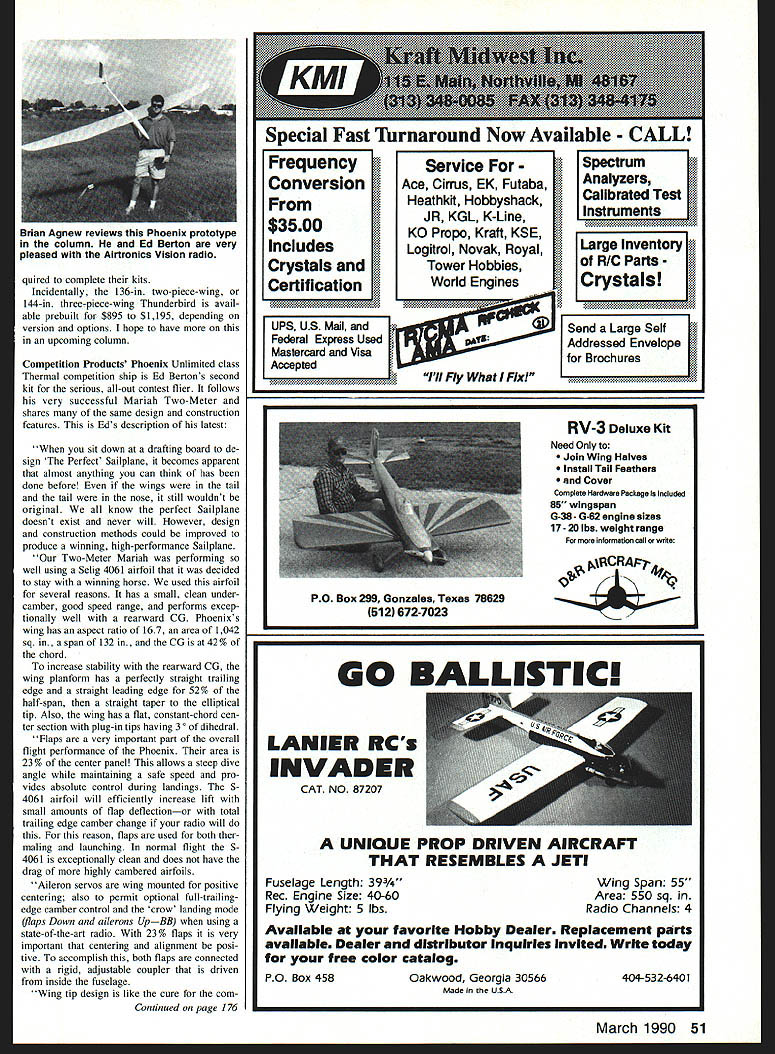
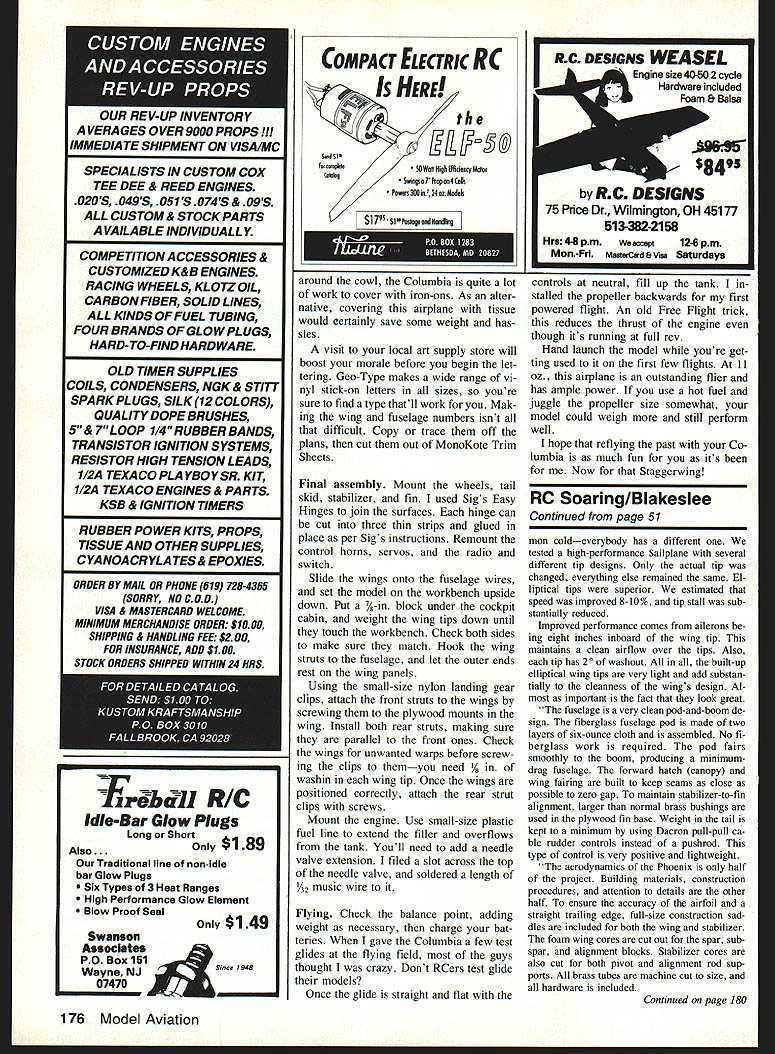
Doug Flett of Vancouver, British Columbia, is often seen flying his new Warrior at Jericho Beach in North Vancouver. The design and conception are the result of airfoil work by Selig and Donovan and Ken Stuhr's low-drag fuselage. Hi Performance Sailplanes uses a high-strength, seamless Kevlar/glass layup for fuselage construction.
Design and features
- Offered in two spans:
- 138 in. span version
- 112 in. Multi-Task / F3B version
- Blue foam wing cores; presheeting with obeche available at extra cost
- Optional airfoils: Eppler 214, Selig 2091, Selig 7032, or the new Selig F3B airfoil
- Prefitted spar assemblies included as a kit feature
- Spar flex patterns store inertial energy during launch and release it to create extra acceleration
Kit contents and options
The Warrior kit ($225 plus shipping) includes:
- Fuselage
- Blue foam wing and stab cores
- Prefitted spar assembly in the wing
- Finished all-composite rudder
- Spruce leading edge
- Stock hardware
- Plans and building instructions
Available at extra cost:
- HP Cell, balsa, or obeche wing sheeting
- Carbon fiber spar assemblies
The F3B version is available completely prebuilt and ready for finishing and radio installation for $850.
Ordering information
For more information on the Warrior and HPS' other Unlimited-class contest ship, the Thunderbird, send a large SASE to: Hi Performance Sailplanes 17902 NE 156th Woodinville, WA 98072 Phone: 206/487-1721
The Wagners also supply a variety of supplies and vacuum-bag accessories.
Competition Products — Phoenix
Overview
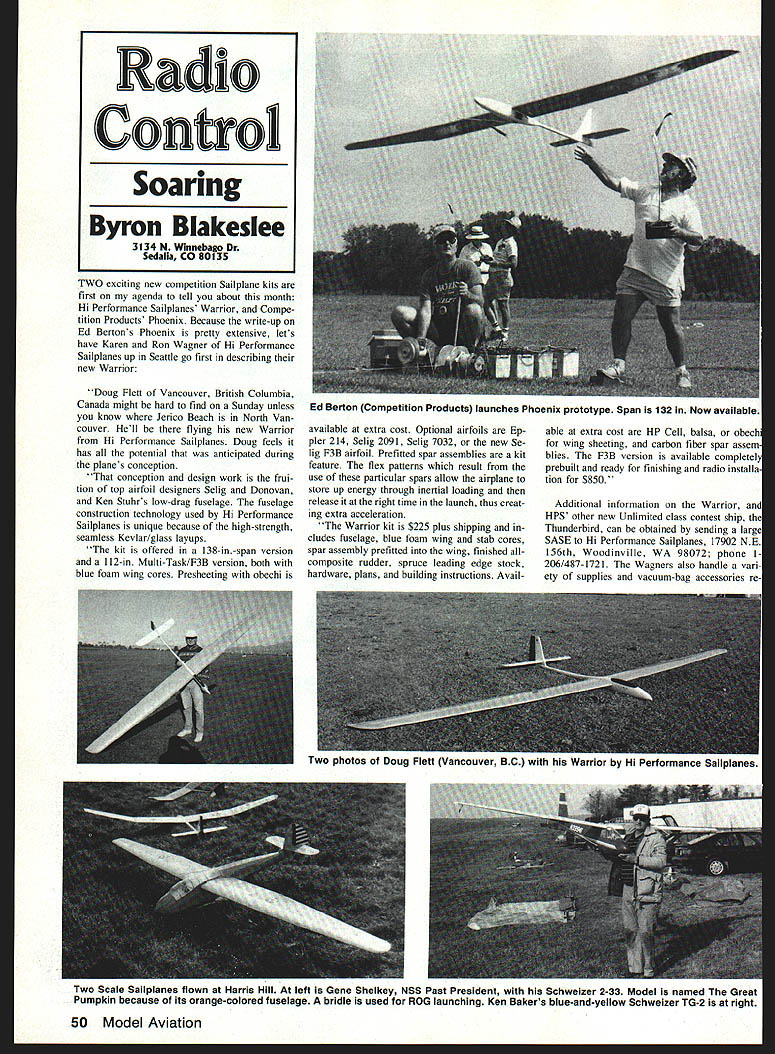
Ed Berton's second kit is an all-out contest flier that follows his successful Mariah two-meter design. The Phoenix shares many design and construction features with the Mariah and is targeted at serious contest flyers seeking top performance.
Design goals
Ed Berton aimed to improve design and construction methods to produce a winning high-performance sailplane. The Selig 4061 (S-4061) airfoil used on the Mariah proved successful and was retained for the Phoenix because of its small, clean undercamber, good speed range, and strong performance with a rearward CG.
Wing and control surfaces
- Aspect ratio: 16.7
- Wing area: 1,042 sq. in.
- Span: 132 in.
- CG: 42% chord
- Planform: straight trailing edge, straight leading edge to 52% half-span, then straight taper to an elliptical tip
- Center section: flat constant-chord with plug-in tips having 3° dihedral
- Wing-tip: elliptical tips for improved speed (estimated 8–10%) and much better stall behavior
- Flaps: 23% center panel; used for thermalling, launching, normal flight, and landing
- S-4061 responds well to small flap deflections or total trailing-edge camber change
- Aileron servos wing-mounted with positive centering allow optional full trailing-edge camber control (crow landing mode — flaps down, ailerons up)
- Both flaps are linked with a rigid, adjustable coupler driven from inside the fuselage to ensure positive centering and alignment
Fuselage and controls
- Clean pod-and-boom fiberglass pod smoothly glassed to the boom for minimal drag
- Forward hatch (canopy) and wing fairing built to minimize seams
- Wing held in place with rubber bands and nylon straps to maintain stabilizer-to-fin alignment
- Rudder uses Dacron pull-pull cable controls (positive and lightweight) to keep tail weight low
- Airbrakes and flaps make landing controllable even in difficult conditions
Construction and kit contents
- High-tech laser cutting for 44 parts (balsa ribs and leading edge for wing tips, plywood formers, bulkheads, doublers, plywood fin base with cutouts)
- Full-size plans (three 36 x 44 in. sheets)
- 36-page building instruction booklet with step-by-step construction details
- Full-size foil-forms for foam wing and stab cores included
Price and ordering
Ed Berton anticipates the Phoenix kit selling for $265 plus shipping. Reduced-scale plans are also available. For more information, send a business-size SASE to: Competition Products 921 Birdie Way Apollo Beach, FL 33572 Phone: 1-813/645-5171
Performance summary
A well-built Phoenix will enter thermals on very low energy, circle tightly, and accelerate quickly when unloaded. It is sensitive to trim and rewards precise setup. The Phoenix offers a remarkable speed range, excellent thermalling comparable to the best polyhedral ships, and the handling benefits of a full-house sailplane.
Review — Brian Agnew
Brian Agnew (Ft. Myers, FL), winner at the 1988 Nats, flew the Phoenix extensively and reports:
- The Phoenix is similar to the Mariah in pod-and-boom fuselage, wing planform (flat center section with dihedral in plug-in tips), S-4061 airfoil, and full-house controls (ailerons, rudder, elevator, and flaps). The elliptical tips and nearly 17:1 aspect ratio make it visually striking.
- In flight tests, the Phoenix exceeded the Mariah's already exceptional speed range. The elliptical tips contribute significantly to the Phoenix’s cleanliness and performance.
- The Phoenix thermals as well as the best polyhedral ships while offering the handling and control of a full-house sailplane — a rare combination.
- Turning performance is excellent: flat, very tight turns with minimal wing drop and low wing sink.
- Flaps are very effective in tight or fast turns and critical for landing; they facilitate small-radius thermalling and provide maximum flare on landing.
- Launch performance is outstanding, reaching very high altitude; the wing flex provides clear feedback during the launch.
- The Phoenix is stable in turbulence and strong lift. With flaps and airbrakes it is straightforward to land even on difficult days.
- Kit quality: the Phoenix kit is among the finest designs seen — detailed full-size foil forms and meticulous attention to detail yield a winning sailplane.
Transcribed from original scans by AI. Minor OCR errors may remain.

