
Radio Control: Soaring
Byron Blakeslee 3134 N. Winnebago Dr. Sedalia, CO 80135
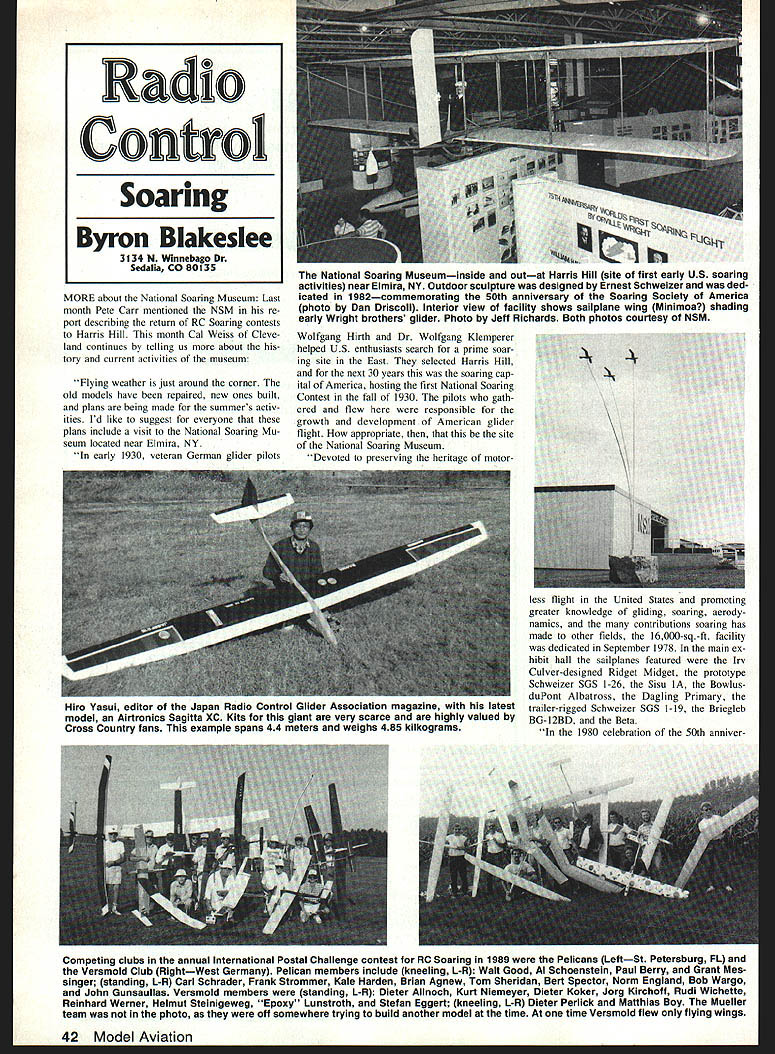
More about the National Soaring Museum
Last month Pete Carr mentioned the NSM in his report describing the return of RC soaring contests to Harris Hill. This month Cal Weiss of Cleveland continues by telling us more about the history and current activities of the museum:
"Flying weather is just around the corner. The old models have been repaired, new ones built, and plans are being made for the summer's activities. I'd like to suggest to everyone that these plans include a visit to the National Soaring Museum located near Elmira, NY.
"In early 1930, veteran German glider pilots Wolfgang Hirth and Dr. Wolfgang Klemperer helped U.S. enthusiasts search for a prime soaring site in the East. They selected Harris Hill, and for the next 30 years this was the soaring capital of America, hosting the first National Soaring Contest in the fall of 1930. The pilots who gathered and flew here were responsible for the growth and development of American glider flight. How appropriate, then, that this be the site of the National Soaring Museum.
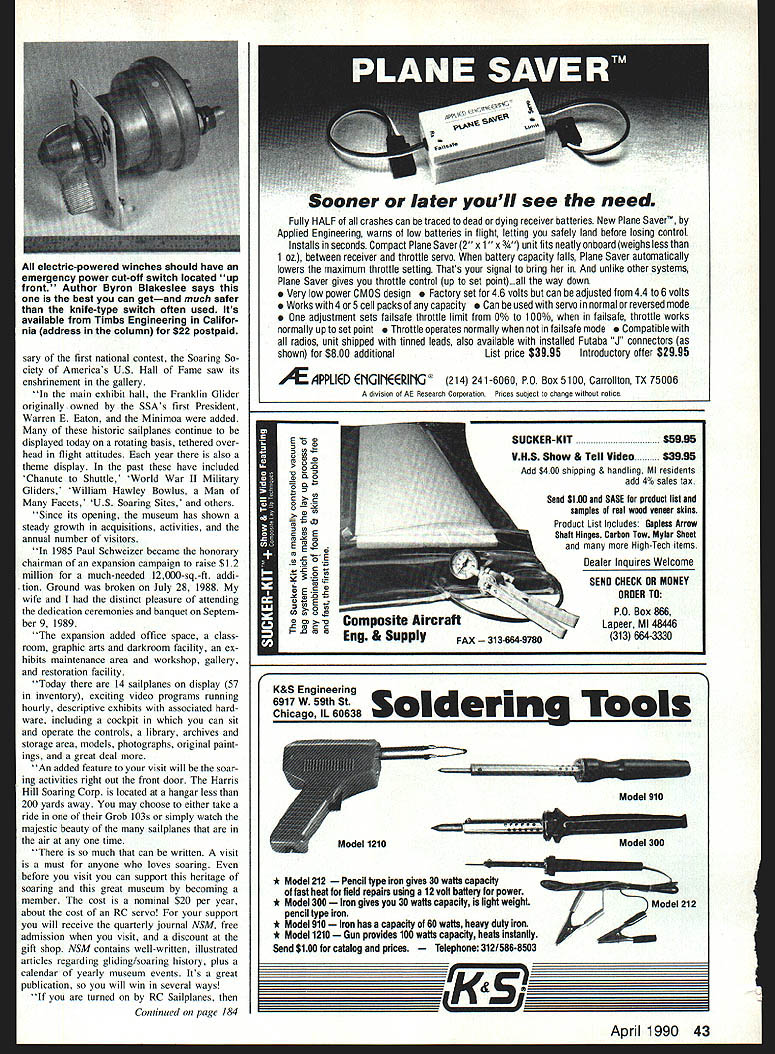
"Devoted to preserving the heritage of motorless flight in the United States and promoting greater knowledge of gliding, soaring, aerodynamics, and the many contributions soaring has made to other fields, the 16,000-sq.-ft. facility was dedicated in September 1978. In the main exhibit hall the sailplanes featured were the Irv Culver–designed Ridget Midget, the prototype Schweizer SGS 1-26, the Sisu 1A, the Bowlus duPont Albatross, the Dagling Primary, the trailer-rigged Schweizer SGS 1-19, the Briegleb BG-12BD, and the Beta.
"In the 1980 celebration of the 50th anniversary of the first national contest, the Soaring Society of America's U.S. Hall of Fame saw its enshrinement gallery in the main exhibit hall. The Franklin Glider, originally owned by SSA's first president Warren E. Eaton, and the Minimoa and other historic sailplanes continue to be displayed today on a rotating basis, tethered overhead in flight attitudes. Past theme displays have included Chanute, Shuttle, World War II Military Gliders, William Hawley Bowlus, Man, Facets, U.S. Soaring Sites, and others.
"Since its opening the museum has shown steady growth in acquisitions and activities and in the annual number of visitors. In 1985 Paul Schweizer became honorary chairman of an expansion campaign to raise $1.2 million for a much-needed 12,000-sq.-ft. addition. Ground was broken July 28, 1988, and I had the distinct pleasure of attending dedication ceremonies and the banquet September 9, 1989. The expansion added office space, a classroom, graphic arts darkroom facility, exhibits maintenance area, workshop, gallery restoration facility and storage.
"Today 14 sailplanes are on display and 57 are in the inventory. Exciting video programs run hourly. Descriptive exhibits and associated hardware, including a cockpit one can sit in and operate controls, plus library, archives, storage area, models, photographs and original paintings, add a great deal.
"An added feature of a visit will be the soaring activities right out the front door. Harris Hill Soaring Corp., located in a hangar less than 200 yards away, offers rides in Grob 103s. You may choose either to take a ride or simply watch the majestic beauty of sailplanes in the air. Much can be written about the visit, but anyone who loves soaring should see and support the heritage of soaring."
If you are turned on by RC sailplanes, then see the museum; with its displays and programs, it will knock you out! Make the effort to join—or visit and join. I guarantee you'll not regret either. The address: National Soaring Museum, R.D. #3, Harris Hill, Elmira, NY 14903.
Thanks to Cal Weiss for taking the time to tell us about the NSM. I'm sure many model-glider fliers appreciate learning about it and will plan to stop there when they are in the area. In his cover letter Cal mentioned that the photos were provided by Shirley Sliva, Director of the NSM.
RC Soaring/Blakeslee
Continued from page 184
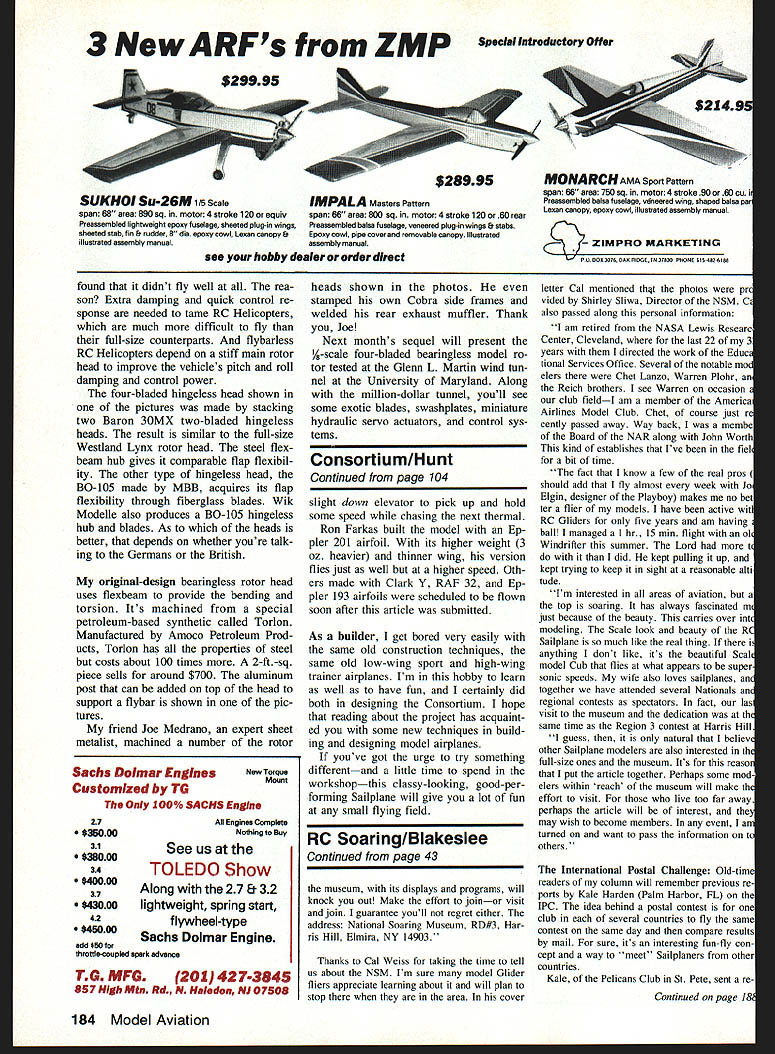
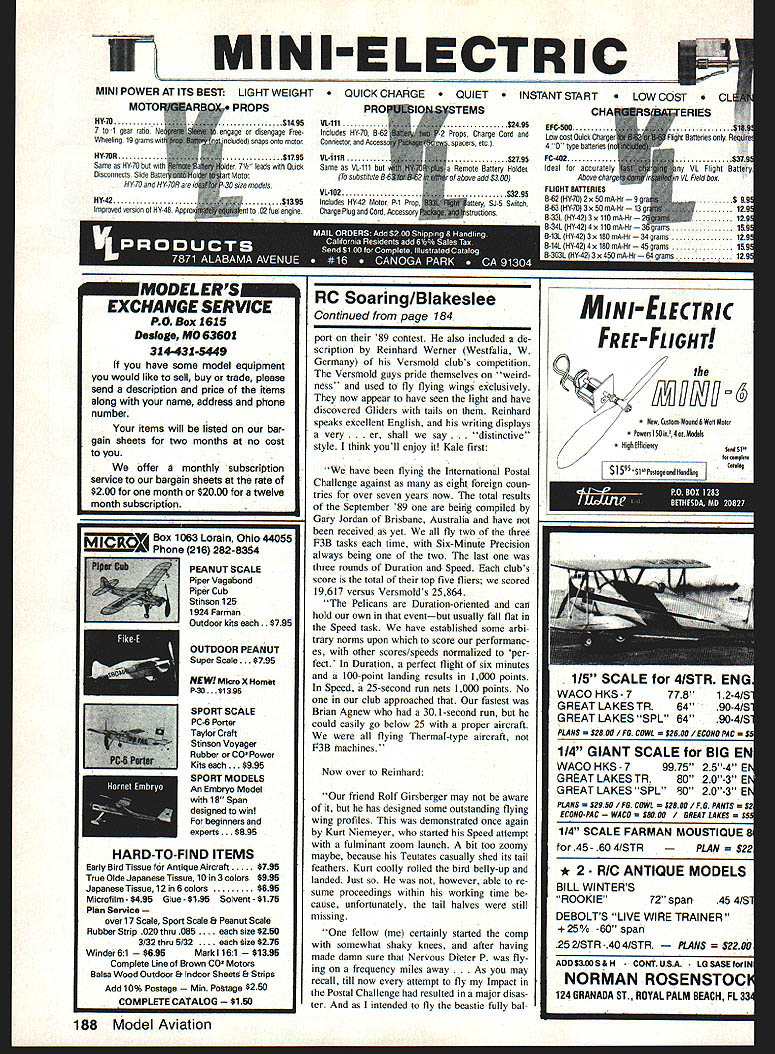
My report on the '89 contest also included a description by Reinhard Werner (Westfalia, W. Germany) of his Versmold club's competition. The Versmold guys pride themselves on "weirdness" and used to fly flying wings exclusively. They now appear to have seen the light and have rediscovered gliders with tails on them. Reinhard speaks excellent English, and his writing displays a very — er, shall we say — "distinctive" style. I think you'll enjoy it. Reinhard first:
From Reinhard Werner — Versmold Club
"We have been flying the International Postal Challenge against as many as eight foreign countries for over seven years now. The total results of the September '89 one are being compiled by Gary Jordan of Brisbane, Australia and have not been received as yet. We all fly three F3B tasks each time, with Six-Minute Precision always being one of the two. The last one was three rounds of Duration and Speed. Each club's score is the total of the top five flyers; we scored 19,617 versus Versmold's 25,864.
"The Pelicans are Duration-oriented and can hold our own in that event — but usually fall flat in the Speed task. We have established some arbitrary norms upon which to score our performances, with other scores/speeds normalized to 'perfect.' In Duration, a perfect flight of six minutes and a 100-point landing results in 1,000 points. In Speed, a 25-second run nets 1,000 points. No one in our club approached that. Our fastest was Brian Agnew who had a 30.1-second run, but he could easily go below 25 with a proper motor; we were all flying thermal-type aircraft, not F3B machines."
Now over to Reinhard:
"Our friend Rolf Girsberger may not be aware of it, but he has designed some outstanding flying wing profiles. This was demonstrated once again by Kurt Niemeyer, who started his Speed attempt with a fulminant zoom launch. A bit too zoomy maybe, because his Teutates caused the bird to go tail-heavy. Kurt coolly rolled the bird belly-up and landed. Just so. He was not, however, able to start a further run from within his working time because, unfortunately, the tail halves were still missing.
"One fellow (me) certainly started the day with somewhat shaky knees. As you may recall, every attempt I had made to fly my Impact in the Postal Challenge had resulted in a major disaster. I intended to fly the beastie fully 'bald' — going much too fast to just bang it in. So I decided to try a little up ... and whack! Uwe was lying on his back like an overturned tortoise. Sunglasses and transmitter were splattered all over the place. The Rock was lying on top of him. Luckily he had gotten his arms up just in time — no damage done except to his ego.
"So I am sure that the flight line would calmly announce: '178 seconds ... no landing points ... pilot slain by own model.' 'Did he hit anything of importance?' one fellow asks sympathetically. 'Nothing,' I say, 'except his head, and certainly no brain mass has emerged.' 'Of course not!' everybody shouts.
"Which reminds me of something I could not help overhearing some time ago, when a couple of fellows from South Germany were talking about the Versmold pilots. 'With friends like these you won't need enemies...!' It may be understandable that Frank Mueller thought the best way to stay out of trouble was to fold the wing of his Carbon Monoxide Squared on his first launch. You see, another nice and uneventful Versmold session!"
The best winch safety switch
My December '89 column had photos of Jack Perecman's constant-tension winch, along with Jack's description of how his winch worked. In my follow-up comments I mentioned that Jack's emergency cut-off switch was a good idea, because sooner or later any winch's solenoid will stick closed and cause the winch motor to keep running even though your foot is off the control switch.
If you can't release your glider from the line, either with a releasable hook or by quickly giving full up elevator (assuming your surprised nerves will allow you to think fast enough!), either the wings...
(continued)
Transcribed from original scans by AI. Minor OCR errors may remain.

