
Radio Control: Soaring
Byron Blakeslee 3134 N. Winnebago Dr. Sedalia, CO 80135
Thornburg Is Back!
RC soaring more or less began in the mid- to late Sixties, and one of the pioneers at the time was Dave Thornburg of Albuquerque, NM. He was considered by fellow competition fliers as a leading soaring guru through the Seventies. He even moved to California to be closer to the "big action."
Dave wrote a series of articles for Model Builder magazine in the late Seventies and early Eighties that have come to be recognized as classics. You still see references to them in magazine columns and club newsletters. "Thornburg's 12 Rules of Soaring" should be memorized by all sailplane fliers.
Dave kind of burned out, moved back to Albuquerque, and has been pretty much out of soaring for the last six or eight years. So imagine my surprise and delight when he sent word of his new book titled Old Buzzard's Soaring Book!
In his letter Dave said, "All that rewriting and new research is the chief reason I wound up at the flying field, and got hooked again. And I thought I was cured this time!"
Dave also mentioned that he expects to be campaigning a Max Mills Southwind on the contest circuit this season. I sure hope he will fly in the upcoming Soaring Masters contest in California, because if there ever was a flier who deserved the "Soaring Master" label, it's Dave.
Old Buzzard's Soaring Book (press release)
During the late Seventies and early Eighties, Dave ("Bird of Time") Thornburg contributed over 60 construction articles and essays to the modeling press. Now 15 of his best soaring pieces have been reprinted in paperback.
Old Buzzard's Soaring Book is jammed with tips from the experts: thermal lore, contest do's and don'ts, programming yourself for better landings, ways to improve kit models, techniques for designing your own sailplane. The book (160 pages) includes two of Dave's classic essays on thermal-hunting: "The River of Air" and "The Perfect Thermal." Many pilots have called "The River of Air" the single most helpful article they've ever read on RC soaring.
The book's first nine chapters focus on flying; the last four cover sailplane design and basic aerodynamics. Dave's nonmathematical approach to aerodynamics is both witty and wise—without a single formula. He manages to explain not only how your airplane flies, but how you can make it fly better.
Many of the chapters in Old Buzzard's Soaring Book originally appeared (in shorter form) in Model Builder magazine. Each piece contains new and updated material, including over 50 new cartoons, illustrations, and comparison charts.
"This is a book for intermediate soaring pilots, not rank beginners," Dave says. "It won't tell you how to cover a wing or make a test glide over tall grass. Old Buzzard is for folk who already know how to fly... folk who are starting to think about how they might fly a little better, land a little more consistently, compete a little more successfully at contests. Also, it's just a fun book to curl up with on a rainy night. It's full of blue skies, cumulus clouds, and rising (almost said hot) air. There's even a chapter or two on slope flying, in case you've need a break from the pursuit of the wily thermal!"
Old Buzzard's Soaring Book is available direct from the publisher, The Pony X Press, 5 Monticello Drive, Albuquerque, NM 87123. The price is $14.95, plus $1.50 shipping and handling. Or call 1-505/299-8749 for Visa, MC, or COD shipment. Dealer discounts on 10 or more copies.
This is Old Buzzard's table of contents:
- The Perfect Thermal — Thermal lore straight from Old Buzzard.
- Happy Landings — The invisible window makes them easy.
- The River of Air — Who has seen the wind? Lots of people!
- Twelve Hot Tips on Thermal Soaring — The collected wisdom of the winners.
- Stalking the Invisible Thermal — How to hunt thermals.
- Flyaway! — What to do when a model tries to escape.
- Choosing a Slope Site — Good slope sites are everywhere!
- The Fine Art of Slope Soaring — How to conquer a windy hill.
- Ten Ways to Lose a Sailplane Contest
- Sharks Fly Better! — On a glider, little things mean a lot.
- Some Notes on Designing Your Own — You start with the boring old wing...
- More Notes on Designing Your Own... and then you get to the fun part!
- A Glib Glossary of Glider Gibberish — A few strange words made clear.
I think Dave's book will be a godsend to sailplaners who have taken up the hobby in the past eight years or so and haven't had the benefit of his learned and, shall we say, "uninhibited" style. This is truly great stuff—heartily recommended. I'm sure you will enjoy Old Buzzard and benefit from his teachings.
Max Mills Southwind
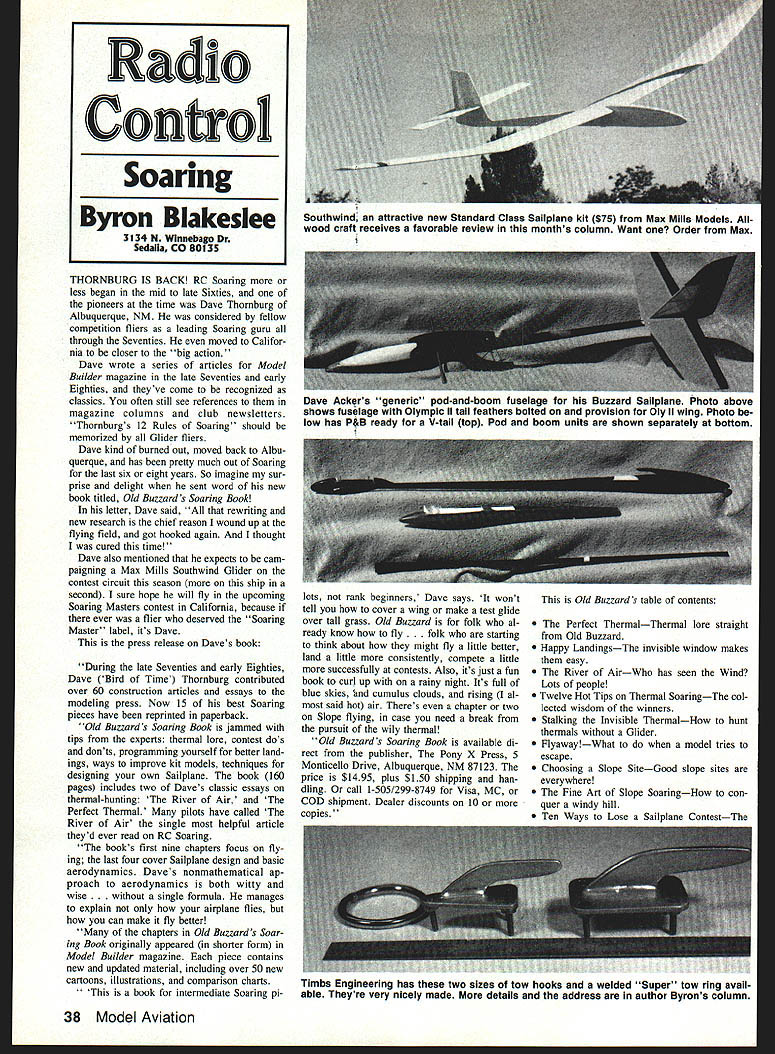
The Southwind from Max Mills is a new Standard Class glider kit on the market. It is an all-wood kit available directly from Max in Albuquerque for $75 plus postage. The best way to tell you about the kit is to print the letter of Tom Thompson, who was Steve Work's helper on the 1987 U.S. F3B World Champs team.
Tom's letter: "It was getting to the point where flying model sailplanes was becoming more work than play. The really high-performance sailplanes were getting to be too much trouble to fly because they required a lot of practice, monofilm, and several friends to practice F3B Speed and Distance. And the Hans Mueller Kings and Comets were getting into too much money to import.
At the other end of the spectrum, there were new, exciting sailplanes to build from kits. There were the well-known standard lines of fairly good performing kits, but I didn't want to spend a lot of time building. I'd rather be flying. So I started to build quarter-scale power planes and put soaring on the back burner.
Then one day I was at the local hobby shop, and the owner said, 'Aren't you looking for a sexy sailplane that goes fast, lands slow, and thermals like an F3B?' I didn't know what to say. Of course I had been looking for this kind of machine for some time.
He said, 'Look at that sailplane up there hanging from the ceiling.' Hanging with all its beauty from a piece of fishing line was a 49-in. poly-wing sailplane. It had a double-sweepback leading edge, like the F3B ships, sleek white fuselage, slats, and flaps. It was love at first sight. My next words were, 'Where do I get one?' He said it was a new plane being kitted right here in Albuquerque. 'Sign me up!' I said.
'The kit was beautiful and proved to be just as satisfying as the airplane itself. It had excellent plans, great wood with handmade ribs, fuselage sides, and formers, and also a very comprehensive assembly manual. What a deal!'
Fuselage assembly time was two evenings. The wings took two evenings, also. In spare evening working time, the plane was ready to fly in just two weeks. Then out to the local soccer field. After the usual hand launches, radio checks, and trimming, I launched her on a hi-start. It went up straight as a string. I had lowered the flaps about a quarter of an inch for the launch, and it was straining the hi-start because it was climbing so hard. What a great launch!
'Now for the cruise part of the flight. Looking for lift, I reflexed the flaps. Like a shot, the plane sped forward in complete control and lost no altitude. I made almost a complete circle of the field, and finally there it was—the lift. I eased in a little down flap to set the lift. Lo and behold, the plane started to rise dramatically.
'The thing was climbing like an elevator. I've found that when the plane is in really good lift it actually flies with the nose pointed down, and the elevator becomes something of a rudder because of the steep angle of attack you're flying. Yet with neutral—or a small amount of down—flap, this plane will ride the smallest eddy of air like a balloon.
'After a full 15 minutes of great flying, it was time for the dreaded first landing. With the usual cautions to look for traffic and set up the approach, I started to turn on base leg and feed in full down flaps. The nose pitched up ever so slightly, and the plane seemed to come to a controlled stop in the air. No fighting the elevator… no panic feeling that the thing was going to roll over on one wing and spin in. There was just a really nice glide to a soft landing, always in complete control. This is the easiest sailplane to catch out of the air I have ever flown.
'Well, I guess this lets you know how easy to build and fly the Southwind is, and how much fun I'm having flying it. I'm going flying now!'"
Thanks to Tom for the scoop. Judging by the photo of Tom's plane, the Southwind looks to be a nicely balanced, "no tricks" type of intermediate-level design. The specs are:
- Controls: rudder, elevator, and flaps
- Span: 99 in.
- Airfoil: modified Eppler 193
- Wing area: 788 sq. in. (9-in. root chord, 4.5-in. tip chord)
- Dry weight: 54 oz.
Price: $75. For availability and shipping charges call 1-505/292-3510. Address: Max Mills Models, 3820 Cheraz N.E., Albuquerque, NM 87111.
Max has also released a straight-winged (ailerons and flaps) combination design called the Westwind. It is an all-molded kit with foam wing cores, priced at $125 plus postage—suitable for Sportsman Multi-Task–type flying.
The Buzzard Series of Fuselages (Precision Cores)
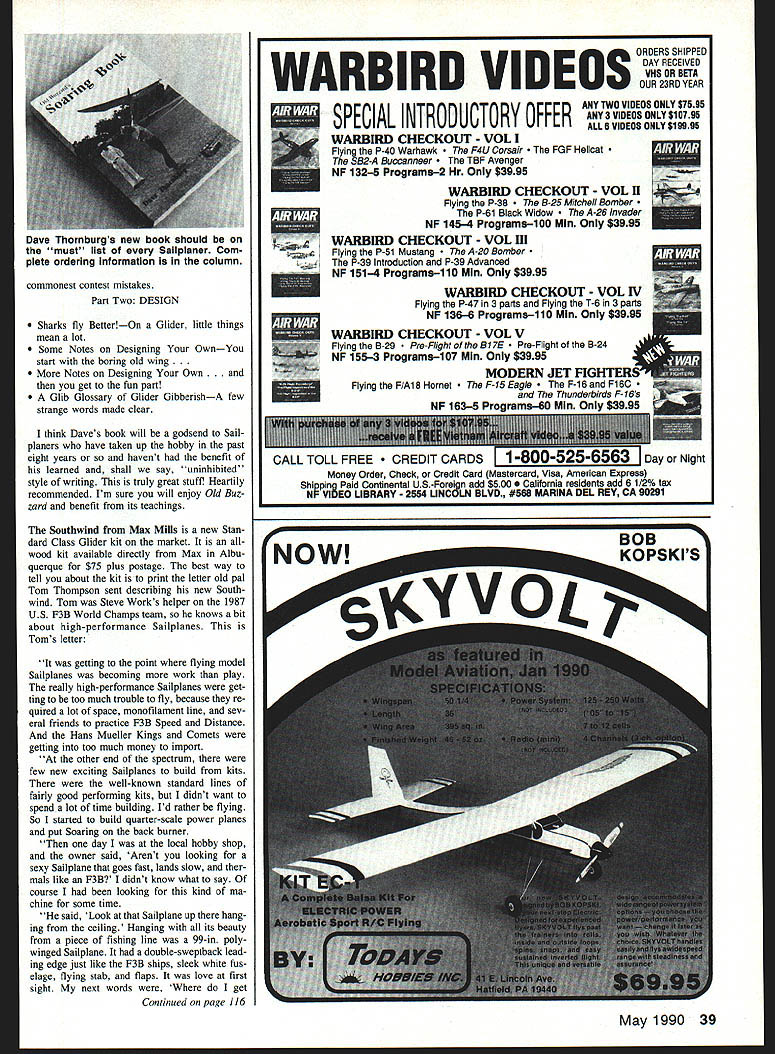
Readers of Jim Gray's R/C Soaring Digest may have noticed an ad for Precision Cores of Pleasanton, CA. The proprietor, Dave Acker, primarily supplies foam wing cores, but last year's Scale Stupe Fun Fly he was showing some of his Buzzard Series fuselages. The fuselages were so nicely made I asked Dave for more info. This is the story:
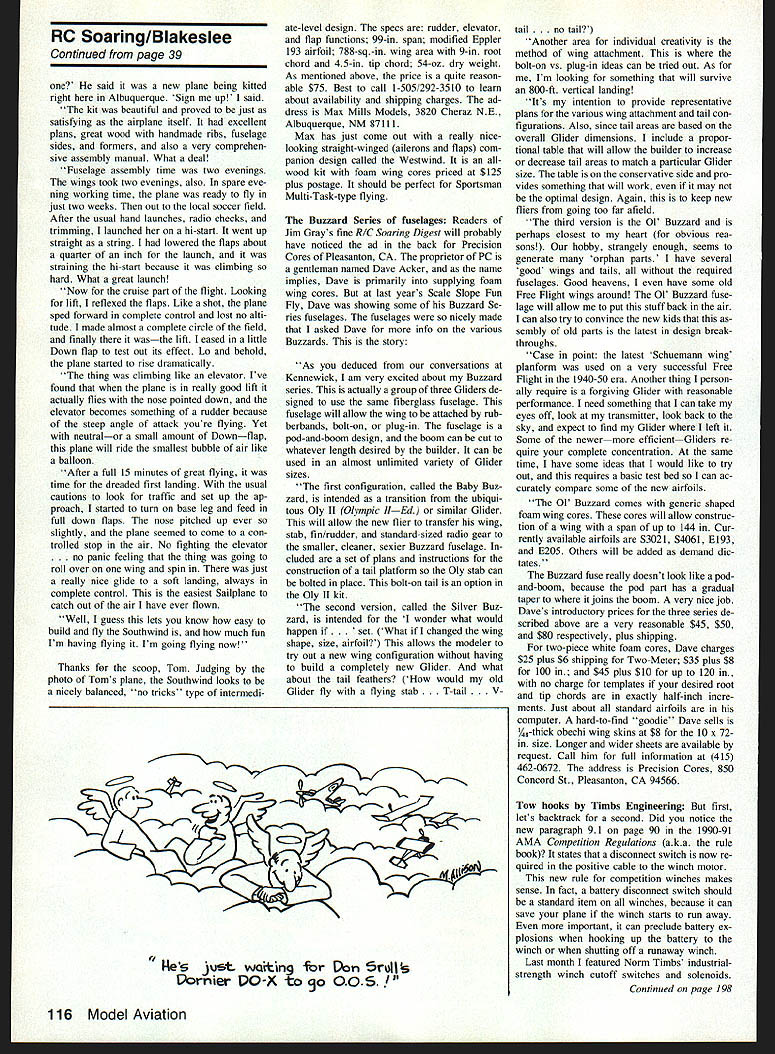
The Buzzard series is actually a group of three gliders designed to use the same fiberglass fuselage. The fuselage allows the wing to be attached by rubberbands, bolt-on, or plug-in. It's a pod-and-boom design and the boom can be cut to whatever length the builder desires. It can be used with a wide variety of glider sizes.
The three configurations:
- Baby Buzzard
- Intended as a transition from the ubiquitous Oly II (Olympic II) or similar glider. This allows the new flier to transfer wing, stab, fin/rudder, and standard-sized radio gear to the smaller, cleaner Buzzard fuselage. Included are plans and instructions for construction of a tail platform so the Oly stab can be bolted in place. The bolt-on tail is an option in the Oly II kit.
- Silver Buzzard
- Intended for experimentation: changing wing shape, size, airfoil, and tail configurations (flying stab, T-tail, V-tail, etc.). Also allows trying different wing-attachment methods (bolt-on vs. plug-in). The idea is a test bed for creative modifications while keeping the fuselage common.
- Ol' Buzzard
- Allows use of many "orphan parts"—old wings and tails without matching fuselages. Useful for resurrecting older designs and providing a forgiving glider with reasonable performance. Includes generic-shaped foam wing cores allowing spans up to 144 in. Available airfoils include S3021, S4061, E193, and E205; others can be added.
Dave includes representative photos of various wing-attachment and tail configurations and a proportional table for determining tail areas to match a particular glider size. Prices (introductory) for the three fuselage versions are $45, $50, and $80 respectively, plus shipping.
Foam core pricing (two-piece white cores):
- Two-Meter: $25 plus $6 shipping
- 100 in.: $35 plus $8 shipping
- Up to 120 in.: $45 plus $10 shipping
No charge for templates if desired root and tip chords are in exactly half-inch increments. Most standard airfoils are on Dave's computer. He also sells 1/4-inch-thick obechi wing skins (10 x 72 in.) for $8; longer and wider sheets available by request. Call (415) 462-0672. Address: Precision Cores, 850 Concord St., Pleasanton, CA 94566.
Tow Hooks by Timbs Engineering
Note: The 1990–91 AMA Competition Regulations added paragraph 9 on page 90 requiring a disconnect switch in the positive cable to the winch motor. A battery disconnect switch is wise on all winches to prevent runaways and battery damage.
Last month I featured Norm Timbs' industrial-strength winch cutoff switches and solenoids. Norm's switch and solenoid are each priced at $22 postpaid.
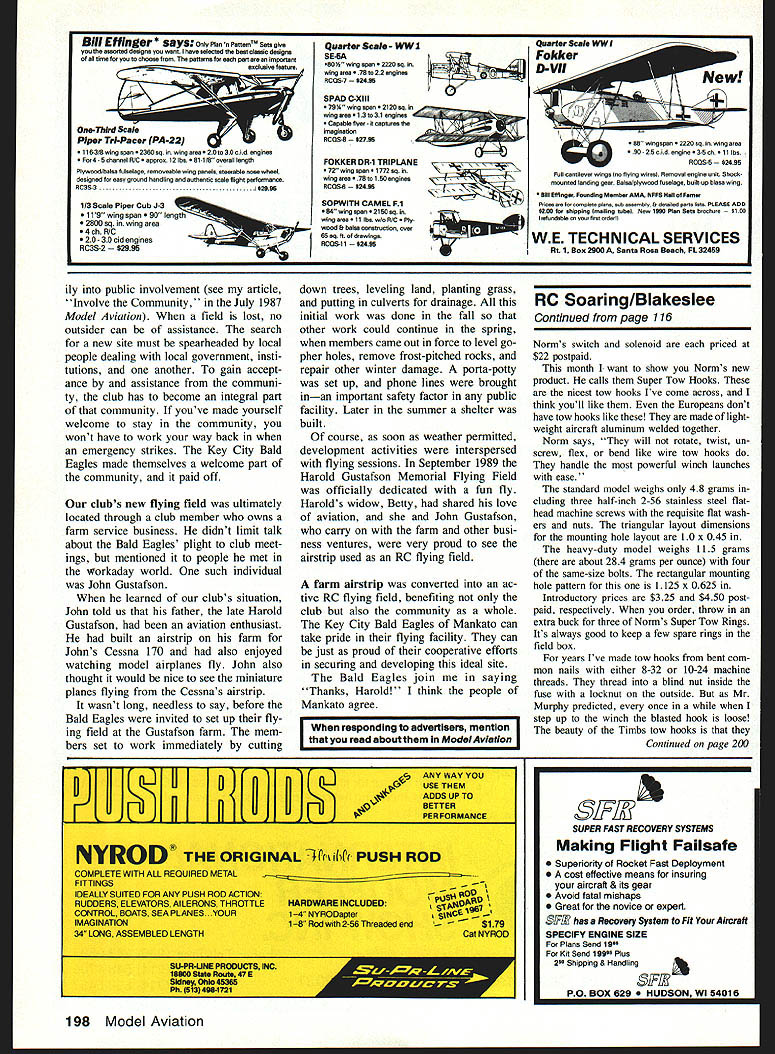
This month Norm's new product: Super Tow Hooks. These are lightweight aircraft-aluminum tow hooks welded together. Norm says, "They will not rotate, twist, unscrew, flex, or bend like two hooks do. They handle the most powerful winch launches with ease."
Details:
- Standard model: 4.8 grams (includes three 1/2-in. #2-56 stainless flat-head screws with washers and nuts). Triangular mounting-hole dimensions: 1.0 x 0.45 in.
- Heavy-duty model: 11.5 grams (use four screws). Rectangular mounting-hole dimensions: 1.125 x 0.625 in.
- Introductory prices: $3.25 (standard) and $4.50 (heavy-duty) postpaid.
- Optional: add $1 for three Super Tow Rings (good to keep spares in the field box).
Timbs tow hooks should not come loose or pull out. The standard hook should be fine for gliders up to the size of a Lovesong; the heavy-duty is meant for X-C ships and F3B planes that put a lot of load on the winch.
One potential snag is mounting the flat base to round-bottomed fuselages, especially fiberglass ones—use thin wedge-shaped shims and a 3/16-in.-thick plywood plate inside the fuse, three to four inches long and as wide as possible, to transfer the loads to the sides of the fuselage.
Order from Timbs Engineering, 1672 Los Osos Valley Rd., Los Osos, CA 93402 (Tel. 1-805/528-5420).
Soartech #8: "Airfoils, at Low Speeds"
I've been poring over this book for a couple of months. It's an impressive effort by Michael Selig, John Donovan, and David Fraser. The book is commercially printed, about an inch thick, and contains 398 pages. Most pages are coordinates, data, and graphs of 53 airfoils tested in the wind tunnel at Princeton University. Actual reading material is about 55 pages, with half explaining the test methodology.
Modelers will find "Comments on Airfoils" most interesting; the authors discuss important characteristics relative to other airfoils. Other sections discuss stall behavior, trips and surface roughness, trailing-edge thickness, and surface waviness and contour accuracy.
One key point on the Quabeck HQ2/9: "The differences between the nominal HQ2/9, RG15, and S2048 are small. Moreover, these differences are of the same order as the differences between the nominal airfoils and the models of the HQ2/9, RG15, and S2048 actually tested." In short, most modelers can't build wings accurately enough to tell the difference between airfoils of similar design—the "airfoil of the month" quest is largely physiological. Still, there's enough material here to keep a soarers' club busy for years.
Soartech #8 can be ordered from Editor/Publisher Derek Stockley, 1504 North Horseshoe Circle, Virginia Beach, VA 23451. Cost: $15 U.S. and Canada, $20 overseas, postpaid. A great bargain for sailplaners.
Sailplane Design Computer Program
The Sailplane Design program is another bargain for sailplaners who own an IBM PC or clone. It's produced by David Fraser (coauthor of Soartech #8). Version 3.0 added all the Princeton data; the latest (November '89) is 3.2.1, which has VGA graphics, plotter support, and additional stored airplane designs.
Version 3.2 is $35 (U.S. and Canada), $37 elsewhere, on either 5.25- or 3.5-inch disks. Version 3.1 owners can be updated at no charge; version 3.0 for $6; earlier versions for $12. Write to David B. Fraser, 1335 Salyton Dr., Maple Glen, PA 19002.
Some New Events and Items of Interest
- Hand-Launch Speed: Joe Wurts has been flying a neat contest—50-yard course (Base A to Base B and back), best try in a two-minute window counts. The CD used a "last try counts" rule, which favors a gambler's choice strategy.
- Sportsman Multi-Task (SMT): Santa Maria ran an SMT contest in December, won by Joe Wurts. SMT is intended as a middle ground between AMA Thermal Duration and F3B. It encourages participation and pilot improvement without forcing F3B-style equipment and procedures. CDs should not run SMT "just like" F3B.
- Slope Racing: Steve Birchner suggested Slope racing F3F-style as a way to get into slope racing without being overwhelmed by the pros. John Dvorak of the South Bay S.S. is forming an association of slope-racing fliers on the West Coast to establish a championship series with races from San Diego to the Bay Area. Possible major sites: Torrey Pines and Davenport. Contact John Dvorak, 1638 Farrington Ct., San Jose, CA 95127 (tel. 408/259-4205).
- Northeast Sailplane Products (NSP): A new mail-order business run by Sal DeFrancisco, Stan Eames, and Jay Kempf. NSP provides a catalog of over 70 kits and a wide selection of radio and accessories, with reviewed and test-flown kit descriptions. Contact Sal at 16 Kingman Lane, Williston, VT 05495 (tel. 1-802/658-9412).
Dawn-to-Dusk Event
LeRoy Satterlee, Soaring editor of R/C Report magazine, proposes a Dawn-to-Dusk event in June or July: open the field one day from 7:00 a.m. to 7:00 p.m. Each team has a clock running while their ship is aloft; the clock stops when the plane isn't flying. The object is to stay in the air the longest during the open period (or have the fewest launches). Each team keeps its own time and launch count.
Teams interested should contact LeRoy Satterlee, 1604 Huntington Rd., Waterloo, IA 50701.
(Continued on page 198)
Transcribed from original scans by AI. Minor OCR errors may remain.

