
Radio Control: Soaring
Byron Blakeslee 3134 N. Winnebago Dr. Sedalia, CO 80135
How Fred Flies (transcript by John Dvorak)
I've read "How Fred Flies." The Fred we're talking about is Fred Weaver of San Jose, CA. Fred was the third person to achieve LSF Level V, completing this rigorous test in 1976 (John Baxter and Steve Work got their Level V's in 1975). With the gliders and equipment available in those days, finishing Level V was an especially tough job—still is, for that matter!
Fred is a three-time winner of the Visalia Fall Soaring Festival, winning last year with his Airtronics Cumulic. With these credentials, Fred has built up a large store of soaring knowledge. The following is John Dvorak's report of a talk Fred gave at a club meeting, transcribed from a question-and-answer format.
Fred on detecting lift and sink:
- When you come off tow, the plane will either glide more or less straight, rise, sink, or turn one way or the other. Launching right into lift is wonderful but not common. You need a plan for the other outcomes.
- If the plane turns to the right by itself, it often indicates lift to the left pushing the plane away. Steer opposite to where the plane wants to go—turn left to get into the thermal.
- Sink is bad, but it indicates unstable air: some air is going up somewhere and some is coming down to replace it.
- A straight, normal glide with no bumps or turns usually means the air is stable and likely has no thermals. In that case cruise at your best glide and try to cover ground looking for lift.
What generates lift?
- Dark surfaces—parking lots, pavement, tarred rooftops—absorb heat and warm adjacent air, which can rise as thermals.
- Dark surfaces next to light-colored surfaces produce stronger thermals because of temperature differences (e.g., plowed ground next to planted crops).
- A uniform square mile of asphalt produces fewer thermals; the edges tend to have more activity.
Search patterns coming off tow
- Best pattern: cheat—go to where someone else is in lift if possible.
- If you don't have information, fly straight upwind and watch for drift. If the plane drifts to one side, it may be being sucked into sink; the thermal is likely on the other side.
- If a wingtip suddenly moves up, you're on the edge of a thermal—turn back toward it and try to find the core.
- If you go straight out and find nothing, don't fly straight back through the same air. Offset to one side and circle back; wind will help bring the plane back.
Signs when flying into the middle of a thermal:
- Plane speeds up, the tail rises, and control response improves. Whenever the tail goes up, you're in lift. Give a little rudder or aileron, pull back, and go.
- To make the tail more sensitive to lift, set the center of gravity as far rearward as you can safely fly it—without making the glider prone to stalling or too twitchy.
What happens in sink:
- The plane becomes sluggish and the tail may drop slightly. Never fly with tail down—push the nose down and speed through the sink. The air nearby is going up somewhere; fly another 100 feet or so and you should find lift.
- Never circle in sink, and never hold up elevator in sink—it's like putting on the brakes. Up elevator does not make a glider go up—only up air makes it go up.
- Rule: speed up in sink, slow down in lift. Sink indicates a thermal nearby; quickly turn through the sink to the side where the up is.
How to "core" a thermal
- Use your glider to identify thermal boundaries and form a mental picture.
- After your plane detects a thermal, don't immediately circle. Fly straight into where you think the thermal is until the plane stops going up—this identifies the other side.
- Turn back into the thermal in the upwind direction. If you hit sink while heading upwind, you've found another boundary—move your turn downwind slightly to get back in.
- Low thermals are small—act faster when low. Thermals drift with the wind (e.g., 5 mph wind = thermal drifts at 5 mph). Winds typically increase with altitude; thermals get larger higher up so you can widen your turns.
- Always drift toward the side of the circle producing the strongest lift to stay cored.
- If high in a thermal and you want another thermal because you're getting too far downwind, don't head straight back upwind (that is usually sink feeding the thermal). Instead head back upwind at an angle, left or right of the wind direction.
Launching into sink and other launch decisions
- If the wind picks up from behind while you're ready to launch, you may be launching into sink; the lift is downwind. Options:
- Launch quickly and chase the thermal downwind.
- Stand on the winch and try to zoom off at an angle toward the next thermal.
- Compromise (sandbagging is unsportsmanlike).
- The decision depends on thermal speed and your plane's performance. Know your options before you step up to the winch.
- A pleasant surprise is a breeze from behind that means a windlaunch directly into a thermal—the breeze is the air feeding into a thermal just in front of you.
- Rule: a sudden shift in breeze direction indicates a local thermal is present; the breeze blows toward the thermal.
Wave action
- On windy days you may find a fixed ridge or wave of lift. Making S-turns back and forth along the wave can sustain flight or lift your plane higher.
- The lift acts like slope lift from wind hitting a hill and may persist for a while, then suddenly disappear.
- Wave lift may be caused by surface features upwind, layered temperature differences, pressure, or a tree line.
Spot landings
- Make the same approach each time. Practice a downwind leg, then turn into the wind for a final straight-in approach.
- As wind picks up, shorten the downwind leg and turn sooner onto final. The starting point for the downwind leg is the "Initial Point" (I.P.).
- Stick with one easy-to-fly plane (polyhedral ships like an Oly II, Paragon, or Gemini). Keep flying the same plane and practice the same approach repeatedly to learn compensations for landing short or long.
Timed landings
- After mastering spot landings, learn timed landings. Have a buddy time your approach from the I.P. Once you know the time, be at that position at your normal airspeed at the target time—no watch needed.
- With newer airplanes that have higher wing loadings and have flaps and crow (Editor's note: "crow" refers to a glider configuration with the flaps partially raised), you can use flaps, crow, and elevator to govern time and speed on the approach and improve consistency.
Cross-country strategy
- Some pilots start high before entering a course; others enter sooner and search for lift along the course. Choice depends on thermal size and spacing and your plane.
- If thermals are large and widely spaced, starting high and riding them is usually best.
- If thermals are small and scattered, a lower, scrappier search often finds lift more frequently.
- Be flexible, watch other pilots, and adapt to the sky.
- In some regions (e.g., Taft, CA) high altitude can be achieved quickly; elsewhere it may be a waste to go very high—get decently high, then start.
- Use a plane you can trim and let fly (e.g., Paragon or big Sagitta). You need a ship that will thermal easily and doesn't require constant manual flying.
Thanks to Fred Weaver and John Dvorak for these tips. Please let me know if you'd like more instructional material.
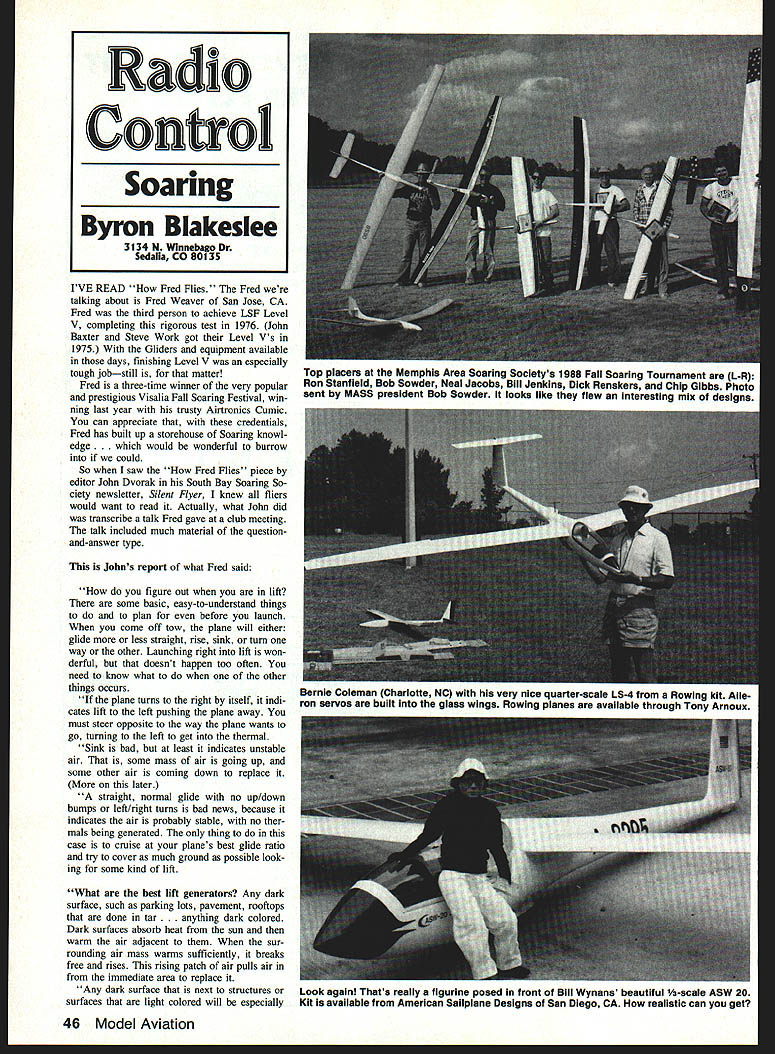
Scale kits and parts (Tony Arnoux, Miami)
A new catalog of scale kits is available from Tony Arnoux in Miami. His catalog includes about a dozen mostly quarter-scale-size sailplanes from German makers Roke, Röwing, and Wike. These gliders are top quality and fly beautifully. The catalog also includes a page or two of goodies for Scale enthusiasts.
- Send a $4 check (refundable with order) to Imparts, Inc., 1736 N.W. 82 Ave., Miami, FL 33126.
Competitors in F3B should note Tony's "real" business is importing German auto parts, so he is a good source of "legal" Bosch winch motors—often much lower than list prices. Write for details.
What the heck is this guy talking about? — Chuck Griswald (TOSS-Up)
The following article by Chuck Griswald appeared in the Thousand Oaks Soaring Society newsletter, TOSS-Up. Chuck explains some technical aerodynamics in a visual way.
Chuck on technical reading and approach:
- He collected references (Martin Simons' Model Aircraft Aerodynamics, material from Ed Olds, a Savoire(?) sent by Herb Skolsky, and Princeton papers) and decided to condense the information into a practical summary of terms and visualizations.
Definitions and concepts
- Reynolds number:
- Rn = (Air density / Viscosity) × Velocity × Length
- For practical use: Rn = 6,360 × Velocity (ft/sec) × Length of chord (ft)
- Reference: 88 ft/sec = 60 mph; 44 ft/sec = 30 mph
- Example: a 10-inch chord wing (0.833 ft) flying at 30 mph (44 ft/sec) produces Rn ≈ 233,000. Higher Rn approaches full-scale behavior.
- Visualize the flow as "grains of sand" on the wing: more grains (higher speed or chord) gives behavior closer to full-scale.
- Boundary layer:
- The layer of air affected by the wing surface.
- Laminar boundary layer: visualize many thin sheets sliding past each other—low drag but separates sooner and reattaches later, if at all.
- Turbulent boundary layer: visualize fine sand tumbling grain over grain—thicker than laminar but sticks to the surface longer and is harder to detach.
- Transition zone: where boundary layer changes from laminar to turbulent or detaches.
- Bubbles:
- When the boundary layer detaches at low-pressure regions (around the thickest part of the wing), a stagnant "bubble" forms, increasing drag dramatically. As angle of attack increases, the bubble can break, the layer may not reattach, and a stall occurs.
- Attached vs Detached:
- Attached: boundary layer stays on or parallel to the surface.
- Detached: boundary layer separates; it may reattach (forming a bubble) or not (leading to high drag or stall).
- Ramps: some airfoils include ramps to keep the boundary layer attached or to help reattachment. At low Reynolds numbers common in RC, ramps may cover much of the upper surface and are not always visible.
Hysteresis
- Hysteresis: a property changed by an external agent does not immediately return to its original state when the agent is removed.
- High-lift hysteresis (leading-edge stall): as AOA increases to just before stall, mark that point. Increase AOA a bit more and stall. On recovery, the AOA must drop below the original mark before the wing flies again—bubble breaks at the leading edge.
- Moderate-lift hysteresis: as AOA increases, drag rises (feeling like spoilers) without speed change; further up-trim may restore flying before final stall. In this case, the bubble reattaches toward the trailing edge, causing high drag. As AOA increases, the bubble's trailing edge moves forward and drag decreases—until higher AOA leads to leading-edge stall again.
- Some airfoils (e.g., Eppler sections used on Sagitta) are designed to stay laminar and reduce drag, but they can exhibit adverse hysteresis. A turbulator strip (small strip of tape) trips laminar flow into turbulent flow, increasing drag slightly but keeping the boundary layer attached longer and delaying bubble formation.
- On full-size aircraft, Rn is so high that rivets and seams naturally trip turbulent flow. On RC gliders with Rn below ~1,000,000, the air is "more viscous" relative to the model, so laminar flow persists over imperfections. To turbulate a wing, a piece of trim tape 0.010 in thick by 1/8 in wide usually works.
Chuck closes with humor and an invitation for more high-tech discussions.
Masters of Soaring report (March 1990)
The Masters of Soaring contest is limited to top fliers (LSF Level IVs and Vs and Nats winners). The March 1990 Masters was hosted by Silent Wings Soaring Association (SWSA) in West Covina, CA and directed by Pete Olsen. The site was a school surrounded by homes, a hospital, and factories. Launch equipment was Brawn winches and retrievers; they worked flawlessly during 14 rounds.
- Contest design: a mix of flight times and landing tasks. The first landing task was a 4 ft × 20 ft runway divided into five scoring squares (20, 30, 40, 30, 20). The other landing used the standard 25-foot tape with a 100-point max.
- Winds were calm most of the time with light but easy-to-find lift.
Notable entrants and equipment:
- Brian Agnew (age 24) from Florida flew a 3.5-meter Phoenix kit with an ATCRS-modified Airtronics Module radio.
- Don Edberg, Joe Wurts (Falcon 880), and eventual winner Bob McGowan (Falcon 880) were among the leaders.
- Airtronics Vision and ATCRS-modified 7SPs were common radios. Geminis and Paragons were also used.
Incidents:
- Two crashes: Rich Garner's Cheetah destroyed after an elevator pushrod failure and flutter; Brian Agnew's Phoenix inverted-dove from ~100 ft in the last round, possibly due to a battery failure—he still finished ninth despite a zero on his last landing.
Top 10 results:
- Bob McGowan, 1,000 pts. (Falcon 880)
- Terry Koplan, 997 pts.
- Joe Wurts, 996 pts. (Falcon 880)
- Chris George, 994 pts. (Hyperlan)
- Don Edberg, 991 pts. (Quattro)
- Craig Fogors, 986 pts. (original design)
- Larry Jolly, 986 pts. (Polly Two-Meter)
- Fred Weaver, 983 pts. (Falcon 880)
- Brian Agnew, 982 pts. (Phoenix)
- Keith Kindrick, 978 pts. (original design)
The 1991 Masters may be in Florida. Suggestions for landing tasks (half-circle scoring, etc.) are under consideration. The SWSA and CD Pete Olsen were commended for a well-run event.
F3J announcement (Thermal Duration Gliding)
- F3J is a provisional FAI class for Thermal Duration Gliding. The first FAI-sanctioned F3J contest will be the BARCS-sponsored Interglide in Warwick, England on July 21–22, 1990.
- To be recognized as a world championship, there must be several (roughly five) contests within a region counted—this requirement has been a challenge for other classes.
- F3J gives thermal specialists a chance at FAI recognition alongside F3B multi-task flying.
- Contact for the Interglide: Sam Hitchcock, 7 Wren Heights Close, Lakin, Nr Warwick CV35 0AZ, England (tel. 0926-651511). Non-British pilots are needed for FAI recognition; organizers may supply a glider and tow team if necessary.
- Note: F3J rules specify hand towing with a 150-meter line. Hand towing is common in Britain but rare in the U.S.; input from those experienced in hand towing is requested.
Transcribed from original scans by AI. Minor OCR errors may remain.

