
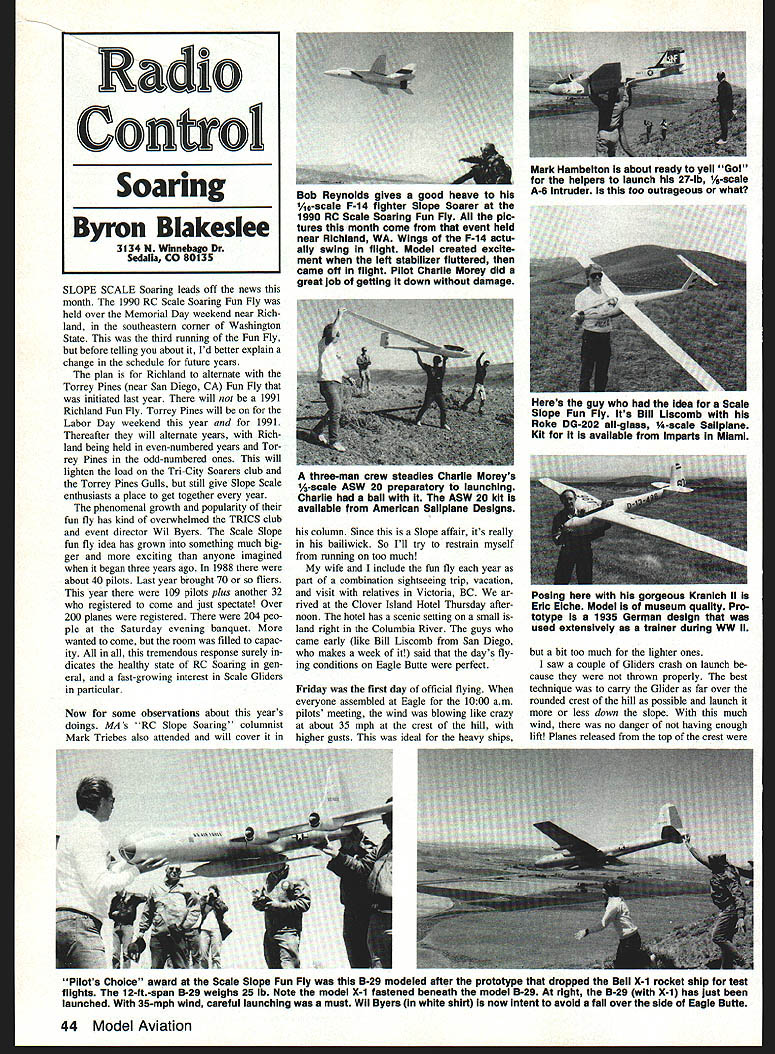
Radio Control: Soaring
Byron Blakeslee 3134 N. Winnebago Dr., Sedalia, CO 80135
SLOPE SCALE Soaring leads off this month's news. The 1990 RC Scale Soaring Fun Fly was held over Memorial Day weekend near Richland in the southeastern corner of Washington State. This was the third running of the Fun Fly. Before describing the event, here's an important change to the future schedule.
The plan is for Richland to alternate with the Torrey Pines (near San Diego, CA) Fun Fly that was initiated last year. There will now be a 1991 Richland Fun Fly. Torrey Pines will be on for the Labor Day weekend this year and for 1991. Thereafter they will alternate years, with Richland in even-numbered years and Torrey Pines in odd-numbered ones. This will lighten the load on the Tri-City Soarers club and the Torrey Pines Gulls, while still giving slope-scale enthusiasts a place to meet every year.
The phenomenal growth and popularity of the Fun Fly has overwhelmed TRICS event director Wil Byers. The Scale Slope Fun Fly idea has grown into something much bigger and more exciting than anyone imagined when it began three years ago. In 1988 there were about 40 pilots. Last year brought about 70 fliers. This year there were 109 pilots plus another 32 who registered to come and spectate. Over 200 planes were registered, and 204 people attended the Saturday evening banquet. The room was filled to capacity. All in all, the tremendous response indicates the healthy state of RC soaring in general and a fast-growing interest in scale gliders in particular.
Arrival and Friday flying
My wife and I include the Fun Fly each year as part of a combination sightseeing trip, vacation, and visit with relatives in Victoria, BC. We arrived at the Clover Island Hotel Thursday afternoon. The hotel has a scenic setting on a small island in the Columbia River. Those who came early, like Bill Liscomb from San Diego (who makes a week of it), reported perfect flying conditions at Eagle Butte that day.
Friday was the first day of official flying. At the 10:00 a.m. pilots' meeting on Eagle the wind was blowing hard — about 35 mph at the crest, with higher gusts. This was ideal for the heavy ships, but a bit much for the lighter models. I saw a couple of gliders crash on launch because they were not thrown properly. The best technique in that wind was to carry the glider well over the rounded crest and, if possible, launch more over the top than down the slope. With that much wind there was no danger of not having enough lift.
Meanwhile the heavy-ship fliers, especially the power-scale brigade, were having a ball. There were quite a few outrageous models.
Pilots' Choice — B-29 and Bell X-1
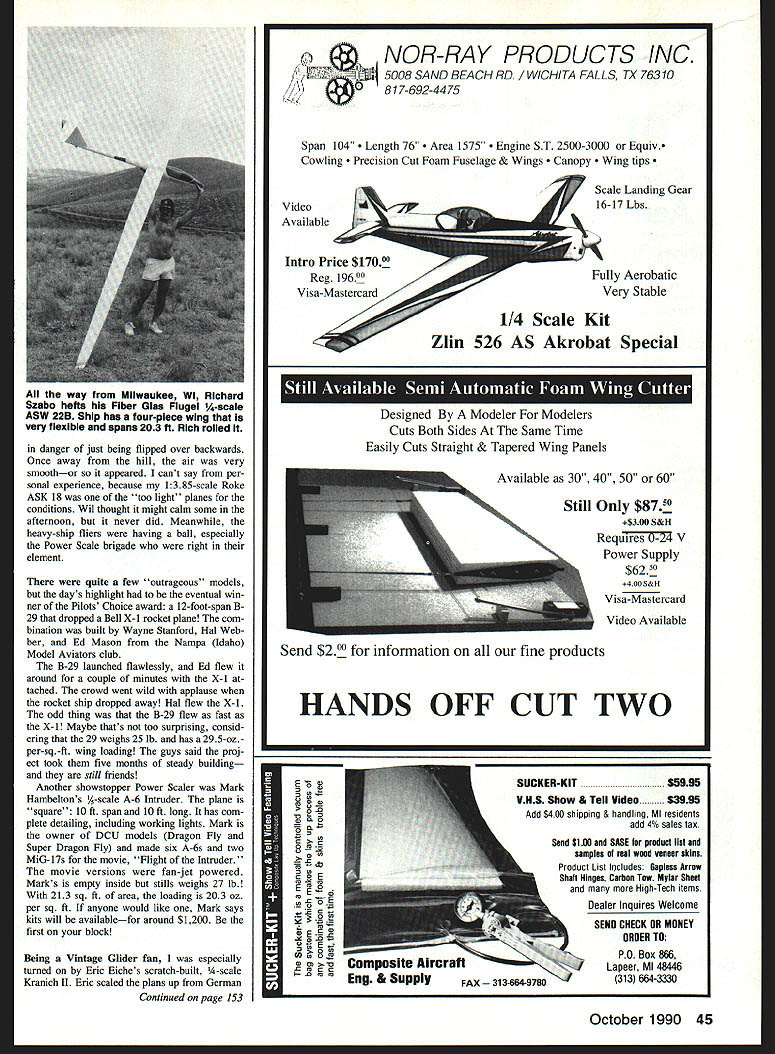
The day's highlight and eventual winner of the Pilots' Choice award was a 12-foot-span B-29 that carried a model of the Bell X-1. The combination was built by Wayne Stanford, Hal Webber, and Ed Mason of the Nampa, Idaho Model Aviators club. The B-29 launched flawlessly; Ed flew it for a couple of minutes before the X-1 detached, to great applause. Hal then flew the X-1. Oddly, the B-29 actually flew as fast as the X-1 that day — perhaps not surprising considering the B-29 weighed about 25 lb and had a high wing loading. The project reportedly took five months of steady building.
Another showstopper power scaler was Mark Hambleton's 1/5-scale A-6 Intruder. The plane is about 10 ft. span and 10 ft. long, with complete detailing including working lights. Mark, owner of DCU Models (Dragon Fly and Super Dragon Fly), built models for the movie Flight of the Intruder. His A-6 is empty inside but still weighs about 27 lb; with 21.3 sq. ft. area, the loading is roughly 20.3 oz. per sq. ft. Kits should be available later (Mark estimated about $1,200).
Scale sailplanes
There were several fine scale sailplanes as well. Charlie Morey handled a potentially damaging in-flight flutter when the left stabilizer on one of his ships fluttered loose; he got his models down without damage. Bill Liscomb brought a Roke DG-202 all-glass 1/4-scale sailplane kit available from Imparts in Miami. Charlie Morey also showed a 1/5-scale ASW 20 (kit available from American Sailplane Designs). Eric Eiche posed with his gorgeous, scratch-built 1/4-scale Kranich II — a museum-quality model of the 1935 German trainer. The workmanship on Eric's Kranich II was flawless; it was perhaps the finest scale glider I’ve seen. The Kranich was too light for Friday's conditions and had zero flights, so he wisely saved it for another day.
Once away from the hill the air appeared very smooth — at least not for my 1/3.5-scale Roke ASK 18, which was too light for the conditions. Wil hoped things might calm in the afternoon, but they never did. Despite that, heavy-ship fliers had a great time, and the event showed how much interest there is in both scale and slope soaring.
Friday evening social
Friday night there was a wine-tasting and hors d'oeuvres social sponsored by Charlie Morey, editor/publisher of Slope Soaring News. Everyone enjoyed talking gliders, although the large crowd made things a bit snug. Washington State vintages proved tasty, and there was a lot of interest in watching the videos shot during the day.
Saturday — Kiona Butte and the lull
Saturday dawned calm on the Columbia. Most pilots hung around the hotel waiting to learn which slope would be used: Eagle or Kiona Butte in Benton City. By mid-morning people headed for one slope or the other. I started for Eagle but met a convoy coming down the hill with the word: "Kiona." Later I heard some pilots stayed at Eagle and flew with winches.
Kiona is a big hill with a gravel road all the way to the top (Eagle is terribly dusty) but it doesn't have as large a landing area as Eagle. The breeze was light from the north; several veterans launched early. Bill Liscomb had his DG-202 ready, but about noon the light wind stopped altogether.
A few planes were airborne when the slope lift petered out. Pilots tried every trick to keep them high enough to land near the top, but they shrank to specks and finally landed at the bottom. Fortunately all landed without damage. Everyone used the lull to talk flying and inspect each other's projects.
Saturday banquet — Michael Seigel and "Seigel's Seven"
The special guest speaker at the Saturday evening banquet was Michael Seigel. He discussed his work at the Princeton wind tunnel and tests he, John Donovan, and David Fraser performed from August 1986 through January 1989. The results were published by Herry Stokely as SoarTech 8, "Airfoils at Low Speeds." Michael also presented his "Seigel's Seven Special Secrets" on glider design. His quick summary:
- Pick a good airfoil for the type of flying the glider is intended for and stick to it. Try only minor variations as you become familiar with it.
- A wing on a pylon (like Rich Spicer's Synergis) is more efficient than one cut into the fuselage.
- Use fully sheeted wings, because the airfoil shape is truer.
- For wingtips, a half-crescent shape with the top surface shaped to a sharp edge (like a trailing edge) is best.
- A small outer wing panel tipped up about 3 to 5 degrees is beneficial (as on the Falcon 880).
- Use a straight, sharp trailing edge.
- Use a springy wing joiner so the joiner acts like a shock absorber; gusts have less effect and the plane is easier to fly.
Following Michael's talk was a huge door-prize drawing. Everybody got something. Major donated prizes included three JR Max radios from Hobby Dynamics and a Multiplex radio from Beemer R/C West. Other prize donors included the organizations listed below.
Door-prize donors:
- Ace R/C
- Aerospace Composite Products
- Model Airplane News magazine
- Airtronics
- American Sailplane Designs
- B2 Streamlines
- Banzai Enterprises
- Beemer R/C West
- Flying Models magazine
- Cliff Hanger Models
- Combat Models
- Composite Structures Technology
- Coverite
- Futaba
- Hobby Dynamics (JR Radios)
- Hobby Lobby
- Kookaburra
- Lone Star Models
- Precision Cores
- R/C Soaring Digest
- R/C Model Builder magazine
- Robbe Model Sport
- Satellite City
- Scale Model Research
- Scale Glider Components
- Sig Manufacturing
- Slope Scale Models
- Slope Soaring News
- Top Flite Models
- Tower Hobbies
- Triton Models
- Viking Models
- Vinylwrite Custom Lettering
- Windspiel Models
Sunday and closing
Sunday was partly rainy in the morning. My wife and I left to continue our trip to Canada, so we didn't stop at either slope. Wil reported that there was flying in the afternoon on the south side of Kiona. Weather is part of the game in soaring — bad weather is a bummer, but it makes you appreciate the perfect days.
Manufacturers and dealers on hand
Manufacturers and dealers attending the Fun Fly deserve special mention. They come because they enjoy flying and because this event keeps them tuned into what's happening in soaring.
- JR Radios (Tom Kikuchi) — Tom has supported the Fun Fly since its inception and was showing JR's new 347 computer radio. It's positioned competitively with the Airtronics Vision radio.
- AMS Imports (Arnold Wratschko) — Brought nicely made German kits, scale and nonscale. For AMS flyers and price lists send a large SASE to AMS Imports, 110 U.S. Wells Ave., Reno, NV 89502 (tel. 1-800/752-7733).
- Beemer R/C West (Boo Boomer) — Sent a stack of Multiplex catalogs. The German-made Multiplex MC 3030 radio is very sophisticated and popular in Europe. The Multiplex DC 600 model (121–137 in. span) is also popular with scale-slope fliers. English Multiplex catalogs are $6 from Beemer R/C West, 17253 E. Falcon Dr., #3, Fountain Hills, AZ 85286 (tel. 1-602/837-0117).
- Viking Models U.S.A. (Jerry Slates) — Fiberglass fuselages, scale and nonscale. Jerry produces 10 scale and eight nonscale fuselages with excellent workmanship. For a catalog send a 45¢ stamp to Viking Models, 2026 Spring Lake Dr., Martinez, CA 94553. Also consider a subscription to R/C Soaring Digest ($17/year).
- Windspiel Models (Pete Bechtel) — One of the people who got the Fun Fly going; specializes in slope-flying big scale ships and imports Fiber Glas Flugel kits from Germany (catalog $2.50). Glas Flugel availability has been limited due to a factory move; write Windspiel Models, Box 2121, Coeur d'Alene, ID 83816 for current availability.
- DCU (Mark Hambleton) — Mark did a beautiful job on his huge A-6 and produces quality fiberglass kits. DCU, 156 S. Anaheim Unit C, Anaheim, CA 92805 (tel. 714/535-6969).
- American Sailplane Designs (Gary Anderson) — A Richland regular and source for many American-made glider kits. Catalog $3. American Sailplane Designs, 2626 Coronado Ave., #89, San Diego, CA 92154 (tel. 1-619/575-5133). Gary also sells glider lapel pins and other items.
- Slope Soaring News (Charlie Morey) — Charlie is very active on the slope and publishes SSN, a monthly mini-magazine covering everything about slope flying. Subscription $15.95/year. SSN, 2601 E. 19th St., #29, Signal Hill, CA 90804 (tel. 1-213/494-3712).
Synergy III product review (Pat Kelly)
In the South Bay SS newsletter's June issue Pat Kelly wrote a product review of the Synergy III. The Synergy III comes nearly complete and requires finishing plus installation of radio and servos. It was developed by Rich Spicer and Richard Tiltman, both with F3B experience.
Pat's key points:
- He enjoys building but prefers to avoid foam and fiberglass work; the Synergy III reduces that burden while offering modern performance.
- The plane is aimed at modelers comfortable with ailerons and flaps and designed for modern computer radios with dual mixed flap and dual mixed-aileron channels. If your radio uses single channels you may need reversed servos, electronic reversals, or linkage kludges.
- Flying impressions: initial flights without flaps showed great speed and penetration; with flaps the launch and handling improved. Dropping flaps at high speed caused a pitch-up and stall, so camber adjustments were suggested. With slight camber the Synergy thermals well and is responsive at cruise. Rudder helps turns and uncoupled mixing can cause issues.
- Cost considerations: the introductory price ($525) may seem high, but when compared to hidden costs of other high-end kits and build time, durability and performance make it a reasonable value.
- Overall: Pat liked the kit and considered it an excellent, relatively painless way to enter performance sailplane flying.
Thanks to Pat Kelly for the review. Club newsletters show more fliers discovering that F3B-designed ships are fun to fly and competitive in club thermal contests.
New items and tapes
Videotapes are increasingly popular for building and flying information. Two tapes mentioned:
- "Building the Falcon 800" from Denny Darnell's Model Construction Videos — a two-hour tape showing wing construction options (HB cell over white foam cores; carbon fiber and glass surfaces with vacuum-bagging; or balsa over foam). It is especially useful for Falcon kit builders and for anyone learning advanced building techniques.
(End of report.)
Transcribed from original scans by AI. Minor OCR errors may remain.

