
Radio Control: Soaring
Byron Blakeslee 3134 N. Winnebago Dr. Sedalia, CO 80135
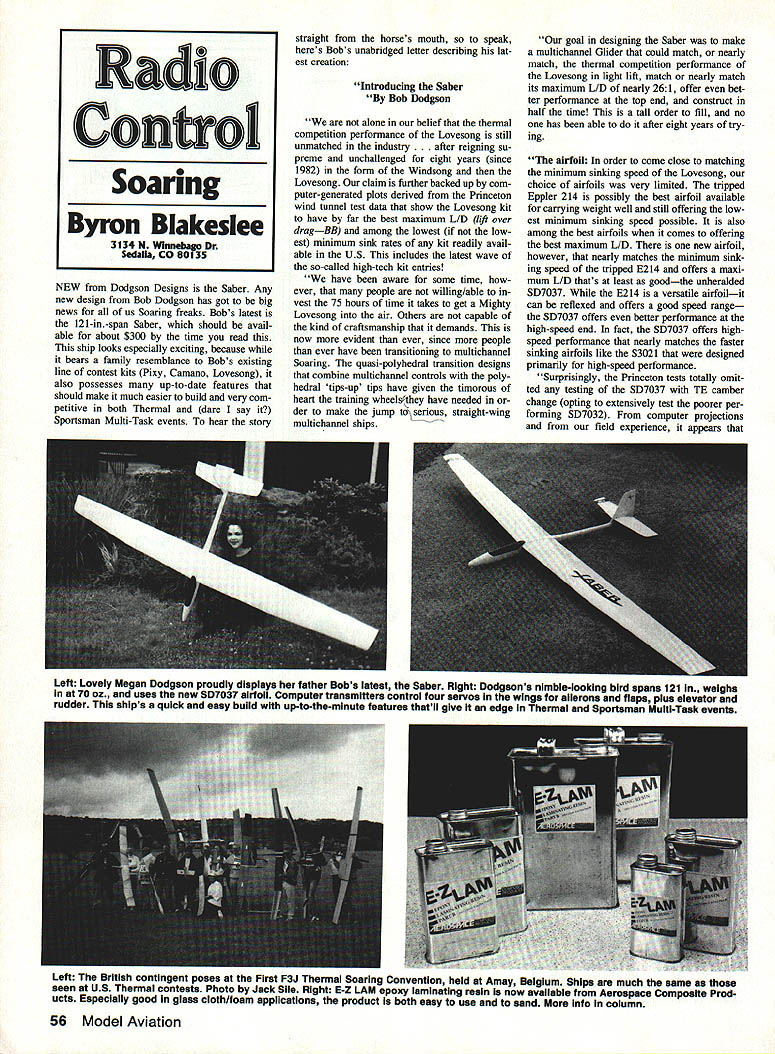
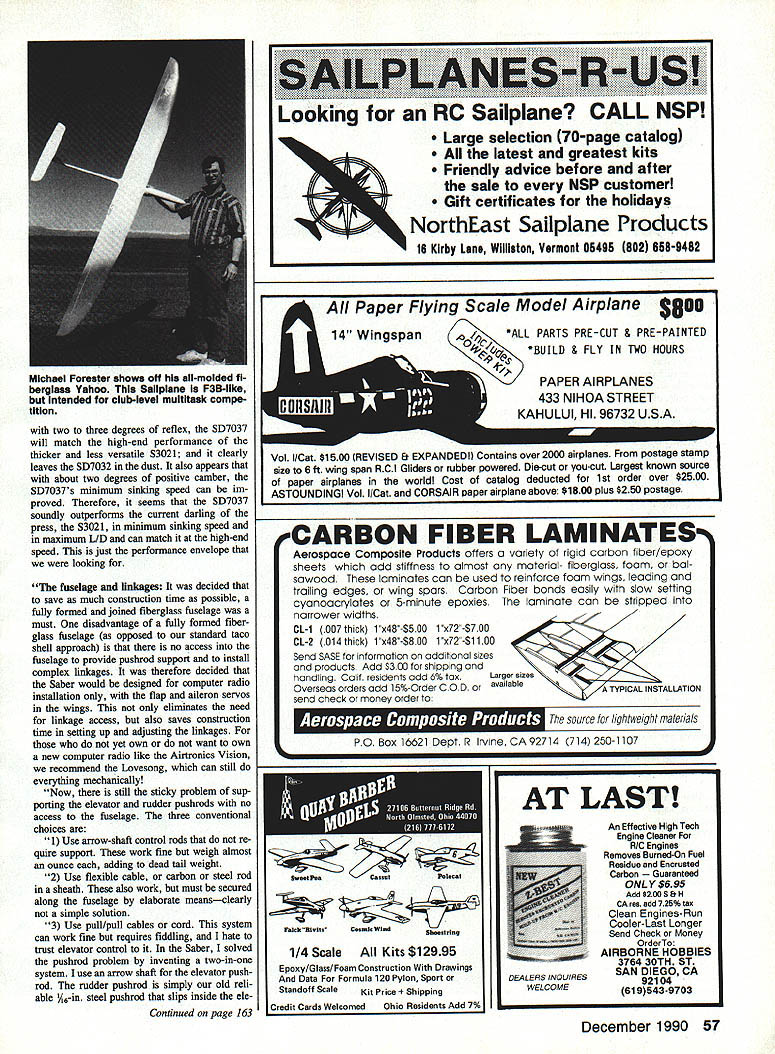
NEW from Dodgson Designs: the Saber
Any new design from Bob Dodgson is big news for soaring fans. Bob's latest is the 121‑in.‑span Saber, which should be available for about $300. While it bears a family resemblance to Dodgson's contest kits (Pixy, Camano, Lovesong), it also incorporates up‑to‑date features intended to make it easier to build and very competitive in both thermal and Sportsman multi‑task events.
To hear the story from the designer, here is Bob Dodgson's unabridged letter describing his latest creation.
Introducing the Saber
By Bob Dodgson
We are not alone in our belief that the thermal competition performance of the Lovesong is still unmatched in the industry after reigning supreme and unchallenged for eight years (since 1982) in the form of the Windsong and then the Lovesong. Computer plots derived from Princeton wind‑tunnel test data show the Lovesong kit to have by far the best maximum L/D (lift‑to‑drag) and among the lowest (if not the lowest) minimum sink rates of any kit readily available in the U.S., including the latest wave of so‑called high‑tech kit entries.
We have been aware for some time, however, that many people are not willing or able to invest the 75 hours it takes to get a Mighty Lovesong into the air. Others are not capable of the craftsmanship it demands. This is now more evident than ever, since more people than ever have been transitioning to multichannel soaring. Quasi‑polyhedral transition designs that combine multichannel controls with polyhedral "tips‑up" tips have given less‑confident pilots the training wheels they needed to make the jump to serious, straight‑wing multichannel ships.
Our goal in designing the Saber was to make a multichannel glider that could match, or nearly match, the thermal competition performance of the Lovesong in light lift, match or nearly match its maximum L/D of nearly 26:1, offer even better performance at the top end, and be constructible in about half the time. This is a tall order; no one has been able to do it after eight years of trying.
The airfoil: To come close to matching the minimum sinking speed of the Lovesong, our choice of airfoils was limited. The tripped Eppler 214 is possibly the best airfoil available for carrying weight while still offering the lowest minimum sinking speed possible; it is also among the best for maximum L/D. One new airfoil, however, nearly matches the minimum sinking speed of the tripped E214 and offers very good maximum L/D—the unheralded SD7037. The E214 is versatile (can be reflexed, offers a good speed range). The SD7037 offers better high‑speed performance and in fact nearly matches faster‑sinking airfoils like the S3021, which were designed primarily for high speed.
Surprisingly, Princeton tests omitted the SD7037; their TE camber change tests focused on the poorer‑performing SD7032. From computer projections and field experience, two to three degrees reflex in the SD7037 will match high‑end performance; about two degrees positive camber improves its minimum sinking speed. The SD7037 thus appears to out‑perform the current darling S3021 in the combination of minimum sinking speed, maximum L/D and high‑speed capability.
Fuselage and linkages: To save construction time we avoided a fully joined fiberglass fuselage that provides no access for pushrod support and complex linkages. Instead, the Saber is designed for computer radio installation with flap and aileron servos in the wings, eliminating the need for fuselage linkage access and saving construction time.
There still remains the problem of supporting elevator and rudder pushrods with no fuselage access. The three conventional choices are:
- Use arrow‑shaft control rods that do not require support. These work fine but weigh almost an ounce each, adding dead weight.
- Use flexible cable, or carbon or steel rod in a sheath. These work, but must be secured along the fuselage by elaborate means—clearly not simple.
- Use pull/pull cables or cords. This system works but requires fiddling, and I dislike trusting elevator control to it.
In the Saber I solved the pushrod problem with a two‑in‑one system: an arrow shaft for the elevator pushrod, and the rudder pushrod is our old 1/8‑in. steel pushrod that slips inside the elevator pushrod.
The wings
The entire wing can be built very quickly using UFO CA glues (they don't attack foam!), five‑minute epoxy and sheeting transfer tape or epoxy. UFO CA glue is a boon to foam wing construction.
Because the SD7037 is thin (about 9.2% thickness), we employed carbon fiber in the spar to achieve the desired strength. We used it so it becomes an integral, easy‑to‑apply part of the spar and does not complicate construction significantly. We provide accurately cut foam cores with spar slots precut.
To simplify building we provide full‑size obeche sheeting that can be applied in one piece to each side of each wing panel. Sheeting can be applied with the transfer tape method (as with our other kits) or with epoxy. No vacuum‑bagging or other tedious processes are required (though you may vacuum‑bag if you wish). The trailing edge stays straight and trouble‑free with the obeche sheeting; no further reinforcement is required.
Low‑temperature covering such as Solarfilm is used to cover the obeche. It goes on as easily as covering balsa‑sheeted wings. I put pinholes in the covering the same as when sheeting over balsa. The obeche is more stable, the TE stays truer, and the covering appears to require less maintenance. The wing surface comes out truer and smoother.
Finished wing panels with servos installed weigh only 15–16 oz. each. The Saber has a total wing area of 1,030 sq. in., a span of 121 in., and a total flying weight of about 70 oz. It carries 20 oz. of ballast with ease.
The wing planform is similar to the Maestro Megan and Maestro Caliente multichannel gliders kitted in the 1970s (a modified Schuemann planform). We used it to get the center of gravity more rearward on the fuselage and minimize nose weight. When designed properly, the Saber eliminates or reduces tip‑stall tendency and the need for tip washout.
The Saber uses a 3/16‑in.‑diameter wing rod to provide a rigid center section for good zoom launching with minimal flex. It is a solid‑feeling ship at all speeds.
The stab / rudder
The stab uses quick, easy foam‑core construction and the SD8020 airfoil. It is fully sheathed and requires no TE reinforcing. Stabs are lightweight, strong, and flutter‑free. The rudder is also foam core and sheathed with 1/32‑in. balsa.
Controls
- Flaps, ailerons, crow, full trailing edge camber (positive and negative), rudder and elevator.
- A computer radio is required. The plans show an Airtronics/SR‑type radio installation.
Performance
Light‑lift, low‑altitude thermalling ability is similar to the Lovesong—among the best. Maximum L/D is nearly as high as the Lovesong (over 25:1) compared with the tips‑up family of gliders with max L/D around 22:1. In wing camber reflex mode it has a top end similar to faster‑sinking gliders using the S3021. In short, the Saber combines a strong blend of minimum sinking speed, max L/D and high‑speed performance.
The rest
The kit includes highly detailed computer‑drawn plans and complete building instructions covering every aspect of construction down to wing servo mounting and electrical wiring hookup. Also included are clevises, pushrods, control horns, etc. We expect to include the fuselage‑to‑wing four‑pin plug and wiring for the wing servo extensions. Compared with what is included in other kits and the end product you receive, the Saber is a strong value.
Specs and handling notes: The Saber is beautifully proportioned, a nice handling size, and has modern features that should make it competitive for a long time. Its wing area is only five squares less than the Lovesong (which has a 132‑in. span). Aspect ratio is 14.2 (compared with 16.7 for the Lovesong). At 70 oz., wing loading is 9.8 oz./sq. ft.; adding 20 oz. of ballast raises it to about 12.6 oz./sq. ft.
The $300 kit price and the need for a computer radio will limit the market to serious contest flyers, but the Saber merits consideration for those seeking a competitive edge. The kit price is only about $70 more than a Lovesong. The Saber should build in less than half the time of a Lovesong, which makes it money well spent for many pilots. It is also likely to be a fun, sporty glider to fly—an important factor since you always do better with a plane you enjoy flying and practicing with.
Contact: Bob Dodgson, Dodgson Designs, 1230 Damon Road, Bothell, WA 98021. Tel. 1‑206‑776‑8067. Send two stamps for a brochure.
---
The SD7037 (per Selig, Donovan and Fraser)
To save you from pulling out Soaring '88 to read "Airfoils at Low Speeds," here is what the authors said about the SD7037:
"The SD7037 is a thinner, decambered SD7032. As would be expected, the drag is lower, the polar is shifted downward in lift, and the lift range is less. To increase the lift range, flaps would be useful.
"The relatively low drag at Cl near 0.3 offers good L/D performance, which together with lower drag at high lift should make the SD7037 a popular airfoil, especially for thermal duration flying. For weak thermal conditions common to East Coast soaring in the U.S., the SD7037 would make an excellent cross‑country airfoil, but flaps in this case are almost essential to improve high‑speed, between‑thermal performance. As with the SD7032, trips are of little benefit."
---
The Yahoo
Michael Forester designed the Yahoo a couple of years ago while a member of the South Bay club in California (he now lives in Salt Lake City). Though it is an F3B‑type ship, he designed it more for club‑style multitask events than for top‑level F3B competition. (However, the model is too heavy for Sportsman Multi‑Task class flying.)
The Yahoo has a 114‑in. span, weighs 96 oz., and has a 14.5‑oz./sq.‑ft. wing loading. Its unique feature is all‑molded fiberglass construction—the top and bottom pieces of the wings are molded and then joined. The only other U.S. sailplane constructed this way is Rich Spicer's Synergy III.
Mike used design rules similar to Mark Allen (designer of the Falcon 880) and selected the S3021/S3014 root/tip airfoil combination that Mark uses on the Falcon. The Yahoo is similarly sized but heavier and has a T‑tail with fixed stab and elevator.
Mike's Yahoo was in Denver at a club F3B contest and impressed everyone with its high‑quality construction and nice flying characteristics. For those interested, Mike is prepared to make copies for about $650. You receive a professionally built, completely finished airframe except for installation of pushrods and radio. Contact: Mike Forester, 11165 Yarrow, Highland, UT 84003. Tel. 1‑801‑756‑7763.
---
The First F3J Thermal Soaring Convention
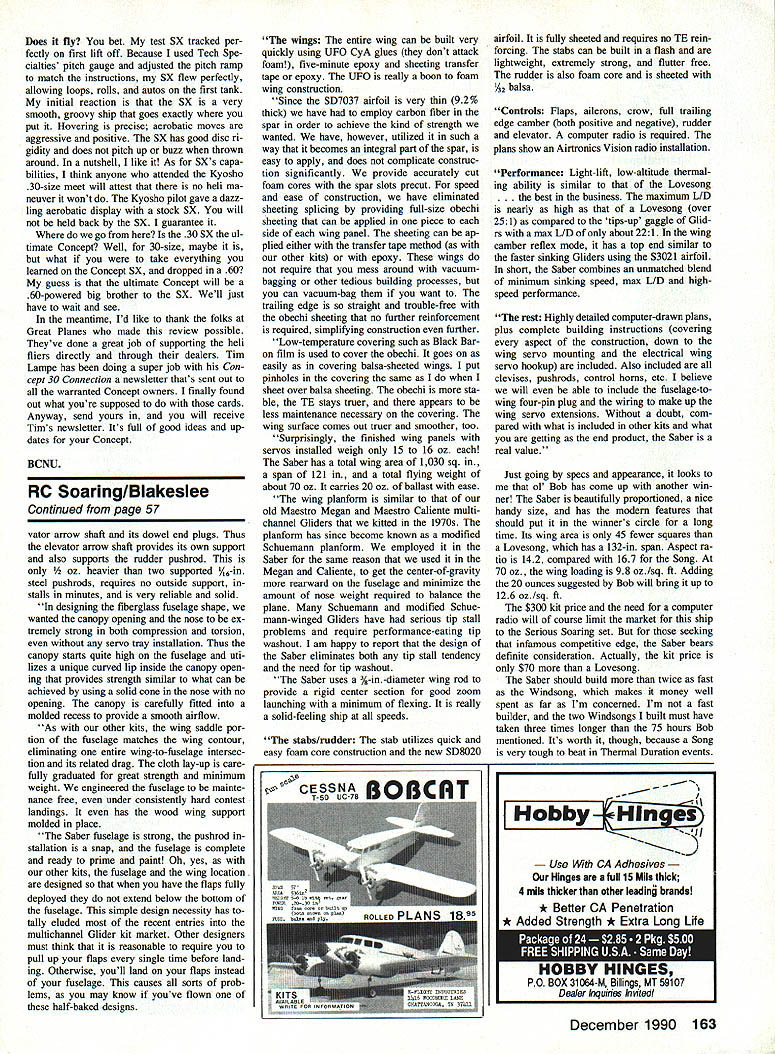
The F3J contest in Amay, Belgium (late June) was billed as the first F3J Thermal Soaring Convention. F3J is the provisional FAI event for thermal duration (F3B is the established multi‑task event). A number of international contests must be held before F3J can be accepted as an official FAI event.
The provisional event used Percentage Scoring rules developed by BARCS (British Association of RC Soarers). Typically six or eight pilots fly against each other in a 10‑minute "slot." The slot winner (longest flight plus landing points) gets 1,000 points; others receive a percentage of that based on relative flight times. A notable rule difference that may concern U.S. pilots: only one landing is allowed in the slot.
Jack Sible (a 27‑year USAF veteran who stayed in Suffolk, England) attended and filed this report:
We had a fantastic time in Belgium, flying against several countries. The Belgians were excellent hosts. Saturday had only marginal breezes and was a nightmare for some, but there was great thermaling to be seen. Conditions changed to Sunday’s 35‑plus mph winds and severe thunderstorms—conditions the Brits handled well. After changeable and trying weather, the Brits took six of the 12 flyoff places, followed by two Dutch, three Czechs, and one German. Markus Koepe won.
It was a superb competition with lots of information generously exchanged, unbeatable hospitality, and some of the toughest weather we have seen. Above all, the spirit of cooperation and friendliness was there.
Jack also sent a short theory on hand towing; we'll print it in an upcoming column because hand‑towing practice will be needed if F3J becomes widely adopted. It appears likely that F3J will be supported by enough countries to become an official FAI World Championship event in a couple of years. Who’s ready to start practicing to make the first U.S. F3J team?
---
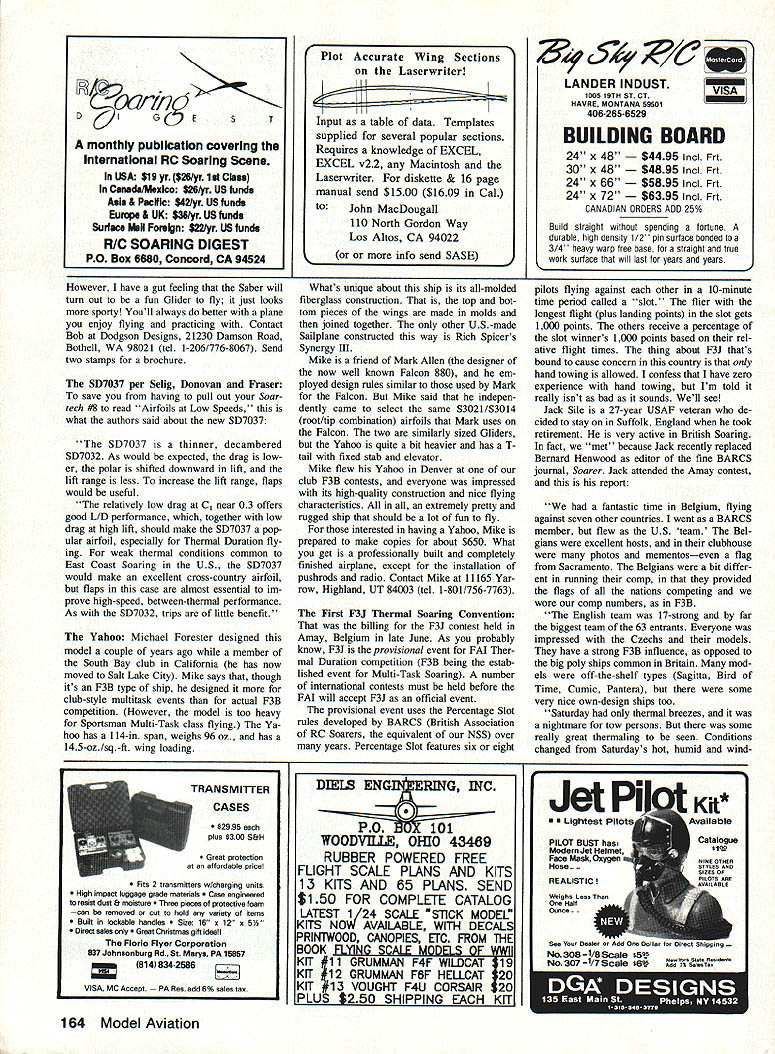
E‑Z LAM
Aerospace Composites recently introduced E‑Z LAM, a two‑part (2:1 mix) epoxy laminating resin formulated for model aircraft use. It's blended for lightweight fiberglass, carbon fiber or Kevlar cloth. Low viscosity allows it to flow into the cloth weave; it cures to a hard, high‑strength gloss finish and sands easily. It's ideal for use with 58‑oz. fiberglass over balsa‑formed foam wings or 2‑oz. cloth over bare molded Styrofoam "bagged" wings. E‑Z LAM may be thinned with 99% isopropyl alcohol for spray applications.
That's Aerospace's news release. How does it really work? Joe Wurts says it's the best epoxy resin he's used. Joe builds a lot of planes, so his endorsement carries weight.
---
Sometimes you encounter thermals that don't follow the rules—wind shears, inversion layers and turbulence can all affect them. I once saw a dust‑devil thermal go straight up, make a sharp 90° turn, then another 90° and go straight up again. How could we ride something like that? Watch soaring birds. They are masters at finding lift; by watching them you can learn a lot.
We amateurs need to thank designers like Bob Dodgson (and Fred Weaver) for sharing their knowledge—well, maybe not all of it! It speeds up the learning process when you know what to look for as you steer your glider around the sky. But a warning: don't relax when you find a thermal. Every time I relax, the glider seems to fall like a stone and I wonder where the thermal went!
To prove Bob knows what he's talking about, this season he has won both the NCS Masters contest and the big Western States contest in Modesto with his Falcons. Bob says his Falcon 800 (100‑in. span) flies as well as his 112‑in. Falcon but is easier to land. In California, flying often comes down to hitting the spot consistently.
Practice, practice—that's the secret!
Transcribed from original scans by AI. Minor OCR errors may remain.

