
Radio Control: Soaring
Byron Blakeslee 3134 N. Winnebago Dr. Sedalia, CO 80135
The Vertigo
The Vertigo from Agnew Model Products is the newest hand-launch glider (HL) on the market. Brian Agnew spends hours at a time throwing HL gliders, so he knows what works. He sent the following information on his latest creation.
- A Vertigo prototype placed second at the Nats last summer. Brian and Ed Berton have been working on and refining the design for over a year; Brian is very pleased with the final product.
- Design goals: highest launching, best flying, simplest and most durable hand launcher available.
- Airfoil: Eppler 387. Wing area: about 380 sq. in.
- Construction: wings and stabs are foam-core with 1/32" sheeting. Stabilizer uses a NACA 009 section. The V-tail is light, clean, gives superior handling in turns, and looks good.
- Build and weight: Vertigo is fast to build and strong. Prototypes have come out between 13.5 and 14.5 oz., giving a wing loading of about 5 oz. per sq. ft.
- Radio/electrics: a 250 mAh battery pack is required; most receivers will fit without problem (the design was centered on the Vision eight-channel receiver). If the mechanical V-tail mixer shown on the plans is used, mini- or micro-sized servos are needed.
- Plans/kits: CAD-drawn plans. Kit price is $59.95, including shipping. For an extra $4.50, Agnew will pre-sheet the wings.
Order from: Agnew Model Products, 5625 Youngquist Rd., Unit #22, Ft. Myers, FL 33912; tel. 1-813-433-5910.
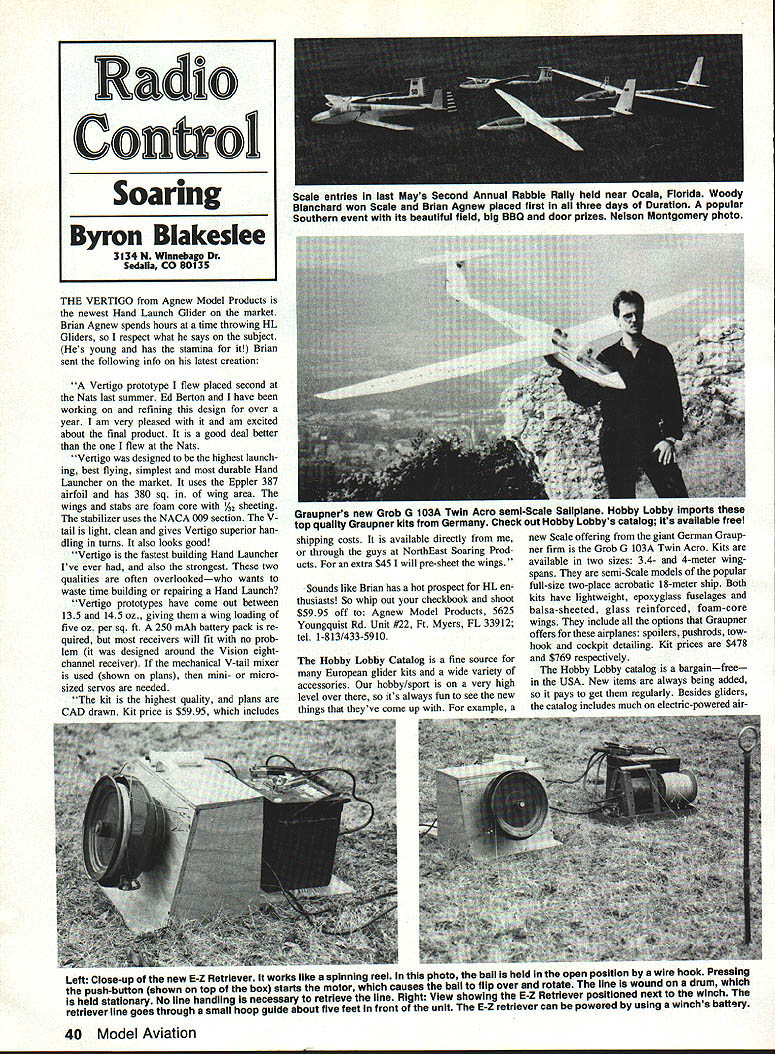
Hobby Lobby / Graupner — Grob G 103A Twin Acro
The Hobby Lobby catalog is a good source for many European glider kits and accessories. A new scale offering from Graupner is the Grob G 103A Twin Acro. Kits are available in two sizes (approximately 3.4 m and 4 m wingspan). They are semi-scale models of the full-size two-place acrobatic 18 m ship.
- Features: lightweight epoxy/glass fuselages, balsa-sheeted glass-reinforced foam-core wings.
- Options included: spoilers, pushrods, tow hook, cockpit detailing.
- Prices: about $478 and $769 for the two sizes.
The Hobby Lobby catalog is free in the USA; new items are added regularly.
The E‑Z Retriever (spinning-reel retriever)
Most retrievers wind line onto a bike-wheel style drum and often twist or tangle the line. Jim Harger developed the E-Z Retriever to address these problems. His design rewinds the line onto a spool exactly as it came off, preventing tangles.
From Jim Harger:
- The unit is lighter and smaller than typical bike-wheel retrievers (approximately 14 x 12 x 12 in., about 20 lb.).
- Operation is simple: pull back and hook the bail in the open position, launch, then push and hold the push-button switch after the glider releases from the towline until the line is returned (about 30 seconds). No manual handling of the line is required during retrieval.
- It uses an efficient permanent-magnet 12‑volt motor that can run off the winch battery. The spool can hold up to 2,000 ft. of 30 lb. test Dacron line (recommended). The spool is designed to keep line off the ground to reduce drag. Working parts are sealed; the box is plywood and includes storage for the switch, guide hoop, extra line, etc.
- Price: $300. 2,000 ft. spools of 30 lb. braided Dacron line: $20.
Jim Harger can be reached at: 1911 Wolcott Dr., Columbia, MO 65202; tel. 1-314-443-6708.
User feedback (Pete Vredenburg, Holmes, NY):
- The automatic bail mechanism eliminates pre-threading the line before launch; just throw down the line and press the button.
- Jim supplied a well-made line guide, hold-down lugs, eye pads, battery clamps, and a push-button switch with about six feet of cord.
- When used with a Sport winch, the retriever struggles a bit with lines over 1,000 ft.; Jim plans slightly more powerful gearing on some units for better torque with heavy lines or windy pilots.
- Pete finds the retriever a valuable part of his equipment and reports it has significantly increased the number of launches he can get in.
Caveats: The retriever is a big improvement but not foolproof. The retrieving line is light and can blow around in crosswinds; if the line hits the ground before being recovered, weeds may snag and cause breaks.
Beginner's Corner (Tony DiGirolamo — continued)
Last month Tony DiGirolamo began his story about getting started in RC gliders. He did the right things: joined a local club, met an experienced instructor, chose a trainer and radio, received construction help, and progressed to solo. This month Tony discusses stage two — becoming a contributing club member.
Tony's experience:
- He started helping with parking, registration, and timing at contests.
- His instructor (Bob Sowder) taught him how to put a contest together.
- Tony took on club safety responsibilities and wrote safety articles using a comical character who did everything wrong, then used those lessons positively.
- He became a Contest Director (CD); his first contest involved heavy rain and muddy conditions that taught him the value of careful planning and reviewing AMA rules.
Advice for new pilots:
- Get involved with a club and work with an instructor before buying or building anything.
- Have someone guide you through construction — plans can be unclear and experienced help saves hours.
- Ask the club to assign you an instructor for periodic checks and lessons; learn with building-block procedures.
- Read books on building and flying gliders; study thermal flying and landings, and have your instructor demonstrate.
- Watch experienced pilots to learn how they find lift and handle situations.
- When comfortable, do a supervised solo ("cold turkey") flight.
- Join the AMA and get involved; volunteer to help your club — many tasks don't require advanced skills but make the sport better for everyone.
Tony's Beginner's Corner will continue in future issues; reader feedback on regular coverage of this material is welcome.
Segelflug Bildkalender 1991
Annual reminder to order the German soaring calendar. It includes 12 full-color photos (48 x 29 cm) of mostly European full-size soaring scenes — excellent as contest prizes or shop/den display. This year's shots include a ULF-1 over the Wasserkuppe's Eagle monument and a 2-33 over Hawaii. The reverse of each photo explains the scene and points on the glider.
- Price: $14.95 plus $5 UPS within U.S.; $6 outside U.S.
- Order from: Aero Smithing, 4420 Darventury Court, Charlotte, NC 28226; tel. 1-704-365-0621.
NSS news
The National Soaring Society (NSS) has had membership and publication problems recently. Some members feel $15 is too much and that NSS doesn't do anything for them; others point out that the organization needs volunteers and participation to function.
Recent administrative changes:
- Secretary/treasurer: Robert Massman, Wilmington, OH. Administrative inquiries should be sent to: 282 Jodie Lane, Wilmington, OH 45177.
- New editor of Sailplane: Jim Burgoon, Emporium, PA. Jim plans to publish an issue of Sailplane in mid-November to detail changes and bring members up to date. He may be reached at 29 E. 5th Street, Emporium, PA 15834.
Gordon Jones (NSS District 8 VP) attributes recent problems to officer burnout and emphasizes the need for volunteers to keep the organization healthy.
Sportsman Multi-Task (SMT) update
SMT was introduced in 1989 to provide a middle ground between AMA Thermal and F3B competition. SMT includes Speed and/or Distance tasks in addition to Duration but at a reduced level from full F3B. Aircraft restrictions aim to keep true F3B ships out of SMT so pilots with classic ships can compete fairly.
- Initial aircraft rule: maximum glider gross weight 75 oz. This excluded most F3B ships, but experience showed smaller gliders with higher wing loading could dominate Speed tasks, favoring more experienced pilots.
- Based on feedback, the Board has been considering rule adjustments to better balance competition between Sportsmen and Experts (task scoring and ballast-change rules among possible changes).
Battery packs — interconnecting six‑cell packs
Six- and seven-cell packs are common because of their use in RC model cars. To make an 18-cell pack from three six-cell packs, using three pairs of ready-made connector leads is bulky and heavy. An alternative described here:
- Interconnect the three six-packs with short individual wires and wire nuts. This is neat, economical, small, light, and simple.
- An even simpler method is soldering the six-packs together into one large 18-cell battery; the author often prefers soldering.
- The wire-nut method allows quick changes in the field (e.g., switching between 12-, 14-, and 18-cell configurations).
- Battery output leads: one lead has a connector that mates with a system fuse; the other has a bare end and is wire-nutted to its mate in the system harness. A single Sermos connector (one example of a connector brand) would also work well and offers color options for easy identification.
Follow-up on this topic will appear next month. In the meantime, happy electric winter flying, everyone!
Transcribed from original scans by AI. Minor OCR errors may remain.

