
Radio Control: Soaring
Byron Blakeslee 3134 N. Winnebago Dr., Sedalia, CO 80135
U.S. F3B Team Fundraising
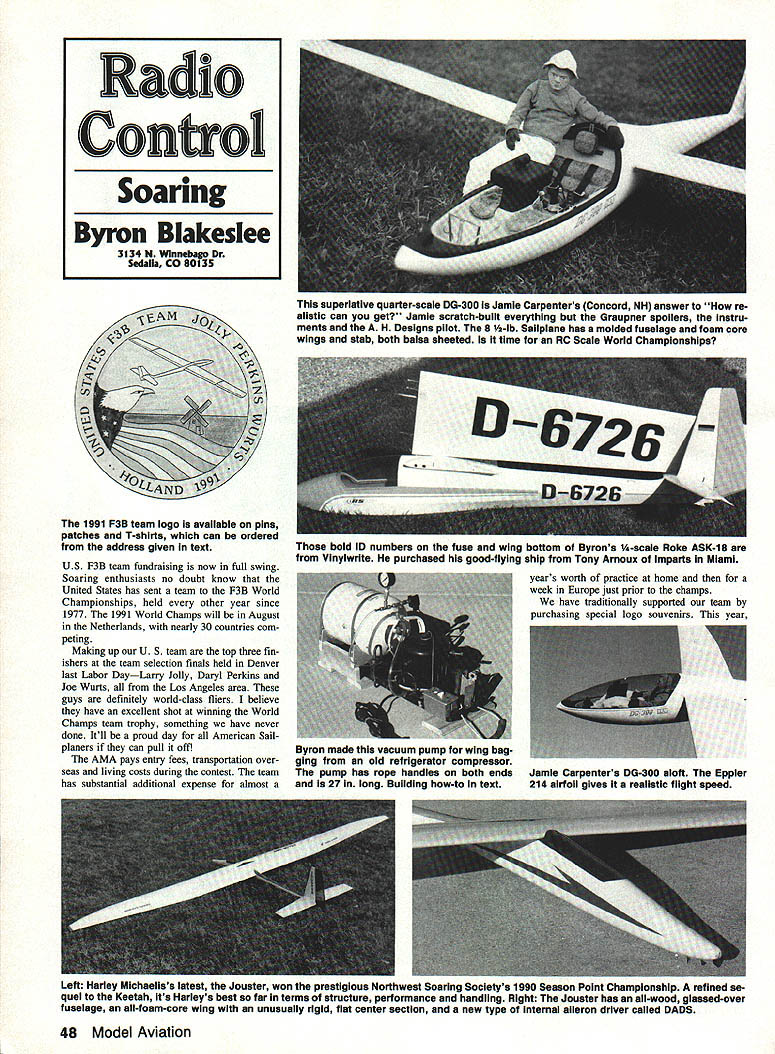
U.S. F3B team fundraising is now in full swing. The 1991 F3B World Championships will be in August in the Netherlands, with nearly 30 countries competing. The United States has sent teams to the F3B World Championships since 1977.
The AMA pays entry fees, transportation overseas and living costs during the contest, but the team has substantial additional expenses for nearly a year of practice at home and for a week in Europe just prior to the champs.
Please support the team by ordering special logo souvenirs or by making an additional contribution.
- Order address: USA F3B Team Fund, P.O. Box 3242, Lakewood, CA 91170-3242.
- Merchandise/prices:
- Pin: $2.50
- Patch: $3.00
- Pin-and-patch set: $5.00
- T-shirt: $12.00 (indicate T-shirt size)
- Additional contributions to the team fund are welcome.
Team status
Team Manager Randy Spencer reports that practices are going well. Speed and duration have been the early priorities; far-distance practice will begin soon. The team is looking for F3B events to attend early in the season to stay attuned to contest pressures.
Team members
#### Larry Jolly Larry began flying RC sailplanes competitively in 1979 and has won five Nats sailplane competitions in both Unlimited and Standard classes. He won the first F3H World cross-country sailplane championship held in South Africa in 1985, flying a model of his own design. Larry was a member of the 1989 U.S. F3B team that placed 10th at the World Championships near Paris.
He is known to modelers for LIMP Kit Manufacturing, which produces a line of top sailplane designs. Larry also works in the movie special effects field and has built and flown aircraft for films such as Die Hard, Flight of the Intruder, Miracle Landing and Airwolf. He is the helicopter columnist for Model Aviation and a contributing columnist to MAN magazine.
#### Daryl Perkins Daryl has been flying sailplanes since 1985 and was immediately drawn to slope racing for its need for speed. He became a premier flier on the slope-race circuit, winning the 1988 and 1989 Hans Weiss Memorial Slope Races (both classes) and the 1989 Nats Slope Races, along with numerous club and local races. Drawing on his racing experience, Daryl excels in F3B.
#### Joe Wurts Joe is a design engineer working on aircraft conceptual design at Lockheed Advanced Development Company. With a B.S. and M.S. in Aero Engineering, his professional training supports his pursuit of improved design and construction techniques for high-performance sailplanes. He has flown competitively since the early 1970s.
Selected accomplishments:
- Three-time winner of the International Slope Race
- Winner of the first Masters Hand-Launch event
- Winner of the 1989 Nats Hand-Launch event
- Winner of two consecutive cross-country events since 1983, with course records for each
- Holder of the FAI-certified world record and two national records for declared distance (141 miles from launch to landing)
All of Joe's wins were accomplished while representing United States Soaring in Holland.
Ordering reminder
The 1991 F3B team logo pins, patches, and T-shirts can be ordered from the address above. Don’t forget to indicate T-shirt size.
---
Making your own vacuum pump
Last month's column featured Frank Weston's article on vacuum-bagging wings. Frank noted that a vacuum pump can be made at little or no cost using a refrigerator compressor. Curious, I investigated and built a working pump from a junk refrigerator compressor. Below is a cleaned, practical account of that process and the parts and cautions involved.
#### How it works A refrigerator compressor increases pressure and circulates refrigerant through the condenser, expansion valve and evaporator. If you take the compressor alone, hook a hose to the inlet side and exhaust the outlet side, it will act as a vacuum pump. A perfect vacuum equals atmospheric pressure (about 29.9 inches of mercury, or 14.7 psi at sea level).
#### Safety and preliminary steps
- Have the refrigerant (Freon or similar gas) safely evacuated by a qualified service before dismantling the refrigerator.
- Save the starting relay and capacitor from the refrigerator; the contact thermostat usually isn’t needed.
- Expect common compressor faults: loss of refrigerant or burned-out motors. If the compressor valves are bad, you may not get a useful vacuum.
#### Sourcing a compressor
- Used compressors can sometimes be obtained from appliance repair shops or used-appliance dealers. Be aware many dealers salvage good compressors for refrigerator repair.
- New compressors run $150 and up; used ones might be available for much less if you locate junk refrigerators whose compressors still run.
#### Disassembly and fittings
- Hacksaw off the inlet and outlet pipes, saving as much tubing as possible.
- If present, remove mounting crossmembers or brackets as needed to extract the compressor.
- Some compressors have an oil cooler or a small filter canister near the inlet; retain these if useful.
- Keep any sturdy copper tubing (e.g., from an icemaker) for later connections.
#### Plumbing recommendations
- Use 1/4-inch vinyl tubing and plastic tees/Xs where possible — they’re cheap and seal well.
- If using copper tubing, prepare for brass compression tees and flare fittings where needed.
- Freon bottle valves commonly use a 1/4-inch flare fitting; if you lack a flaring tool, ask a supplier to flare a short piece for you.
- For gauges and switches, you’ll need pipe-threads-to-tubing adapters to mount them to a panel or tank.
#### Electrical connections and vacuum regulator
- The starting relay typically has three wires to the motor (including a capacitor lead for the starting winding). Retain the relay and capacitor.
- Cut and rewire the power cord with an on/off switch. Replace the refrigerator thermostat wiring with a vacuum switch controlling the starting relay.
- A subminiature adjustable vacuum switch is convenient. One source: Tom Overton, 1302 Arleen Ave., Sunnyvale, CA 94001 (note: parts availability and prices may have changed since this report).
- I bought a vacuum gauge from Grainger for about $8.
#### Assembly notes and troubleshooting
- Clean copper filings thoroughly if you hack or drill tubing—cotton swabs and tweezers can help remove debris from the inlet. Filings can damage the compressor if left inside.
- Mount the compressor securely; if original rubber mounts are awkward, use salvaged crossmembers to create a stable base.
- Pipe the vacuum gauge and switch solidly to the tank so they can be freestanding.
#### My results
- After assembly and wiring, the compressor-built pump reached a maximum vacuum of about 23 inches of mercury.
- I adjusted the vacuum switch so the pump turns off at 15 inches and comes back on at 13 inches—suitable for many vacuum-bagging tasks and safe for extruded foams (noting some foams require lower vacuum).
- The gauge held steady with the pump off, indicating no significant leaks. After the pump was off overnight there was still six inches of vacuum.
- The compressor ran quietly and did not expel oil from the exhaust in my setup. Some users recommend adding a shot of compressor oil into the inlet periodically.
#### Parts and approximate cost
- Used refrigerator compressor and extracted parts: variable (often from junk refrigerators)
- Vacuum switch (subminiature adjustable): about $30 (source cited)
- Vacuum gauge: about $8
- Misc fittings, tubing, panel, small hardware: variable
- Example total investment: roughly $56 (mostly for the vacuum switch) for my build
#### Final notes and caveats
- Refrigeration compressors are not designed specifically as vacuum pumps; longevity of a salvaged compressor is uncertain.
- A failure during a bagging cycle could be costly if foam core, carbon fiber, glass cloth and epoxy are inside the bag.
- If you’re uncertain about refrigerant handling, electrical wiring, or compressor condition, consult a professional.
- If anyone with refrigeration experience can explain the purpose of certain inlet/filter parts seen on compressors, author feedback is welcome.
I haven’t yet used the pump for bagging but am optimistic it will work. If you build one, take proper safety precautions and expect some trial and error.
Transcribed from original scans by AI. Minor OCR errors may remain.

