
Radio Control: Soaring
Byron Blakeslee 3134 N. Winnebago Dr. Sedalia, CO 80135
F3B World Championships and Fundraiser
THE 1991 F3B World Championships will be held in the Netherlands beginning August 24. Nearly 30 countries will compete for Individual and Team Championship titles. The U.S. F3B team pilots are Larry Jolly, Daryl Perkins and Joe Wurts. Team Manager Randy Spencer reports a fundraising raffle to help support the team.
Raffle and merchandise
- Raffle tickets: $10 each. Drawing scheduled at the Nats in July.
- First prize: round-trip air ticket to Holland to attend the World Championships.
- Other prizes: Airtronics Vision radio system; Airtronics Legend sailplane kit; Composite Structures Technology vacuum-bagging system; custom wing bags from American Sailplane Designs; plus many other items donated by major manufacturers.
- Team merchandise: T-shirts with team logo $12 (sizes S, M, L, XL, XXL); 1-inch enameled pins $3; 4-inch embroidered patches $5. Add 10% for shipping & handling.
Send checks for raffle tickets and merchandise (add 10% S&H) to: U.S.A. F3B Soaring Team Box 3242 Lakewood, CA 90711-3243
Randy: "We have been working on Speed and have started practicing Distance, using team and non-team members as rabbits, to get used to the competition again. It really helps to go against unknowns, although team practice is very competitive, as it should be."
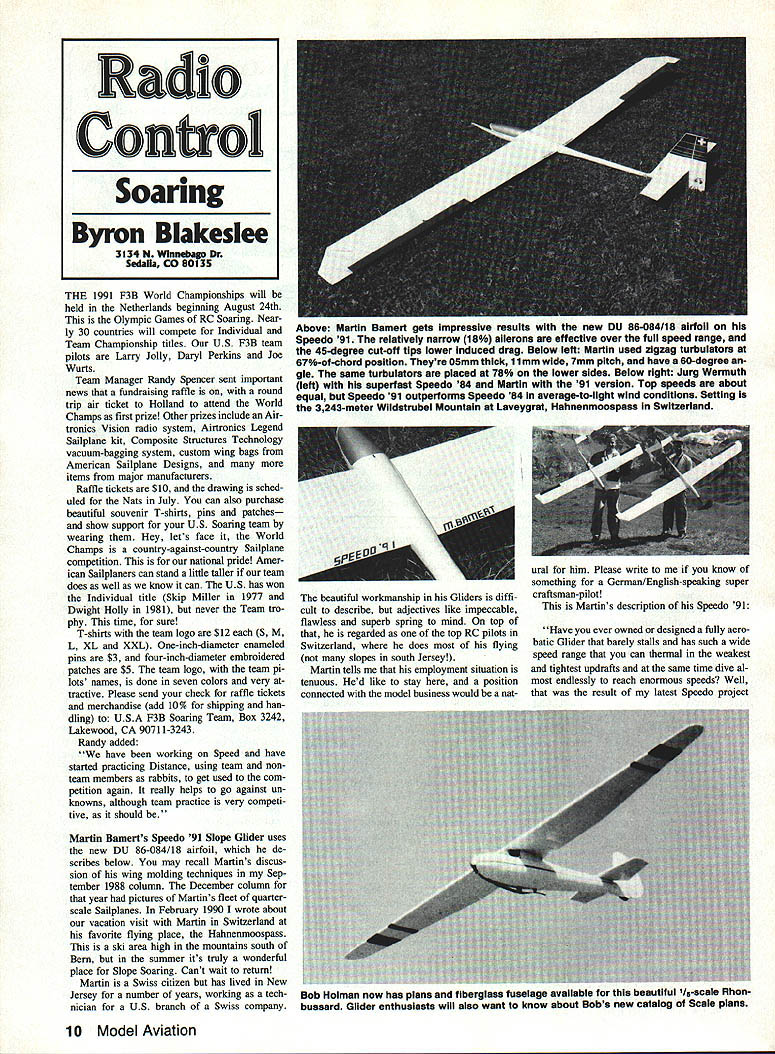
Martin Bamert — Speedo '91
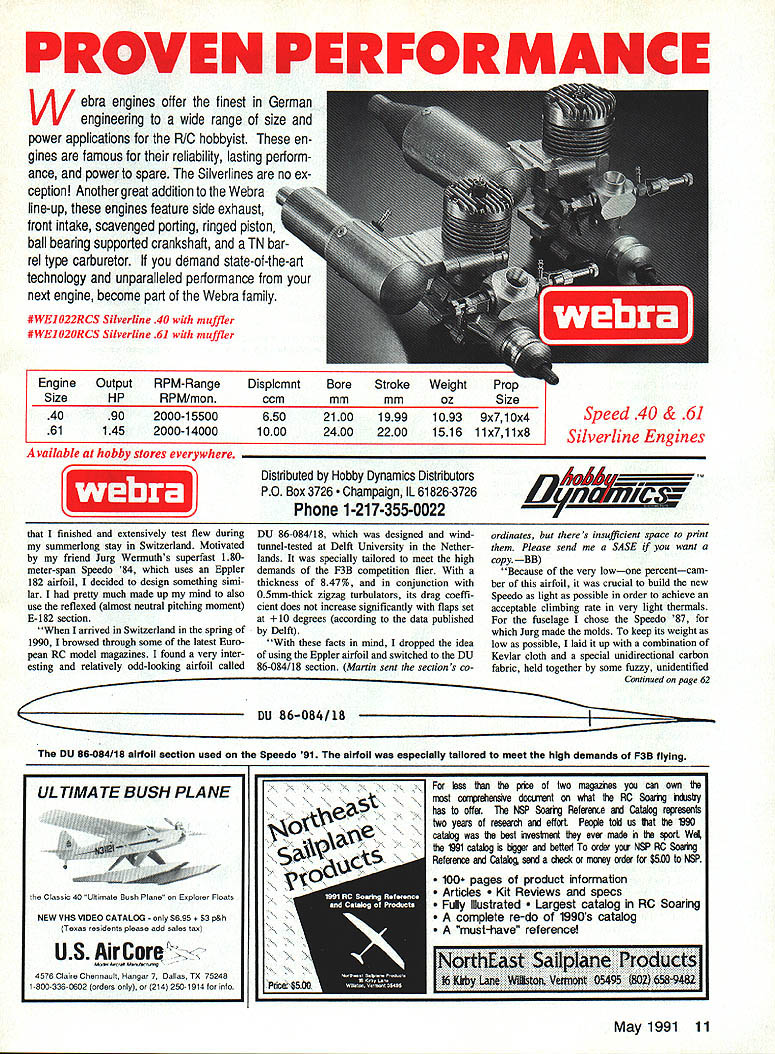
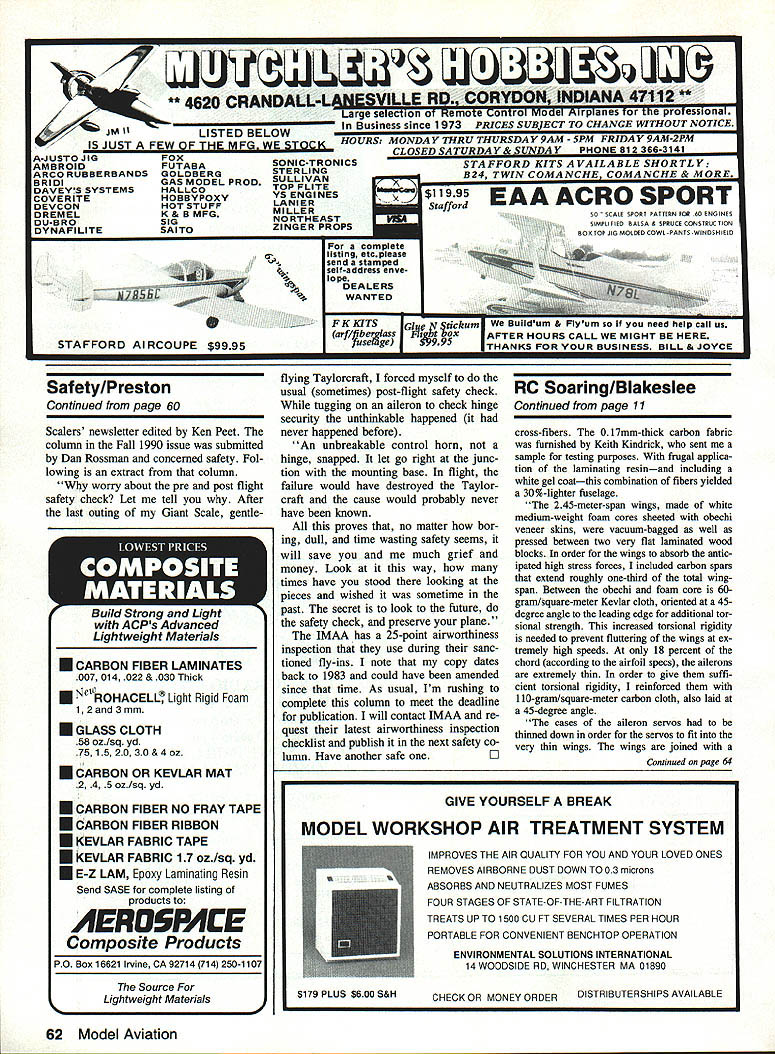
Martin Bamert (Swiss citizen, long-time New Jersey resident) finished and extensively test-flew his Speedo '91 slope glider during a summer stay in Switzerland. Martin is noted for superb workmanship and is regarded as one of the top RC pilots in Switzerland. He is seeking employment in the model business (German/English-speaking, skilled craftsman/pilot); contact me if you know of opportunities.
Design inspiration and airfoil choice
Motivated by Jürg Wermuth’s fast 1.80 m Speedo '84 (Eppler 182 airfoil), Martin initially considered a reflexed Eppler 182. While in Switzerland he found the DU 86-084/18 airfoil (designed and wind-tunnel-tested at Delft University, Netherlands) and switched to it. Key characteristics:
- Thickness: about 8.47%
- Very low camber (about 1%): required an extremely light airframe to retain climb performance in weak thermals.
- Works well with 0.5 mm zigzag turbulators; drag does not increase significantly with +10° flaps (Delft test data).
(Section coordinates were supplied by Martin — send a SASE to Byron Blakeslee for a copy.)
Construction
- Fuselage: Speedo '87 molds by Jürg; laid up with Kevlar cloth and unidirectional carbon fabric plus a fuzzy filler material to minimize weight.
- Control surfaces: glass-molded tail surfaces for warp-free, sharp trailing edges.
- RC controls: rudder, elevator, ailerons, flaps and air brakes. Flaps and air brakes were mixed with the aileron servos using a Multiplex 3030 transmitter.
- Estimated CG: ~38% chord; ~7 oz lead added to the nose.
- Weights and wing loading: without turbulators the model weighed 69.4 oz, wing loading 12.8 oz/sq ft. Adding 8.3 oz ballast in the wings increased wing loading to 14.4 oz/sq ft.
Zigzag turbulators (installation and specs)
Martin installed self-sticking zigzag turbulator tape to interrupt the laminar separation bubble and reduce bubble drag:
- Upper turbulator: placed at 67% chord.
- Lower turbulator: placed at 78% chord (lower surface).
- Turbulator specs: 0.5 mm thick, 11 mm wide, 7 mm pitch, 60° angle.
According to Delft data, these positions give the best overall performance improvement for this section.
Flight testing and characteristics
- Handling: Despite narrow ailerons (18% chord), they were effective across the speed range. The model is docile and hard to stall; excessive elevator input tightened the turn radius but did not lead to wing drop. Even deliberate stall attempts during landing showed atypical behavior—the model tended to keep flying in a straight path rather than abruptly stalling.
- Noise: At about 40 mph a high-pitched wing noise appeared; after installing turbulators it disappeared, replaced by a slight rustling audible only close by.
- Climb: Flaps set to 10° (via aileron-down camber) improved climb noticeably in thermals.
- Speed: After adding ballast the Speedo '91 attained top speeds comparable to Speedo '84, but felt slightly more controllable at high speed. High-speed turns were easy and very stable; tested successfully in winds up to 30 mph.
- Thermalling: Performs well in weak thermals by retaining energy and penetrating between cores; not a languid "cloverleaf" thermal performer due to narrow wing and sharp airfoil, but superior for average-to-light wind conditions and slope work.
- Overall: Good all-around competition design—excellent glide angle, solid and locked-in feel on the slope, good low-to-medium speed performance combined with strong high-speed capability. Martin considers the Speedo '91 forgiving and even suitable as a "perfect beginner's model" because of its uncritical behavior.
Notes and sourcing
- Zigzag turbulator tape: available from Hobby Lobby (catalog No. 17).
- Carbon fiber material source mentioned: Keith Kindrick (Aerospace Composites may carry similar material).
- Martin mentioned he is developing a triple-taper (Schuemann) wing version.
Bob Holman — Scale Plans and Rhönbussard
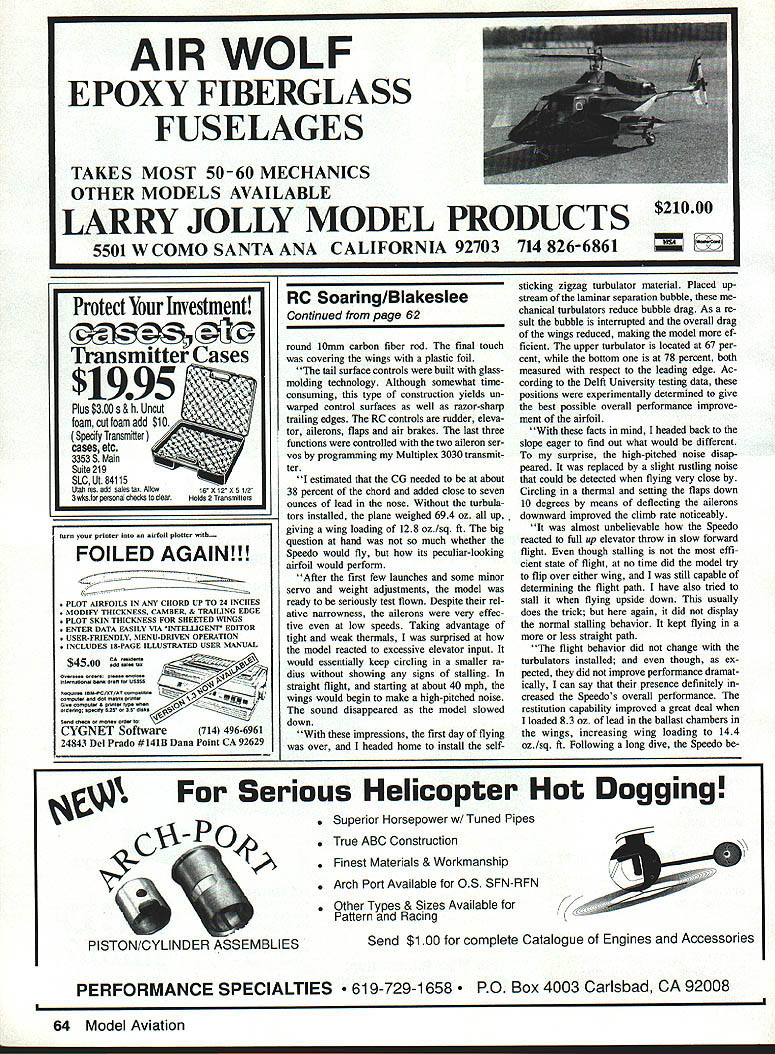
Bob Holman now offers plans and a fiberglass fuselage for a 1/6-scale Rhönbussard and has released a new scale plans catalog.
- Catalog: $2 postpaid; draws from British magazines (Radio Modeller, RCM&E, RC Model World), includes plans from Mike Smart, Richard Green and the German VTH plans. The catalog contains about 120 plans, price range roughly $10–$30+. A great reference for scale glider enthusiasts.
- Rhönbussard offerings: Mike Smart plans for an all-built-up and a glass-fuselage version. (One listing cited a 1/5-scale Rhönbussard with 112.6-inch span; check catalog listings for details.) Example price: plans and fuselage ~$93 shipped direct airmail from England; photo packs $25 and $20.
Bob Holman address: P.O. Box 741, San Bernardino, CA 92402.
Airtronics Legend Kit — Overview and Flying Notes
Airtronics' new Legend kit joins a modern generation of RC sailplanes (alongside Mark Allen's Falcon 880 and Bob Dodson's Saber). These are all-rounder designs, higher wing-loading than traditional duration ships, and built for strong performance and aerobatic capability when ballasted.
Kit and construction highlights
- Wing: all-wood, three-piece bolt-on wing with a flat center section (center panel 41 in; tip panels 36 in including 6-in winglet). Top sheeting provided as one-piece 1/8" balsa sheets; spars reinforced with carbon fiber. Traditional balsa/spruce/ply built-up construction appeals to builders who prefer wood to presheeted foam cores or vacuum bagging. Three-piece wing gives strength where needed (center) while keeping outboard panels lighter.
- Comparison: Falcon kits offer various wing options (balsa skin on foam core, full-size cores for vacuum-bagging, or presheeted foam); Saber uses one-piece beechwood wing skins. Legend’s approach balances modern strength with traditional building methods.
- Airfoil: Legend uses S-3021 (Michael Selig's version of the Eppler 205). Falcon uses S-3021 at the root, transitioning to S-3014; Saber uses the Selig-Donovan 7037.
- Fuselage: T-tail fuse weighs ~10.5 oz and is very stiff; Kevlar strips extend from below the wing to the tail. Pre-laminated foam core and glasswork are excellent; fiberglass canopy well formed.
- Kit quality: high standard—parts sanded to shape, parts bagged, detailed rolled plans and an illustrated instruction manual.
At last check the Legend list price was $249.95 (discounts possible; price changes expected). Falcon kits range about $120 (semi-kit) to just over $300 (presheeted wing). Saber kits quoted around $300 direct from Bob Dodgson.
Flying section (excerpt from Legend manual)
"The Legend is a very honest airplane to fly, and you will be surprised at how easily it handles. The plane has no bad tendencies, and everyone who has flown one of the prototypes has been impressed with the plane's ability to cover large areas of sky with minimal loss of altitude. The most important thing to keep in mind when flying the Legend is to take advantage of its ability to move around. Quite simply, the more sky you can cover during a flight, the better your chances of finding lift. The Legend has a fantastic L/D, so as you learn the plane and practice with it, you should concentrate on exploiting that quality. Keep in mind that the Legend is a very clean airplane and will build up speed very quickly when put in a dive. The airplane will convert speed into altitude as efficiently as any other design in the field, which is very useful on zoom launches or when you encounter lift after a fast run across the sky.
"Once you are in lift, the Legend will climb very rapidly with the application of up elevator, so don't be afraid to pull back on the stick once you have centered in the thermal. When you have enough stick time on the Legend, you will have a very high degree of confidence in your Legend's ability to get to lift and to work it to maximum altitude.
"The turning characteristics of the Legend will also help build your confidence when flying the airplane. The wing planform and winglets both contribute to the Legend's reluctance to tip stall. As you get into the plane, you will find yourself making turns slower and tighter than an airplane of this size and wing loading has a right to be able to make without stalling. This is not to say the Legend is stallproof, because it will stall if slowed up with too much up elevator, but it is nice to know that when you are trying to milk that little thermal at 25 feet, your airplane won't suddenly give up on you and drop a wing tip.
"The Legend's flaps are extremely effective on tow, in the air, and on landing. With the flaps lowered on launch, the plane will climb very steeply without any tendency to weave on tow. Dropping the flaps all the way down and then pulling a very effective way to lose altitude without building up excess speed. On landing approach, lowering the flaps 90 degrees will show the Legend down to a walk while still allowing full directional control with the rudder.
"When you are setting your Legend up, start by setting all the control throws as outlined on the plans. Your personal preferences may dictate increasing or decreasing the throws slightly, but starting with the plane set up as outlined will give you a tested setup to begin with. The Legend will also benefit from the mixing available in the computer-type radios of the day."
Recommended mixes (starting points):
- Aileron/rudder coupling: 1/2 in. rudder at full aileron
- Flap/elevator compensation: 1/4 in. down elevator at full flap
- Elevator/camber mixing: 1/2 in. down camber with full up elevator
- Aileron crow mixing: 3/4 in. up aileron with full flaps
- Reflex camber: 3/32 in. up camber on flaps and ailerons
Construction advice excerpt:
- Expect one to two months to build your first glider. Consider buying a used trainer to start flying while you build. Short workshop tip: use a 10 in. x 6 ft board and a 2 ft x 4 ft wood-fiber ceiling panel (for holding pins) glued on one side; store flat when not building.
New Multiplex Catalog
Bob Boomer at Beemer RC West has the new 160-page Multiplex (all-English) catalog available for $7.50 via UPS postpaid. Multiplex (Germany) is known for radios and a wide range of RC products. Martin Bamert uses the Multiplex Profi MC 3030 transmitter. To order, call Bob at 602-637-0311 (Visa/MasterCard), or send a check to: Beemer RC West 17252 E. Falcon Dr. #3 Fountain Hills, AZ 85268
Closing notes
- The U.S. has won the F3B Individual title in the past (Skip Miller 1977; Dwight Holly 1981) but has never won the Team trophy — a Team win would be a source of national pride for American sailplaners.
- For more information, SASE requests (e.g., for airfoil coordinates) or to help Martin find model-business employment, contact Byron Blakeslee.
Transcribed from original scans by AI. Minor OCR errors may remain.

