
Radio Control: Soaring
Byron Blakeslee 3134 N. Winnebago Dr. Sedalia, CO 80135
The Thermal Eagle (Flite Lite Composites)
THE THERMAL EAGLE from Flite Lite Composites is the latest design by Mark Allen of Falcon fame. The Thermal Eagle bears a strong family resemblance to the Falcon, but has a slimmer fuselage and a stretched wing. Actually, the Thermal Eagle is derived from Mark's new F3B design called the Eagle. Mark is working with Joe Wurts and Daryl Perkins on the development of the F3B Eagle. These U.S. F3B Team members want to fly an American-made ship in the upcoming F3B World Champs.
After building and flying the F3B Eagle, which has 112 in. glass/foam wings, Mark wondered how obeche-covered 3-meter wings would work on the same fuselage. The result is a beautifully proportioned sailplane that should be great for AMA thermal events as well as Sportsman Multi-Task. From early reports, the Thermal Eagle's flight performance is as good as its looks.
A first in the kit business is the use of the new SD8000 airfoil. This is a relatively thin (8.9%), low camber (1.7%) section. In Soartech No. 8, Selig, Donovan and Fraser say:
"Although the shape of the SD8000 is quite different from the HQ2/9, RG15, and S2048 group of airfoils, the performance is strikingly similar."
You know these latter three airfoils are the current F3B standards, so what Mark was looking for in the Thermal Eagle was good flying speed and penetration. Thermaling ability is said to be exceptional, in spite of the fast airfoil.
When you pick up an Eagle fuselage, you'd swear it is longer than a Falcon. It's not. The optical illusion comes from the fuselage's being so skinny. The maximum width of the Eagle's fuselage is just 1.6 inches, while the Falcon, no fatty, measures 2.4 inches. The Falcon fuselage has pretty much circular cross sections. Eagle cross sections are definitely oval. It's like Mark put the Falcon mold in a big vise and squeezed the sides together. Aside from being a bit more aerodynamically slippery, the Eagle fuselage is very strong and stiff — designed to take the rigors of F3B landings.
Other than widths, Falcon and Eagle fuselage dimensions and moments are identical — except the Eagle's fin chord is about 3/4" wider, providing a little more vertical area. Mark is using Spectra instead of Kevlar to reinforce the Eagle's back end. White foam core wings and stabs are sheeted with obeche. With 926 sq. in. of wing area, ballasting to the SMT maximum allowable 12.5 oz./sq. ft. would make a gross weight of exactly 80 oz.
These are the full specs:
- Span: 118 in. (3 meters)
- Wing area: 926 sq. in.
- Weight (min): 60–68 oz.
- Wing loading: 9.3–10.5 oz./sq. ft.
- Aspect ratio: 15:1
- Airfoils: SD8000 (wing); SD8020 (stabilizer)
Pricing and availability:
- Complete kit including obeche wing skins: $295 (plus UPS shipping)
- Factory pre-sheeted wing and stab kit version: $425 (plus UPS shipping)
- Mark is considering offering an ARF Thermal Eagle for about $650; he is interested in hearing from anyone who likes this idea.
Contact:
- Flite Lite Composites, 466 Primero Court, Ste. E, Cotati, CA 94928; 707/792-9174
Other news from Flite Lite Composites is that Florida's hottest pilot and kit manufacturer, Brian Agnew, has moved to Northern California to join Mark as a partner. Their combination of skills and enthusiasm for soaring should keep us supplied with many interesting new designs for years to come.
Bob McGowan wins Masters of Soaring
The 1991 Masters was hosted in March by the Silent Wings Soaring Association at their field in Covina, California. Twenty-nine of the country's top glider pilots gathered under a clear blue, rain-scrubbed sky to participate in ten rounds of tough competition. To participate in the Masters a flier must have achieved LSF Level V, or Level IV and collect points for Level V; hold a national record; or have won a major two-day, national or regional contest.
Saturday's seven rounds started with a three-minute precision duration warm-up followed by a four-, seven- and ten-minute triathlon. Rounds five, six and seven were five-, seven- and three-minute precision rounds with steep scoring curves. All landings were runway type, adding a maximum of only 40 points. These rules made the flying time of paramount importance. The lift was vicious when found—and so was the sink when it wasn't!
Round one ended with eight perfect scores and an eight-way tie for ninth. At the end of Saturday's flying, Joe Wurts led with 5950.8 points, followed by last year's winner Bob McGowan with 5923.5. In third was Visalia's own Steve George with 5922. The top nine fliers were within 127 points of each other.
Sunday's opener was another three-minute precision with runway landing. Round nine offered a choice of three, five or seven minutes with weighted flight/landing scorings of 700/300, 800/200 or 900/100 respectively. A standard landing tape was used to put more pressure on landing skills. The last round was a five-minute precision. As the final two rounds came up, so did a gusty south wind which made the now very important landing points even harder to earn.
McGowan, flying a Falcon 800, and Wurts, with his Falcon derivative, were neck and neck, but Bob prevailed with a better landing in round ten.
One throw-out round was allowed. Bob had to throw away a 971-point round! The top six fliers were separated by less than 100 points after ten rounds. There were a total of 33 perfect rounds flown in this contest!
The most popular airplane was the Falcon (8) followed by the Airtronics Legend (6). The most popular brand of radios was Airtronics (23), 17 of which were Visions. Tim Renaud of Airtronics generously donated a Vanguard V6GDR radio to be raffled off to the SWSA folks who ran the contest and provided free coffee and donuts.
Trophies were awarded to the top five places:
- Bob McGowan
- Joe Wurts
- Steve George
- Chris George
- Ben Clerx
Next in line were: Don Edberg, Pete Russell, Daryl Perkins, Brad Clausen, Ed Holder, and Fred Weaver. These ten gentlemen all demonstrated superb flying skill and are deserving of the title, "Masters of Soaring."
This report was written by Don McGowan, editor of SWSA's newsletter PropTalk. In his cover letter Don added, "It was a really good contest. CD Pete Olsen designed it to be challenging and it was. Everyone seemed to have a good time and the weather was almost perfect."
The "Bag" from High Visibility Inc.
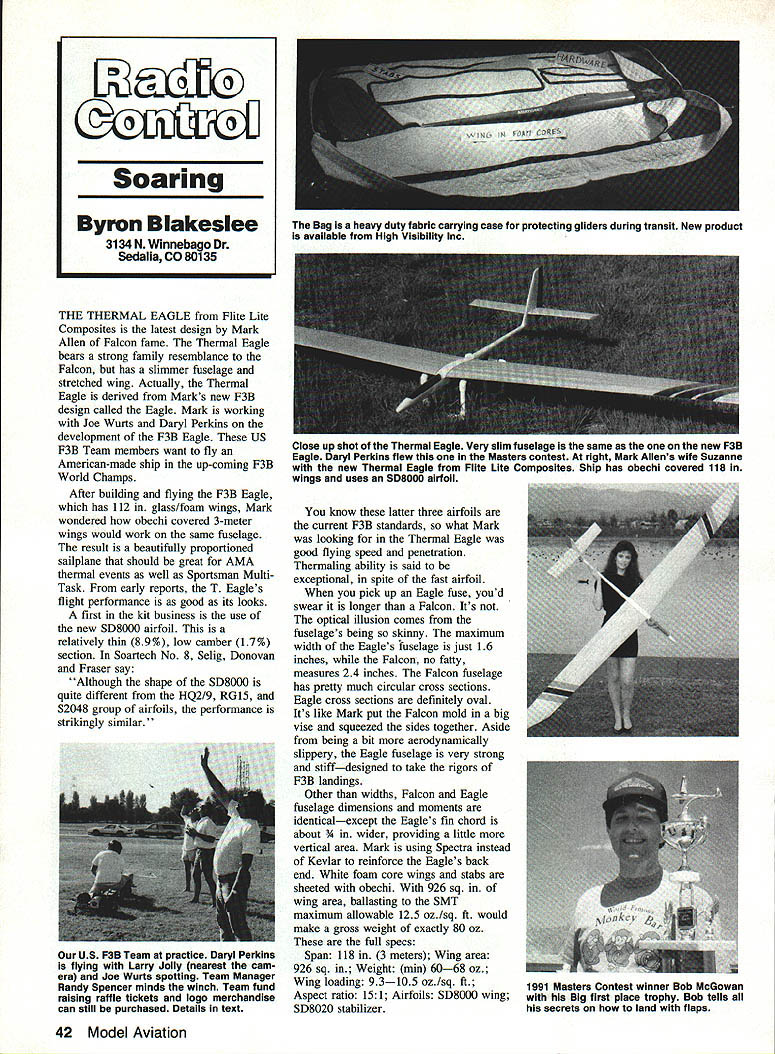
Tom Thompson of Albuquerque sent details of a new and unique product he is manufacturing—a soft traveling bag for gliders. This is Tom's description:
"The Bag is for the serious sailplane flier who wants to protect his investment from hangar and travel rash. The Bag is made from quilted canvas and seamed in such a way that the wings are placed in their foam cores, the stabs in their own pockets, and the wing rods in their own flapped pocket. Nothing can touch the fuselage, which is tied down the middle. The Bag is large enough for two models at a time and long enough for most all the SMT and F3B aircraft being flown today. It measures 58 in. long x 17 in. deep x 7 in. wide. It zips up with the largest plastic zippers available. The bag will hold two Mueller Comets in the Bag. I personally have two Falcon 880s in mine.
"We are also producing a rugged all-wood box that The Bag fits into for transportation on the airlines. It is constructed of 3/4 in. pine and 1/4 in. plywood and finished, coated with Verathane. The rugged handle is recessed into the top so it has less chance of being torn off. There is a very nice saying printed on the box directly in front of the handle: 'Please—Model Airplane.'
"The Bag retails for $150 and The Box for $100. UPS shipping is $8 for The Bag and $20 for The Box. Send $1.00 along with a SASE and we will send you a photo sheet. High Visibility Inc., P.O. Box 9375, Albuquerque, New Mexico 87119; 505/839-0069."
RC Flying Today / Myers
Dave Brown, AMA's Executive VP, told me that while he was setting up a new flying site in Ohio, an RC airplane flew over his head. Upon investigation, he found that there was a flying site in Kentucky less than a mile away!
Because there is a river between them, it's a 40-mile drive to get from one site to the other. I think that the distance between Dave's flying sites is a lot less than a mile, because even a Giant Scale airplane becomes a dot in the sky at a distance of one mile. If you doubt that statement, take an airplane to the beach or some other flat place and pace off the distance until you can't recognize the model.
WHY AM I TELLING YOU ALL OF THIS?
I would like to see my vision put to work. If you think it has merit, the way you can help these things come to pass would be to endorse my idea and tell it to your AMA District Vice President, who could then take it up before the AMA Executive Council. In turn, proper planning and budgeting could bring the plan to fruition.
Once such a system is implemented, if everybody uses only postcards to file the Lat/Lon data, then filing the information
Transcribed from original scans by AI. Minor OCR errors may remain.

